
NVIDIA, Google and Emerald AI Launch Alliance for Grid-Responsive AI Data Centers
Emerald AI, Google and NVIDIA have launched the AI Energy Management Alliance to advance flexible AI data centers that can respond to grid conditions, improve electricity infrastructure utilisation and support reliable, affordable power.
Xcademia Team
Xcademia Research Team
Introduction
The rapid expansion of artificial intelligence is increasing demand for computing infrastructure and the electricity needed to operate it. As AI data centers grow, connecting them to power grids has become an important infrastructure challenge.
On September 16, 2026, Emerald AI, Google and NVIDIA announced the launch of the AI Energy Management Alliance (AEMA), a coalition focused on making AI data centers more responsive to electricity grid conditions.
The alliance aims to bring together organisations across the AI and energy sectors to develop approaches for connecting flexible data centers to the grid, strengthening reliability and supporting energy affordability.
Its central objective is to develop AI infrastructure that can work alongside the power grid rather than operate as an entirely inflexible electricity consumer.
What Is the AI Energy Management Alliance?
The AI Energy Management Alliance is an initiative designed to advance grid-responsive data centers through collaboration across the computing and energy industries.
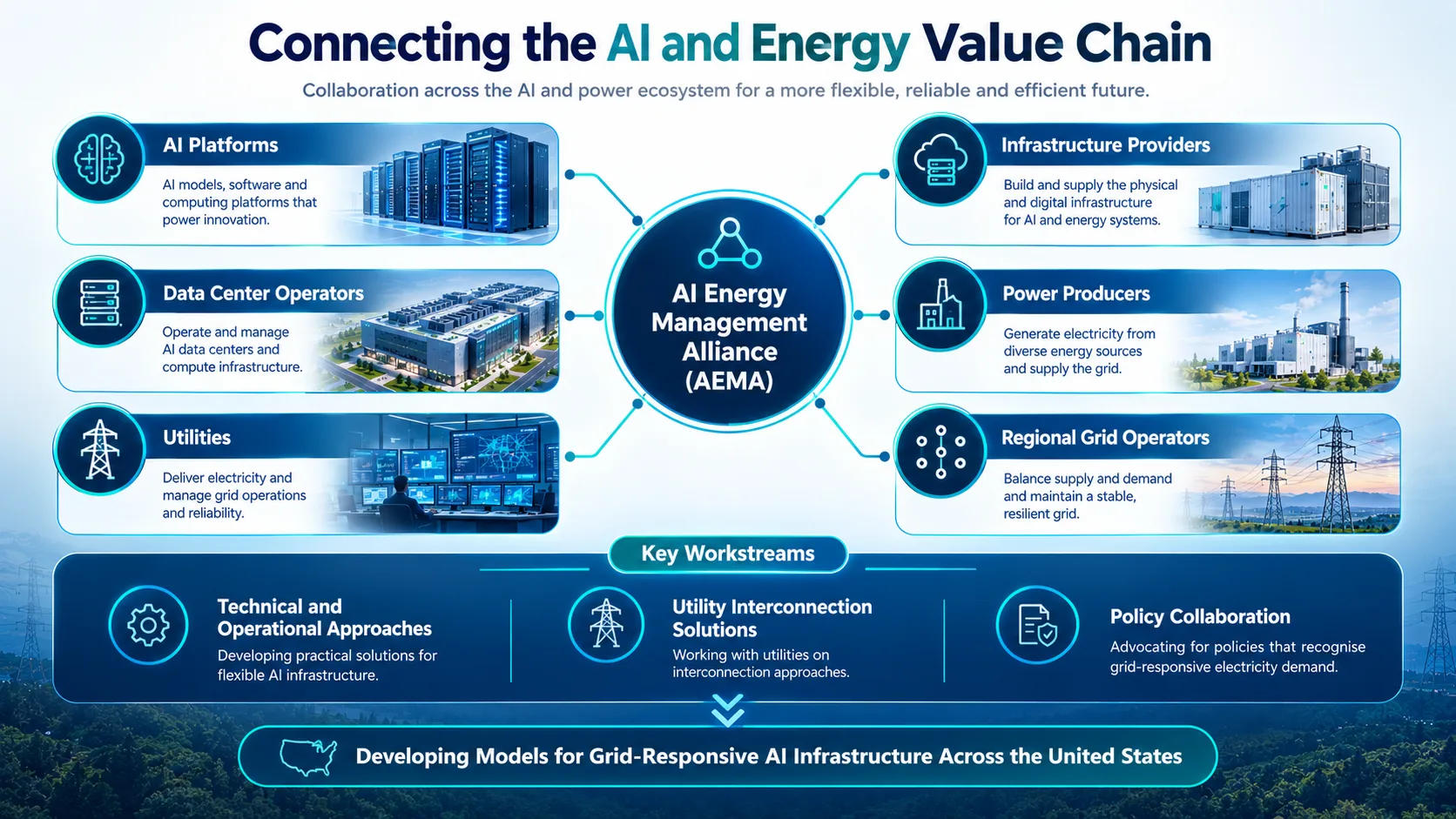
AEMA brings together stakeholders from across the AI and power value chain, including:
AI platforms and infrastructure providers
Data center operators and technology companies
Power producers and utilities
Regional grid operators
The founding members will work with launch partners to develop technical and operational approaches, collaborate with utilities on interconnection solutions and advocate for policies that recognise grid-responsive electricity demand.
The alliance intends to establish common approaches that can be applied across the United States.

AI data centers depend on power infrastructure that can accommodate growing computing demand.
Why Flexible AI Data Centers Matter
Electricity access is becoming an infrastructure constraint
Traditional electricity interconnection processes were designed primarily around facilities with relatively steady, predictable electricity demand.
AI computing infrastructure introduces a different challenge. Data centers can potentially adjust their electricity consumption in response to grid conditions, but conventional connection processes were not designed around this kind of operational flexibility.
According to NVIDIA's announcement, power has become a defining constraint on the expansion of AI infrastructure in the United States.
AEMA seeks to address this challenge by promoting data centers that can adjust their electricity use when the power system is under pressure.
From fixed demand to responsive electricity consumption
A conventional data center may be treated as a large electricity consumer with a relatively fixed demand profile.
A flexible AI data center, by contrast, can potentially modify how much electricity it draws from the grid, depending on operational requirements and available resources.
This flexibility could help grid operators manage periods of high demand and make more effective use of existing electricity infrastructure.
The alliance identifies several ways that facilities could provide this flexibility.
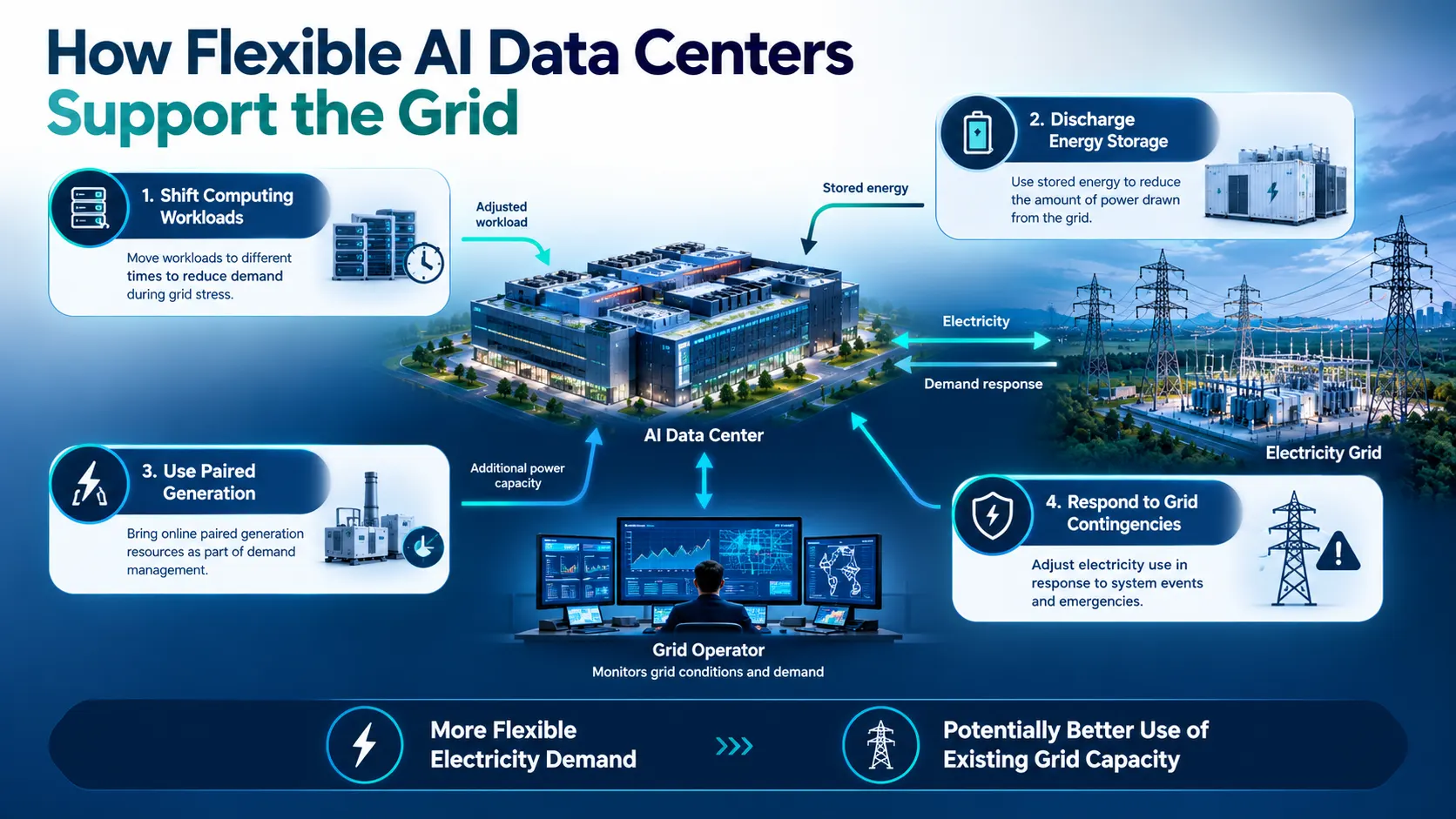
How Flexible AI Data Centers Can Support the Grid
The alliance identifies several mechanisms through which data centers could adjust their electricity demand or provide additional power resources.

1. Shifting computing workloads
Moving computing workloads to different times can help reduce electricity demand during periods when the grid is constrained.

2. Discharging energy storage
Facilities with energy storage could discharge stored electricity to reduce the amount of power they draw from the grid.

3. Using paired generation
Data centers could use paired generation resources as part of their approach to managing electricity demand.

4. Responding to grid contingencies
Facilities could adjust their electricity consumption in response to specific power system events and emergency conditions.
These mechanisms are presented as potential approaches to flexibility. The announcement does not disclose specific deployment configurations, workload scheduling algorithms, or performance results for individual facilities.
A Technology-Neutral, Performance-Based Framework
AEMA says its approach will be technology-neutral and performance-based.
This means the alliance's focus is on what a data center can demonstrably deliver to the electricity system, rather than requiring a particular hardware or software solution.
The announcement identifies four important dimensions of flexibility:
Performance dimension | What it means |
|---|---|
Response speed | How quickly a facility can adjust its electricity use |
Duration | How long the facility can sustain a response |
Predictability | How consistently it can deliver the expected response |
Emergency behaviour | How it responds during grid emergencies |
This approach could allow facilities with different technical configurations to demonstrate their ability to support the grid using common performance expectations.
However, the announcement does not disclose specific numerical thresholds, testing procedures or certification requirements for these measures.
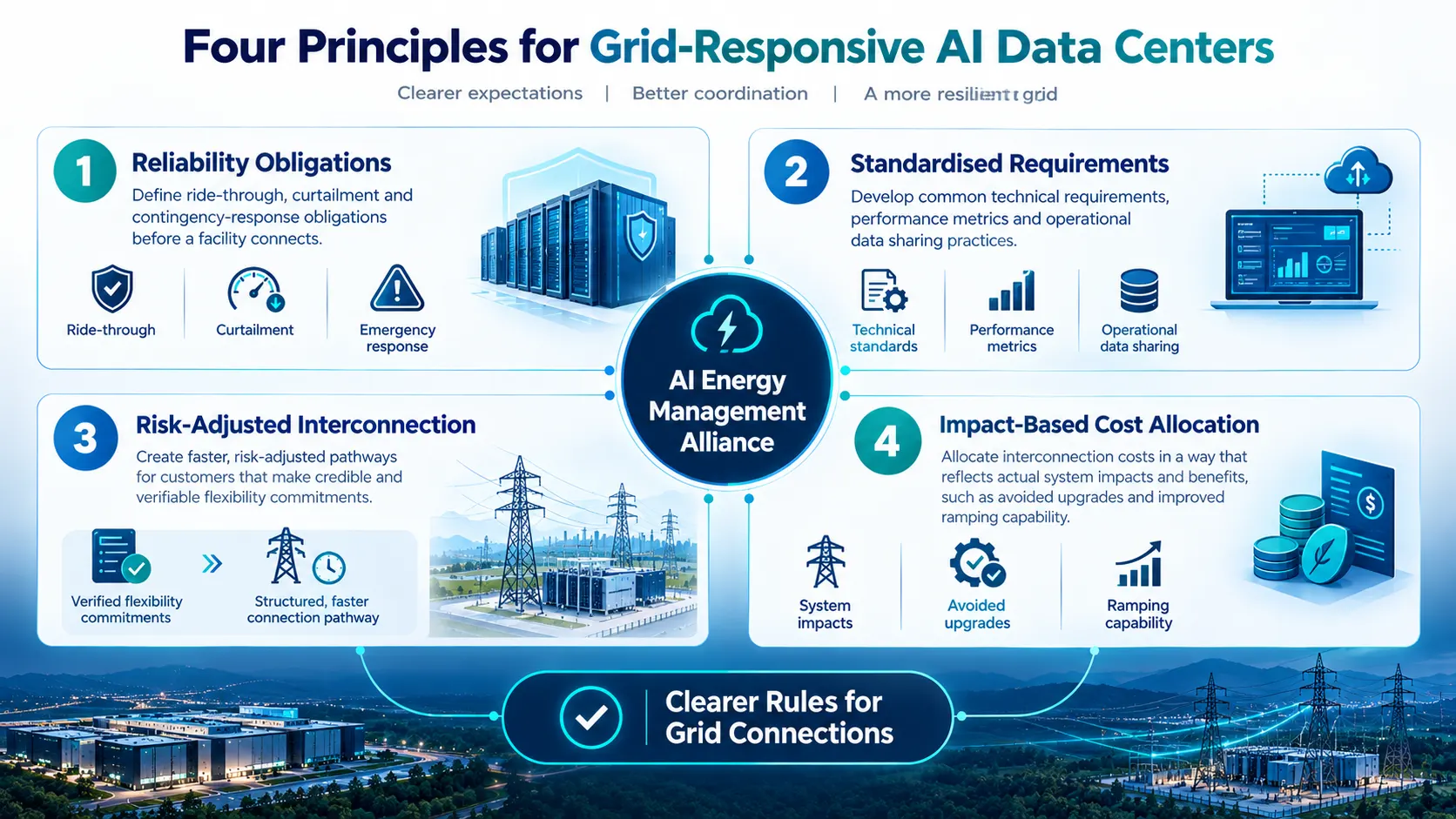
Four Priorities for Grid Reliability and Interconnection
AEMA outlines several principles intended to provide greater clarity for data center developers, utilities and grid operators.
1. Define reliability obligations before connection
Establish expectations for ride-through, curtailment and contingency response before a facility connects to the grid.
Ride-through refers to remaining connected during specified disturbances. Curtailment means reducing electricity demand when required.
2. Standardise technical requirements and data sharing
Develop common technical requirements, performance metrics and operational data-sharing practices to improve coordination.
3. Create faster, risk-adjusted interconnection pathways
Enable customers that make credible and verifiable flexibility commitments to pursue faster connection processes, while accounting for system risks.
4. Align interconnection costs with system impacts
Allocate connection costs in a way that reflects a facility's actual effects on the electricity system, including potential avoided upgrades and improved ramping capability.
Together, these principles aim to reduce uncertainty for developers while giving electricity system operators the information and control they need to maintain reliability.
Bringing the AI and Energy Industries Together
AEMA is designed to coordinate organisations across sectors that are often involved in separate parts of AI infrastructure development and electricity delivery.
Its membership model brings together computing companies, infrastructure providers, data center operators, power producers, utilities and regional grid operators.
The alliance says its founding members will be joined by launch partners from across the ecosystem.
Its planned work includes:
Developing technical and operational approaches for flexible AI infrastructure.
Collaborating with utilities on interconnection solutions.
Advocating for policies that recognise grid-responsive electricity demand.
Establishing common approaches that can be deployed across the United States.
The announcement does not provide a complete list of launch partners, membership requirements, governance arrangements or a detailed implementation timetable.
NVIDIA and Emerald AI's Existing Work
NVIDIA says it and Emerald AI are already working with energy and infrastructure leaders on AI factories that can respond to grid conditions in real time.
AEMA is intended to broaden this work by bringing together technology, energy and policy stakeholders around approaches that could be deployed across the United States.
The announcement does not identify specific facilities, provide project-level performance data or disclose detailed technical architectures for this existing work.
What the Alliance Could Mean for AI Infrastructure
AEMA's announcement reflects a broader infrastructure challenge: expanding AI computing capacity while managing the electricity requirements of large data centers.
The alliance's proposed approach centres on making electricity demand more responsive and improving coordination between data center developers and the organisations responsible for power delivery.
Potential implications for data center developers
For developers, credible flexibility commitments could become an important consideration in electricity interconnection planning.
AEMA's principles point towards greater emphasis on measurable performance, operational predictability and clearly defined reliability obligations.
The announcement does not guarantee faster connections for participating facilities. It describes the development of risk-adjusted pathways for customers that can verify their flexibility commitments.
Potential implications for utilities and grid operators
For utilities and grid operators, flexible electricity demand could provide another way to manage system constraints.
Standardised performance metrics and operational data sharing could also support coordination between power system operators and large electricity consumers.
The actual benefits would depend on the performance of individual facilities and the conditions of the electricity systems where they operate.
Potential implications for energy affordability and infrastructure planning
The alliance says more efficient use of existing infrastructure could help reduce environmental impacts per watt and support energy affordability.
Its proposed cost-allocation principles also recognise that a facility's connection may affect the wider power system differently depending on its flexibility and operational characteristics.
These are objectives of the initiative, rather than demonstrated outcomes. The announcement does not provide cost savings, emissions reductions, or measured changes in electricity prices.
What Has Not Been Disclosed?
While AEMA has outlined its objectives and principles, several implementation details remain unspecified.
Area | Information available |
|---|---|
Launch partners | Additional partners are expected, but a complete list was not provided in the supplied announcement. |
Technical standards | General principles are described, but numerical performance thresholds are not disclosed. |
Deployment schedule | A detailed implementation timeline was not provided. |
Project-level results | Specific facilities and measured outcomes were not identified. |
Membership | Membership opportunities are mentioned, but detailed eligibility and governance terms are not provided. |
Financial impact | Specific cost savings, investment figures and electricity price effects are not disclosed. |
The Bigger Picture: AI Growth and Grid Coordination
The launch of the AI Energy Management Alliance highlights a growing focus on the relationship between AI infrastructure and electricity systems.
As AI data centers expand, infrastructure planning increasingly involves both computing capacity and access to reliable power.
AEMA's approach is to bring technology providers, energy companies, utilities and policymakers together around measurable flexibility and common interconnection principles.
Whether these principles lead to faster connections, more efficient infrastructure use or improved affordability will depend on how they are implemented and verified.
For now, the announcement establishes a collaborative framework and an intention to develop approaches for grid-responsive AI infrastructure across the United States.
Source: NVIDIA Blog
About the Author