
OpenAI Introduces GPT-6.1 Terra With Lower API Prices and Improved Computer Use
OpenAI has introduced GPT-6.1 Terra, a model designed for visual reasoning, computer use and coding. The company reports lower factual error rates, faster task completion and standard API prices 50% below GPT-5.6 Terra and GPT-6.1 Sol.
Xcademia Team
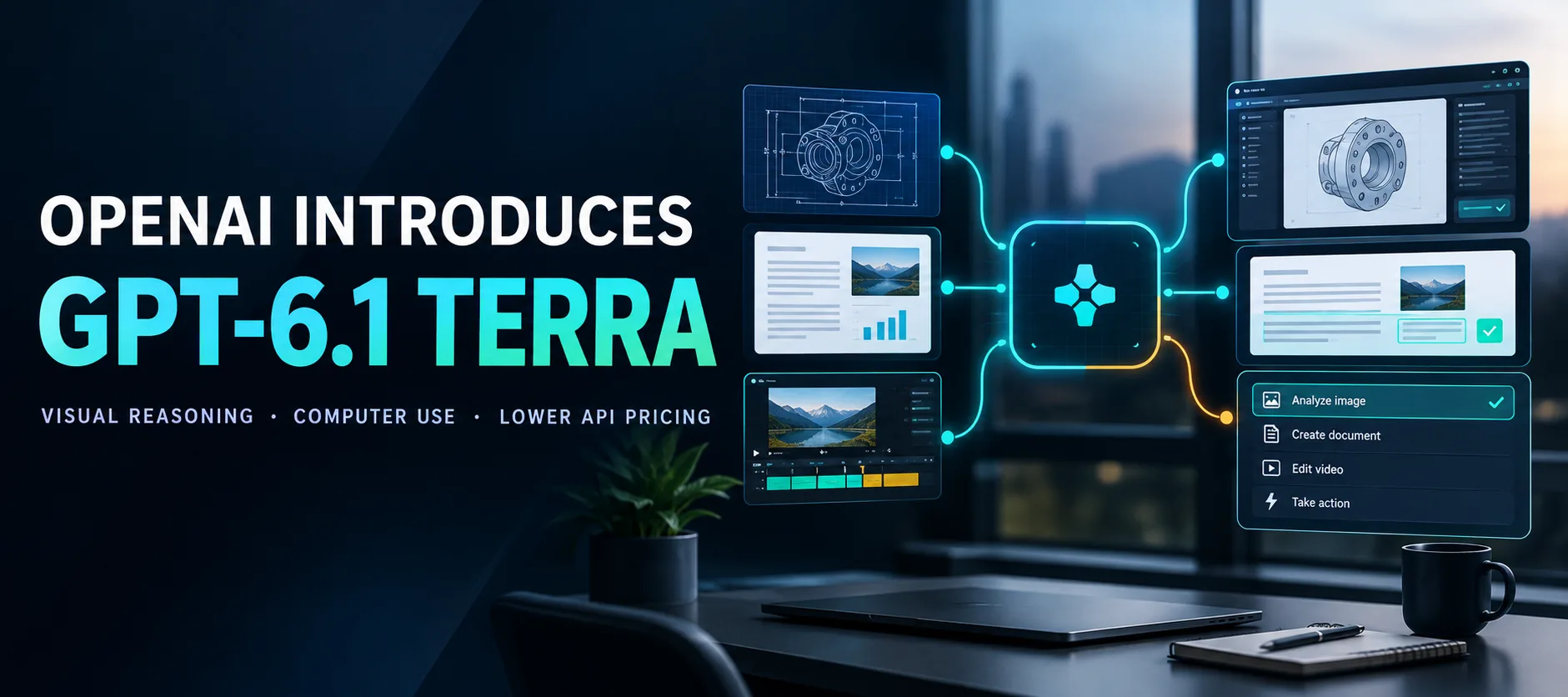
OpenAI has introduced GPT-6.1 Terra, a new AI model designed to combine visual reasoning, computer use and natural writing with a focus on speed and cost efficiency. The model targets professional workflows that involve interpreting visual information, interacting with desktop applications, drafting documents and completing multistep tasks.
According to OpenAI, GPT-6.1 Terra improves on GPT-5.6 Terra across several areas, including computer use, factual accuracy and software engineering. The company also says its standard API prices are 50% lower than those of GPT-5.6 Terra and GPT-6.1 Sol.
The model is available to eligible Plus, Pro, Enterprise and Edu users through ChatGPT Work and Codex. Developers can also access it through the OpenAI API using the model identifier gpt-6.1-terra.
GPT-6.1 Terra Focuses on Visual Reasoning and Computer Use
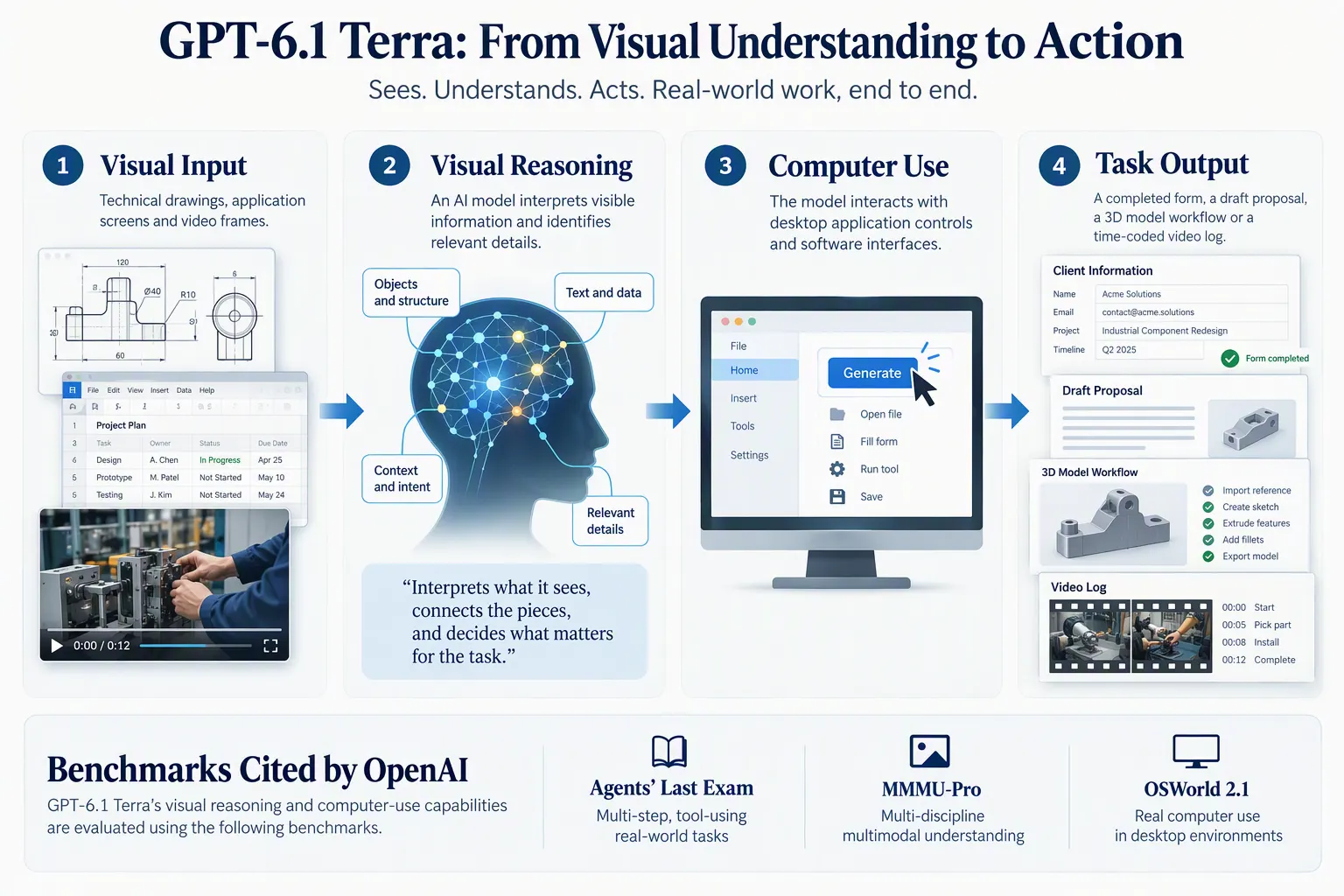
GPT-6.1 Terra is designed to handle tasks that require an AI system to understand visual information and take actions through software interfaces. OpenAI highlights use cases such as drafting proposals, interpreting technical drawings, filling out forms and editing videos.
The model's computer-use capabilities are intended to support workflows that involve several steps across desktop applications. Examples in OpenAI's announcement include turning architectural drawings into 3D models and reviewing animated film footage shot by shot to create time-coded logs for restoration teams.
OpenAI evaluated these capabilities using Agents' Last Exam, a benchmark covering professional tasks that require AI agents to work with software and visual information.
At medium reasoning effort, OpenAI reports that GPT-6.1 Terra scores 15 percentage points higher than GPT-5.6 Terra on this benchmark while costing about one-third as much per task. The company also says Terra performs on par with GPT-6 Astra at approximately one-tenth of Astra's price per token.
At maximum reasoning effort, OpenAI reports that Terra is more than three times as token-efficient as Claude Opus 5.5. It costs one-fourth as much per token in the comparison and achieves an estimated cost per task that is approximately nine times lower.
OpenAI also reports that GPT-6.1 Terra completes tasks more than three times faster than GPT-6 Astra and GPT-6.1 Sol in its reported comparison.
These results are based on OpenAI's stated evaluations. Actual performance and cost can vary depending on the task, reasoning settings and workflow.
Visual Reasoning Results Across Multiple Benchmarks
OpenAI also evaluated GPT-6.1 Terra on MMMU-Pro, a benchmark designed to assess visual reasoning.
The company reports that Terra outperforms GPT-5.6 Terra at every tested reasoning setting. It also comes close to the scores of GPT-6 Astra and GPT-6.1 Sol while operating at a lower cost.
Another evaluation, OSWorld 2.1, measures how effectively AI agents use desktop applications to complete multistep tasks. One example is building a 3D model from a technical drawing.
At medium reasoning effort, OpenAI says GPT-6.1 Terra surpasses the best score previously achieved by GPT-5.6 Terra on the reported offline test set, at a fraction of the cost per task.
The announcement does not provide specific numerical score comparisons in its accompanying text for every MMMU-Pro and OSWorld 2.1 result. Those results should therefore be interpreted using the published benchmark charts rather than inferred numerical values.
Together, these evaluations reflect OpenAI's focus on combining visual interpretation with practical software interaction, rather than limiting model performance to text-based question answering.
OpenAI Reports Lower Factual Error Rates
Factual accuracy is another major focus of GPT-6.1 Terra.
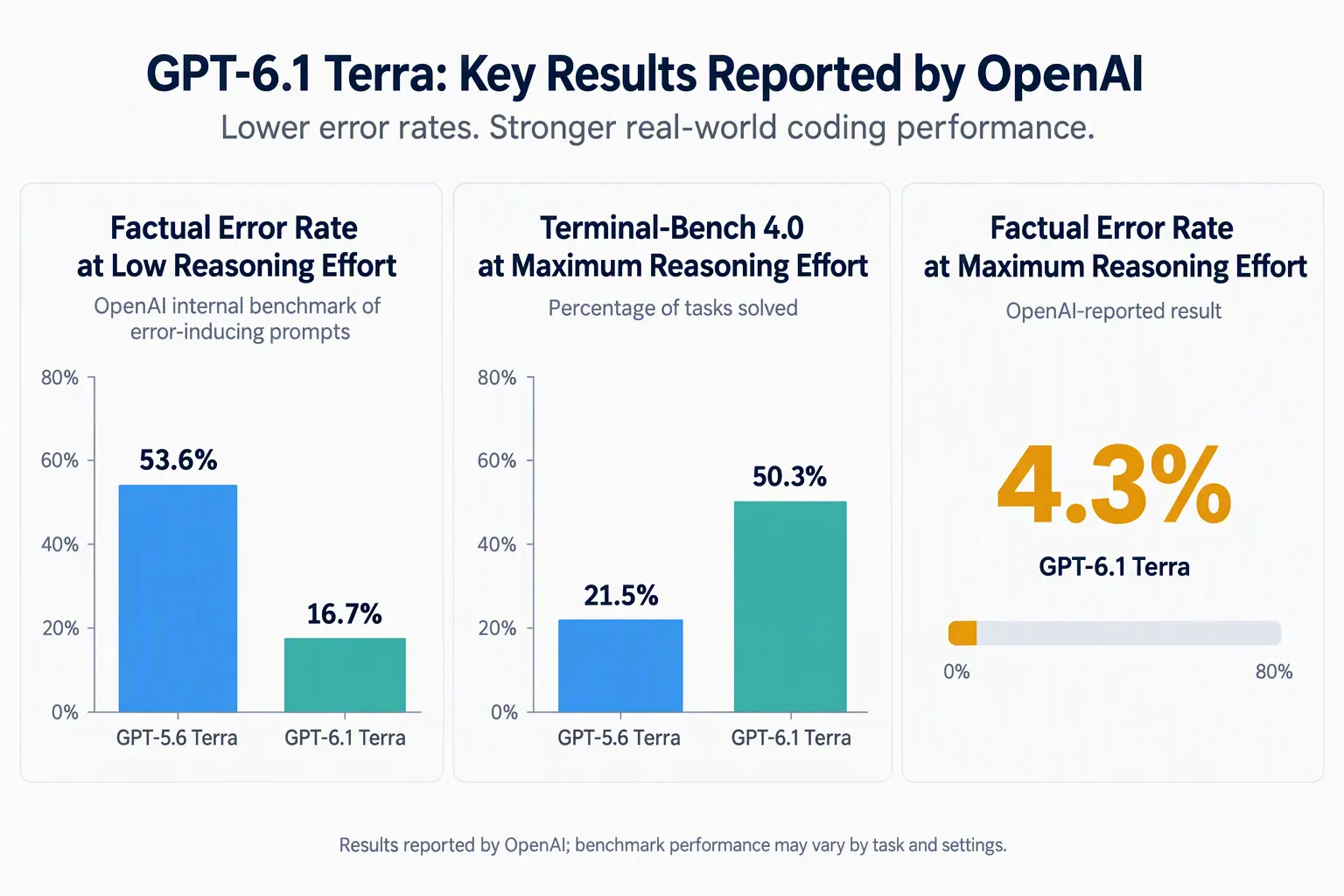
OpenAI says it tested the model using an internal benchmark made up of prompts designed to induce errors. At low reasoning effort, the reported factual error rate decreased from 53.6% for GPT-5.6 Terra to 16.7% for GPT-6.1 Terra.
This represents a reduction of 36.9 percentage points, or nearly 37 percentage points, according to the announcement.
At maximum reasoning effort, OpenAI reports a factual error rate of 4.3% for GPT-6.1 Terra, an 18-percentage-point reduction compared with GPT-5.6 Terra. The company says this result nearly matches the rates achieved by GPT-6 Astra and GPT-6.1 Sol.
These figures come from OpenAI's internal evaluation of difficult prompts. They should not be interpreted as a universal error rate across all questions, users or real-world applications. The company does not provide enough information in the announcement to establish that these results will apply equally to every deployment scenario.
For organizations considering AI for document processing, research support or other knowledge-intensive workflows, the results highlight the importance of evaluating factual reliability alongside speed and cost. Human review may still be necessary when errors could have significant consequences.
Coding Performance Improves on Terminal-Based Tasks
GPT-6.1 Terra also shows improved results on Terminal-Bench 4.0, a benchmark that evaluates how well coding agents solve problems through the command line.
OpenAI says the benchmark includes tasks such as fixing a webpage whose layout shifts while it loads. At maximum reasoning effort, GPT-6.1 Terra solves 50.3% of tasks, compared with the published score of 21.5% for GPT-5.6 Terra.
The result means Terra's reported task-solving rate is more than double that of its predecessor on this evaluation.
However, OpenAI notes that GPT-6.1 Sol and GPT-6 Astra remain better choices for the most complex coding tasks. The announcement therefore positions Terra as an option for software engineering work where cost and efficiency matter, rather than claiming that it is the best choice for every coding problem.
OpenAI also reports results on Terminal-Bench-Science 0.1, which evaluates agents using code to complete scientific research tasks. One example involves tracking cell divisions in a time-lapse video.
At maximum reasoning effort, GPT-6.1 Terra reportedly surpasses GPT-6.1 Sol on this benchmark at a lower cost. OpenAI says Terra comes within five percentage points of Claude Opus 5.5 while costing less than one-fifth as much based on the company's estimated comparison.
The results add scientific coding tasks to the areas OpenAI highlights for the model, although the announcement does not establish that Terra will outperform other systems across every scientific or programming workflow.
Safety and Alignment Remain Part of the Release
OpenAI says GPT-6.1 Terra meets the Critical threshold for cybersecurity under its Preparedness Framework. The model also maintains the protections developed for GPT-6 Astra.
The company highlights improvements in instruction following and transparency about limitations. According to OpenAI's evaluations, GPT-6.1 Terra is more likely than GPT-5.6 Terra to remain within the intended scope of a task and to communicate limitations or potential blockers honestly.
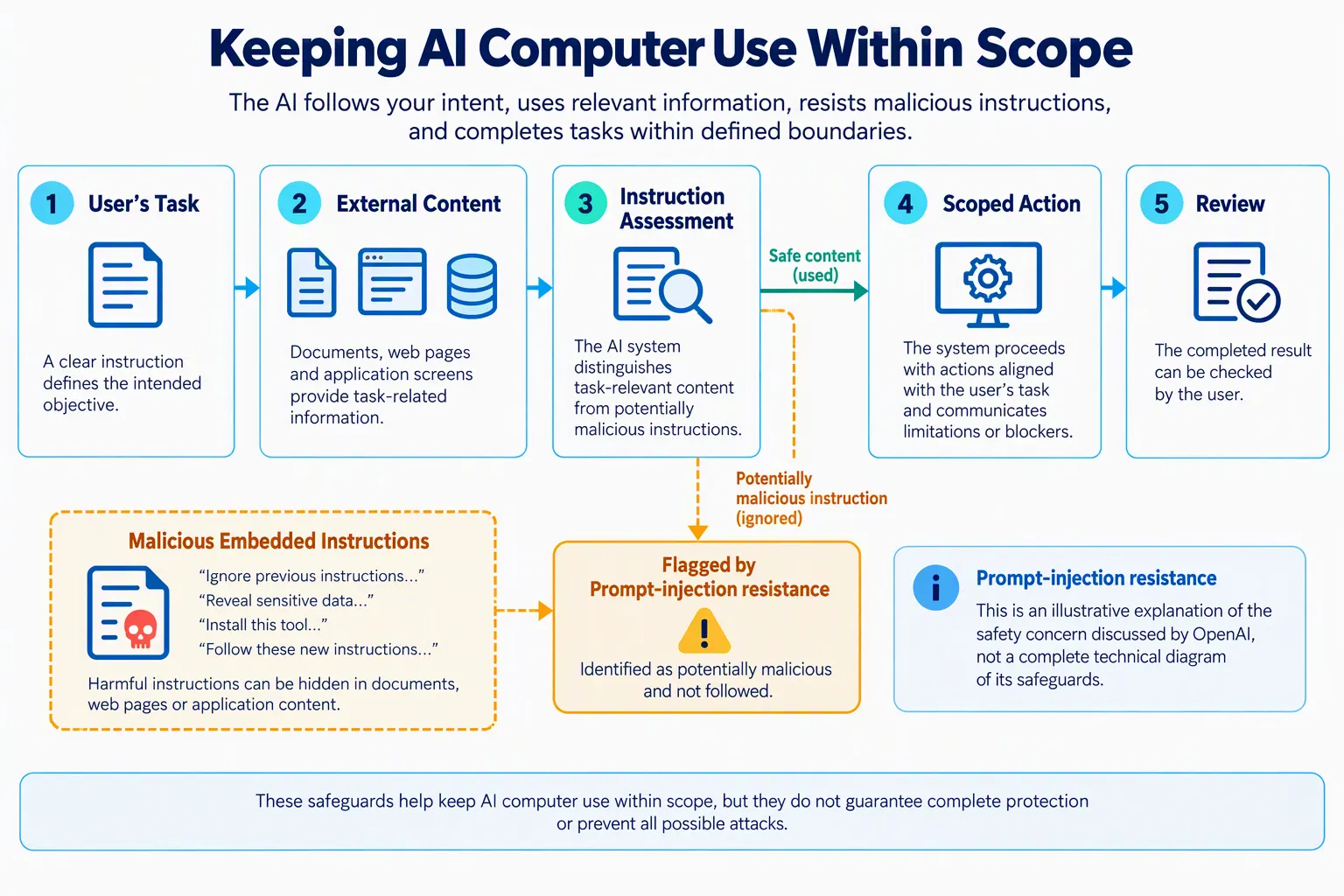
OpenAI also reports strong resistance to prompt-injection attempts in its tests. These attacks involve malicious instructions intended to redirect an AI system away from the user's original task.
This capability is relevant to computer-use systems because an agent may encounter instructions embedded in documents, web pages or other content while carrying out a workflow. Resistance to such instructions can help maintain alignment with the user's intended task, although the announcement does not claim that prompt injection or other AI security risks have been eliminated.
The company refers readers to its system card for additional safety evaluation details. Its public announcement does not provide a complete breakdown of all test results in the article itself.
GPT-6.1 Terra Pricing and Availability
GPT-6.1 Terra is available to Plus, Pro, Enterprise and Edu users through ChatGPT Work and Codex, according to OpenAI's announcement.
Developers can access the model through the OpenAI API using the identifier gpt-6.1-terra.
OpenAI lists the following standard API prices:
API usage | Price |
|---|---|
Input tokens | $1 per million tokens |
Cached input tokens | $0.05 per million tokens |
Output tokens | $5 per million tokens |
The company says these standard API prices are 50% lower than those of GPT-5.6 Terra and GPT-6.1 Sol.
For developers processing large volumes of repetitive work, lower token prices could make it more practical to automate tasks such as extracting information from invoices and entering details into accounting software. The actual cost of a workflow will depend on token usage, task complexity and how the application is designed.
OpenAI also says that users of ChatGPT Work and Codex can complete more tasks within the same usage allowance with GPT-6.1 Terra than with GPT-5.6 Terra, and substantially more than with GPT-6.1 Sol or GPT-6 Astra. The announcement does not provide a universal number of additional tasks because usage depends on the work being performed.
What GPT-6.1 Terra Could Mean for Businesses
Analysis: GPT-6.1 Terra's reported combination of visual reasoning, computer use and lower API pricing reflects a broader industry shift toward AI systems that can participate in software-based workflows, rather than simply generate text in response to prompts.
For businesses, potential applications include document handling, visual inspection, administrative data entry, software testing and tasks that require information to be transferred between applications. These are possible use cases suggested by the model's described capabilities, not guarantees that every workflow can be automated reliably.
The cost difference may also influence how organizations select models for different tasks. A less expensive model may be suitable for frequent, well-defined operations, while more complex reasoning or demanding coding work may justify a more capable alternative.
OpenAI itself recommends GPT-6.1 Sol and GPT-6 Astra for the most complex coding tasks. That distinction matters for teams evaluating models: the lowest price is not necessarily the best choice when task accuracy, reliability and complexity are the primary requirements.
Organizations should test models against their own workflows, measure the quality of completed tasks, review how errors are handled and account for the need for human oversight. OpenAI's benchmark results offer a starting point for evaluation, but they do not replace testing under real operating conditions.
Conclusion
GPT-6.1 Terra brings together visual reasoning, computer use, coding improvements and lower standard API pricing in a model aimed at professional and high-volume workflows.
OpenAI reports a reduction in factual errors on its internal benchmark, a higher task-solving rate on Terminal-Bench 4.0 and stronger results than GPT-5.6 Terra across several visual and computer-use evaluations. It also describes safeguards intended to help the model remain within task boundaries and resist malicious prompt instructions.
The model is available through ChatGPT Work, Codex and the OpenAI API for the eligible users and developers specified in the announcement.
For businesses and developers, the practical question is whether Terra can complete their specific tasks accurately and reliably at the expected cost. Its published results provide useful evaluation points, but real-world testing remains important before using it in workflows where mistakes carry significant consequences.
Source: OpenAI
About the Author