
Microsoft Warns CISOs: AI Is Changing the Scale and Speed of Vulnerability Risk
Microsoft says frontier AI is increasing the volume and speed of vulnerability discovery, forcing CISOs to rethink patching, prioritization, defense in depth, and security controls as AI-assisted attacks accelerate.
Xcademia Team
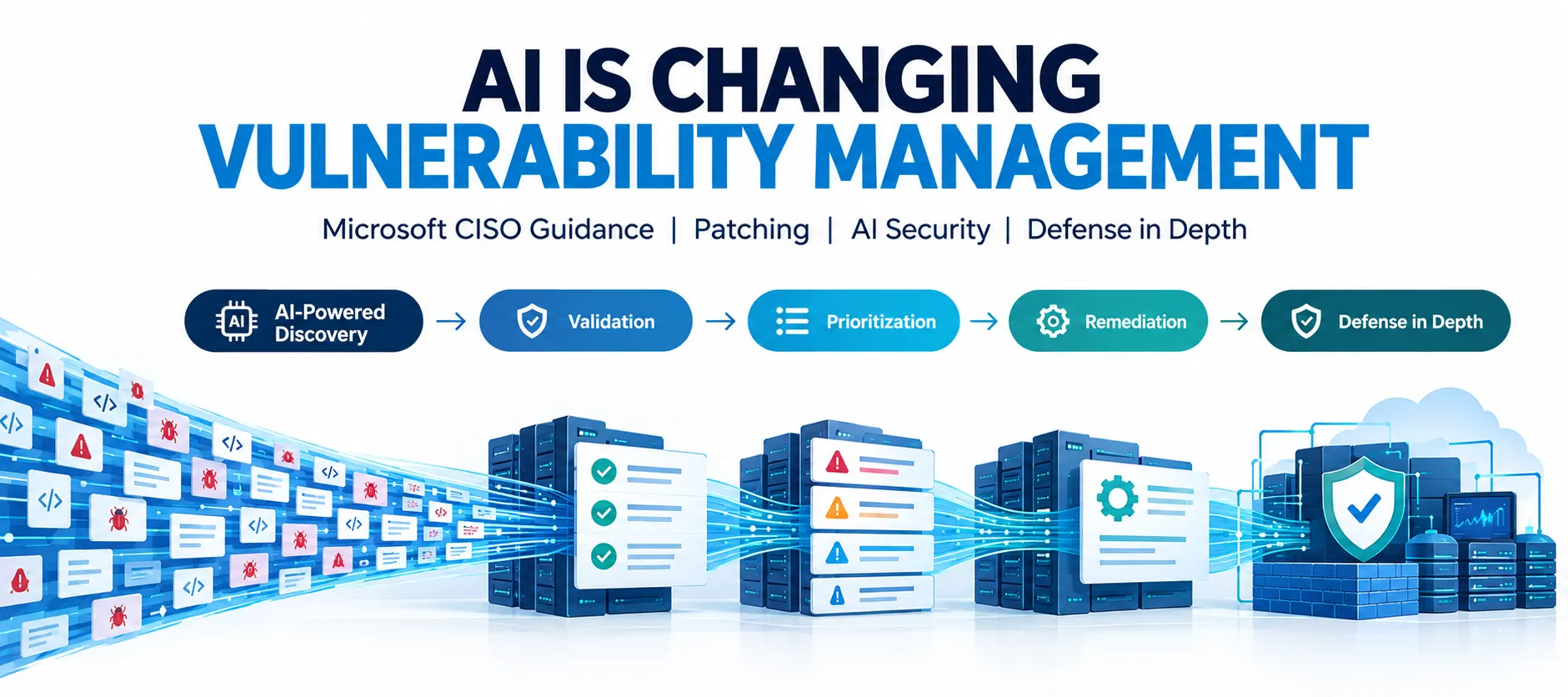
AI Is Changing the Vulnerability Management Equation
The rapid development of frontier AI models is changing how organizations discover and respond to software vulnerabilities.
Microsoft says much of the discussion has focused on how quickly AI can scan code, identify weaknesses, develop patches, and build exploits.
But for chief information security officers (CISOs), Microsoft argues that the more difficult challenge comes after vulnerability discovery.
As AI produces a much larger set of findings, security teams must determine which issues matter most, how quickly they should be addressed, and whether fixes are being applied correctly.
Microsoft describes the central challenge as maintaining the balance between patching quickly and patching correctly at a scale that traditional human review processes were not designed to handle.
The company also points to a dual-use dynamic. The same AI capabilities that can help defenders identify exposures and automate remediation can also increase the speed and scale of attacks.
Microsoft says this makes defense in depth increasingly important because not every vulnerability will be patched before exploitation becomes possible.
The company recommends that CISOs strengthen the security posture of Microsoft environments by deploying Microsoft Baseline Security Mode (BSM), which is based on how Microsoft protects its own infrastructure.
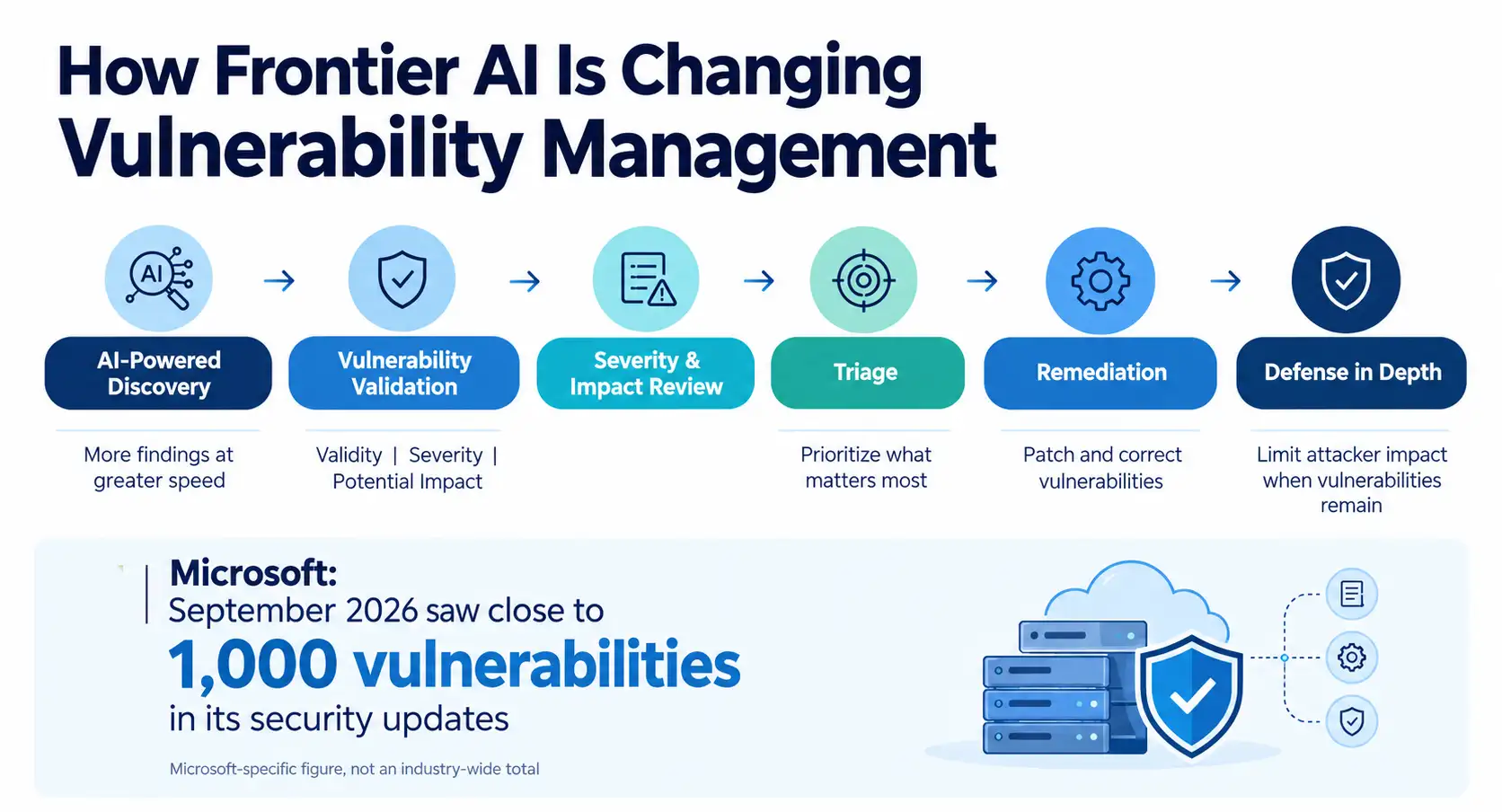
How Frontier AI Changes Vulnerability Management
Microsoft says it already uses frontier AI models to find vulnerabilities in its code base and mitigate them at a controlled pace.
Potential vulnerabilities are reviewed based on:
Validity
Severity
Potential impact
The company has also been integrating AI into multiple stages of its vulnerability handling and disclosure processes.
Microsoft says these AI-powered processes allow its security operations to scale as vulnerability discovery accelerates.
For cloud software, Microsoft says most vulnerabilities are mitigated without customer intervention.
The situation is different for on-premises Microsoft software.
Microsoft says customers should continue to expect a substantial increase in vulnerabilities released through Patch Tuesday compared with historical volumes before the arrival of frontier AI models earlier in 2026.
Microsoft says September 2026 saw a record number of vulnerabilities in its security updates, with the total close to 1,000.
This figure refers specifically to Microsoft's security updates and should not be interpreted as an industry-wide vulnerability count.
Microsoft also highlights an important characteristic of AI-powered vulnerability discovery: results are not necessarily deterministic.
Different runs using the same model, or different models, can produce different results.
Because increasingly capable models are becoming available over time, Microsoft says AI-powered vulnerability scanning of both existing and newly developed code should become part of standard security assurance.
Microsoft Uses AI Harnesses to Control Vulnerability Scanning
Microsoft says it uses a "harness" layer around AI models during vulnerability scanning.
The harness controls how AI models:
Access code
Validate their outputs
Integrate findings into triage workflows
Feed results into remediation processes
Microsoft says it has expanded the use of these harnesses across its engineering groups.
One of the harnesses, codenamed MDASH, has also been made available to customers.
The company says its internal Red Teaming engagements also use AI to help identify weaknesses in security controls and improve the efficiency and speed of operations.
The source does not provide additional performance figures for these internal AI-assisted red-team activities.
What CISOs Should Do as AI Accelerates Vulnerability Risk
Microsoft outlines four recommendations for CISOs preparing for a security environment in which AI can increase both vulnerability discovery and attack speed.
1. Increase Resources for On-Premises Patching
Microsoft recommends that CISOs increase resources dedicated to patching, prioritization, and timing for Microsoft on-premises software.
The company says organizations should continue to expect high patch volumes on future Patch Tuesdays, at least over the coming period.
This means vulnerability management teams may need additional capacity to assess and address a larger number of findings.
2. Rethink Patch Timing for Critical Systems
Microsoft also recommends reconsidering when the most critical systems are patched.
Historically, organizations have often scheduled updates for systems such as domain controllers and edge devices during periods when downtime is least disruptive, including weekends and holidays.
Microsoft argues that this trade-off may need to change as AI potentially shortens the time between vulnerability disclosure and exploitation.
For critical systems, the company suggests considering deployment of fixes within 24 hours rather than waiting for the next maintenance window.
This is presented as Microsoft's recommendation for CISOs, not as a universal requirement for every organization.
3. Use AI Harnesses for Scanning and Remediation
Microsoft recommends that organizations use harnesses to scan and remediate vulnerabilities in their own code bases.
The company says organizations should begin this work without waiting for access to the most advanced frontier AI models.
CISOs should also allocate resources for both AI usage and the human personnel required to triage and remediate vulnerabilities.
This reflects Microsoft's view that AI-assisted vulnerability discovery does not eliminate the need for human review and remediation processes.
4. Strengthen Defense in Depth
Microsoft says CISOs should focus more heavily on defense in depth and continuously monitor the health of critical security controls.
The company connects this recommendation to growing expectations from governments and regulators around cyber resilience, operational resilience, and regulatory readiness.
Microsoft points organizations toward its Security Exposure Management resources for additional guidance and capabilities.
Open-Source Software Becomes Another AI-Driven Risk Area
Microsoft also highlights the implications of AI-powered vulnerability discovery for open-source software.
Many organizations depend on open-source components in their infrastructure and products.
Microsoft says the ability to identify and fix vulnerabilities in these components is becoming increasingly important as governments and regulators raise expectations around software security.
The challenge is that many open-source maintainers do not have the tools or resources required to respond quickly.
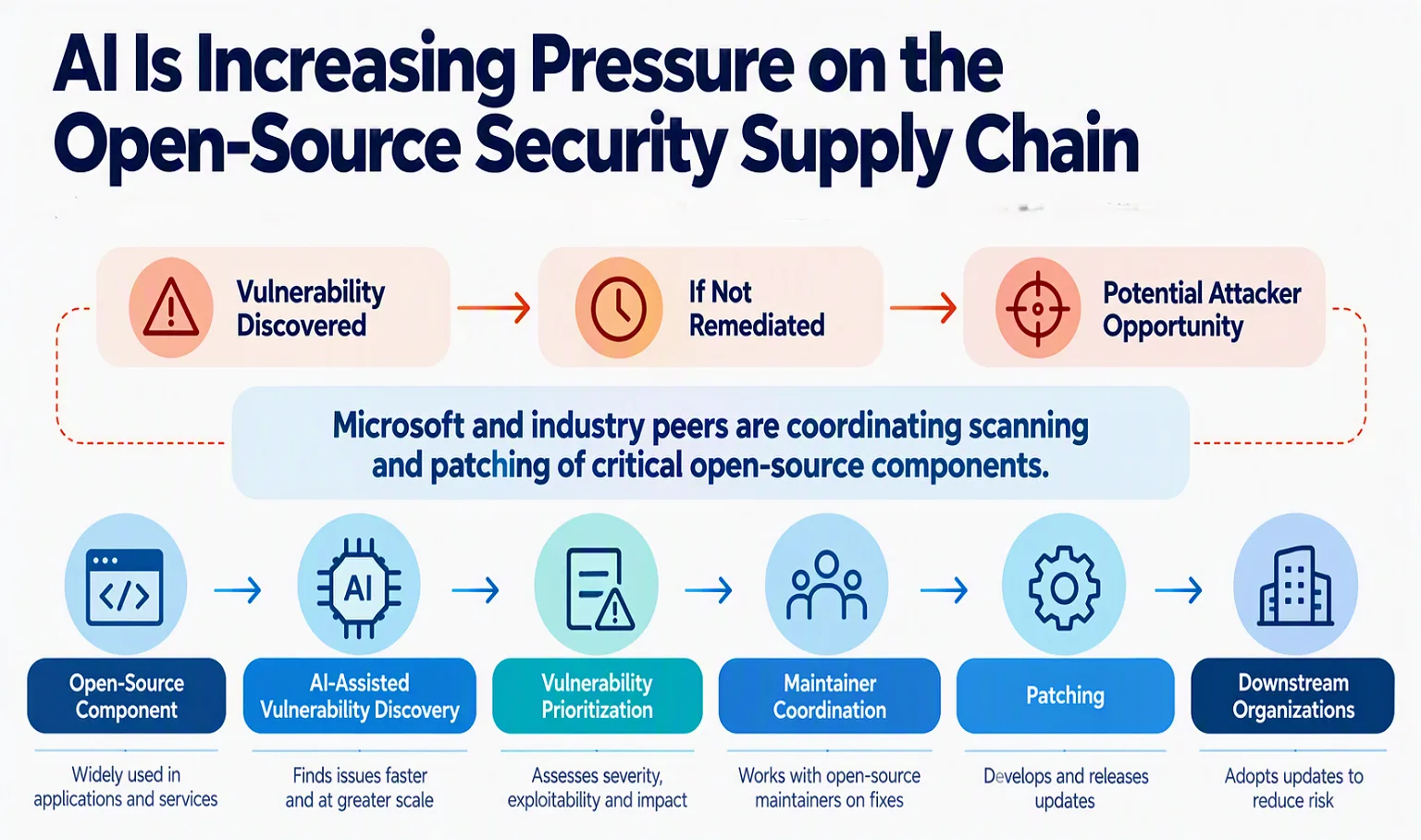
That can increase supply chain risk if AI-assisted vulnerability discovery allows attackers to identify weaknesses faster than maintainers can address them.
Microsoft says it has therefore teamed up with industry peers to coordinate the scanning and patching of vulnerabilities in critical open-source components before attackers find them.
Participating organizations are pooling resources to prioritize and scan open-source packages and work with maintainers on remediation.
Secure by Design and Secure by Default
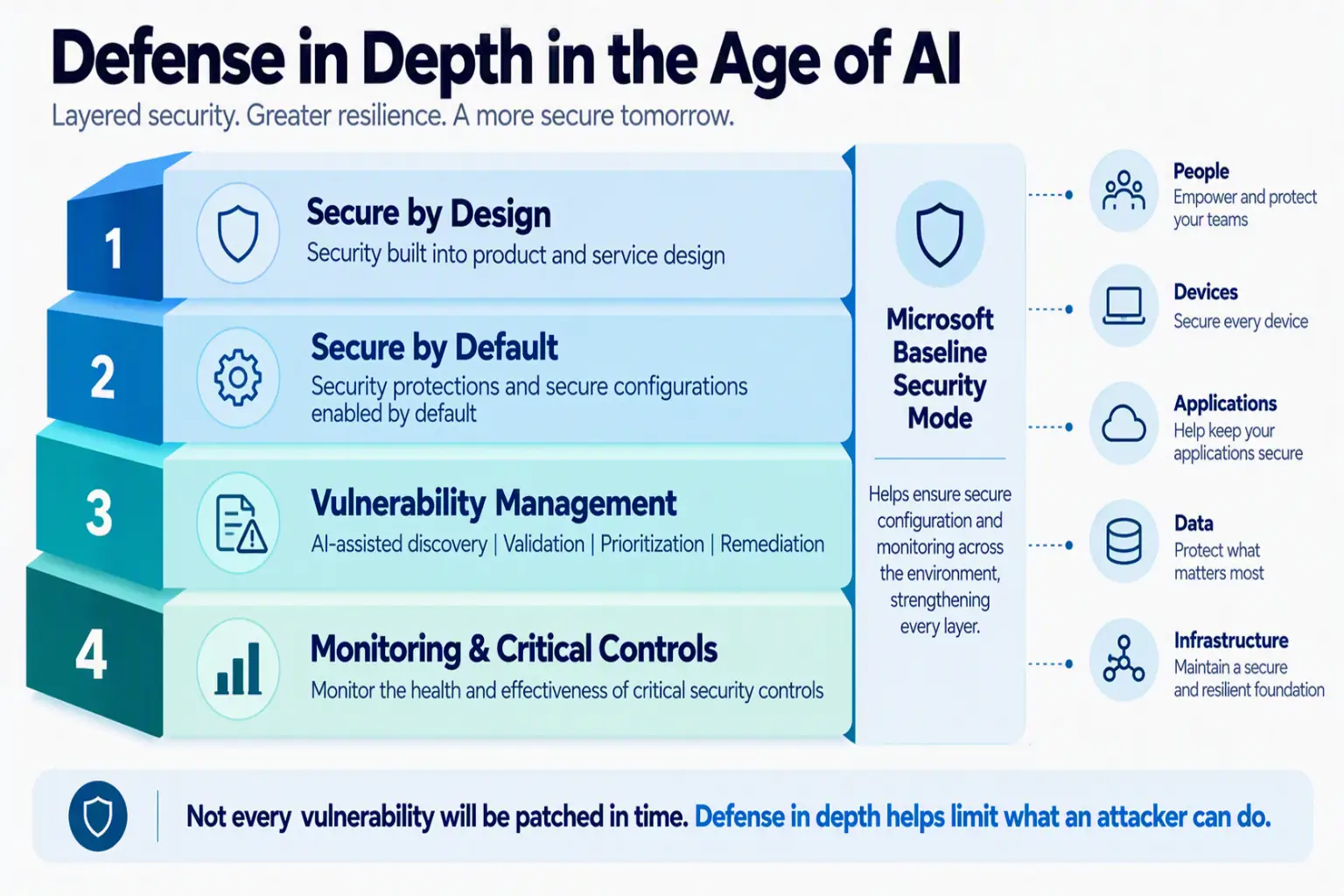
Microsoft says another way organizations can improve defense in depth is by making baseline security controls part of the default security posture.
The company distinguishes between Secure by Design and Secure by Default.
Secure by Design
Microsoft defines Secure by Design as putting security first when designing a product or service.
According to Microsoft, customers do not need to opt in and cannot opt out of these security protections.
The company lists several recent examples:
Mandatory multifactor authentication for Microsoft Azure administrators
Conditional Access policies for Windows Hello for Business and macOS Platform single sign-on registration
Secure-by-design protections built into Azure infrastructure
Secure by Default
Secure by Default means that security protections and secure configurations are enabled automatically.
Microsoft gives examples including:
Azure Backup soft delete enabled by default
Azure Virtual Network default outbound access disabled
Microsoft says customers can opt out of certain controls if they accept a higher-risk posture.
Customers can also choose additional controls when they want a stronger or more sophisticated security posture.
Microsoft Baseline Security Mode
Microsoft recommends Microsoft Baseline Security Mode (BSM) as another way for CISOs to strengthen the default security posture of Microsoft environments.
BSM is designed to help organizations implement and monitor secure configurations at scale based on Microsoft's internal security practices.
Microsoft says scenario analyses can be used to assess the impact of additional controls within existing tenants.
This allows organizations to introduce controls through a staged rollout.
The company says controls can be turned on and off, while exceptions can also be created and removed.
Microsoft Baseline Security Mode is available to existing customers within their current license agreement.
Microsoft says new customer tenants will gradually receive BSM controls by default.
What Microsoft's Guidance Means for CISOs
The announcement highlights a broader industry shift toward treating vulnerability management as a capacity and prioritization problem, not simply a patching problem.
As AI-assisted tools generate more findings, organizations need processes capable of validating those findings, assessing severity and impact, prioritizing remediation, and confirming that fixes are applied correctly.
Microsoft's recommendations also emphasize that vulnerability management cannot operate in isolation.
Secure configurations, monitoring, identity controls, defense in depth, and default security settings can reduce exposure when vulnerabilities cannot immediately be eliminated.
For enterprises, this could mean security programs need to evolve alongside AI-powered discovery capabilities rather than treating AI scanning as a standalone tool.
The source also reinforces the importance of human resources. Microsoft recommends allocating both AI resources and people to triage and remediate vulnerabilities.
In other words, faster discovery does not automatically translate into faster risk reduction.
Microsoft Continues Using AI Across Its Security Operations
Microsoft says it will continue using newer technologies to find and correct vulnerabilities in existing code and reduce the likelihood of vulnerabilities being introduced into future code.
The company also says it will extensively use AI to protect its own infrastructure and customer infrastructure.
At the same time, Microsoft frames risk-based cybersecurity management as the foundation of its approach.
The company says AI and Secure by Default principles have become integral parts of that strategy.
The CISO Challenge: Managing Vulnerabilities at AI Speed
The arrival of frontier AI models is changing the scale and speed of vulnerability discovery.
Microsoft's message to CISOs is that the challenge is no longer simply finding vulnerabilities faster. Security teams also need the capacity to validate findings, prioritize risk, remediate vulnerabilities, and maintain strong controls around systems that cannot be patched immediately.
The company's recommendations focus on four areas: increasing resources for patching, reconsidering patch timing for critical systems, adopting AI-assisted vulnerability scanning and remediation workflows, and strengthening defense in depth.
Microsoft also points to open-source coordination and Secure by Design and Secure by Default practices as additional ways to reduce exposure.
The broader lesson is that faster vulnerability discovery increases the importance of everything that comes after discovery.
For CISOs, AI is therefore not only a vulnerability management opportunity. It is also a reason to reassess how quickly their organizations can make accurate security decisions and turn those decisions into effective remediation and resilience.
Source: Microsoft Security Blog
About the Author