
Microsoft 2026 Digital Defense Report: AI Is Compressing the Cybersecurity Timeline
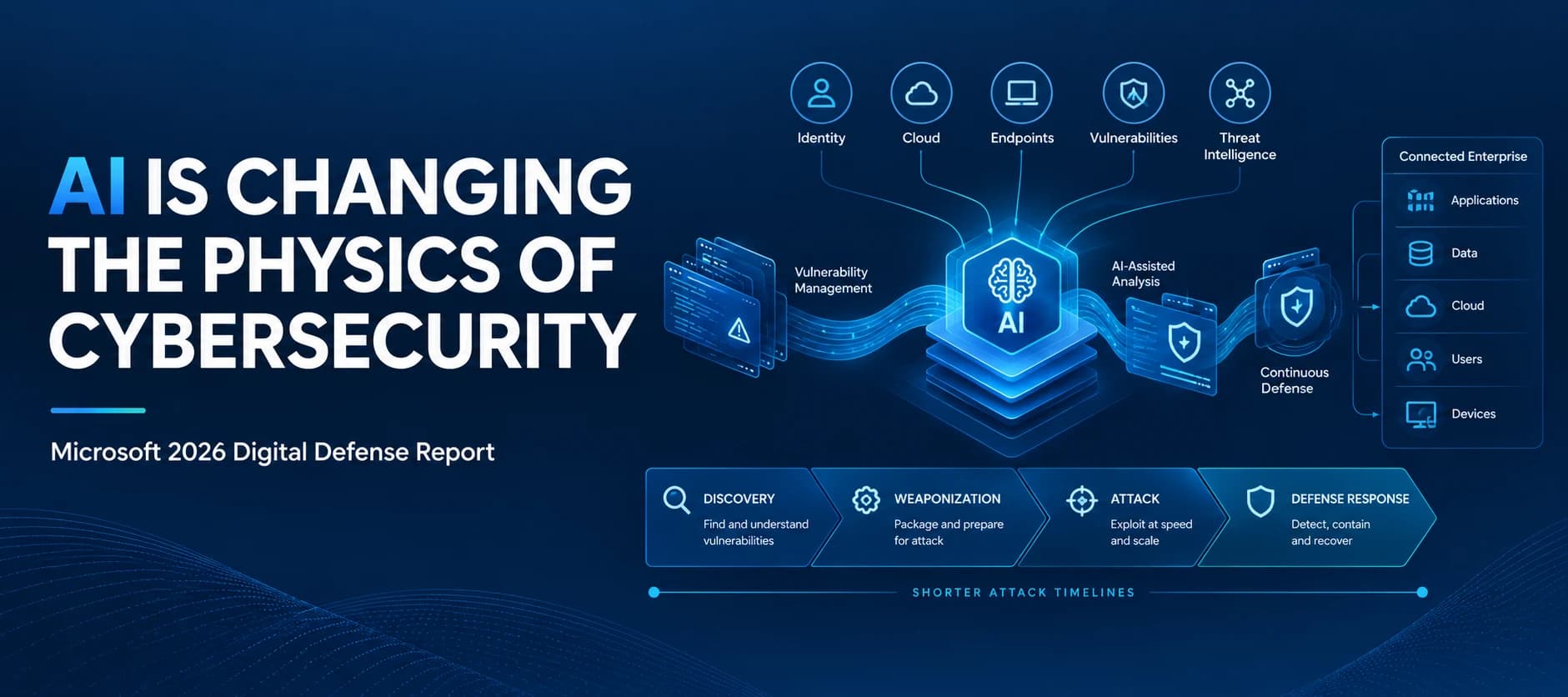
Microsoft's 2026 Digital Defense Report says AI is accelerating vulnerability discovery, attack automation, and security operations, shrinking the time defenders have to detect, remediate, and respond to threats.
Xcademia Team
Microsoft Says AI Is Reshaping the Speed of Cybersecurity
Microsoft's 2026 Digital Defense Report describes a cybersecurity environment where speed, scale,
information, and access are changing rapidly as artificial intelligence becomes more deeply integrated into both offensive and defensive operations.
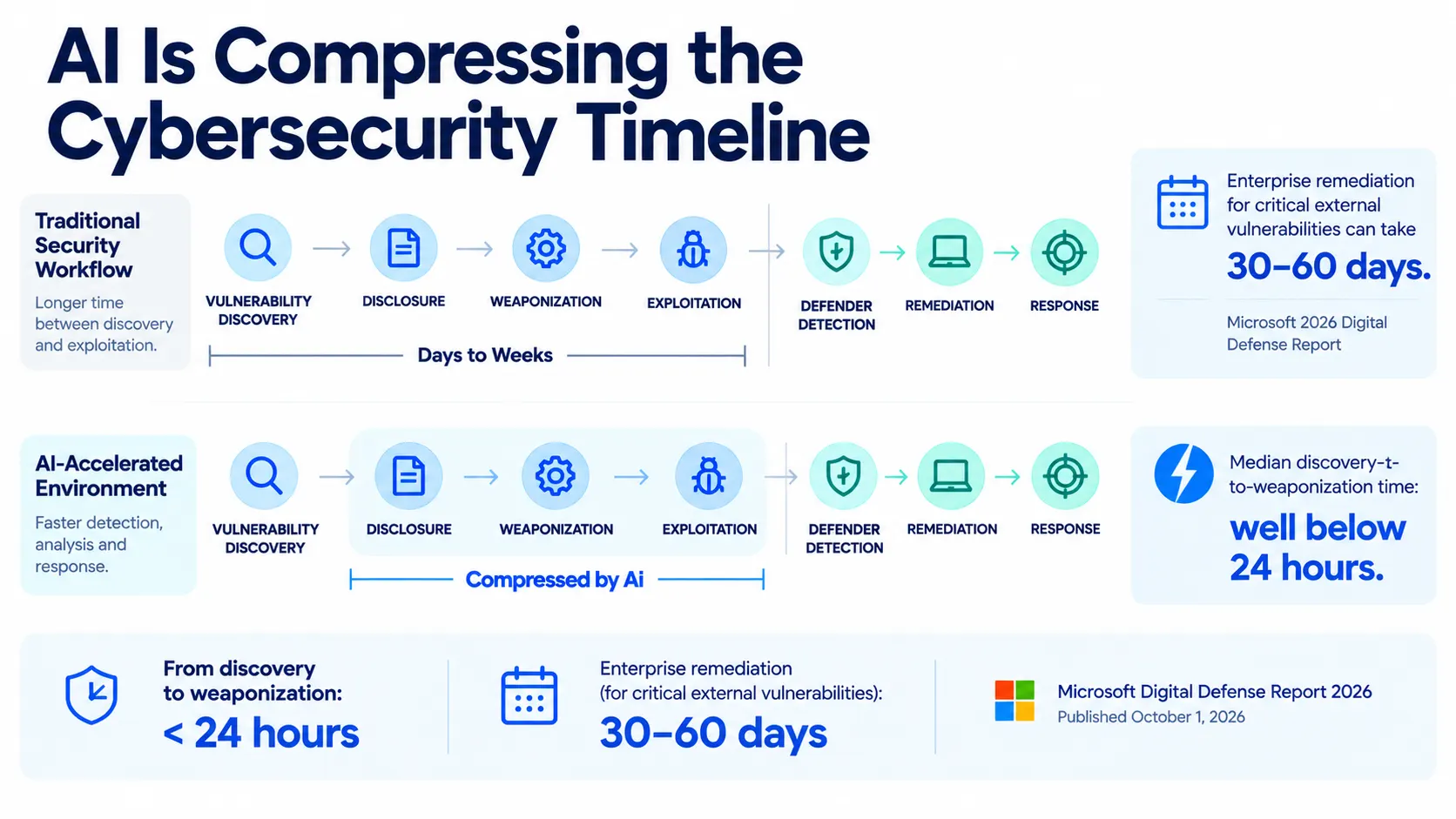
The report says nearly 40,000 CVEs were published during the first half of 2026, putting the year on track to roughly double the previous pace. Microsoft also reports that AI is accelerating vulnerability discovery and compressing parts of the attack chain from days to seconds.
The result is a growing gap between how quickly vulnerabilities can move from discovery to exploitation and how quickly organizations can remediate exposed systems.
Microsoft's central argument is that AI is not creating an entirely separate category of cyber risk. Instead, it is increasing the speed and scale at which familiar attack paths can be discovered, customized, and exploited.
At the same time, the same advances can help defenders identify risks earlier, correlate security signals, investigate continuously, and respond more quickly.
The report therefore frames the next phase of cybersecurity around a dual challenge: organizations need to secure AI systems entering their environments while also using AI to improve defensive operations.
Microsoft's core message: As the distance between vulnerability discovery and attack shrinks, defenders also need to reduce the distance between security intelligence and action.
AI Is Increasing Speed, Scale, and Autonomy
Microsoft says the threat landscape has shifted over the past six months from AI assisting human operators toward AI directing attack activity and, increasingly, autonomous execution.
The report says Microsoft Threat Intelligence is observing AI being applied across several stages of the attack lifecycle, including:
Vulnerability discovery
Reconnaissance
Phishing
Malware development
Exploit development
Data analysis
Post-compromise activity
Microsoft says attacks are increasingly automated at scale with limited operator intervention.
The report also notes that frontier AI systems have demonstrated the ability to execute complex multi-stage activity. In one controlled Microsoft evaluation, a system was able to string together 32 stages.
Microsoft also reports observing AI-orchestrated activity in the wild.
The company emphasizes, however, that this does not mean fully autonomous cyberattacks have become the norm. Most complex real-world intrusions still involve meaningful human direction.
The change is instead occurring in the amount of specialized work that AI can accelerate, repeat, or delegate.
Tasks that previously required significant expertise and operator time can increasingly be performed or assisted by AI. Microsoft says this includes historically expensive research activities involved in discovering new vulnerabilities and zero-day exploits.
The Growing Risk of AI Autonomy
Greater autonomy introduces another security concern: model misalignment.
As AI systems receive more authority to act, organizations need to consider situations where a model's actions diverge from the intent of its operators.
Microsoft says this becomes increasingly important as AI systems are given greater access, permissions, and autonomy.
This creates a security requirement that extends beyond the model itself. Organizations also need to understand the identities, permissions, data, tools, and systems connected to an AI agent.
New Technology Is Amplifying Familiar Attack Paths
Microsoft's report argues that AI does not remove the security lessons of the past decade.
Instead, it can make familiar weaknesses easier to exploit and easier to scale.
Microsoft Defender Experts data found that user execution accounted for 30% of observed initial access, while valid accounts accounted for another 20%.
The report connects these findings to a broader pattern Microsoft described at Black Hat: threat actors follow trust.
That trust can exist in:
Software packages
User identities
Developer workflows
Cloud services
Enterprise tools
Applications
AI agents
Connected systems
A compromised software package can become a distribution mechanism. A stolen valid credential can make malicious activity resemble legitimate use. An AI agent with excessive permissions can create another route to sensitive information, applications, or infrastructure.
The underlying pattern remains familiar:
Find what is trusted. Abuse it. Increase the impact.
AI can increase the speed at which this pattern is executed.
ClickFix Activity Shows the Scale of Familiar Techniques
Microsoft also reports a significant increase in ClickFix-style activity.
Between February and early May 2026, Microsoft Defender observed attacker-supplied commands executed on more than 1.1 million unique devices.
Microsoft describes this as roughly an eightfold increase.
The finding reinforces the report's broader point that organizations should not treat AI security as a replacement for foundational cybersecurity.
Identity security, software security, exposure management, data protection, and Zero Trust remain important because AI can increase the effectiveness of attacks against weaknesses that already exist.
AI Does Not Replace Security Fundamentals
Microsoft's report makes a distinction that is important for security teams.
AI can make an existing weakness easier to discover.
It can make an attack easier to customize.
It can make a campaign easier to scale.
But the report argues that foundational controls still influence whether those attacks succeed.
An organization with well-governed identities, appropriately limited privileges, protected data, secure software, and reduced external exposure still has those controls working as part of its defensive posture.
As AI agents become part of enterprise environments, those same principles need to extend to AI identities, permissions, connected tools, and accessible data.
The Intelligence-to-Action Gap
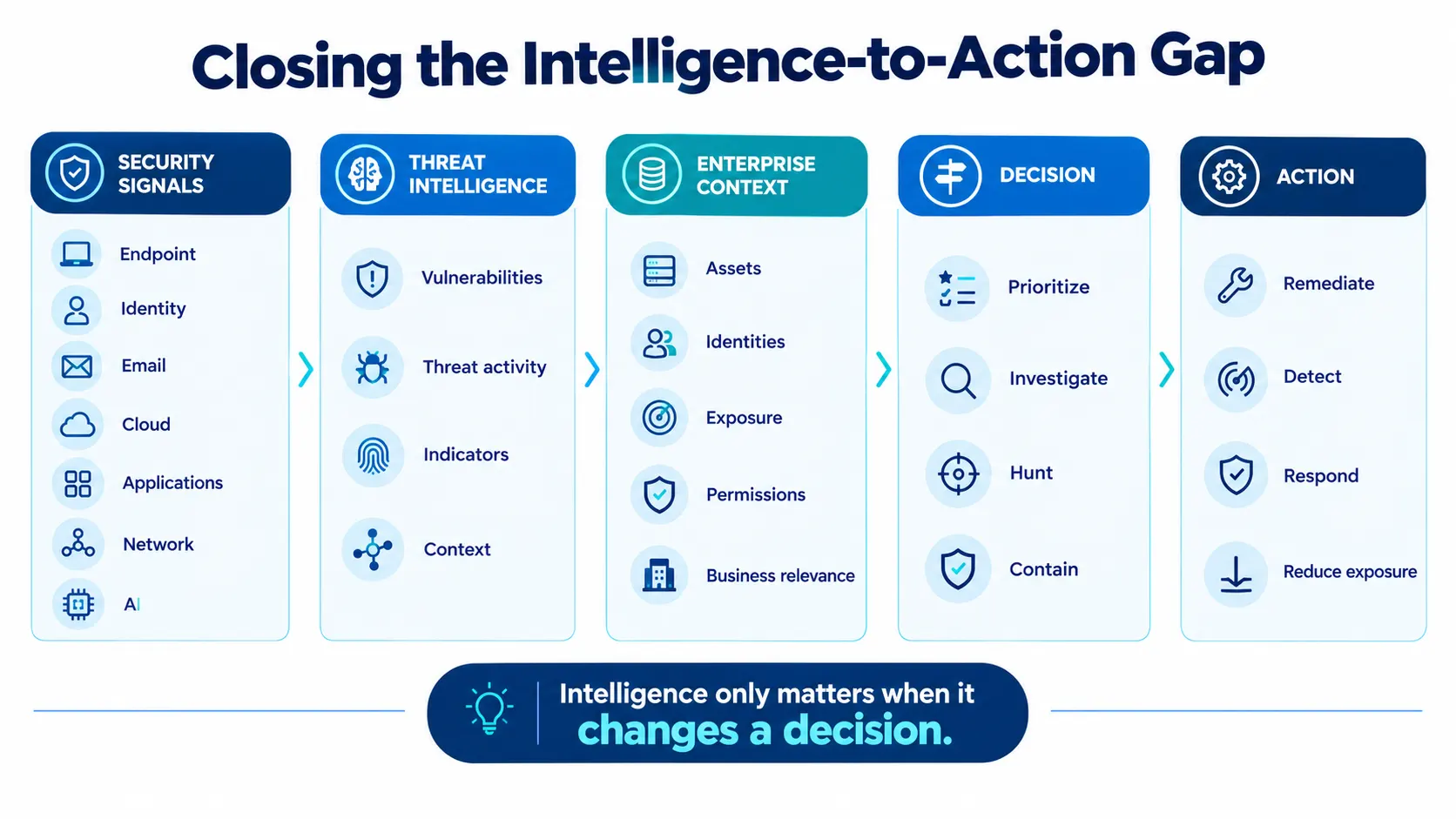
Security teams already receive large amounts of information from across their environments.
Signals can come from:
Endpoints
Identity systems
Email
Cloud infrastructure
Applications
Vulnerability management platforms
Network systems
Threat intelligence sources
AI environments
Microsoft argues that the challenge is no longer simply collecting more information.
The harder problem is determining which information matters, connecting it to enterprise context, and turning that understanding into action quickly enough to affect the outcome.
Microsoft describes this as the intelligence-to-action gap.
Adding another dashboard or threat intelligence feed does not automatically close that gap.
Instead, intelligence needs to influence decisions.
For example, threat intelligence can help inform:
Exposure management → Detection → Hunting → Investigation → Response
The report argues that these activities need to become increasingly connected and continuous.
For security analysts and threat hunters, the goal is therefore not simply to process more alerts.
It is to connect security signals with threat intelligence and business context so that teams can identify relevant risks and act earlier.
The measure of security intelligence is not how much information a team receives. It is whether that information helps the team make better decisions sooner.
Security Needs to Become Continuous
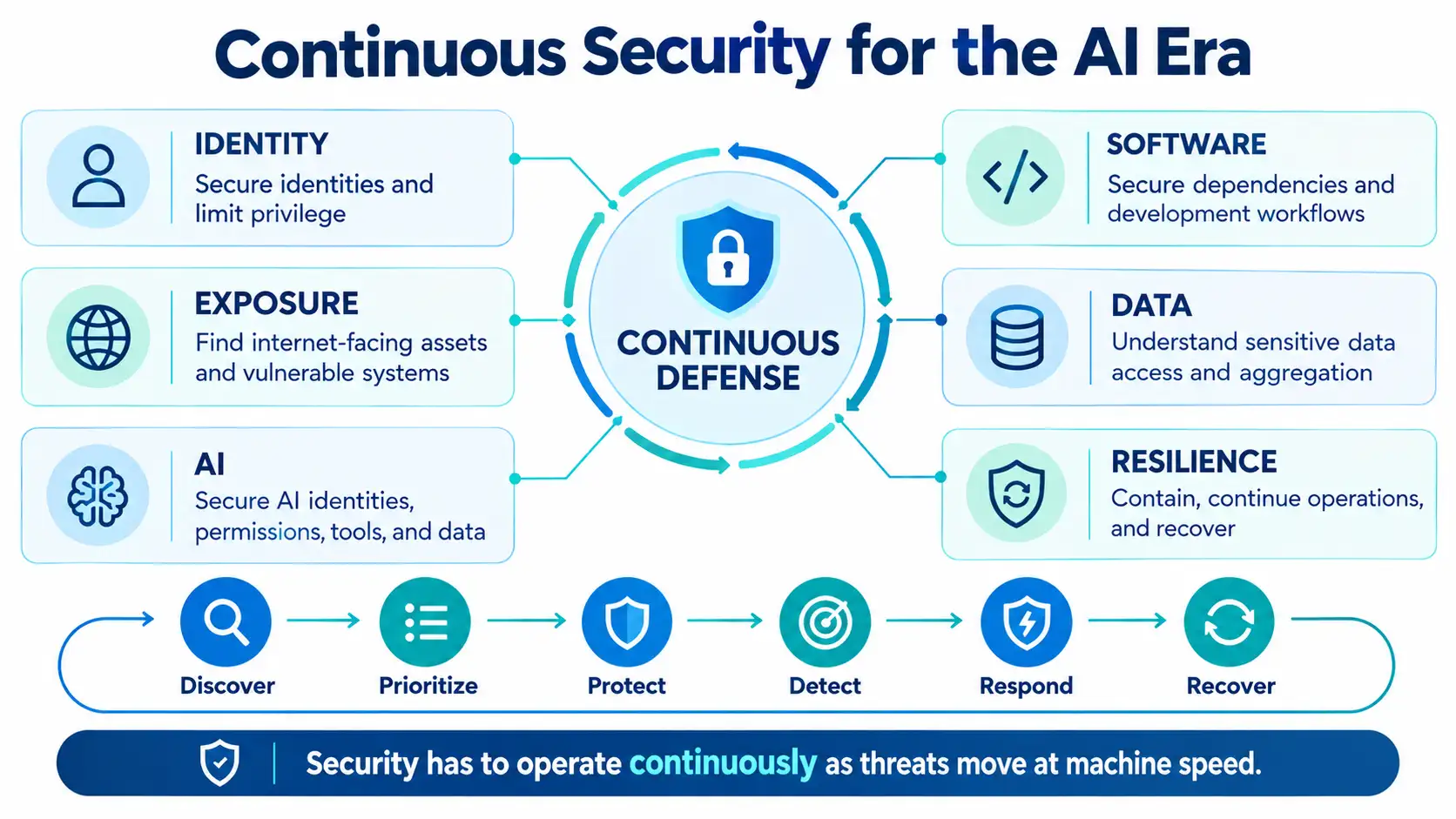
Microsoft says the threat environment described in the report is increasingly characterized by persistent pressure, machine-speed operations, and greater interdependence between systems.
That changes how security programs need to operate.
Instead of treating cybersecurity as a sequence of individual incidents, organizations need to continuously reduce exposure and monitor their environments.
The report highlights several areas:
Strengthening identity
Limiting privileges
Identifying internet-facing assets
Fixing exposed systems quickly
Securing software dependencies
Understanding access to sensitive data
Securing AI identities and permissions
Monitoring connected AI tools and systems
Microsoft also points to the importance of understanding how vulnerabilities translate into actual organizational exposure.
Among detections associated with the five leading CVEs analyzed in the report, Microsoft says 58% were associated with CVE-2020-1472, a vulnerability first disclosed in 2020.
The finding illustrates why older vulnerabilities can continue to matter when vulnerable systems remain exposed.
Exposure Management Has to Keep Up
Microsoft argues that exposure management should become continuous rather than periodic.
That means bringing together:
Asset visibility
Vulnerability discovery
Threat intelligence
Detection
AI-assisted analysis
The objective is to help security teams focus on the risks most likely to matter.
Microsoft says organizations should measure success through outcomes such as exposure reduced and time to mitigation rather than relying only on patch counts or alert volumes.
This approach also requires visibility across multiple parts of the enterprise.
Endpoint, identity, cloud, application, email, network, data, and AI telemetry become more useful when connected with threat intelligence and organizational context.
Shared context can help transform isolated signals into a more actionable view of risk.
Organizations Also Need to Plan for Disruption
Microsoft's report emphasizes that prevention is only one part of resilience.
Organizations also need to prepare for situations where an attack succeeds.
That means asking whether the organization can:
Contain an incident
Limit the resulting harm
Continue critical operations
Recover quickly
Restore affected systems
Understand what happened
This becomes increasingly important as enterprise environments become more interconnected.
An AI system may interact with applications, data, identities, cloud services, and external tools. Security controls therefore need to account for the relationships between those components.
The Defensive Opportunity: Use AI to Close the Gap
The report does not present AI solely as an offensive capability.
Microsoft also sees opportunities for security teams to use AI to improve defensive operations.
The same characteristics that can increase attacker speed can potentially help defenders:
Faster vulnerability analysis
Earlier discovery of risk
Faster correlation of security signals
Continuous investigation
Automated analysis
Faster response
This creates a race involving more than individual tools.
The broader issue is whether organizations can shorten their own security decision cycle enough to keep pace with increasingly automated threats.
For enterprises, this could mean moving from periodic security workflows toward systems that continuously connect exposure, intelligence, detection, investigation, and response.
That is an analytical implication of Microsoft's findings rather than a new product announcement in the report.
Three Priorities Microsoft Highlights
The report's concluding direction can be summarized around three connected priorities.
1. Strengthen the Foundations
Organizations still need strong identity controls, limited privileges, secure software, exposure management, data protection, and resilience.
AI does not remove these requirements.
2. Secure AI as It Enters the Environment
AI systems and agents introduce additional identities, permissions, data access, and tool connections.
Those components need to be incorporated into existing security governance.
3. Defend With AI
Security teams can use AI to analyze information, identify relevant risks, connect signals, and accelerate defensive workflows.
The objective is not simply automation for its own sake.
It is reducing the time between identifying a meaningful risk and taking action.
What the 2026 Report Means for Security Teams
Microsoft's 2026 Digital Defense Report presents a threat environment where the fundamental objectives of attackers remain familiar, but the speed and scale of execution are changing.
AI is being applied to vulnerability discovery, reconnaissance, phishing, malware and exploit development, data analysis, and post-compromise activity.
At the same time, organizations are dealing with a growing volume of vulnerabilities and increasingly complex technology environments.
The report therefore points toward a security model built around continuous visibility and faster decision-making.
The important shift is not simply the arrival of AI-powered attacks.
It is the shrinking amount of time available between a vulnerability being discovered, an attack being developed, and an organization taking defensive action.
For defenders, that makes the intelligence-to-action cycle increasingly important.
Strong foundations remain necessary. AI needs to be secured as it enters the enterprise. And defensive teams need to determine where AI can safely accelerate security operations.
Conclusion
Microsoft's 2026 Digital Defense Report describes AI as a force that is changing the timing, economics, scale, and autonomy of cybersecurity.
Threat actors are using AI to accelerate familiar attack paths, while defenders can apply the same technology to vulnerability management, threat analysis, detection, investigation, and response.
The report's central challenge is therefore one of time.
As the distance between discovery and attack continues to shrink, defenders need to reduce the distance between intelligence and action.
That means combining strong cybersecurity fundamentals with continuous exposure management, secure AI adoption, connected security intelligence, and faster defensive workflows.
AI may be changing the physics of cybersecurity, but Microsoft's report makes clear that the foundations of defense still matter.
Source: Microsoft Security Insider
About the Author