
Google Dataflow Adds Pause/Resume and Blackwell GPU Support for AI Workloads
Google Cloud has announced general availability of Pause/Resume for Dataflow batch jobs and support for NVIDIA RTX PRO 6000 Blackwell GPUs, targeting more efficient batch processing and demanding AI inference workloads.
Xcademia Team
Xcademia Research Team
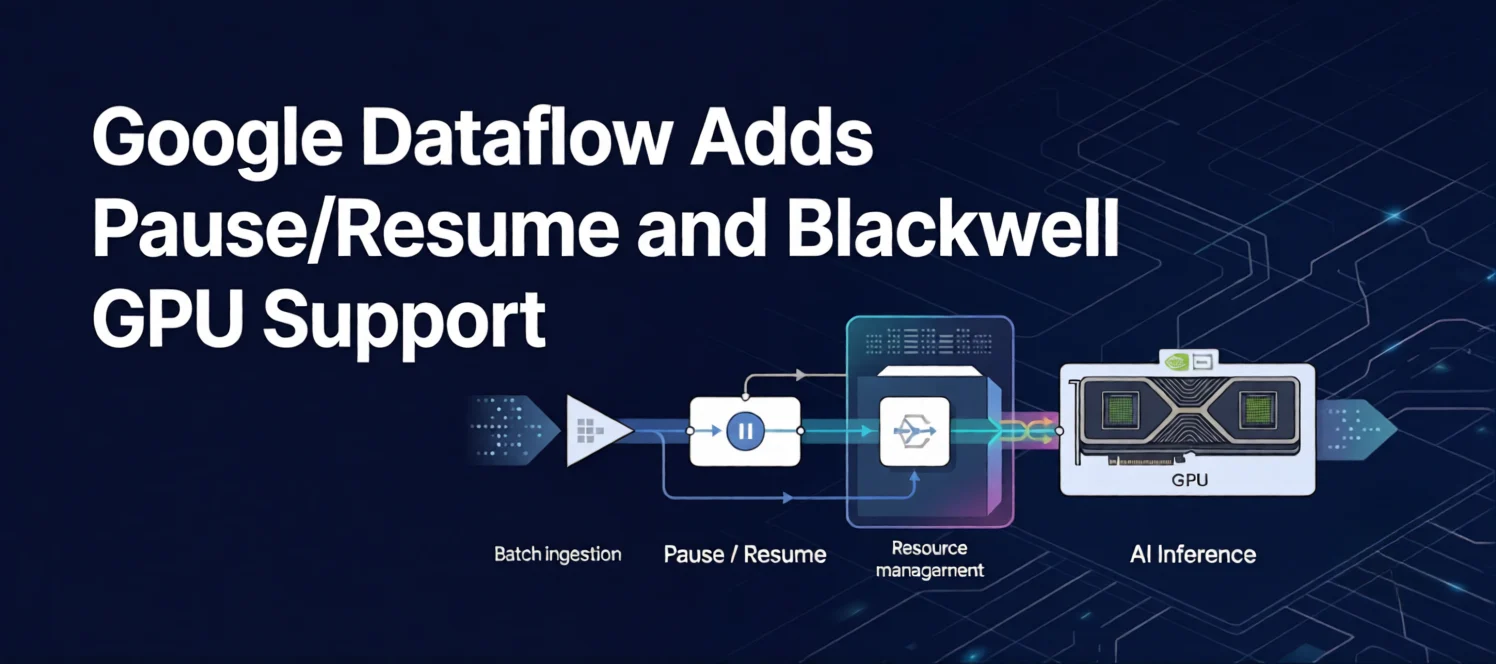
Google Cloud is adding two capabilities to Dataflow aimed at organizations running increasingly demanding data and AI workloads.
The company has announced the general availability of Pause/Resume for Dataflow batch jobs, along with support for G4 virtual machines powered by NVIDIA RTX PRO 6000 Blackwell Server Edition GPUs.
The updates target two different challenges. Pause/Resume is designed to reduce wasted compute when long-running batch jobs fail or when workloads need to be temporarily suspended. The new GPU support is aimed at increasing inference capacity for demanding AI workloads.
Dataflow is a serverless data processing platform used to build batch and streaming pipelines for analytics and AI use cases. Google Cloud describes it as a component of its broader AI stack, supporting data preparation for model training, evaluation, and inference.
Together, the new capabilities extend Dataflow further into AI-intensive processing scenarios.
Pause/Resume Addresses Long-Running Batch Job Failures
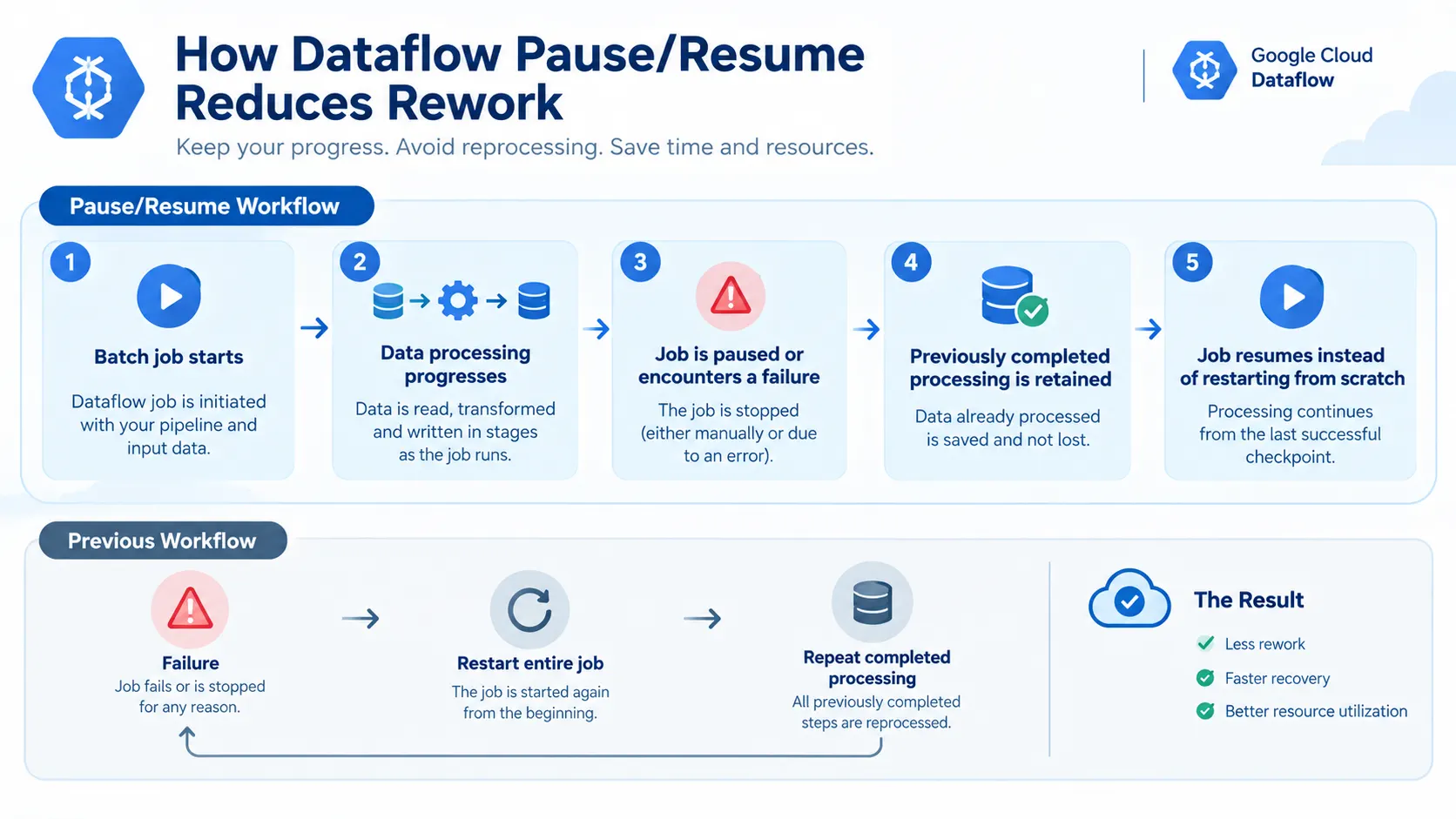
Large batch workloads can run for days. When one of these jobs fails, the work that was already completed can become difficult to recover.
According to Google Cloud, Dataflow users previously had to retry the entire failed job rather than resume from the work that had already been processed.
That can result in additional compute consumption and more engineering effort.
The newly announced Pause/Resume capability changes this workflow.
With the feature now generally available, customers can resume failed long-running Dataflow batch jobs rather than restarting them from the beginning.
The feature also supports intentionally pausing and resuming batch jobs according to business requirements.
This provides another way to manage compute resources when workloads do not need to run continuously.
Dynamic Compute Allocation for AI Workloads
Google Cloud also connects Pause/Resume with a broader resource-management use case.
Some AI workloads rely on accelerated compute resources such as GPUs and TPUs. According to the announcement, customers may want to reallocate these resources from lower-priority Dataflow batch jobs to higher-priority workloads.
Examples provided by Google Cloud include feature engineering and AI inference.
The ability to pause and resume batch jobs can therefore provide more flexibility around how compute resources are used.
Rather than treating every running batch workload as something that must continue uninterrupted, organizations can pause selected jobs when priorities change and resume them later.
The announcement describes this as a way to improve compute utilization while supporting changing workload requirements.
Google Cloud says the capability is powered by internal Google innovation.
Additional technical details about the underlying implementation were not disclosed in the announcement.
Dataflow Adds NVIDIA RTX PRO 6000 Blackwell GPU Support
The second major update focuses directly on AI inference.
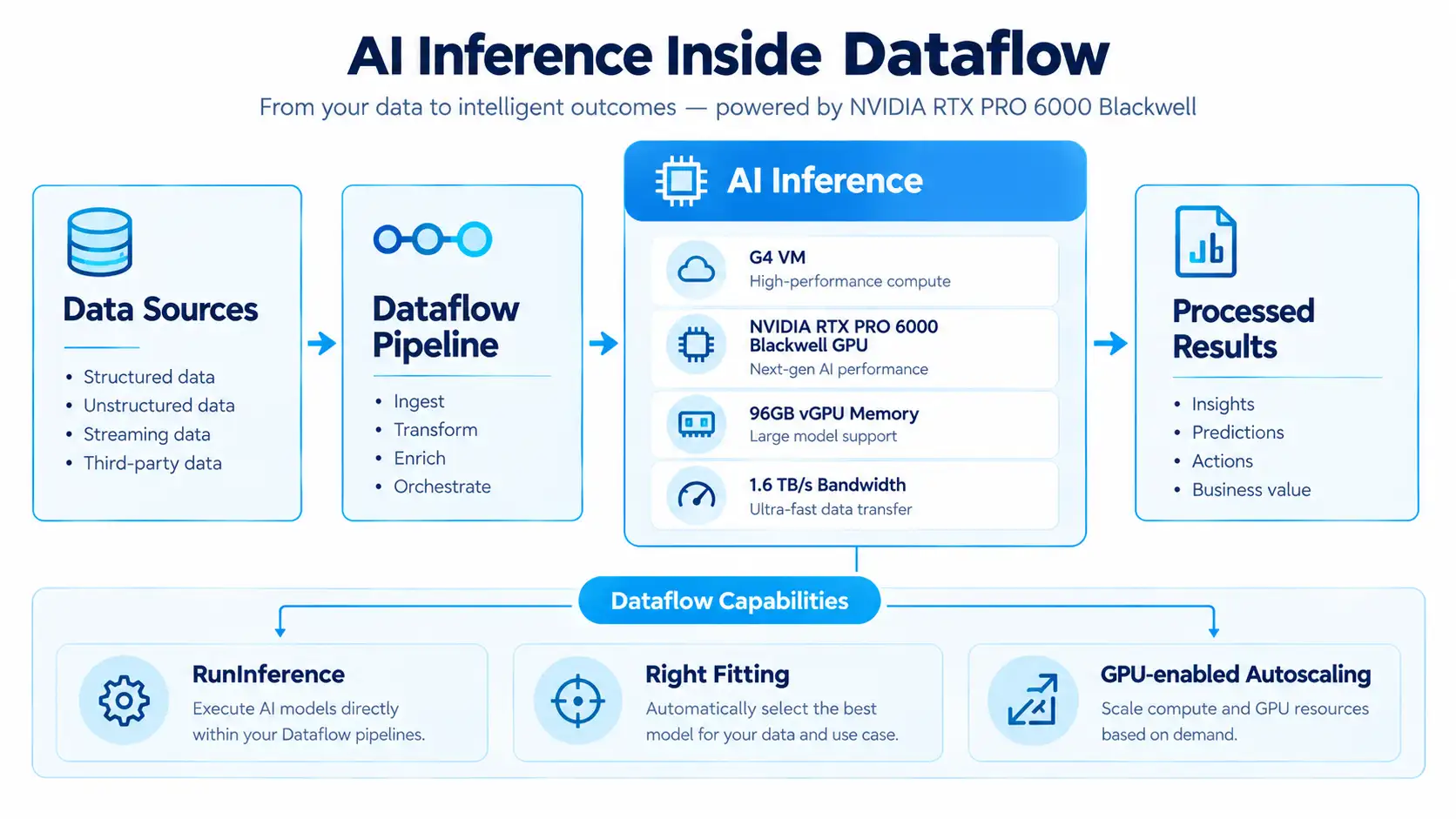
Dataflow already supports a range of GPUs and TPUs for accelerating AI inference workloads. Google Cloud is now adding support for G4 VMs powered by NVIDIA RTX PRO 6000 Blackwell Server Edition GPUs.
The announcement highlights the GPU's 96GB of vGPU memory and 1.6 TB/s of bandwidth.
Google Cloud says the additional capacity enables AI inference within Dataflow jobs using models with 70 billion or more parameters.
This is particularly relevant for workloads where inference itself is part of a larger data processing pipeline.
Instead of treating inference as an entirely separate infrastructure layer, Dataflow can run inference as part of the data processing job.
What the Blackwell GPU Support Enables
Google Cloud says the RTX PRO 6000 Blackwell support can be used for AI inference with models of 70B+ parameters.
The company also points to existing Dataflow capabilities that can help customers onboard and scale inference workloads.
These include:
RunInference, for integrating machine learning inference into Dataflow pipelines
Right fitting, which helps align workloads with available accelerator resources
GPU-enabled autoscaling, which supports scaling inference workloads without manually managing the underlying infrastructure
The combination is intended to reduce the infrastructure management burden associated with AI inference workloads.
Google Cloud specifically highlights the ability to use these capabilities without manually handling challenges such as tuning and autoscaling.
The announcement does not provide independent benchmark results comparing Dataflow's new GPU support against alternative platforms.
Two Updates, Two Different Operational Challenges
Although Pause/Resume and Blackwell GPU support address different parts of the Dataflow experience,
Google Cloud is positioning them as complementary improvements for AI-intensive workloads.
Pause/Resume focuses on compute efficiency and workload management.
It addresses long-running batch jobs, failed workloads, and situations where teams need to temporarily change compute priorities.
Blackwell GPU support focuses on inference capacity.
It adds another accelerator option for workloads requiring significant GPU resources and supports inference for models with 70B+ parameters, according to Google Cloud.
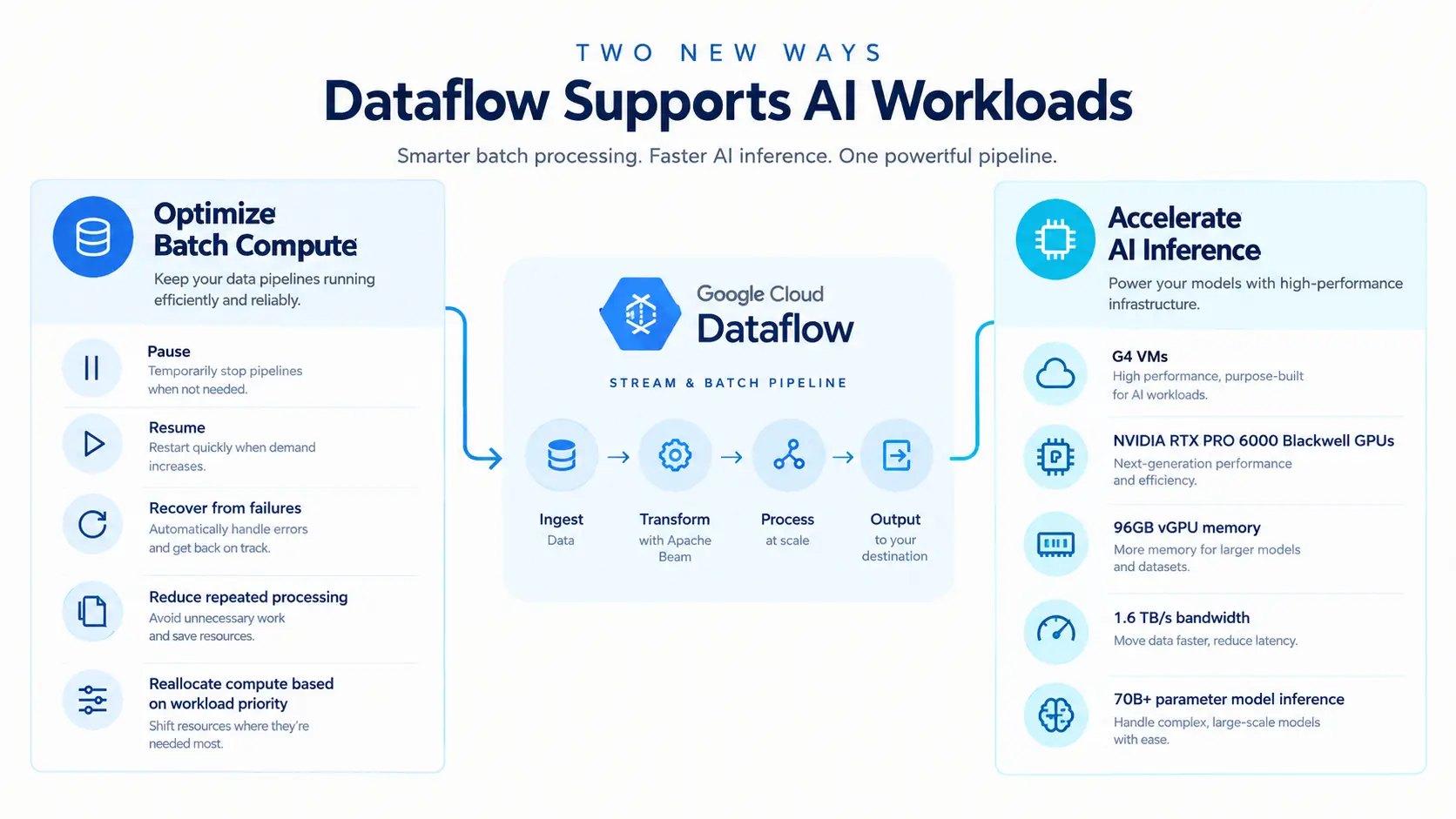
Together, the updates cover both sides of a common data and AI workflow: managing how compute is consumed and providing additional compute capability for demanding inference workloads.
What the Update Means for Data and AI Teams
The announcement reflects a broader industry shift toward combining data processing and AI workloads within more integrated cloud infrastructure.
For enterprises, this could mean greater flexibility when data pipelines and AI inference workloads compete for accelerated compute resources.
Pause/Resume is particularly relevant to teams managing long-running batch processing. The ability to resume failed jobs rather than restarting from the beginning can change how teams approach interruptions in those workflows.
The GPU update addresses a different requirement. As organizations run increasingly demanding inference workloads, access to higher-capacity accelerators becomes an important part of the infrastructure equation.
Dataflow's existing inference, autoscaling, and resource-management capabilities are intended to help organizations operate these workloads without directly managing every underlying infrastructure component.
These benefits are based on Google Cloud's description of the new capabilities. The announcement does not provide independent customer performance results or detailed cost comparisons.
A More Flexible Dataflow for AI-Heavy Pipelines
Google Cloud's latest Dataflow updates focus on making large-scale workloads easier to manage from two directions.
The general availability of Pause/Resume for batch jobs gives teams a way to recover from failures and manage long-running workloads without necessarily starting over.
Meanwhile, support for NVIDIA RTX PRO 6000 Blackwell GPUs on G4 VMs adds additional accelerator capacity for demanding AI inference workloads, including models with 70B+ parameters according to Google Cloud.
The broader direction is clear: data processing platforms are increasingly being designed to accommodate AI workloads as part of the same processing environment.
For organizations already using Dataflow, these updates provide additional options for managing long-running batch pipelines and AI inference workloads.
Google Cloud has made both capabilities available as part of its latest Dataflow enhancements.
Source: Google Cloud Blog
About the Author