
Google Cloud's GKE Agent Sandbox Helps SeaVerse Cut Infrastructure Costs by 60%
SeaVerse says Google Kubernetes Engine (GKE) Agent Sandbox has helped reduce infrastructure costs by up to 60%, while improving workload visibility, isolation and flexibility for its AI-powered interactive creation platform.
Xcademia Team
Xcademia Research Team
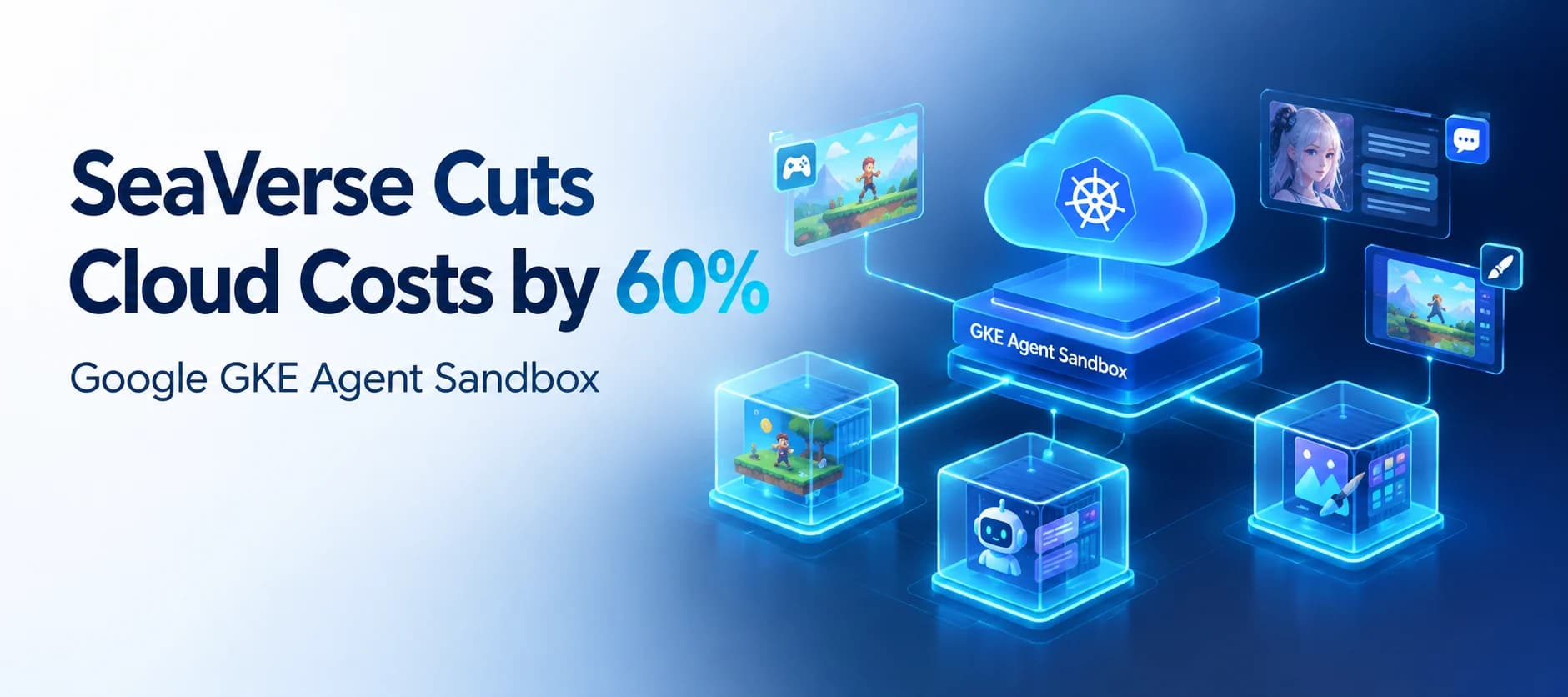
Google Cloud's GKE Agent Sandbox is helping SeaVerse reduce infrastructure costs by up to 60%, improve sandbox observability and support secure execution of AI-generated interactive experiences.
AI-powered applications are creating new infrastructure challenges for developers, particularly when users can generate and execute their own interactive content. Each experience may require an isolated execution environment, reliable performance, and sufficient visibility for engineers to diagnose failures.
SeaVerse, a gaming startup from SeaArt, says it has addressed several of these challenges by adopting Google Kubernetes Engine (GKE) and GKE Agent Sandbox.
In a customer announcement published on September 17, 2026, Google Cloud describes how the platform uses these technologies to operate AI-generated games, character chats, and interactive applications. SeaVerse reports that the infrastructure changes have helped cut its infrastructure costs by up to 60%, while providing greater flexibility in resource allocation and persistent storage.
What Is SeaVerse?
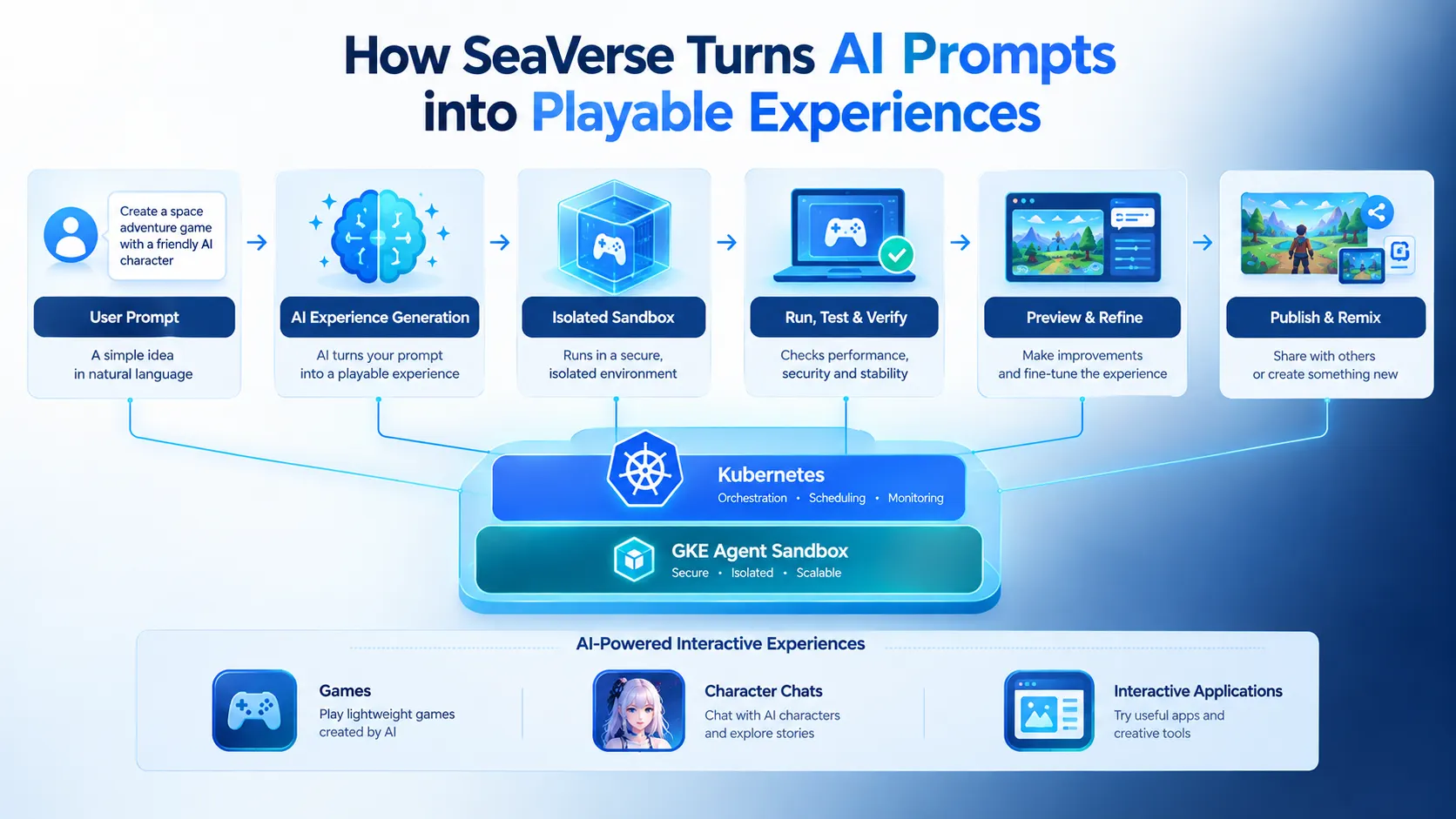
SeaVerse is a creation-first platform for playable AI experiences. Users can interact with lightweight games, chat with AI characters, explore interactive applications, or create their own experiences using natural-language prompts.
The platform is designed to make AI-powered creation accessible without requiring a traditional coding workflow.
A user can describe an idea, refine the generated experience, test it, and publish it. Other users can share or remix those creations.
Behind this simple workflow is a complex execution process. Each creation moves through a sequence of generation, execution, preview, debugging, publishing, and remixing.
SeaVerse says the experience needs to remain responsive and reliable throughout this process. Delays, failures, or weak isolation between workloads can directly affect how users interact with the platform.
The Infrastructure Challenge: Isolating Dynamic AI Workloads
SeaVerse runs each creation as a distinct workload. This architecture introduces several operational requirements.
First, the platform needs clear security boundaries between users, individual creations, and their execution environments. Second, it must maintain responsive interactions without allowing security controls to introduce unnecessary delays.
The engineering team also needed better visibility into workload behaviour.
Before adopting GKE Agent Sandbox, diagnosing failures could involve tracing problems across multiple components of the execution chain. Engineers could detect that a sandbox had failed but often lacked sufficient runtime status, metrics, and failure signals to determine the cause.
SeaVerse explored existing sandbox approaches but wanted deeper isolation and native observability to support diagnosis across multi-tenant environments.
The company selected Google Cloud's infrastructure to address these operational requirements while allowing its engineers to concentrate on developing the platform.
How GKE and GKE Agent Sandbox Support SeaVerse
Google Kubernetes Engine provides SeaVerse with a managed Kubernetes foundation. According to the company, this reduces the operational burden of maintaining the underlying cluster and allows its engineering team to focus more directly on the product.
GKE Agent Sandbox provides a Kubernetes-based execution environment designed for agent code execution and computer-use workloads.
SeaVerse says it uses GKE Agent Sandbox with Kata Containers and Cloud Hypervisor microVMs. The announcement also describes the ability to switch isolation runtimes between microVMs and gVisor.
These options provide flexibility in how sandbox workloads are isolated and operated.
The announcement describes gVisor-based isolation as part of the platform's approach to running dynamic sandbox workloads within the Kubernetes orchestration model. This allows sandbox workloads to be managed through the same scheduling, monitoring, and operational processes as other workloads in the cluster.
The reported general availability figures are:
Up to 300 sandbox allocations per second, per cluster.
90% of allocations completing within 200 milliseconds.
These figures describe the allocation capabilities cited in the announcement. They should not be interpreted as a guarantee of end-to-end application response times.
SeaVerse says the infrastructure provides a foundation for its long-term ambition to support more than one million sandboxes. This is a stated future target, not a reported current deployment size.
From a Black Box to Better Runtime Visibility
Observability was another important part of SeaVerse's infrastructure requirements.
Previously, when a sandbox workload failed, engineers could struggle to identify what had happened inside the execution environment. Limited runtime information made troubleshooting more difficult.
With GKE Agent Sandbox, SeaVerse says Google Cloud's native logging and monitoring capabilities provide visibility directly into sandboxed environments.
This gives the engineering team a clearer view of workload behaviour and failure signals, helping them investigate and resolve issues more effectively.
The company also highlights the importance of this visibility for the end-user experience.
Creators do not interact directly with the underlying cluster, logs, or orchestration systems. They experience the platform through the speed at which their creations open, respond to interactions, and remain available for further editing and sharing.
For SeaVerse, operational visibility is therefore connected to the reliability of the creative workflow.
How SeaVerse Reports Infrastructure Cost Savings of Up to 60%
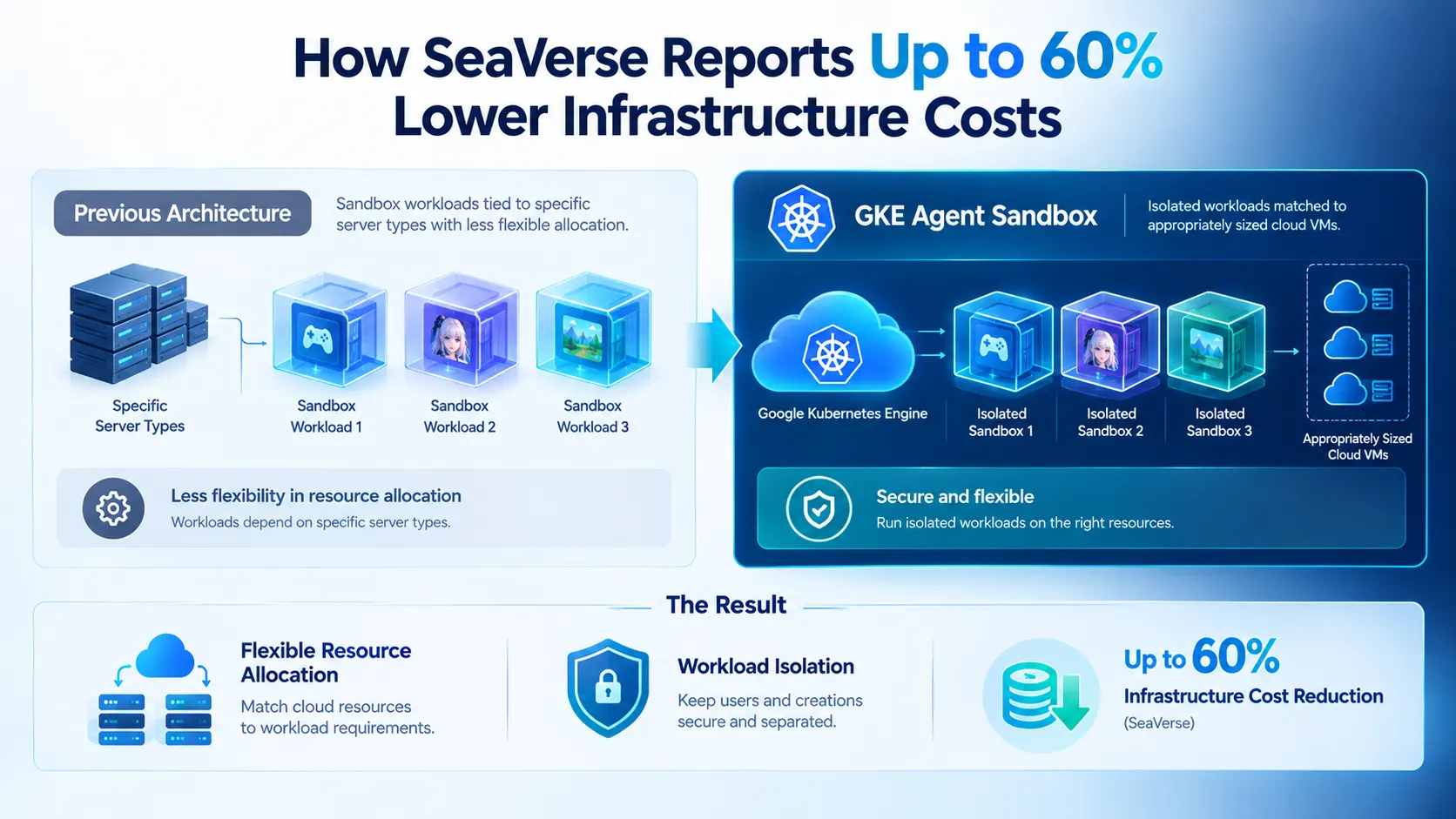
One of the most significant outcomes described in the announcement is a reduction in infrastructure costs of up to 60%.
SeaVerse says its previous sandbox architecture depended more heavily on specific server types. This limited its ability to match computing resources precisely to individual workloads.
GKE Agent Sandbox has given the company greater flexibility to run isolated workloads on appropriately sized cloud virtual machines.
This allows SeaVerse to allocate infrastructure resources more closely to workload requirements, which the company says has helped reduce costs.
The reported saving is specific to SeaVerse's experience. Google Cloud's announcement does not establish that other organisations should expect the same percentage reduction.
Persistent Storage for Creations That Evolve Over Time
SeaVerse also describes improvements to storage flexibility.
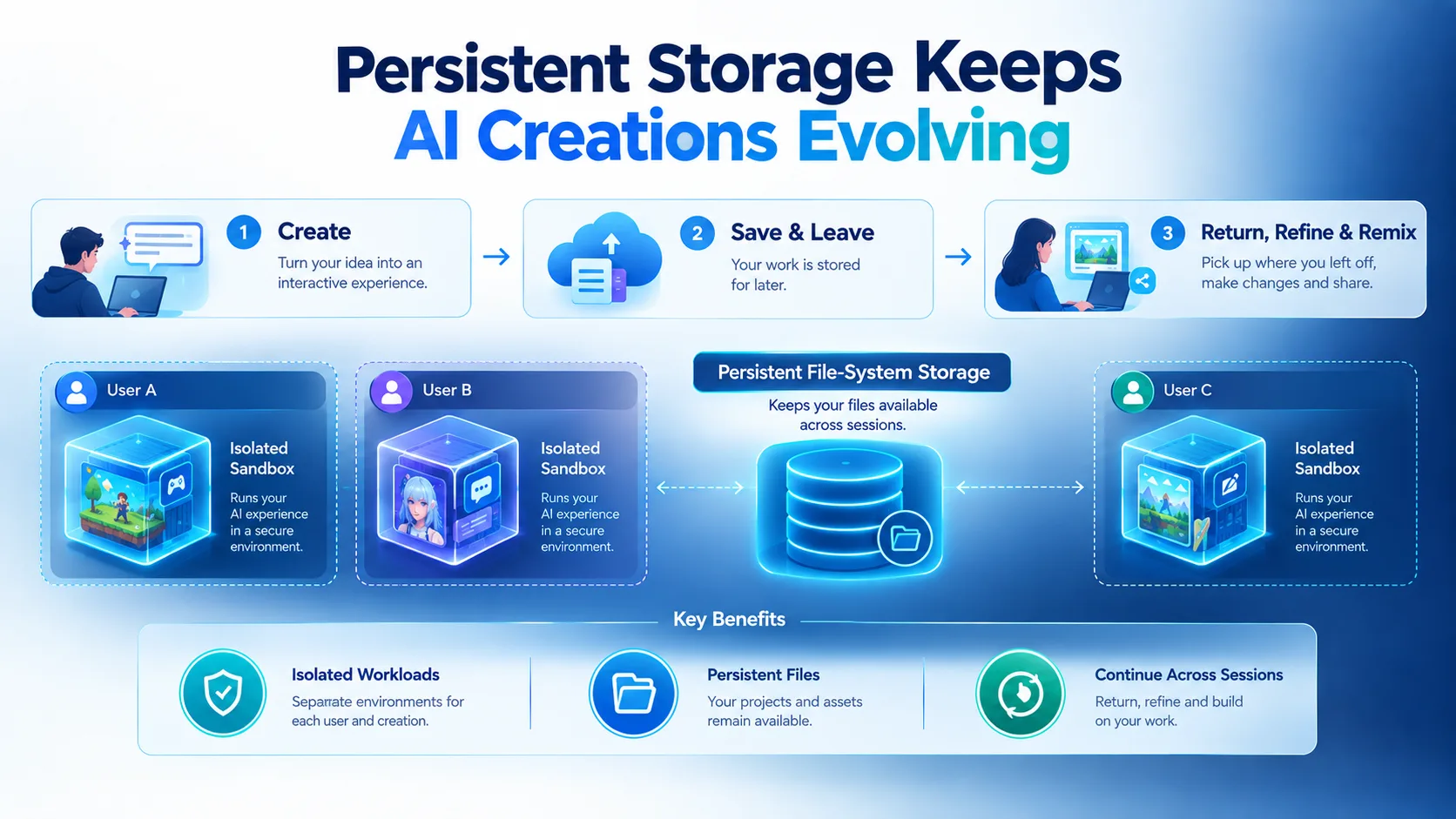
Some user-created experiences are not completed in a single session. Creators may return to refine an idea, expand an application, or allow other users to remix their work.
The company's previous architecture did not support the persistent file-system capabilities required for these use cases.
SeaVerse says it can now attach persistent storage to workloads that require it while maintaining isolation boundaries between tenants.
This enables creations to retain files across sessions, supporting workflows in which users revisit and continue developing their projects.
The announcement does not disclose specific storage products, capacity limits, performance benchmarks, or detailed implementation configurations.
What Comes Next for SeaVerse?
SeaVerse says it plans to continue strengthening stability, observability, elastic scaling, and cost efficiency as its platform develops.
The company is also exploring additional Google Cloud tools for analytics and AI-assisted creation.
The announcement identifies several areas of interest:
Gemini and agent models: Potential support for helping operators and creators better understand how experiences perform.
BigQuery AI and machine learning: Possible applications include churn prediction, lifetime value (LTV) and return on investment (ROI) prediction, and user segmentation.
Imagen and Veo on Gemini Enterprise Agent Platform: Potential applications in material analysis, creative generation, and interactive AI content production.
These are areas SeaVerse says it is exploring. The announcement does not confirm that all these capabilities are already deployed in production or provide implementation timelines.
What This Means for AI Infrastructure Teams
SeaVerse's experience highlights several infrastructure considerations for organisations building platforms that execute user-generated or AI-generated code.
1. Isolation needs to fit the workload. Multi-tenant execution environments need clear security boundaries. The choice of isolation runtime can affect how workloads are operated and managed.
2. Observability is essential for troubleshooting. Visibility into runtime behaviour and failure signals can help engineers investigate problems in environments where many workloads execute independently.
3. Resource flexibility can affect operating costs. Matching cloud resources to workload requirements may create opportunities to improve infrastructure efficiency. SeaVerse's reported savings illustrate one company's experience, not a universal benchmark.
4. Persistent storage can support longer creative workflows. Applications that evolve over multiple sessions may need storage that remains available beyond an individual execution session.
5. Allocation performance is only one part of user experience. The reported sandbox allocation figures provide useful context, but application responsiveness also depends on factors not detailed in the announcement.
These considerations are relevant to AI application platforms, agent execution environments, and other services that need to run dynamic workloads at scale.
Conclusion
SeaVerse's adoption of GKE and GKE Agent Sandbox demonstrates how managed Kubernetes infrastructure, sandbox isolation, observability, and flexible resource allocation can support an AI-powered creation platform.
The company reports infrastructure cost reductions of up to 60%, alongside improved runtime visibility and support for persistent storage.
Its longer-term ambition is to scale towards more than one million sandboxes, while continuing to improve reliability, operational efficiency, and the creator experience.
For organisations developing similar AI-powered services, the announcement offers a practical example of the infrastructure challenges involved in running isolated, multi-tenant workloads. The results are specific to SeaVerse, and the company has not disclosed a detailed cost breakdown or independent performance evaluation.
Source: Google Cloud Blog
About the Author