
CrowdStrike Finds AI-Driven ARTEX Used Against South Korean Finance
CrowdStrike says an unidentified threat actor used the AI-driven ARTEX pentesting tool and multiple LLMs in a campaign targeting South Korean financial organizations from late September to early October 2026.
Xcademia Team
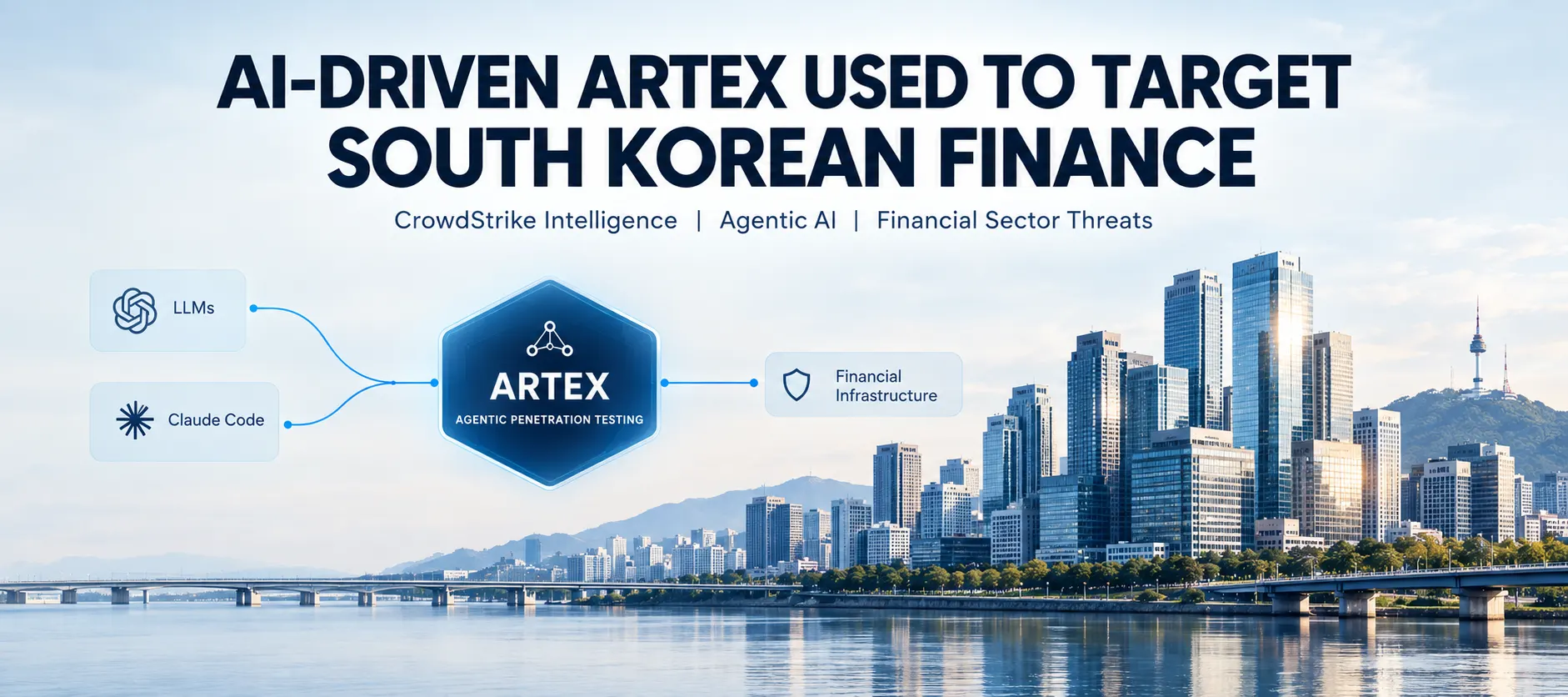
CrowdStrike Intelligence has identified infrastructure associated with a targeted campaign against South Korean financial organizations that resulted in data exfiltration.
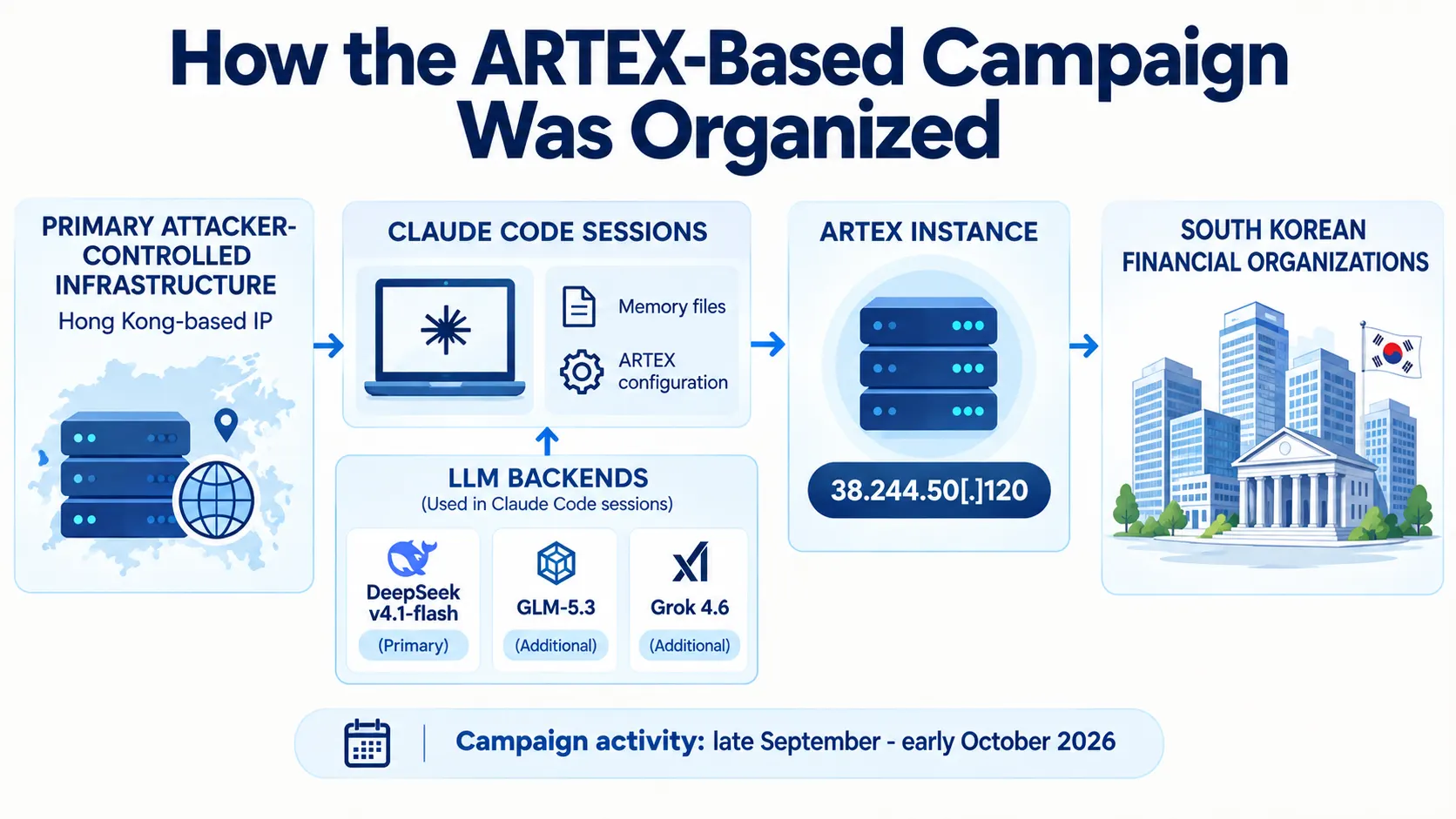
The activity was observed from late September through early October 2026. According to CrowdStrike, analysis of threat actor-controlled open directories uncovered Claude Code session histories, ARTEX configuration files, and Claude memory files.
These artifacts provided researchers with direct visibility into how the threat actor organized the campaign and used agentic AI tooling alongside traditional offensive techniques.
The threat actor has not been attributed to a named adversary. CrowdStrike assesses with moderate confidence that the actor is likely Chinese-speaking and financially motivated, based on the use of the Chinese-developed ARTEX tool and observed Chinese-language prompts.
What Is ARTEX?
ARTEX is described by CrowdStrike as a recently released open-source agentic penetration testing tool developed in China.
In the activity analyzed by CrowdStrike, ARTEX was used alongside large language models to support offensive security operations targeting South Korean financial organizations.
The investigation is notable because researchers were able to examine not only infrastructure associated with the activity, but also configuration files and AI coding sessions that exposed parts of the operational workflow.
CrowdStrike says the activity illustrates the continued evolution of adversarial tradecraft as threat actors experiment with agentic AI systems.
South Korean Financial Organizations Were Targeted
CrowdStrike's report cites industry reporting indicating that several South Korean financial organizations experienced data breaches beginning in late September 2026.
At one affected bank, the threat actor reportedly breached a loan progress inquiry service used by financial brokers.
At another bank, the attacker reportedly compromised an employee mobile work-support system.
The total number of affected organizations remained unconfirmed at the time of CrowdStrike's reporting.
CrowdStrike also observed overlapping IP addresses associated with activity at multiple organizations. References to the string ARTEX in HTML files on a reportedly threat actor-controlled server further indicated the tool was involved.
Two-Server Infrastructure Provided Visibility Into the Campaign
One of the key findings came from analysis of infrastructure associated with the campaign.
The IP address 38.244.50[.]120 hosted an ARTEX instance and an open directory containing a Claude Code markdown document. The document included a Chinese-language prompt instructing the LLM on how to conduct penetration testing activities.
The document also referenced a Hong Kong-based IP address controlled by the threat actor.
Further analysis of that infrastructure uncovered additional open directories containing Claude Code session histories, ARTEX configuration files and Claude memory files.
According to CrowdStrike, these artifacts indicate that the threat actor used ARTEX and LLMs extensively while targeting South Korean financial organizations.
CrowdStrike's analysis identified a two-server structure:
Hong Kong-based infrastructure: Primary attacker-controlled infrastructure associated with the Claude Code sessions.
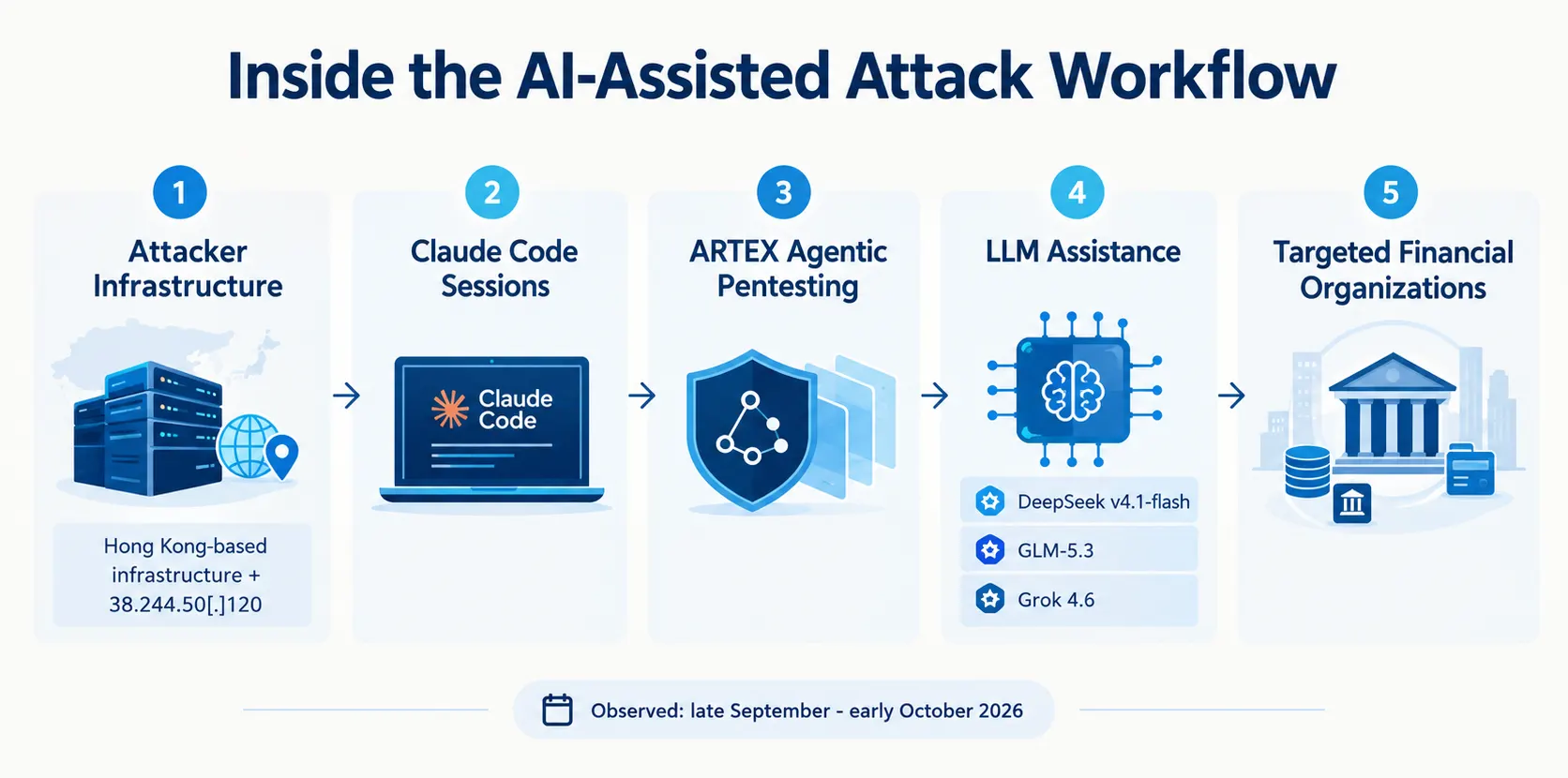
38.244.50[.]120: Hosted the ARTEX instance believed to be responsible for the Korean attacks.
The ARTEX instance used DeepSeek v4.1-flash as its primary LLM backend. CrowdStrike also identified use of GLM-5.3 from Zhipu AI and Grok 4.6 in additional Claude Code sessions.
CrowdStrike assesses that the threat actor likely accessed DeepSeek through the likely LLM API proxy or reseller xcai[.]pro.
Multiple Proxy Addresses Were Used
CrowdStrike identified nine proxy IP addresses associated with the ARTEX-related activity:
IOC | Description |
|---|---|
| Proxy IP address |
| Proxy IP address |
| Proxy IP address |
| Proxy IP address |
| Proxy IP address |
| Proxy IP address |
| Proxy IP address |
| Proxy IP address |
| Proxy IP address |
| Threat actor-controlled IP address |
These infrastructure findings gave CrowdStrike visibility into the systems used during the campaign and the connections between the ARTEX deployment and other attacker-controlled infrastructure.
AI Tooling Was Used Alongside Traditional Offensive Capabilities
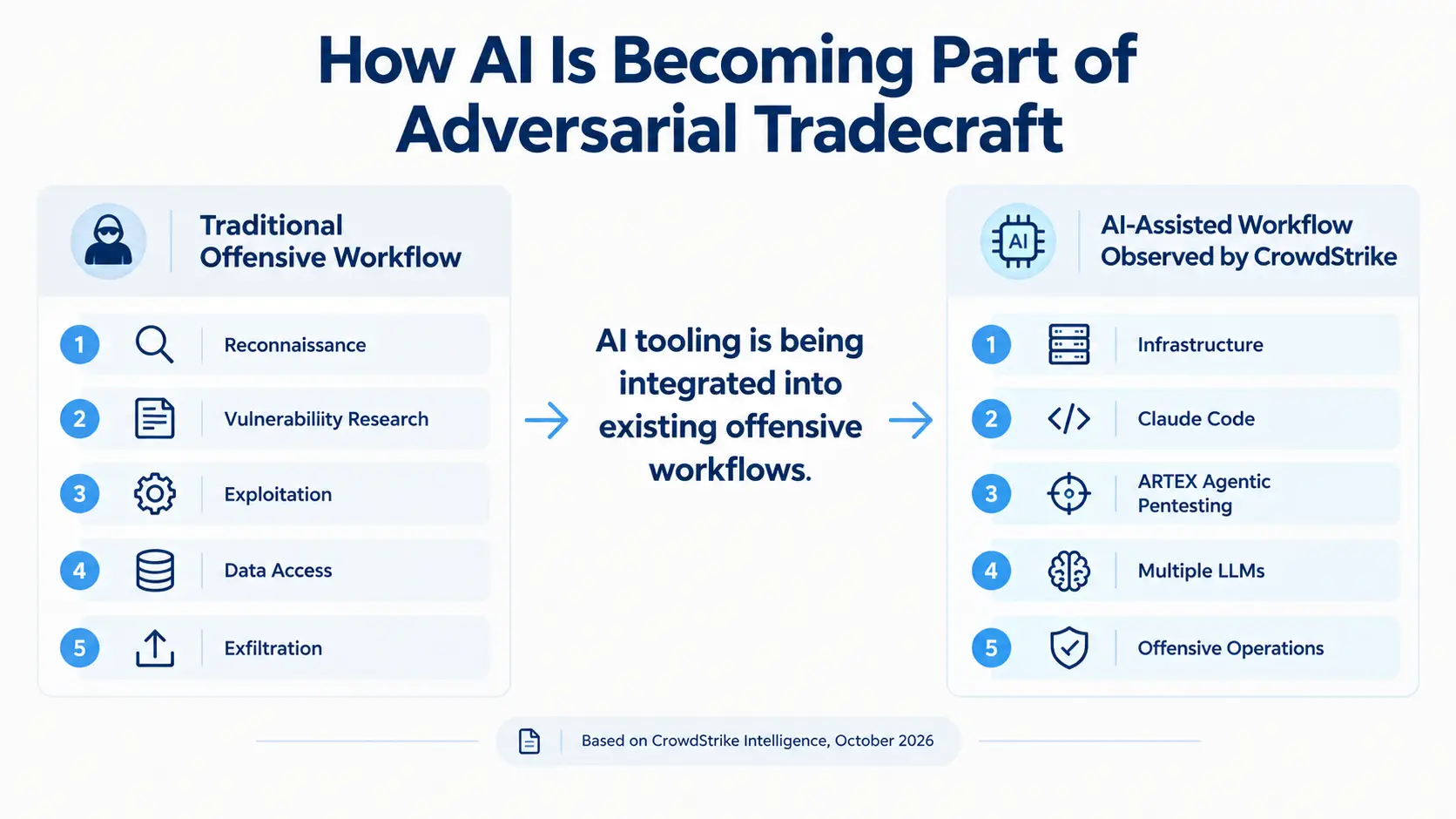
The CrowdStrike investigation provides an example of how agentic AI tooling is being incorporated into offensive security activity.
The threat actor did not rely exclusively on ARTEX. CrowdStrike observed ARTEX being used alongside multiple LLMs and Claude Code sessions.
The sessions exposed prompts and operational artifacts that showed how the threat actor attempted to use AI systems during penetration testing and vulnerability research.
CrowdStrike also observed the threat actor asking Claude where threat actors typically sell information from Korean data breaches and requesting assistance in finding Korean Telegram groups associated with data sales.
These observations are part of the broader operational picture described in the report.
CrowdStrike Found Possible Identity Clues, But Attribution Remains Unconfirmed
One Claude Code session contained a request to create a security researcher résumé that included results from the ARTEX-related activity.
The prompt contained personal information that CrowdStrike says may belong to the individual behind the activity. However, the company explicitly notes that the available information cannot definitively associate those details with the threat actor.
CrowdStrike also identified the Telegram username YY520CN in Claude Code sessions involving vulnerability research on a Telegram-based NFT gift marketplace.
The same username was also associated with activity targeting a possible Chinese payment platform.
These overlaps provide potential investigative leads, but they do not establish definitive attribution.
For that reason, the report does not assign the campaign to a named adversary.
CrowdStrike Assesses the Actor Is Likely Chinese-Speaking and Financially Motivated
CrowdStrike assesses with moderate confidence that the threat actor is likely Chinese-speaking and financially motivated.
The assessment is based primarily on two observations cited in the report:
The use of the Chinese-developed ARTEX tool.
Chinese-language prompts observed in the campaign's AI sessions.
CrowdStrike has not publicly attributed the activity to a specific named threat actor.
That distinction is important because infrastructure overlaps, language indicators and tool selection can provide useful intelligence without establishing definitive actor identity.
The Campaign Shows How AI Can Increase Operational Tempo
CrowdStrike's assessment focuses on the operational implications of agentic AI.
The company says the activity demonstrates how AI tooling can enable a financially motivated threat actor to conduct multiple intrusions within a relatively short period.
Rather than presenting AI as a completely separate attack category, the investigation shows how LLMs and agentic security tools can be incorporated into existing offensive workflows.
This includes penetration testing activity, vulnerability research, infrastructure management and information gathering.
MITRE ATT&CK Techniques Identified by CrowdStrike
CrowdStrike mapped the activity described in the report to several MITRE ATT&CK techniques.
Resource Development
T1583.003 - Acquire Infrastructure: Virtual Private Server
CrowdStrike observed the acquisition and use of infrastructure across multiple IP addresses to establish command-and-control operations.
T1588.007 - Obtain Capabilities: Artificial Intelligence
The report maps the acquisition and deployment of ARTEX, an open-source, Chinese-developed agentic penetration testing tool, to the acquisition of AI capabilities.
Command and Control
T1090 - Proxy
CrowdStrike identified multiple proxy IP addresses used during the ARTEX-related activity.
This mapping provides defenders with a structured way to understand the campaign's infrastructure and tooling behavior.
What the ARTEX Activity Means for Defenders
The announcement highlights a broader industry shift toward adversaries experimenting with AI as part of established attack workflows.
The significance of this campaign is not simply that an attacker used an LLM. CrowdStrike's investigation shows a more integrated model in which agentic pentesting software, coding assistants, LLM backends, proxy infrastructure and traditional offensive operations can work together.
For defenders, this means visibility into AI-assisted activity may increasingly depend on understanding the surrounding infrastructure and operational artifacts, rather than looking only for a specific AI tool.
The report also demonstrates the value of exposed configuration files, session histories and memory files as sources of threat intelligence. In this case, those artifacts helped CrowdStrike reconstruct aspects of the threat actor's methodology.
The Bigger Picture: AI Is Becoming Part of Offensive Security Operations
CrowdStrike assesses that adversaries will likely continue experimenting with AI tooling to increase operational tempo and capabilities.
The South Korean financial sector campaign provides one example of that evolution. The actor remained unattributed, but investigators were able to connect infrastructure, ARTEX deployment, Claude Code sessions, LLM usage and proxy activity into a broader picture of the campaign.
The development reflects growing demand for defenders to monitor not only traditional indicators of compromise, but also the infrastructure and operational patterns surrounding AI-assisted activity.
At the same time, the report's attribution caveats remain important. The available evidence supports CrowdStrike's assessment that the actor is likely Chinese-speaking and financially motivated, but it does not establish a named adversary.
For security teams, the practical takeaway is straightforward: AI-assisted offensive tooling is becoming part of the threat landscape, and understanding how these tools are connected to conventional attack infrastructure will remain important for threat hunting and incident response.
Source: CrowdStrike
About the Author