
Cloudflare Launches Turnstile Spin to Help AI Agents Secure Websites
Cloudflare has introduced Turnstile Spin, an agent-mediated workflow that lets AI coding agents install, repair, or migrate Turnstile protection across a website's frontend and backend.
Xcademia Team
Xcademia Research Team
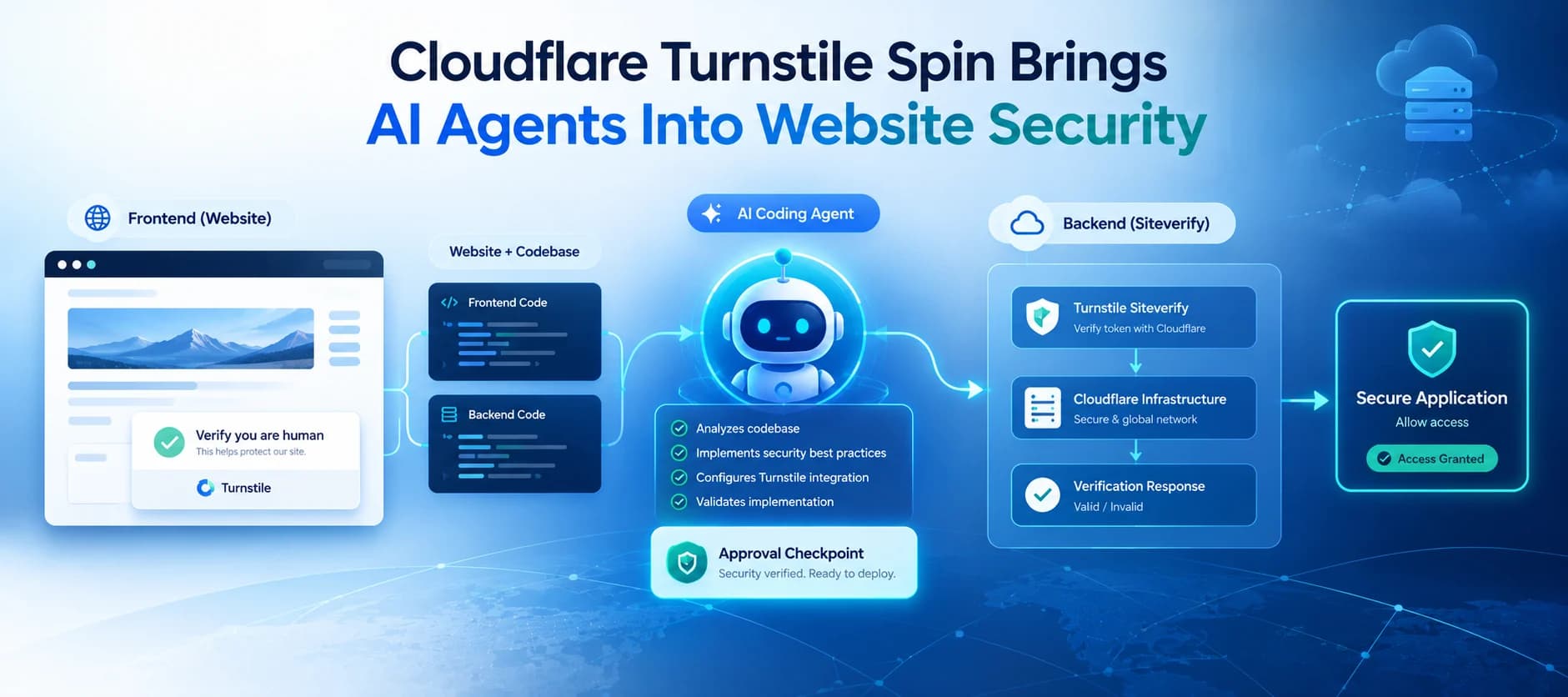
Cloudflare has introduced Turnstile Spin, a new agent-mediated workflow designed to simplify the deployment and maintenance of its Turnstile bot protection for websites.
Announced on September 25, 2026, Spin is designed around the growing use of AI coding agents. Instead of requiring developers to manually configure Turnstile on both the frontend and backend, the agent can identify the relevant application code, propose changes, and apply them after approval.
The development reflects a broader shift in web development, where AI coding tools increasingly handle tasks that traditionally required developers to work across multiple parts of an application.
From manual Turnstile integration to agent-assisted setup
Cloudflare introduced Turnstile in 2023 as a privacy-focused alternative to traditional CAPTCHAs. It does not require visitors to solve puzzles and can be deployed on websites without routing their traffic through Cloudflare.
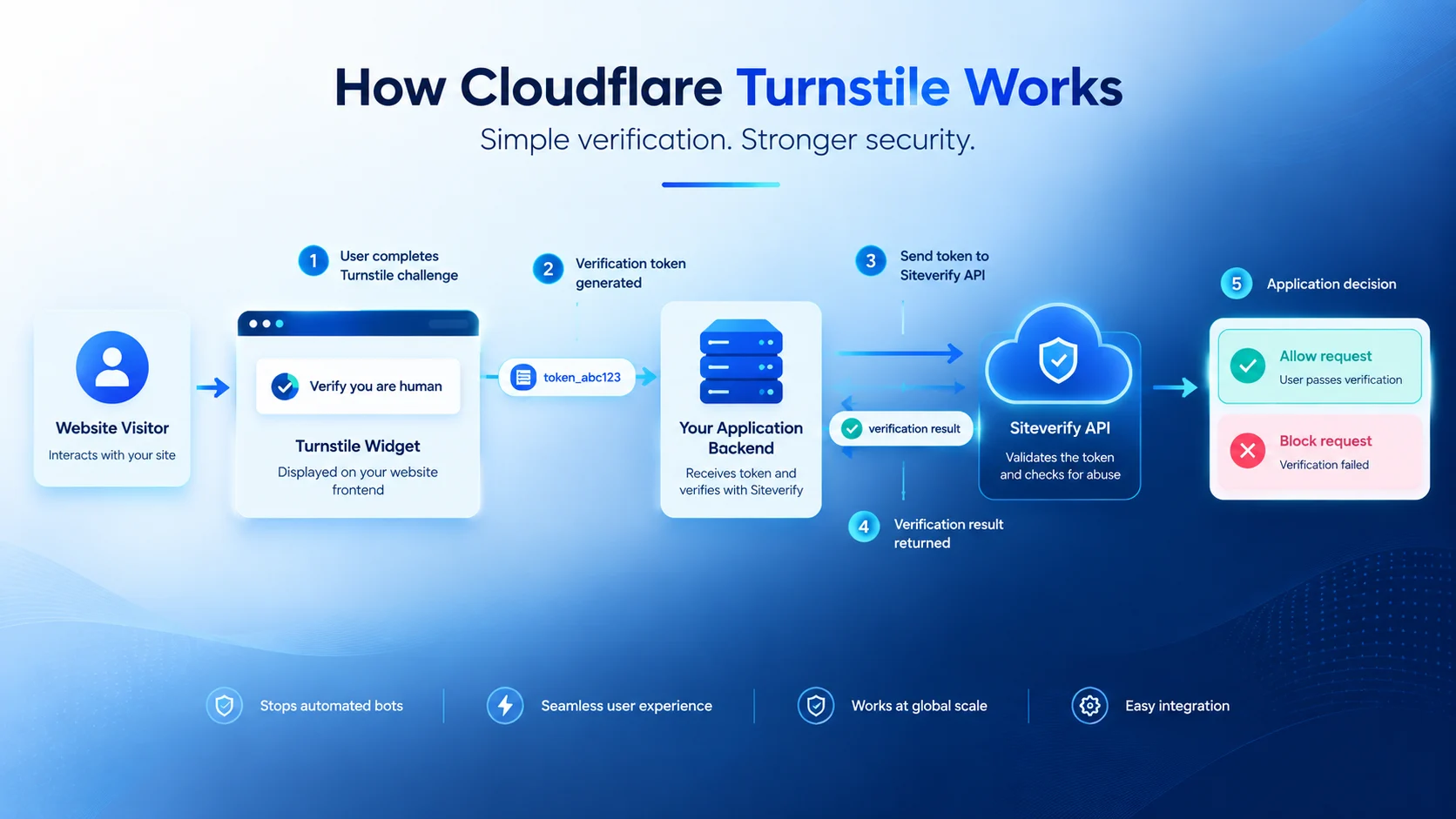
A standard Turnstile implementation involves two key steps.
First, developers add the Turnstile widget to the website's frontend. The widget performs client-side challenges and generates a token.
Second, the application's backend sends that token to Cloudflare's Siteverify API. The backend receives the verification result and can then decide how to handle the request.
This architecture provides an important security boundary because the backend remains responsible for deciding whether an action should be allowed.
Why Cloudflare is adapting Turnstile for AI coding agents
Cloudflare says Turnstile now handles about three billion verifications on a typical weekday. The company also says that, during one recent week, more than 23,000 accounts created a new widget through the Cloudflare dashboard.
These figures are presented by Cloudflare as evidence of substantial adoption. They also helped motivate the company to examine how Turnstile could be made easier to implement correctly.
The challenge is particularly relevant as AI coding agents become more common.
Modern AI development tools can generate working application code from natural-language instructions. However, security controls that require coordinated frontend and backend changes can still require developers to understand how the different parts of an application interact.
Cloudflare designed Turnstile Spin to bridge that gap.
The company describes Spin as an implementation specifically adapted for AI-agent workflows, allowing a coding agent to handle the application changes while keeping the security validation within the application's backend.
How Turnstile Spin works
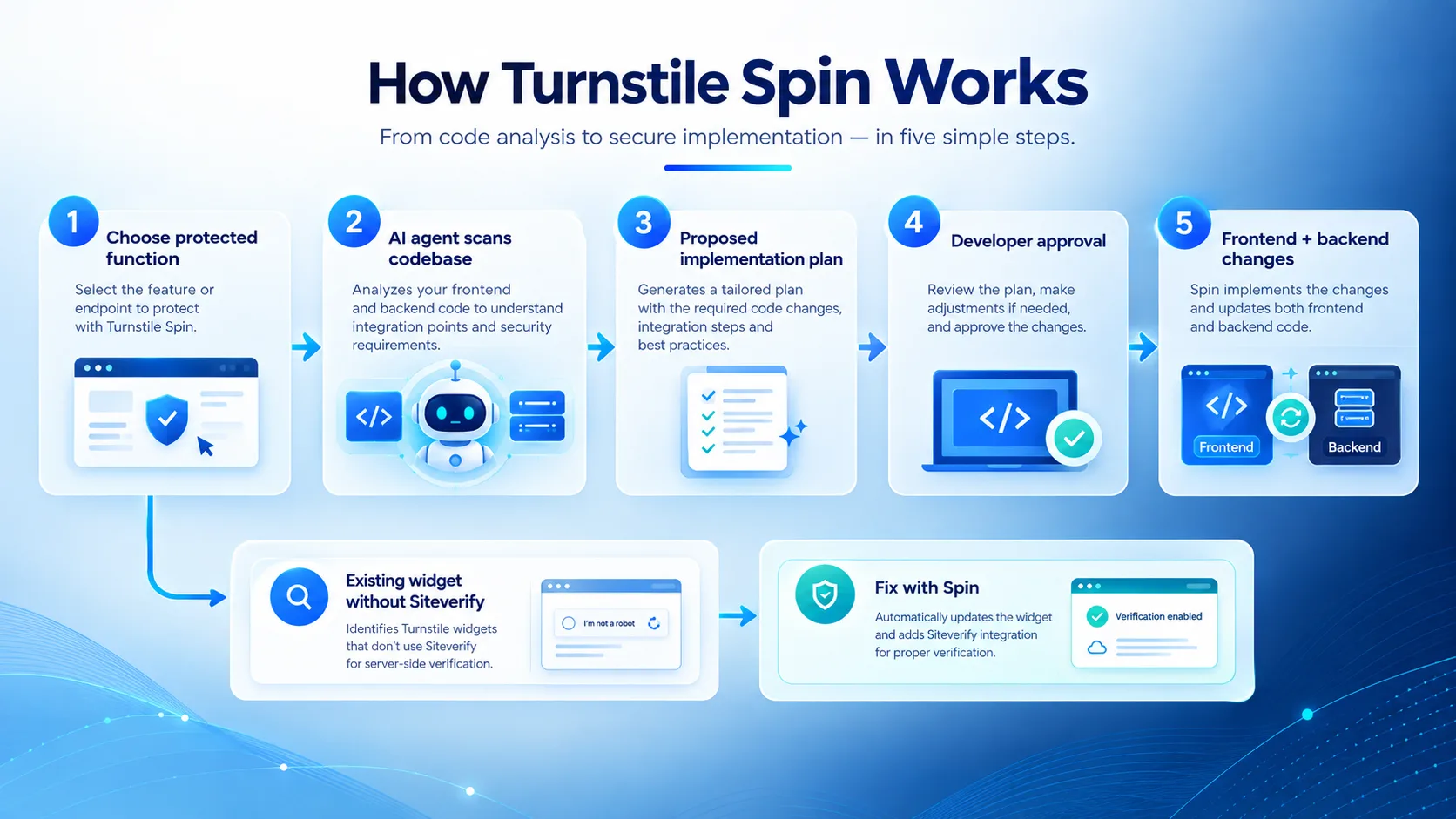
Turnstile Spin turns the traditional two-part implementation into a guided workflow.
The developer identifies where protection is required. The coding agent then searches the relevant codebase, proposes an implementation plan, and waits for approval before making changes.
After approval, the agent handles the frontend and backend portions of the integration together.
Cloudflare says the workflow can support three main scenarios.
1. Fresh Turnstile installation
If the website does not already have CAPTCHA protection, the agent can add the Turnstile widget to the frontend and configure Siteverify in the backend.
This removes much of the repetitive implementation work associated with setting up the two components separately.
2. Recovering an incomplete Turnstile implementation
Spin can also identify an existing Turnstile widget that is receiving traffic without corresponding server-side validation.
Cloudflare monitors Siteverify calls associated with widgets. When a widget has traffic but no backend validation, Cloudflare says the dashboard can display a "Fix with Spin" action.
The agent can then use the existing secret and add the missing backend validation while leaving the widget operational.
This is significant because simply displaying a CAPTCHA or challenge on a website does not by itself complete the server-side verification process.
3. Migrating from another CAPTCHA provider
Spin can also assist websites that already use another CAPTCHA system.
According to Cloudflare, the agent identifies relevant implementation markers, proposes a migration plan and applies the changes once the developer approves them.
Cloudflare notes that existing documentation continues to provide tool-specific migration guidance.
This means Spin is positioned not only as a deployment tool, but also as an implementation and migration assistant for existing applications.
Application code stays with the developer's coding agent
One of the more important architectural details is where the code changes happen.
Cloudflare says Turnstile Spin does not send the application's code to Cloudflare or ask Cloudflare to modify the application remotely.
Instead, the developer's existing coding agent performs the changes within the local codebase.
Cloudflare lists coding agents such as Claude Code, Cursor and Codex as examples, while describing Spin as compatible with the broader agent workflow.
The only new resource created in the user's Cloudflare account is the Turnstile widget.
The validation logic remains in the application's backend, alongside the application logic that determines what happens after verification.
This approach keeps the code modification process within the developer's existing development environment while using Cloudflare for Turnstile configuration and verification services.
Three ways to start Turnstile Spin
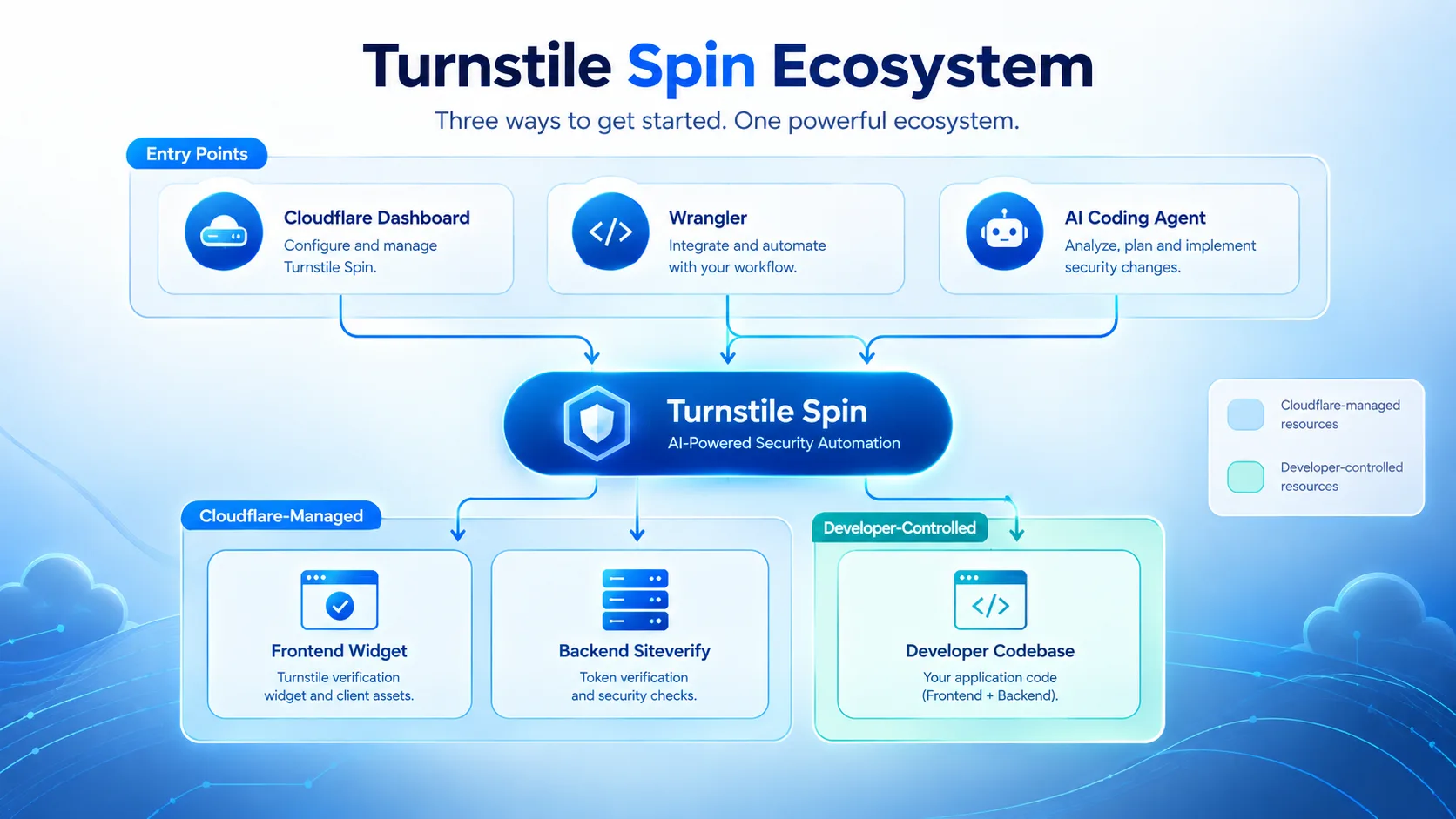
Cloudflare says developers can initiate Spin through three routes:
The Cloudflare dashboard
Cloudflare Wrangler
A public skill URL provided directly to an AI coding agent
The company describes these options as complementary rather than separate workflows. A developer can start from the Cloudflare dashboard, provide the skill to their coding agent, and use Wrangler as part of the implementation process.
Early adoption of Turnstile Spin
Cloudflare says Spin began appearing in the dashboard in July.
Since its release, the company reports more than 65,000 successful Spin widget creations. It also says developers have copied the generated prompt more than 30,000 times.
These are Cloudflare's own reported adoption figures. The announcement does not provide additional information about the number of unique organisations or users represented by these figures.
Cloudflare also links the development to feedback gathered during the creation of Spin, describing repeated simplification of the workflow as an important part of its development process.
What Turnstile Spin means for AI-assisted development
The announcement highlights a broader industry shift toward integrating security tasks directly into AI-assisted software development workflows.
Historically, developers often needed to understand the implementation details of individual security services before integrating them into an application. AI coding agents can increasingly act as an intermediary between a developer's intent and those implementation details.
Turnstile Spin applies this model to bot protection.
For developers, the practical change is that a request such as protecting a particular application function can lead to a guided implementation that spans both frontend and backend code.
For organisations adopting AI coding tools, the example also illustrates why security validation cannot necessarily stop at generated frontend code. Turnstile's architecture still requires server-side verification before the application makes a security-sensitive decision.
The company did not provide specific information about how Spin performs across different programming languages, frameworks or application architectures.
Security still depends on correct implementation
Although Spin is designed to simplify deployment, Cloudflare's own Turnstile architecture continues to place verification in the backend.
That distinction matters.
A frontend widget can provide a challenge and produce a token, but the application must still validate that token through Siteverify before relying on the result.
Spin's role is therefore primarily to help developers and coding agents complete the required implementation rather than replacing server-side validation.
For teams using AI-generated code, this highlights a broader engineering principle: security controls need to be implemented across the full request path, not only in the visible user interface.
The bigger picture
Turnstile Spin arrives as AI coding agents increasingly participate in application development.
The announcement highlights a broader industry shift toward making security controls compatible with prompt-driven development. Rather than expecting every developer to manually understand each integration step, security vendors are beginning to build workflows that allow AI agents to locate, explain and implement those controls with developer approval.
For enterprises, this could mean less repetitive configuration work for common security integrations. At the same time, teams will still need appropriate review processes for AI-generated code and security-sensitive changes.
Cloudflare's announcement focuses specifically on Turnstile. It does not claim that the approach eliminates the need for developer review or broader application security practices.
Conclusion
Cloudflare Turnstile Spin extends Turnstile from a conventional developer integration into an AI-agent-assisted workflow.
It can help with fresh installations, incomplete implementations and migrations from other CAPTCHA providers. The agent works inside the developer's existing codebase, while Turnstile verification remains part of the application's backend.
The development reflects growing demand for security tools that fit naturally into AI-assisted software engineering rather than requiring separate, manually configured workflows.
Source: Cloudflare Blog
About the Author