
Attackers Target Unpatched Roundcube Servers With CVE-2026-48842
Attackers are actively exploiting CVE-2026-48842 against unpatched Roundcube servers. The high-severity flaw allows pre-authentication SQL injection, putting outdated webmail installations at risk.
Xcademia Team
Xcademia Research Team
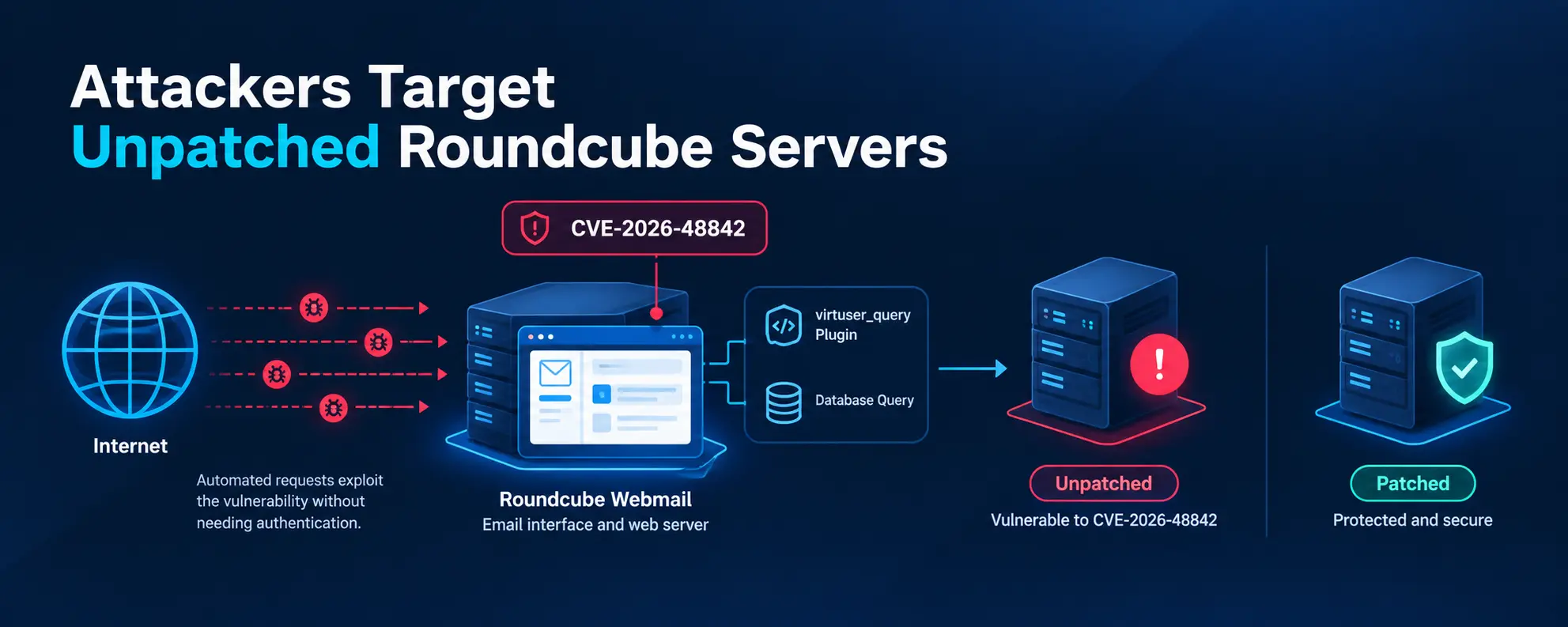
Attackers Exploit Unpatched Roundcube Servers Months After Security Fix
Organizations running older versions of Roundcube Webmail are facing renewed security pressure after reports that attackers are exploiting CVE-2026-48842 in the wild.
The vulnerability was patched by the Roundcube project on May 24, 2026, but several months later, unpatched installations remain potential targets. Canada's Cyber Centre updated its advisory on September 21 to warn that open-source reporting indicated active exploitation of the vulnerability.
The situation highlights a familiar problem in vulnerability management: releasing a security patch does not protect systems that have not yet been updated.
For organizations operating internet-facing email infrastructure, the issue is particularly important because Roundcube provides a browser-based interface for accessing email systems.
What Is CVE-2026-48842?
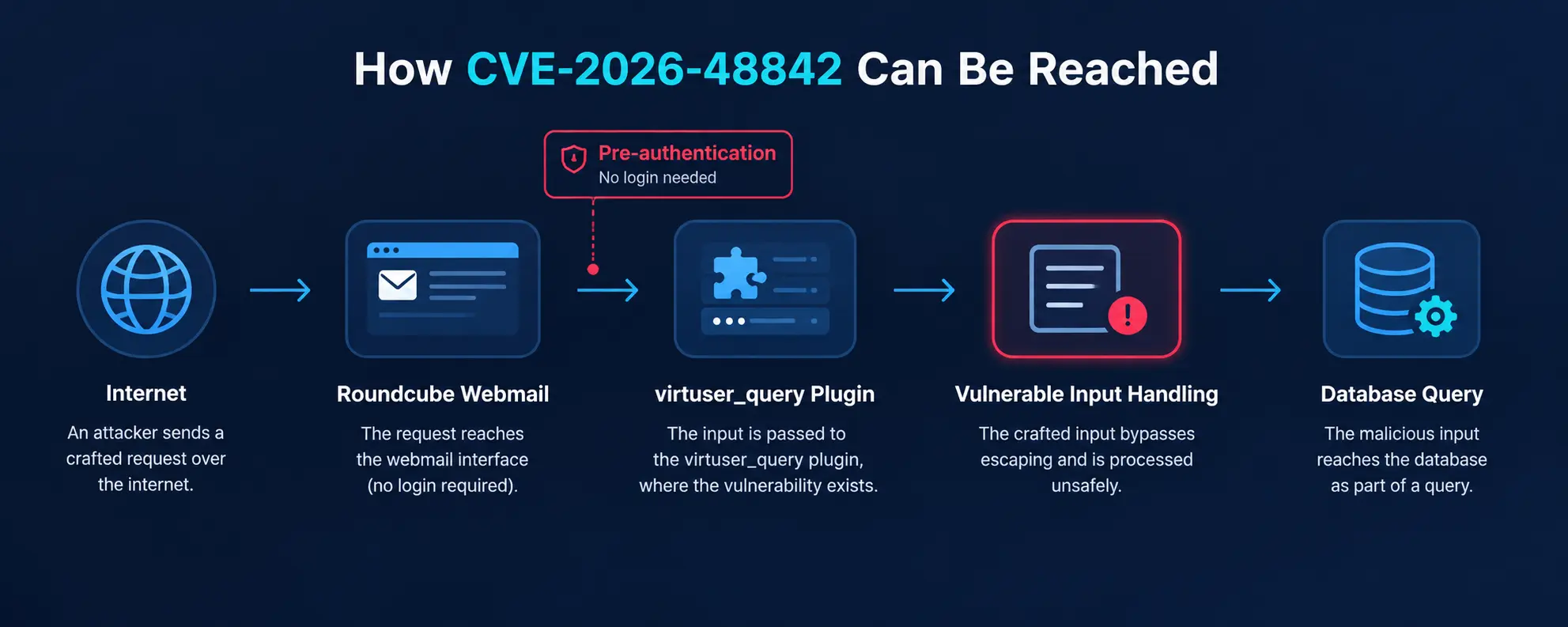
CVE-2026-48842 is a high-severity, pre-authentication SQL injection vulnerability affecting Roundcube's virtuser_query plugin.
According to the Roundcube project's May security update, the vulnerability involved a backslash-escape bypass associated with PHP's preg_replace() function. The issue could allow specially crafted input to interfere with database queries.
The important security characteristic is that the flaw is pre-authentication.
That means an attacker does not need to successfully authenticate to Roundcube before attempting to exploit the vulnerability.
The affected versions identified in the security reporting are:
Roundcube versions before 1.6.16
Roundcube versions before 1.7.1
Roundcube released versions 1.6.16 and 1.7.1 specifically to address the issue, along with several other security vulnerabilities.
Why the Vulnerability Is Being Exploited Now
CVE-2026-48842 is not a newly discovered vulnerability.
Roundcube disclosed and patched it in May. The current concern is that attackers are now targeting installations that have not applied the available fixes.
This is a common pattern following public vulnerability disclosures. Once a vulnerability and its patch become public, security researchers and attackers can study the changes made between vulnerable and fixed versions. This can provide information about the underlying weakness and help identify systems that remain exposed.
TechRepublic reported that Canada's Cyber Centre cited open-source reporting indicating that the vulnerability is being exploited in the wild.
For defenders, this changes the priority of the issue.
A vulnerability that was previously a patching task can become an active incident-prevention concern once exploitation is reported.
More Than 500,000 Roundcube Instances Reported Exposed
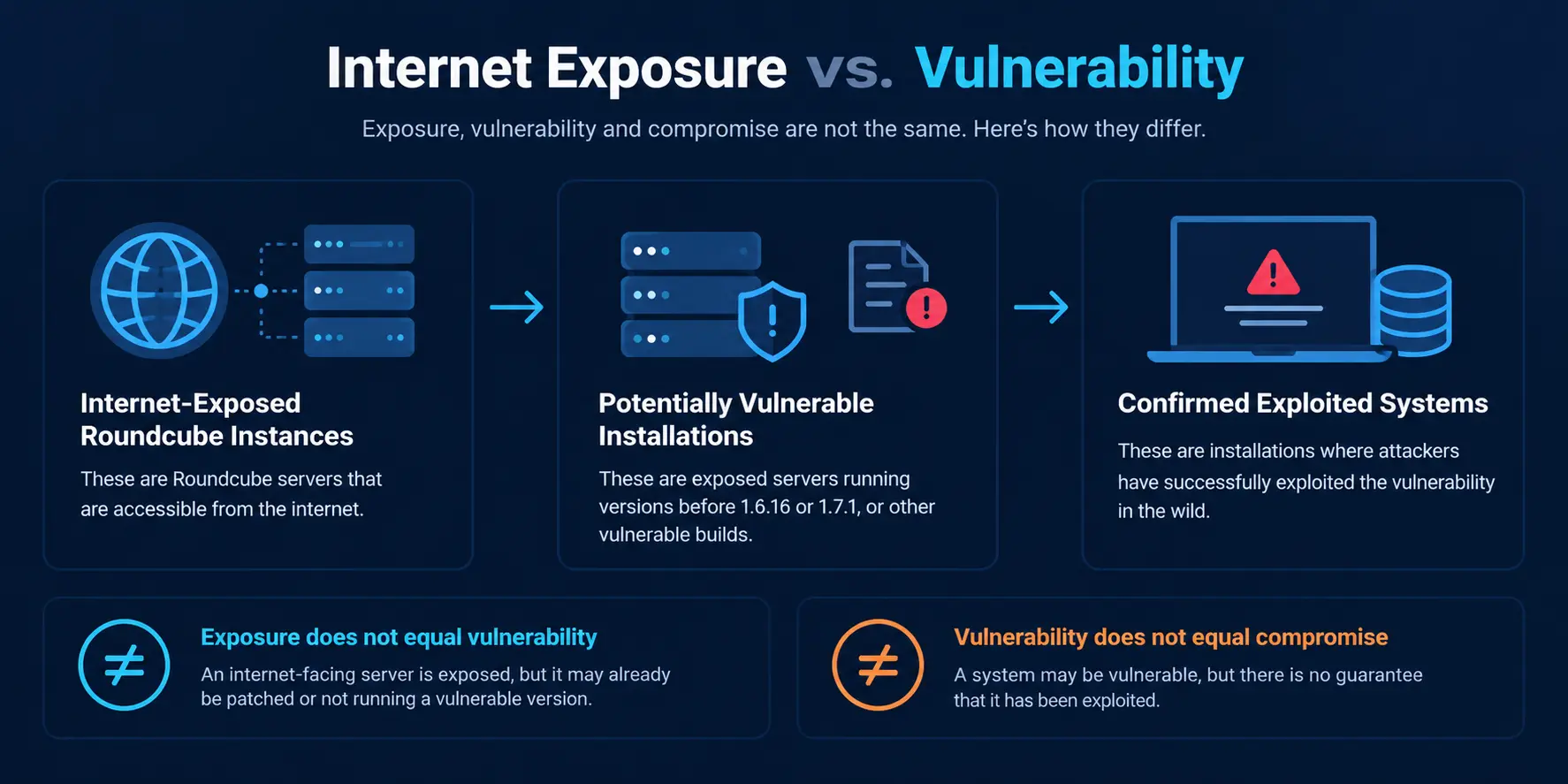
TechRepublic cited Shadowserver data showing more than 523,000 Roundcube instances exposed on the internet.
This number should not be interpreted as the number of vulnerable or compromised systems. Internet exposure does not establish whether an installation is running an affected version, whether the vulnerability is exploitable in a particular environment, or whether a system has already been compromised.
However, the figure illustrates why internet-facing Roundcube installations can attract attention from attackers.
Roundcube's May Security Release Addressed Multiple Issues
The May 24 Roundcube security release did not address CVE-2026-48842 alone.
The project listed multiple security fixes in versions 1.6.16 and 1.7.1. These included fixes for stored XSS and HTML/CSS injection, a CSS injection bypass, the pre-authentication SQL injection in virtuser_query, SSRF-related bypasses, remote image blocking bypasses, a pre-authentication arbitrary file deletion issue, and a code injection vulnerability involving LDAP autovalues.
This matters because administrators who delayed the May update may not simply be carrying one unresolved vulnerability.
They may also be running an older Roundcube release containing other security issues addressed by subsequent updates.
In fact, Roundcube has released additional security updates since May. Its security archive lists versions 1.6.17 and 1.7.2 in July, 1.6.18 and 1.7.3 in August, and 1.6.19 and 1.7.4 in September 2026.
Therefore, organizations should not treat the May versions as the latest available releases.
Roundcube Has Previously Faced Exploited Vulnerabilities
The current exploitation also fits into a broader history of security issues affecting Roundcube.
TechRepublic reported that CISA has added or tracked multiple Roundcube vulnerabilities associated with exploitation in the wild over recent years. These include CVE-2023-5631, a cross-site scripting vulnerability, and CVE-2023-43770, another XSS vulnerability that was later added to CISA's Known Exploited Vulnerabilities catalog.
Another significant issue, CVE-2025-49113, exposed vulnerable Roundcube installations to remote code execution, according to the TechRepublic report.
The recurring appearance of exploited Roundcube vulnerabilities reinforces the importance of treating webmail software as part of an organization's security perimeter rather than simply as an application that can be updated on a convenient schedule.
Why Unpatched Email Systems Are Important Security Targets
Email infrastructure can contain valuable organizational information, including business communications, attachments, account details and other sensitive information.
A compromise of an internet-facing webmail application can therefore have consequences beyond the application itself.
The specific consequences of exploitation depend on the vulnerability, configuration and surrounding environment. Additional details about successful exploitation against individual organizations were not disclosed in the source material.
For defenders, the main issue with CVE-2026-48842 is the combination of three factors:
The vulnerability is pre-authentication.
Security fixes have been publicly available since May.
Open-source reporting now indicates exploitation in the wild.
Together, these factors make version verification and patch management particularly important for organizations operating Roundcube.
What Roundcube Administrators Should Do
The primary recommendation is to update affected Roundcube installations.
Roundcube itself recommended that organizations update productive installations of its 1.6.x and 1.7.x branches when versions 1.6.16 and 1.7.1 were released.
Because newer security releases have since been published, administrators should verify their current version against the latest supported security release rather than stopping at the original May patch.
As of September 2026, the Roundcube security archive lists 1.6.19 for the 1.6 LTS branch and 1.7.4 for the 1.7 branch as the latest releases shown by the project.
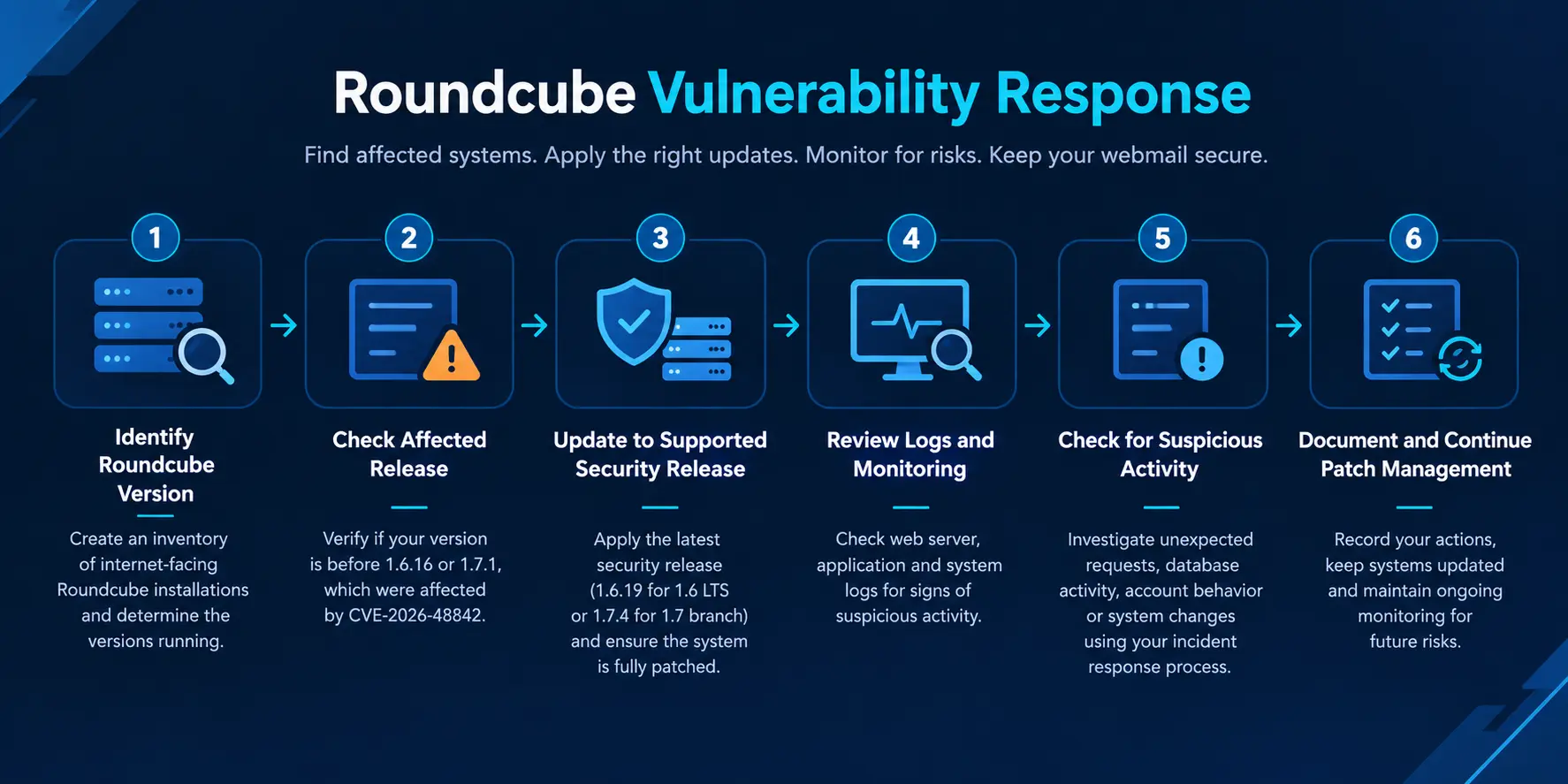
Security teams should also consider the following steps:
1. Identify exposed Roundcube installations
Create an inventory of internet-facing Roundcube servers and determine which versions are running.
2. Check for affected versions
Systems running versions before 1.6.16 or 1.7.1 were affected by the CVE-2026-48842 issue described in the May advisory.
3. Apply current security updates
Do not rely solely on the original May release. Review the current Roundcube security releases and update to an appropriate supported version.
4. Review security logs
Because exploitation has been reported in the wild, administrators should review relevant web server, application and system logs for suspicious activity.
The company did not provide specific information about indicators that can be used to identify every exploitation attempt.
5. Investigate unexpected activity
If suspicious requests, database activity, account behavior or system changes are identified, organizations should follow their established incident-response procedures.
6. Continue monitoring after patching
Installing the security update addresses the vulnerable software version, but organizations should continue monitoring systems for signs of prior compromise.
The Broader Lesson for Vulnerability Management
The Roundcube case highlights a broader industry shift toward faster exploitation of publicly disclosed vulnerabilities.
Security teams often have to manage large numbers of applications, operating systems and internet-facing services. A vulnerability can remain unresolved because of maintenance windows, compatibility testing, operational dependencies or incomplete asset inventories.
However, once exploitation is reported, the risk calculation changes.
The important distinction is between a vulnerability that exists in theory and one for which exploitation has been observed. CVE-2026-48842 has moved into the latter category according to the Canadian Cyber Centre's September 21 update.
For enterprises, this could mean giving greater priority to externally exposed applications when security updates become available, particularly when the affected vulnerability does not require authentication.
Conclusion
CVE-2026-48842 demonstrates why vulnerability remediation cannot end when a vendor publishes a patch.
Roundcube released fixes for the pre-authentication SQL injection vulnerability in May 2026. Months later, open-source reporting cited by Canada's Cyber Centre indicates that attackers are exploiting the vulnerability in the wild.
Organizations using Roundcube should verify their installed versions, apply current security updates and review relevant security logs.
The immediate issue is specific to Roundcube, but the underlying security lesson is broader: once a vulnerability is publicly fixed and exploitation begins, unpatched internet-facing systems can become attractive targets.
Source: TechRepublic
About the Author