
AWS Fixes MCP Gateway Registry Flaw That Could Give Low-Privilege Users Administrator Access
AWS has disclosed CVE-2026-100307, an authorization flaw in mcp-gateway-registry that could let authenticated low-privileged users gain registry administrator access. The fix is available in version 1.25.0, but affected deployments require additional security reviews.
Xcademia Team
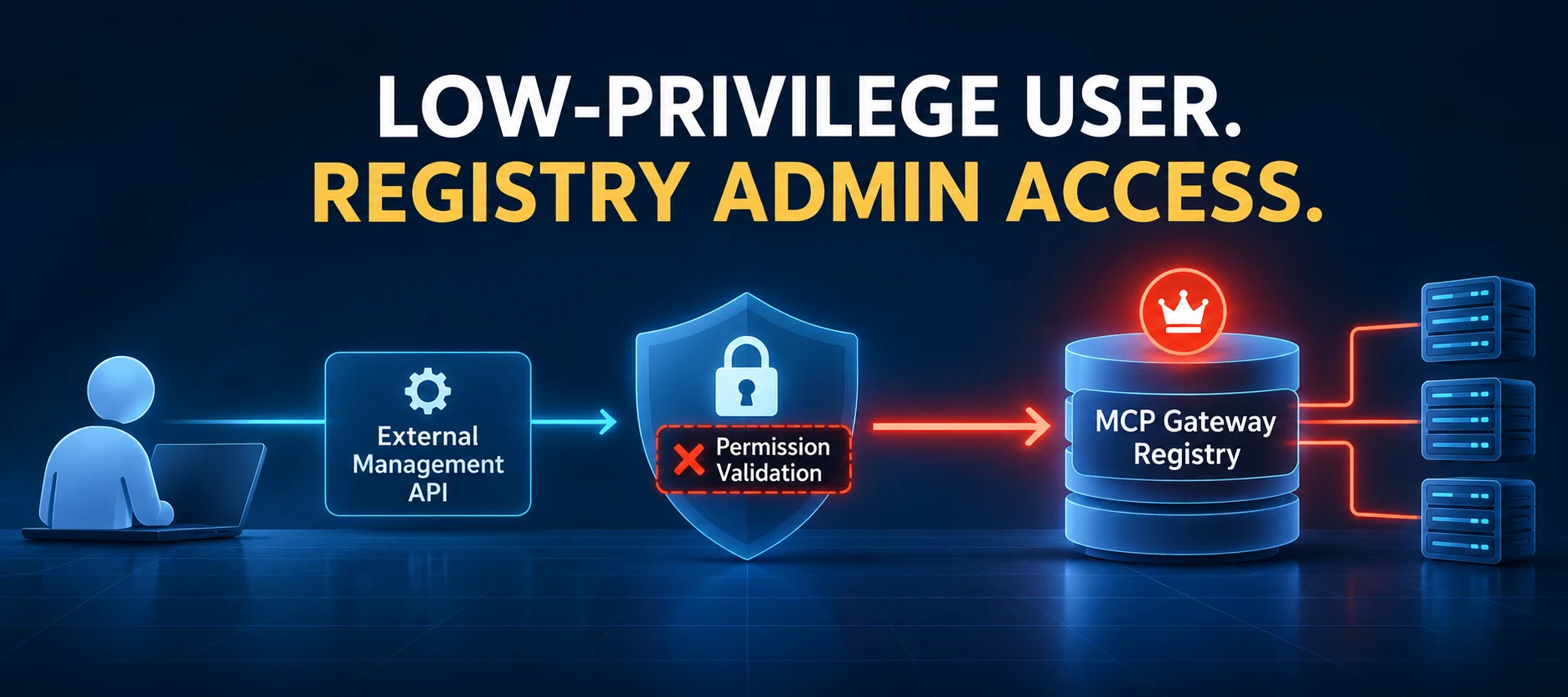
Amazon Web Services (AWS) has published a security bulletin for CVE-2026-100307, a missing-authorization vulnerability in the external management API of the open-source mcp-gateway-registry project.
The flaw could allow an authenticated remote user with low privileges to escalate their access to registry administrator. The issue affected the registry's /api/servers/* management endpoints, which authenticated callers but did not enforce role-based or permission-based authorization.
The vulnerability is particularly relevant to deployments that use the registry to manage Model Context Protocol (MCP) servers and their associated tool assets. The registry centralizes server discovery, access control and proxying, so administrator access can extend across registered gateway assets.
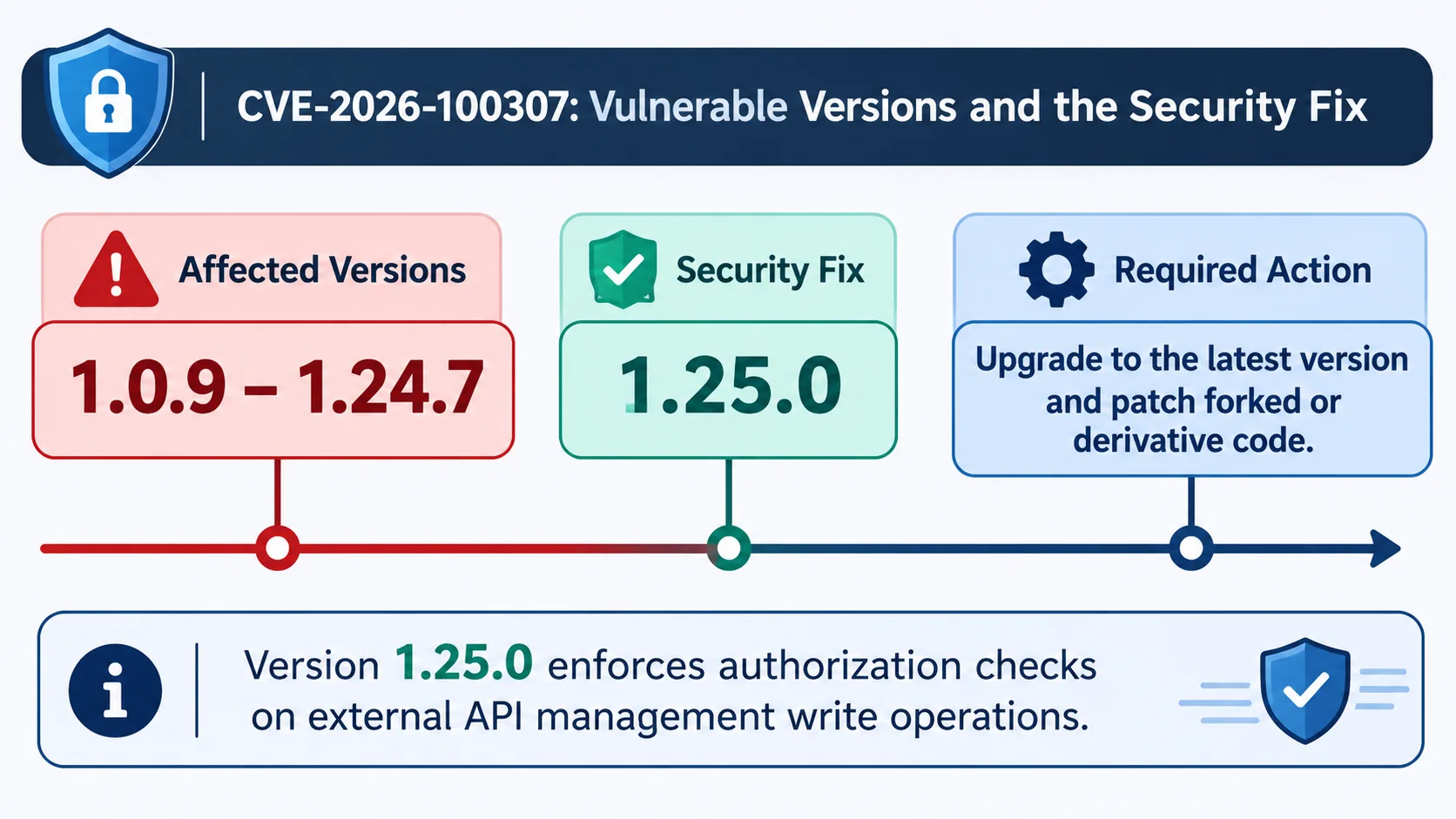
AWS classified the bulletin as Important (requires attention). The issue affects mcp-gateway-registry versions 1.0.9 through 1.24.7 and is addressed in version 1.25.0.
How the Missing Authorization Check Enabled Privilege Escalation
The vulnerability originated in the external management API's authorization handling.
Although the affected endpoints authenticated incoming requests, they did not verify whether the authenticated user had the required role or permissions to perform the requested management operation.
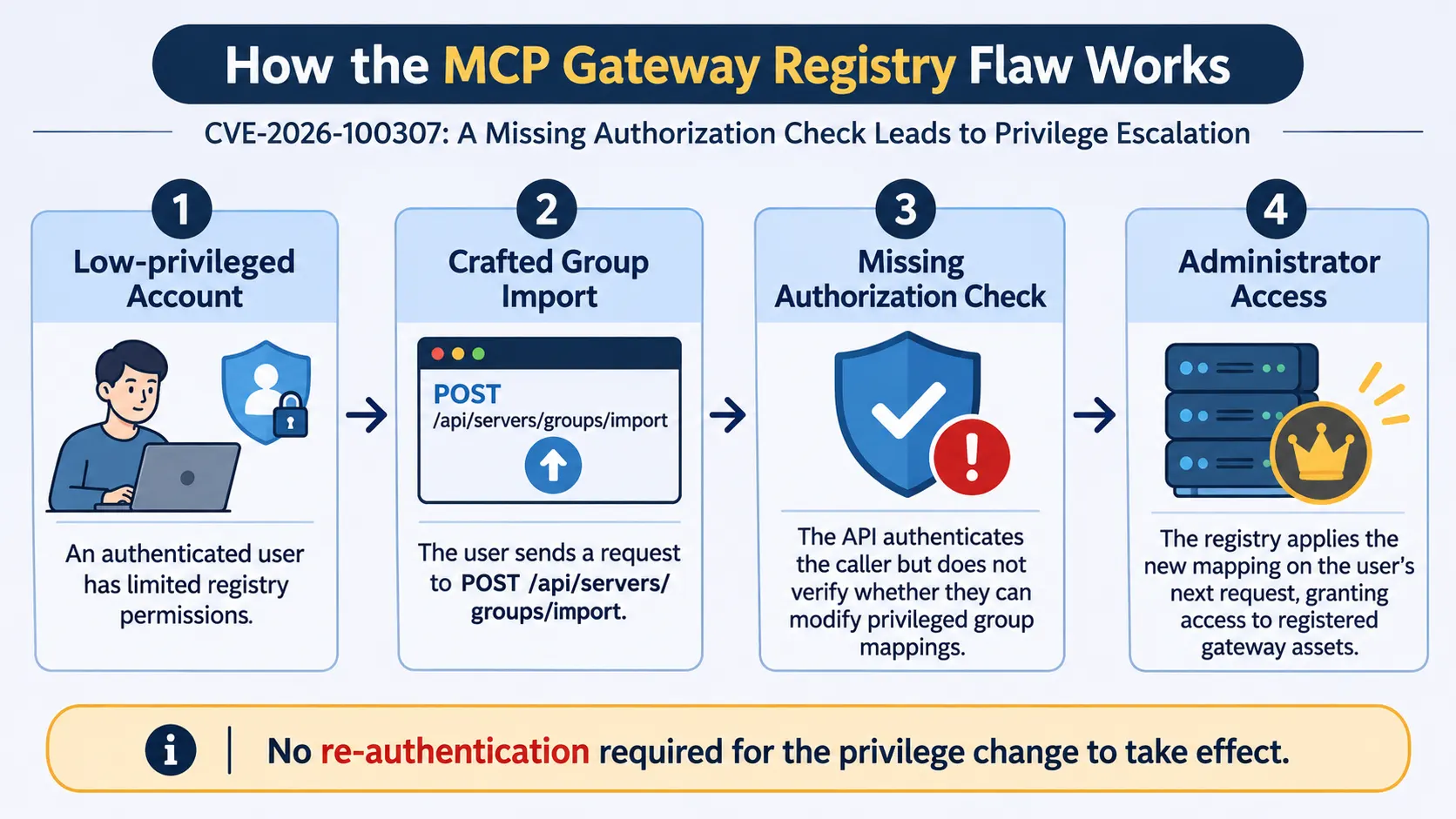
An attacker with a valid, low-privileged account could exploit this gap by sending a crafted group import request to:
POST /api/servers/groups/importThe request could map a group associated with the attacker's own identity provider to the registry's administrator scope, identified as mcp-registry-admin.
The registry stores this group definition in its scope store and determines the caller's administrator status on each request. Consequently, the newly created mapping takes effect on the user's next request. The attacker does not need to authenticate again to obtain the elevated access.
Once the escalation succeeds, the user gains administrative control over registered gateway assets.
The accompanying GitHub security advisory also describes a crafted payload that could grant mutating UI permissions to all servers, illustrating the broader authorization weakness in the affected management routes.
What an Attacker Could Access After Escalation
Administrator privileges extend beyond changing a user's role. According to the GitHub advisory, an attacker who obtains registry administrator access can register, modify, toggle and remove servers and agents.
The elevated permissions can also expose access-control groups, backend credentials and configuration managed by the registry.
This includes stored authentication credentials and custom headers associated with registered servers. These values are decrypted when read through administrator-accessible routes.
The advisory also identifies affected management operations involving server registration, status changes, authentication credential updates and version-default or version-delete actions.
This means an organization investigating a potentially exploited deployment should not limit its review to group permissions. It also needs to determine whether registered assets, upstream destinations or stored credentials were accessed or changed.
Affected Versions and Available Fix
AWS confirms that the vulnerability affects:
Affected range:
>= 1.0.9and<= 1.24.7Fixed version:
1.25.0Bulletin ID:
2026-179-AWSCVE:
CVE-2026-100307
The issue was addressed in mcp-gateway-registry version 1.25.0, released on June 27, 2026, according to the AWS bulletin.
The release enforces authorization checks on the external API management endpoints. The project release notes explain that these endpoints now apply authorization checks that were previously enforced only through their legacy UI counterparts.
AWS recommends upgrading to the latest version and applying the corresponding fixes to any forked or derivative code.
Upgrading Does Not Automatically Remove Existing Privileged Access
AWS highlights an important limitation of the version 1.25.0 fix: upgrading does not automatically clean up changes made through the vulnerable endpoints.
The update enforces authorization on the write path, but it does not modify group definitions created before the upgrade. It also does not invalidate credentials that may have been read while an attacker had administrator access.
As a result, a privileged group mapping created through the vulnerable API can continue to grant administrator access after the software has been updated.
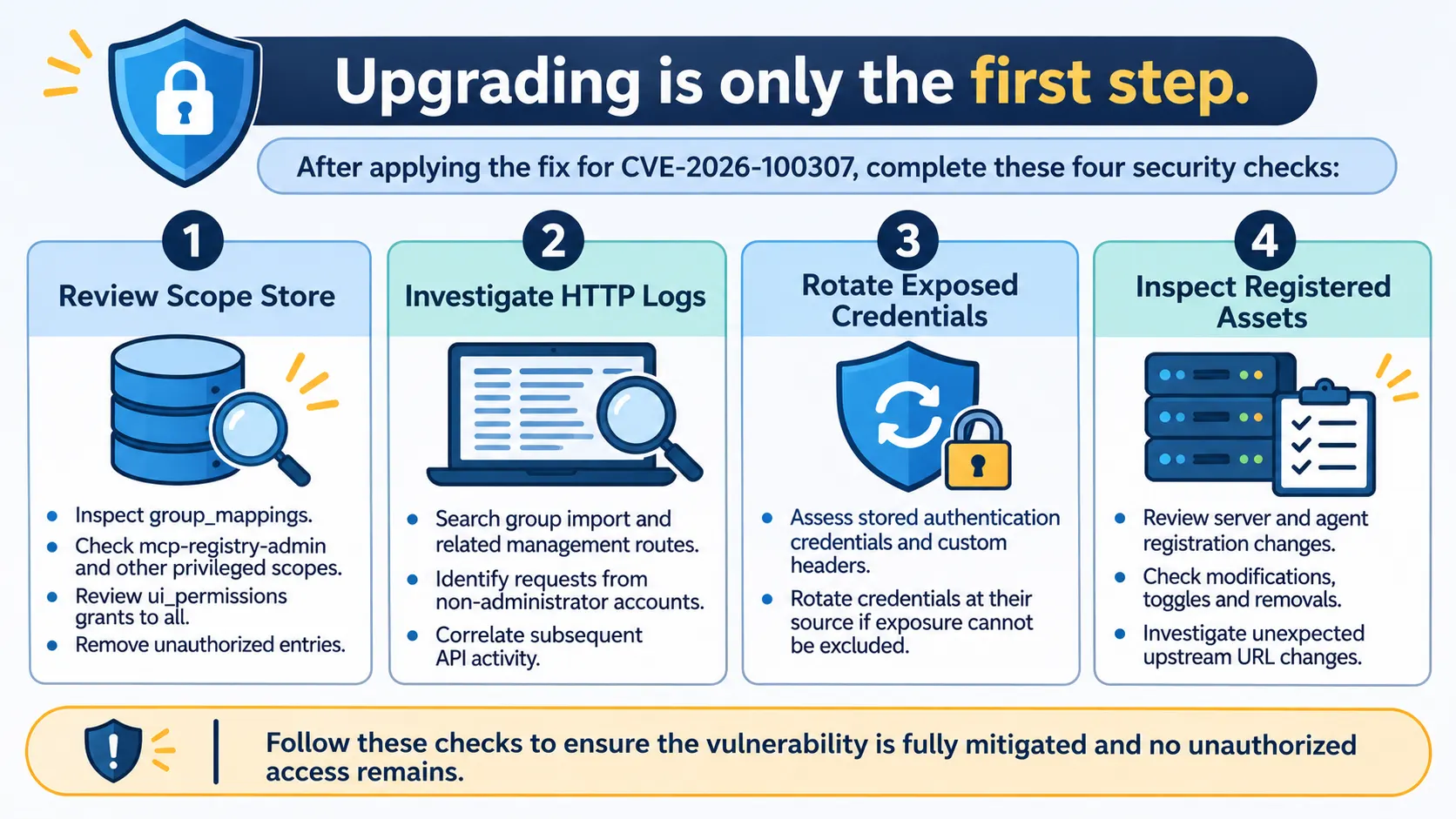
Organizations that operated an affected version must therefore review the period during which that version was deployed and complete additional security checks.
1. Inspect the Scope Store
Review the mcp_scopes DocumentDB collection.
AWS recommends examining:
Every
group_mappingsentry for mappings tomcp-registry-adminor another privileged scope.Every
ui_permissionsentry that grants a mutating action toall.
Remove any grant that was not created by an administrator. This step is necessary to eliminate unauthorized administrator access that could persist after the upgrade.
2. Examine Application HTTP Logs
Review application HTTP logs covering the period when an affected version was deployed.
Look for requests to:
POST /api/servers/groups/import/api/servers/groups/create/api/servers/groups/add/api/servers/groups/remove/api/servers/groups/delete
AWS also advises reviewing requests to the affected server-mutation routes.
Pay particular attention to requests originating from non-administrator accounts. Correlate suspicious activity with subsequent /api/servers/* requests from the same identity to identify which registry resources may have been modified.
3. Rotate Credentials if Exposure Cannot Be Ruled Out
An attacker with registry administrator access could read credentials stored for registered servers, including authentication credentials and custom headers.
Because these values are decrypted when accessed through administrator-reachable routes, organizations need to assess whether stored credentials may have been exposed.
If the relevant application logs are unavailable or incomplete, AWS recommends rotating the affected credentials at their source systems.
4. Check Registered Servers and Agents for Unauthorized Changes
Review registered assets for unexpected activity during the affected deployment period.
This includes servers and agents that were:
Newly registered.
Modified or toggled.
Removed.
Updated with a different upstream URL or host.
The review should establish whether any registry configuration or connected asset was changed without administrator approval.
Temporary Mitigations for Deployments That Cannot Upgrade
AWS provides interim measures for organizations that cannot immediately move to version 1.25.0. These controls are intended to restrict further unintended access, but they do not replace the upgrade and post-upgrade investigation.
Until the update is applied, AWS recommends restricting access to the external management API.
At the ingress or proxy layer, organizations should limit POST /api/servers/groups/* and other /api/servers/* mutation routes to trusted administrator identities. Alternatively, these routes can be blocked for non-administrator callers.
Security teams should also monitor the mcp_scopes DocumentDB collection for unexpected changes to group_mappings and ui_permissions. Particular attention should be given to mappings involving mcp-registry-admin and permissions that grant mutating actions to all.
Application HTTP logs should also be reviewed for group import requests originating from non-administrator accounts.
These measures can help limit additional unauthorized changes while an upgrade is pending. They do not remove existing malicious mappings or address credentials that may already have been accessed.
What Organizations Using MCP Gateway Registries Should Do
CVE-2026-100307 highlights the importance of enforcing authorization checks consistently across management interfaces, not just authenticating users before accepting API requests.
For organizations operating mcp-gateway-registry, the immediate priority is to identify whether an affected version was deployed and upgrade to version 1.25.0 or a later release.
However, the remediation process should not end with the software update. Existing group mappings, stored credentials, application logs and registered gateway assets need to be reviewed because the fix does not automatically reverse changes made before the upgrade.
The distinction matters: patching closes the vulnerable authorization path, while the post-upgrade review helps identify and address any access or configuration changes that may have occurred earlier.
Source: AWS Security Bulletins
About the Author