
Apple Patches CoreGraphics Vulnerability in iOS 26.7.1 and iPadOS 26.7.1
Apple has released iOS 26.7.1 and iPadOS 26.7.1 to address a CoreGraphics vulnerability that could enable arbitrary code execution. Apple says the flaw may have been exploited in a sophisticated targeted attack.
Xcademia Team

Apple has released iOS 26.7.1 and iPadOS 26.7.1 with a security fix for a vulnerability in the CoreGraphics component. The flaw, tracked as CVE-2026-86950, could allow arbitrary code execution when a device processes a maliciously crafted file.
More significantly, Apple says it is aware of a report that the vulnerability may have been exploited in an extremely sophisticated attack against specific targeted individuals on versions of iOS before iOS 27.
The security update was released on September 28, 2026, and Apple credited Meta Product Security for reporting the vulnerability.
What is CVE-2026-86950?
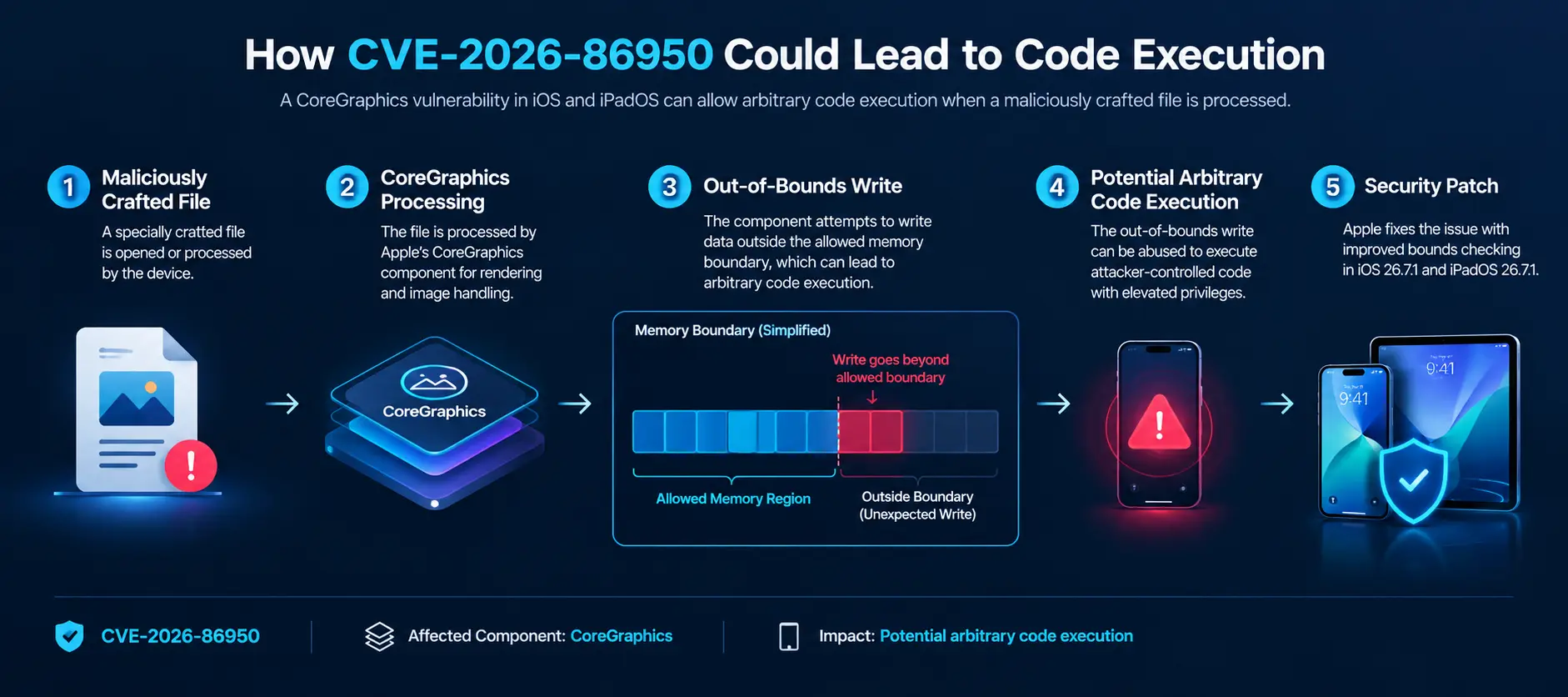
CVE-2026-86950 is an out-of-bounds write vulnerability affecting Apple's CoreGraphics component.
CoreGraphics is part of Apple's software framework for handling graphics and related visual content. In this case, Apple says that processing a specially crafted malicious file could potentially result in arbitrary code execution.
In simple terms, an out-of-bounds write occurs when software attempts to write data outside the memory area it is expected to use. Depending on how the vulnerability can be triggered and controlled, this type of memory-safety issue can potentially be abused to execute attacker-controlled code.
Apple's advisory does not disclose the specific file format involved, how the malicious file was delivered, or what additional steps an attacker would need to take to successfully exploit the vulnerability.
Apple says the issue was addressed through improved bounds checking.
Apple Says the Vulnerability May Have Been Exploited
The most notable part of Apple's advisory is its statement about possible exploitation.
Apple says it is aware of a report that the issue may have been exploited in an extremely sophisticated attack against specific targeted individuals on versions of iOS before iOS 27.
Apple does not provide additional information about the reported attacks.
The company does not disclose:
The number of individuals targeted
The identities or locations of the targets
The suspected attacker or group
The delivery method used
The malicious file format
Whether exploitation resulted in successful compromise
When the reported exploitation occurred
Any indicators of compromise
Additional details were not disclosed in the announcement.
This distinction is important. Apple's wording indicates that the company is aware of a report of possible exploitation, but the advisory does not provide enough information to establish the complete attack chain or identify the party behind it.
Which Devices Are Affected?
Apple lists the following devices as compatible with the iOS 26.7.1 and iPadOS 26.7.1 security update:
Platform | Supported devices |
|---|---|
iPhone | iPhone 11 and later |
iPad Pro | 12.9-inch 3rd generation and later |
iPad Pro | 11-inch 1st generation and later |
iPad Air | 3rd generation and later |
iPad | 8th generation and later |
iPad mini | 5th generation and later |
Apple's security release page lists iOS 26.7.1 and iPadOS 26.7.1 as releases dated September 28, 2026.
What Did Apple Change?
Apple describes the underlying problem as an out-of-bounds write and says it fixed the issue with improved bounds checking.
Bounds checking is a security technique that helps software verify whether an operation is accessing an allowed area of memory.
For developers and security teams, this is an important part of understanding the patch. Apple has not published a detailed technical analysis of the vulnerability in its advisory, so the exact vulnerable code path and exploitation mechanism remain undisclosed.
The company also does not provide a proof of concept or detailed exploitation instructions in the security notice.
Why CoreGraphics Vulnerabilities Matter
Graphics-processing components routinely handle content from different sources, including files and other data that may not always be trustworthy.
A vulnerability in such a component can therefore be relevant from a security perspective because specially crafted content may reach the affected processing code.
However, the Apple advisory does not disclose enough information to determine the precise attack path for CVE-2026-86950.
The known information is limited to the following chain:
Maliciously crafted file → CoreGraphics processing → out-of-bounds write → potential arbitrary code execution
The actual delivery mechanism used in the reported targeted attack has not been disclosed by Apple.

Meta Product Security Credited With the Discovery
Apple credits Meta Product Security for CVE-2026-86950. The advisory identifies Meta Product Security as the source associated with the vulnerability report.
Apple's advisory does not provide additional information about how the vulnerability was discovered or whether it was identified through analysis of an attack, security research, or another process.
The company did not provide specific information about this area.
Apple's Approach to Security Disclosure
Apple says that, for customer protection, it does not disclose, discuss, or confirm security issues until an investigation has occurred and patches or releases are available.
The company's security documents reference vulnerabilities using CVE identifiers when possible.
This approach means that Apple's public advisory focuses on the affected component, security impact, available versions and technical fix rather than providing a complete exploitation narrative.
For CVE-2026-86950, that leaves several important questions unanswered, particularly around the reported targeted exploitation.
The Broader Apple Security Update Context
The September 28 release was part of a broader set of Apple security updates.
Apple's security releases page lists iOS 27.0.1 and iPadOS 27.0.1 as also released on September 28, 2026. That advisory has no published CVE entries, while the iOS 26.7.1 and iPadOS 26.7.1 releases specifically contain the CVE-2026-86950 disclosure.
Apple also published separate security advisories for macOS Tahoe 26.7.1 and macOS Sequoia 15.8.1, which contain the same CoreGraphics vulnerability and describe the same potential impact and reported exploitation.
This indicates that the vulnerability was not limited to Apple's mobile operating systems.

What Security Teams Should Know
For organizations managing Apple devices, CVE-2026-86950 is relevant because Apple's own advisory mentions possible exploitation against specific targeted individuals.
Security teams should therefore identify devices running versions covered by the affected branches and track whether the corresponding security updates have been installed.
For the iOS and iPadOS 26 branch, Apple lists 26.7.1 as the security release addressing the vulnerability.
Organizations using mobile device management can also use their existing software-version reporting processes to identify devices that have not yet reached the required release.
The advisory does not provide a separate workaround or mitigation. The documented remediation is the security update.
What Remains Unknown
Despite the exploitation warning, Apple's advisory leaves substantial technical details undisclosed.
There is currently no information in the Apple advisory identifying:
The threat actor
The victims
The malicious file type
The initial delivery mechanism
The exploitation chain
Any malware associated with the attack
Indicators of compromise
The number of successful attacks
The timeframe of exploitation
These limitations are important when assessing the vulnerability. The available information confirms the vulnerability, its potential impact, the affected software and Apple's statement about a report of possible targeted exploitation. It does not provide enough information to reconstruct the attack.
What Users and Organizations Can Do
Users running supported iOS or iPadOS 26 devices should check their available software updates and apply the security release when appropriate.
Organizations should also review their Apple device inventory and verify that supported devices have received the relevant security update.
Because Apple has specifically mentioned possible targeted exploitation, organizations with users who may be targeted by sophisticated attacks should pay particular attention to security-update compliance.
At the same time, the lack of publicly disclosed attack details means organizations should avoid assuming a particular attack method or threat actor without additional evidence.
Final Takeaway
Apple's iOS 26.7.1 and iPadOS 26.7.1 address CVE-2026-86950, an out-of-bounds write vulnerability in CoreGraphics that could allow arbitrary code execution when processing a maliciously crafted file.
The issue is particularly notable because Apple says it is aware of a report that the vulnerability may have been exploited in an extremely sophisticated attack against specific targeted individuals on iOS versions before iOS 27.
Apple credited Meta Product Security with reporting the flaw and says the vulnerability was fixed through improved bounds checking.
For now, the public record remains limited. Apple has not disclosed the attack vector, affected individuals, threat actor, malicious file type or other operational details.
The key security information is clear: CVE-2026-86950 affects CoreGraphics, has a potential arbitrary-code-execution impact, and Apple has released security updates addressing the issue.
Source: Apple Support
About the Author