What Is Project Management? A Complete Guide to Processes and Methodologies
Learn what project management is, explore its key phases and processes, and understand popular methodologies, essential skills, tools and benefits of managing projects effectively.
Every successful project begins with an idea, but turning that idea into a meaningful result requires planning, coordination and consistent execution. Whether an organisation is launching a new product, organising a corporate event, developing a website or introducing a new business process, it needs a structured way to manage people, time, budgets and responsibilities.
This is where project management becomes important.
Project management helps individuals and organisations define objectives, organise resources, coordinate teams and monitor progress throughout a project's duration. It provides a clear approach to completing work while managing limitations such as deadlines, costs, resources and changing requirements.
For beginners, understanding project management is useful not only for managing professional assignments but also for developing skills such as communication, organisation, problem-solving and decision-making.
In this guide, we explore what project management is, how it works, its key components, the five common phases of a project lifecycle, popular methodologies, benefits, challenges and practical applications.
What Is Project Management?
Project management is the application of knowledge, skills, tools and techniques to project activities to meet defined project requirements. It involves planning, organising, executing and monitoring work to achieve a specific objective.
According to the Project Management Institute (PMI), project management focuses on applying these capabilities to project activities so that the intended requirements can be met.
In simple terms, project management is the process of taking an idea and organising the work needed to turn it into a completed result.
For example, consider a company planning to launch a new website. The project may involve:
Defining the website's purpose and requirements.
Establishing a budget and completion date.
Assigning responsibilities to designers, writers and developers.
Planning the website structure and content.
Reviewing progress and resolving issues.
Testing the website before launch.
Each activity contributes to the outcome. Project management helps coordinate these activities so that the team understands what needs to be done, who is responsible and when the work should be completed.
What Is a Project?
Before understanding project management in detail, it is important to understand what a project means.
A project is a temporary endeavour undertaken to create a unique product, service or result. It has a defined beginning and an end, along with specific objectives.
Examples of projects include:
Launching a new product or service.
Organising a business conference.
Developing a company website.
Implementing a new employee training programme.
Moving an office to a different location.
Introducing a new customer service process.
Projects are different from routine business operations.
Project | Ongoing Operations |
|---|---|
Has a defined beginning and end | Continue regularly |
Produces a specific, unique result | Maintain recurring business activities |
Has project-specific objectives | Support ongoing organisational functions |
Example: Implementing a new payroll system | Example: Processing monthly payroll |
For instance, implementing a new payroll system is a project because it involves a defined set of activities and a completion point. Processing employee salaries every month is an ongoing operation.
Understanding this distinction helps organisations decide when a structured project management approach is appropriate.
How Does Project Management Work?
Project management works by dividing a larger objective into manageable activities. These activities are planned, assigned, monitored and coordinated until the intended outcome is delivered.
Although the exact process varies depending on the project, most projects involve the following activities:
1. Define the Project Objectives
The first step is to understand what the project needs to achieve.
Project objectives should explain the expected outcome and provide a clear direction for the team. They should be specific enough to guide planning and decision-making.
For example, an organisation may want to develop an employee training programme to improve customer service skills.
2. Establish the Project Scope
Project scope defines what the project will and will not include. It identifies the work required, expected deliverables and project boundaries.
A clearly defined scope helps prevent misunderstandings and reduces the likelihood of uncontrolled changes during execution.
For example, a website development project may include five main pages, a contact form and mobile-friendly design. Additional features may require separate approval.
3. Develop a Project Plan
Once the objectives and scope are established, the project manager develops a plan.
This plan may include:
Activities and tasks.
Project milestones.
Estimated timelines.
Required resources.
Budget and expected costs.
Team responsibilities.
Potential risks.
Communication arrangements.
A project plan gives team members a shared understanding of how the work will be completed.
4. Organise Resources and Responsibilities
Projects require people, time, equipment, information and financial resources.
The project manager coordinates these resources and assigns responsibilities based on the project's requirements and team members' capabilities.
Clear responsibility assignments help avoid duplicated work and confusion about ownership.
5. Execute the Project Plan
During execution, team members complete the assigned activities and produce the required deliverables.
The project manager coordinates the work, supports communication, resolves issues and ensures that activities remain aligned with the agreed plan.
6. Monitor Progress and Manage Changes
A project needs regular monitoring to determine whether it is progressing as expected.
The team reviews completed tasks, deadlines, costs, quality and potential risks. If problems arise, corrective action may be required.
Changes to the project should also be evaluated to understand their effect on the scope, schedule, budget and expected outcome.
7. Complete and Close the Project
Once the required work is finished, the project is reviewed and formally closed.
This may involve obtaining approval, handing over the final deliverables, documenting results, closing outstanding activities and recording lessons learned.
Project closure helps organisations understand what worked well and what could be improved in future projects.
What Are the Five Phases of Project Management?
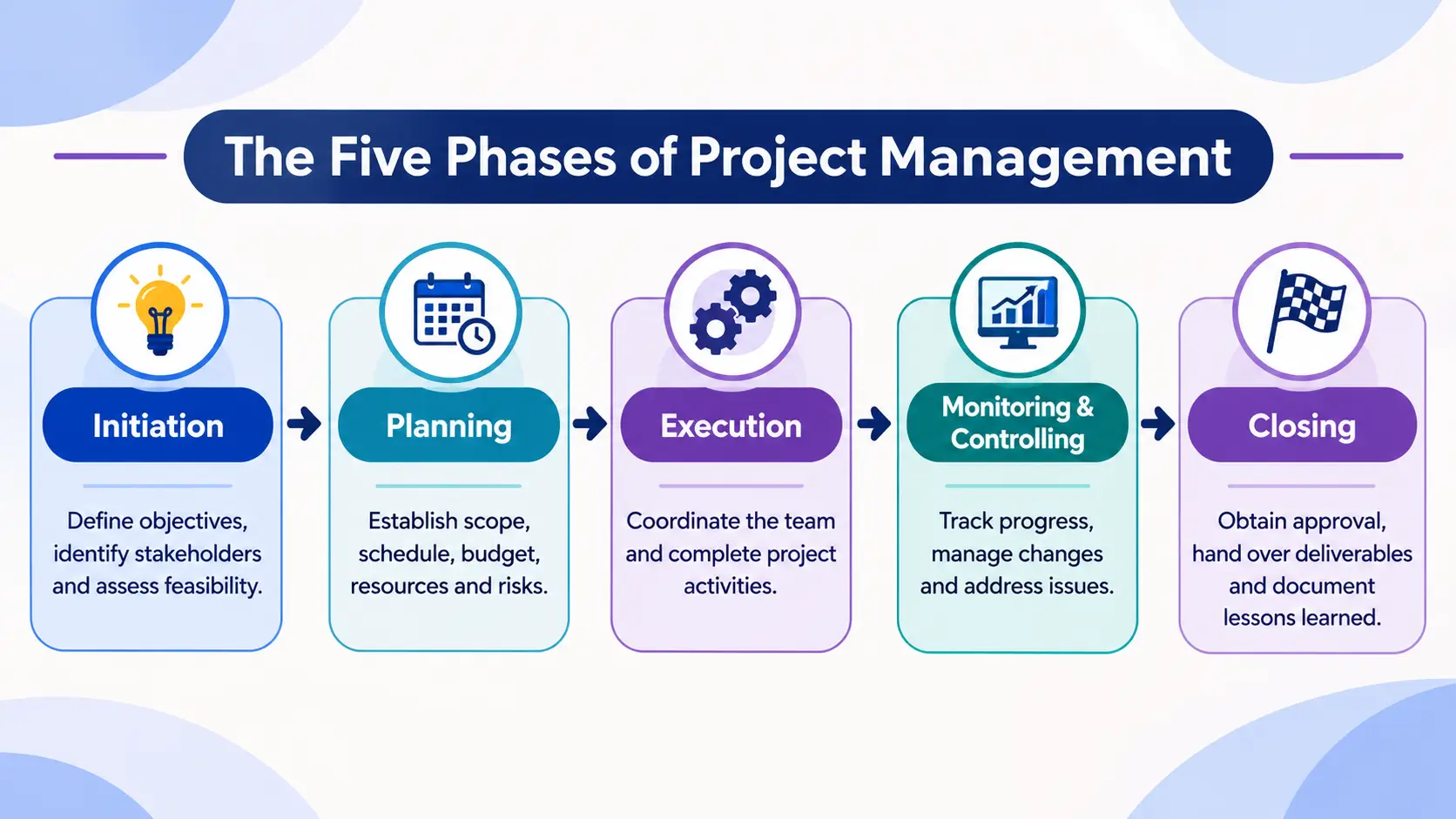
A commonly used way to understand the project lifecycle is through five phases: initiation, planning, execution, monitoring and controlling, and closing.
These phases provide a useful structure for managing projects from the initial idea to completion. Their level of detail and overlap may vary depending on the project and the approach being used.
1. Project Initiation
Initiation is the starting phase of a project. It focuses on understanding the purpose, feasibility and expected value of the proposed work.
During this phase, organisations identify the problem or opportunity, define initial objectives and determine the key stakeholders.
Typical activities include:
Identifying the project purpose.
Establishing initial objectives.
Identifying key stakeholders.
Assessing feasibility and major constraints.
Defining the initial scope.
Obtaining approval to proceed.
Example: A company identifies the need for a new employee learning platform. During initiation, it defines why the platform is needed, who will use it and what outcomes it should support.
2. Project Planning
Planning establishes how the project will be completed. It translates the initial objectives into a structured plan.
This phase is important because unclear expectations, unrealistic deadlines and insufficient resources can create problems later.
Typical activities include:
Breaking the project into smaller tasks.
Preparing a schedule and milestones.
Estimating costs and creating a budget.
Assigning team responsibilities.
Identifying resources.
Assessing potential risks.
Establishing communication and quality plans.
Example: For the learning platform, the team prepares a development schedule, assigns content and design responsibilities, estimates costs and identifies the resources required.
3. Project Execution
Execution is the phase in which the planned work is carried out.
Team members complete their assigned tasks, collaborate with one another and produce the project's deliverables. The project manager coordinates activities and supports the team throughout the process.
Typical activities include:
Assigning and completing tasks.
Coordinating team members.
Managing resources.
Communicating with stakeholders.
Reviewing deliverables.
Addressing issues that affect progress.
Example: Designers prepare the platform interface, content teams develop learning materials and developers build the required features.
4. Project Monitoring and Controlling
Monitoring and controlling take place alongside project execution. The purpose is to compare actual progress with the project plan and identify areas that need attention.
This phase helps project managers understand whether the project is meeting its objectives, schedule, budget and quality expectations.
Typical activities include:
Tracking task completion.
Reviewing project milestones.
Monitoring costs and resource use.
Identifying risks and issues.
Evaluating proposed changes.
Taking corrective action when necessary.
Example: If the development team experiences delays, the project manager reviews the schedule, identifies the cause and works with the team to determine an appropriate response.
5. Project Closing
Closing is the final phase of the project lifecycle. It confirms that the agreed work has been completed and the project can be formally concluded.
Typical activities include:
Obtaining final approval.
Delivering or handing over the completed output.
Closing contracts and outstanding activities, where applicable.
Documenting project results.
Reviewing performance.
Recording lessons learned.
Example: After testing and approval, the learning platform is handed over to the organisation. The team documents the outcome and identifies improvements for future projects.
What Are the Key Components of Project Management?
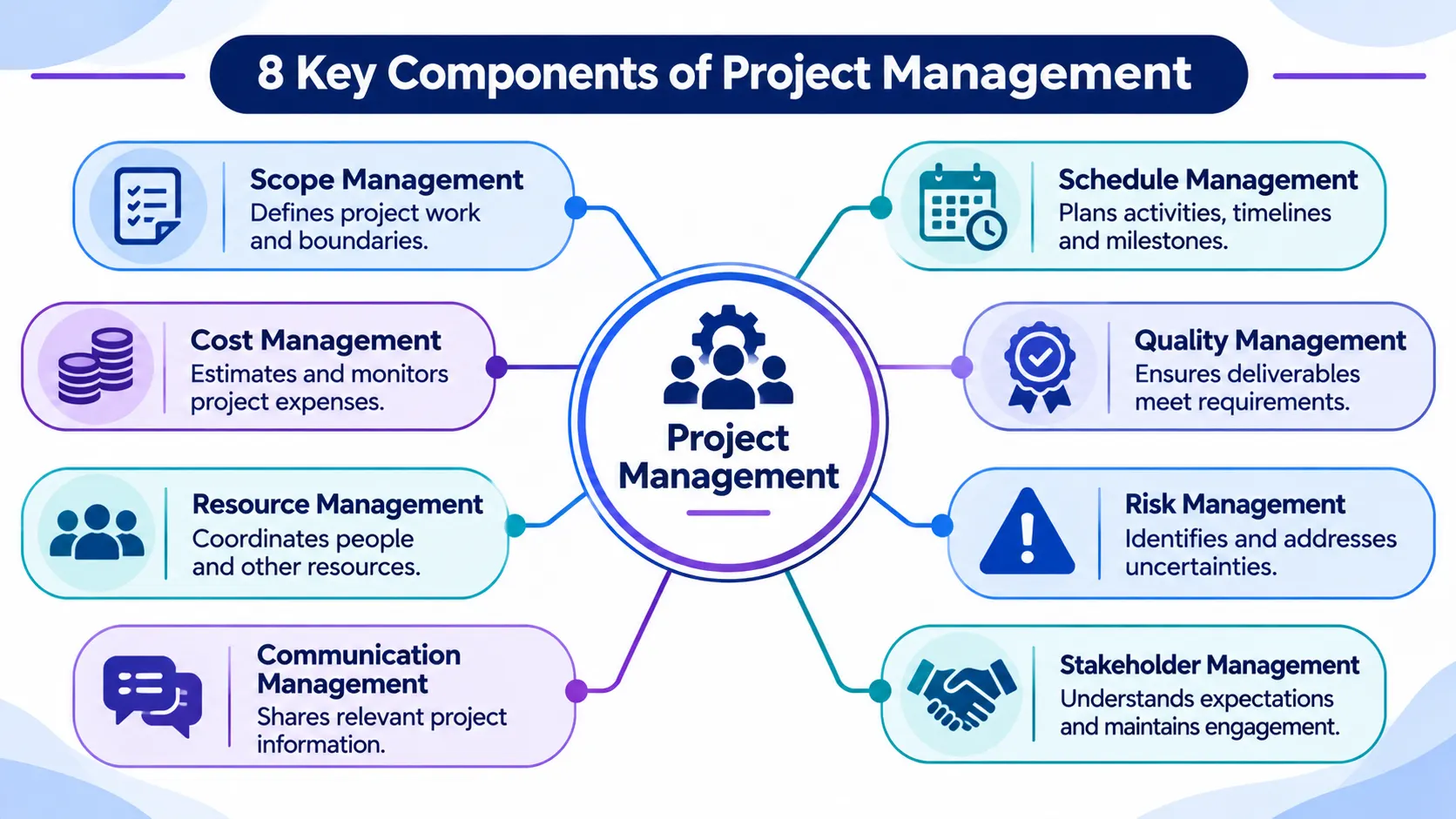
Successful project management requires attention to several interconnected areas. These components help teams organise work, manage constraints and maintain control throughout the project.
1. Scope Management
Scope management defines the work required to complete the project. It includes identifying deliverables, setting boundaries and evaluating proposed changes.
2. Schedule Management
Schedule management involves identifying activities, estimating their duration, arranging their sequence and developing a project timeline.
It helps teams understand deadlines, dependencies and important milestones.
3. Cost Management
Cost management focuses on estimating, budgeting and controlling project expenses. It helps organisations understand the financial resources required and monitor spending throughout the project.
4. Quality Management
Quality management ensures that project deliverables meet the agreed requirements and expected standards.
It involves defining quality expectations, reviewing work and addressing defects or gaps.
5. Resource Management
Resource management involves planning and coordinating the people, equipment, materials and other resources needed to complete project activities.
6. Risk Management
Risk management identifies uncertainties that could affect project objectives. It involves assessing potential risks, understanding their possible impact and preparing appropriate responses.
7. Communication Management
Communication management ensures that relevant information reaches the right people at the right time.
Regular updates, meetings, reports and shared documentation help keep team members and stakeholders informed.
8. Stakeholder Management
Stakeholders are individuals or groups who can affect a project, are affected by it or have an interest in its outcome.
Stakeholder management involves understanding their expectations, maintaining engagement and addressing concerns throughout the project.
What Are the Different Project Management Methodologies?
A project management methodology or approach provides guidance on how project work is planned, organised and delivered.
Different projects have different requirements. Some need detailed upfront planning, while others require flexibility and frequent feedback.
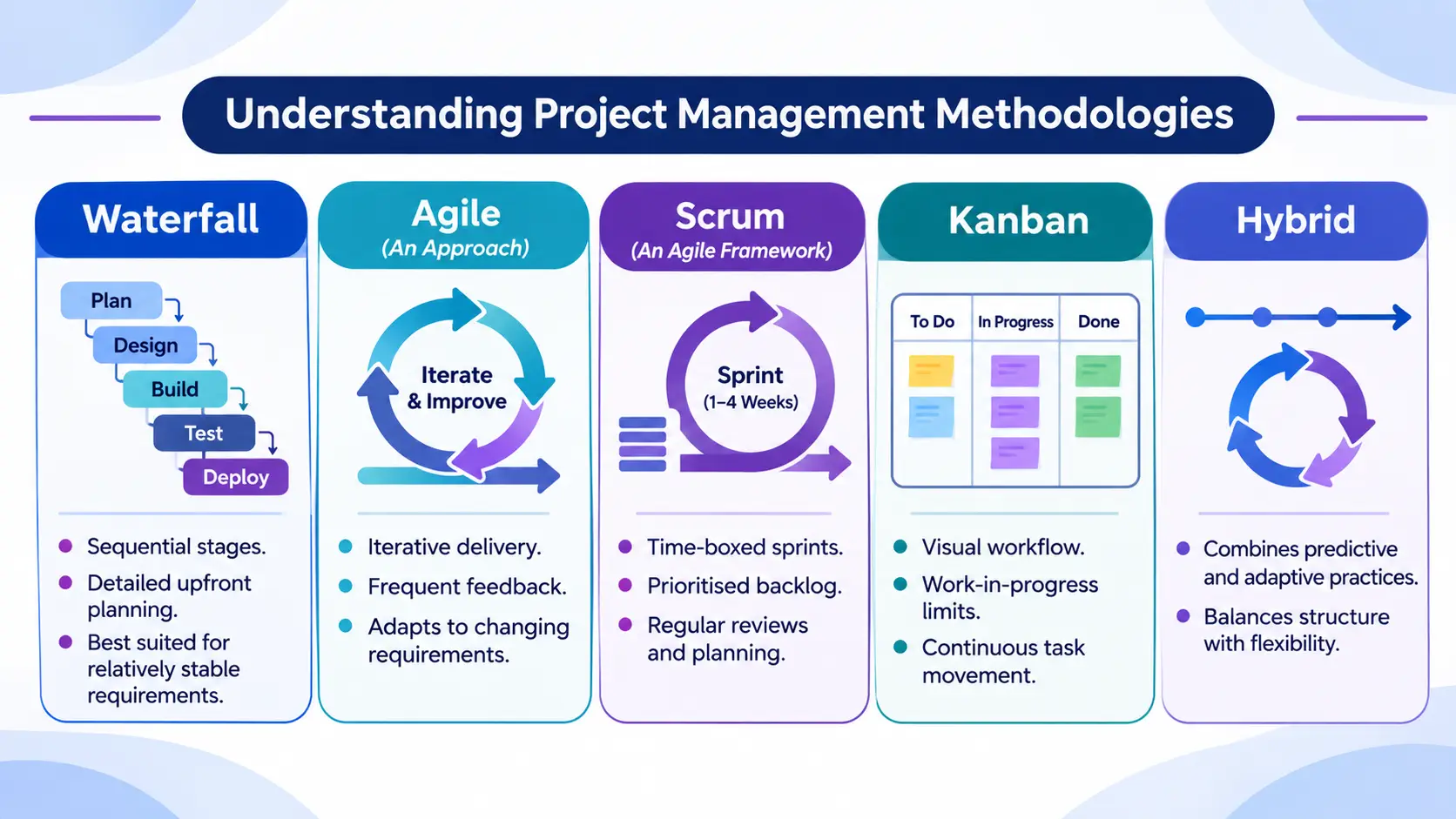
The following are some commonly used project management approaches and frameworks.
1. Waterfall Methodology
Waterfall is a sequential approach in which project work progresses through defined stages. A stage is generally completed before the next one begins.
It is useful when project requirements are relatively stable and the work can be planned in advance.
Key characteristics:
Structured and sequential workflow.
Detailed upfront planning.
Clearly defined project stages.
Documentation and approval at key points.
Example: A construction project may use a sequential approach because design, approvals and building activities depend on one another.
2. Agile Approach
Agile is an adaptive approach that focuses on delivering work in smaller increments, gathering feedback and responding to changing requirements.
Instead of relying entirely on a fixed plan created at the beginning, Agile teams review progress regularly and adjust their work when necessary.
Key characteristics:
Iterative development.
Frequent feedback.
Continuous collaboration.
Flexibility to respond to change.
Example: A software team may release an initial version of an application, collect user feedback and improve the product through subsequent iterations.
3. Scrum Framework
Scrum is a framework commonly used by Agile teams to manage complex work through short, time-boxed periods called sprints.
It defines accountabilities, events and artefacts that help teams organise their work and inspect progress regularly.
Key characteristics:
Work is organised into sprints.
Teams maintain and prioritise a backlog.
Regular planning and review events.
Frequent inspection and adaptation.
Example: A product development team may use two-week sprints to plan, develop and review selected product features.
Scrum is an Agile framework rather than a separate alternative to Agile itself.
4. Kanban Method
Kanban is a method for visualising work and improving the flow of tasks. Teams commonly use a Kanban board to show the status of activities.
A basic board may include columns such as:
To Do
In Progress
Under Review
Completed
Kanban can also use work-in-progress limits to prevent teams from taking on more tasks than they can manage effectively.
Example: A marketing team may use a Kanban board to track content from topic selection through writing, editing, approval and publication.
5. Hybrid Project Management
Hybrid project management combines elements of predictive and adaptive approaches.
It is useful when some parts of a project require detailed planning while others need flexibility.
Example: An organisation may use a fixed schedule and budget for a major event while using an Agile-style feedback process to develop its digital campaign.
Project Management Methodologies: A Quick Comparison
Approach | Best suited for | Main characteristic |
|---|---|---|
Waterfall | Projects with stable requirements | Sequential planning and delivery |
Agile | Projects with changing requirements | Iterative work and continuous feedback |
Scrum | Complex work managed by an Agile team | Time-boxed sprints and defined practices |
Kanban | Continuous workflows | Visual task management and flow |
Hybrid | Projects requiring both structure and flexibility | Combines different approaches |
There is no single approach that works best for every project. The choice depends on the project's objectives, complexity, level of uncertainty, team structure and stakeholder expectations.
Why Is Project Management Important?
Project management provides structure and direction to work that involves multiple activities, people and resources.
Without clear planning and coordination, teams may experience missed deadlines, unclear responsibilities, unnecessary expenses and inconsistent results.
Project management helps organisations:
Establish clear objectives: Team members understand what the project is expected to achieve.
Coordinate people and resources: Responsibilities and resource requirements are organised.
Manage time and budgets: Schedules and expenses can be planned and monitored.
Identify risks early: Potential problems can be assessed before they create greater disruption.
Improve communication: Stakeholders receive relevant updates and understand project progress.
Maintain quality: Deliverables can be reviewed against agreed requirements.
Support better decisions: Project information helps managers identify issues and evaluate possible actions.
Project management is useful across industries, including education, healthcare, construction, finance, marketing, information technology and professional services.
What Are the Benefits of Project Management?
A structured project management approach can provide several practical benefits to organisations and teams.
Better Organisation
Breaking a large objective into smaller activities makes the work easier to understand, assign and track.
Improved Team Collaboration
Clearly defined responsibilities and communication arrangements help team members coordinate their efforts and reduce misunderstandings.
More Effective Resource Utilisation
Planning helps organisations allocate people, time, equipment and budgets according to project requirements.
Greater Visibility into Progress
Schedules, milestones and progress reports help managers understand what has been completed and what still needs attention.
Improved Risk Awareness
Identifying potential challenges early gives teams more time to prepare responses and reduce disruption.
More Consistent Project Outcomes
Clear objectives, quality expectations and regular reviews help teams work towards the intended results.
These benefits depend on how well project management practices are applied. A plan alone does not guarantee success; teams must review progress, communicate effectively and adapt when circumstances change.
What Are the Common Challenges in Project Management?
Even well-planned projects can face unexpected difficulties. Understanding common challenges helps project managers prepare for them.
Challenge | How it affects a project | Possible response |
|---|---|---|
Unclear objectives | Creates confusion about expected outcomes | Define measurable objectives and deliverables |
Scope creep | Adds work without properly assessing its impact | Establish scope boundaries and a change approval process |
Poor communication | Leads to misunderstandings and delays | Set regular updates and clear communication channels |
Unrealistic deadlines | Creates pressure and affects quality | Estimate task durations realistically |
Budget overruns | Increases project costs | Monitor spending and review cost estimates |
Resource constraints | Delays activities when people or materials are unavailable | Plan resource requirements in advance |
Unexpected risks | Disrupts schedules, costs or deliverables | Identify risks and prepare response plans |
One common challenge is scope creep, which occurs when additional work or requirements are introduced without properly evaluating their effect on the project's schedule, budget or resources.
For example, if a website project originally includes five pages but additional pages and features are continuously requested without adjusting the timeline or budget, the project may become difficult to manage.
A clear change management process helps teams assess requests and make informed decisions.
What Are the Common Project Management Tools?
Project management tools help teams plan activities, assign responsibilities, monitor progress and share information.
They range from simple spreadsheets and visual boards to specialised project management software.
Some commonly used tools include:
Microsoft Project: Supports project scheduling, task planning and resource management.
Trello: Uses visual boards and cards to organise and track tasks.
Asana: Helps teams manage projects, assign tasks and monitor progress.
Jira: Commonly used by software and product teams to manage issues and Agile workflows.
monday.com: Provides configurable work management boards and project tracking features.
Teams may also use practical project management techniques such as:
Gantt charts: Display project activities along a timeline.
Kanban boards: Visualise tasks and their progress through different stages.
Work Breakdown Structure (WBS): Divides project scope into smaller, manageable components.
Risk registers: Record identified risks, their potential impact and planned responses.
Project dashboards: Present key project information and progress indicators.
The right tool depends on the project's size, complexity, team requirements and available resources. Software supports project management, but it does not replace clear objectives, communication and effective decision-making.
Practical Example of Project Management
Consider an organisation planning a one-day employee training workshop.
The goal is to organise a session that helps employees develop communication and teamwork skills.
The project can be managed through the five common phases:
Initiation: The organisation identifies the need for training, defines the intended participants and establishes the workshop objectives.
Planning: The team selects a date, prepares a budget, books a venue, identifies a trainer and creates the session schedule.
Execution: Invitations are sent, training materials are prepared, arrangements are confirmed and the workshop is conducted.
Monitoring and Controlling: The team tracks preparation activities, checks expenses, confirms attendance and resolves any issues that arise.
Closing: The workshop is completed, participant feedback is collected, expenses are reviewed and lessons are documented for future training events.
This example demonstrates how project management brings different activities together to achieve a defined outcome.
What Skills Are Important in Project Management?
Project management requires a combination of organisational, communication and leadership skills. While the level of expertise needed varies by role and project, the following skills are valuable.
Communication: Sharing information clearly with team members and stakeholders.
Planning and organisation: Breaking objectives into manageable activities and arranging work effectively.
Time management: Prioritising tasks and monitoring deadlines.
Leadership: Guiding teams, supporting collaboration and helping resolve conflicts.
Problem-solving: Identifying issues and evaluating practical solutions.
Decision-making: Considering available information and selecting appropriate actions.
Risk management: Recognising potential challenges and preparing responses.
Adaptability: Adjusting plans when requirements, resources or circumstances change.
Teamwork: Working collaboratively towards shared objectives.
These skills are useful beyond formal project management roles. Professionals in administration, marketing, human resources, finance, operations and other business functions can also apply them in their daily work.
Conclusion
Project management is an essential business practice that helps turn ideas into organised, achievable outcomes. It brings together planning, people, resources, communication and monitoring to guide projects from initiation to completion.
Understanding the project lifecycle, key management components and different methodologies gives beginners a strong foundation for working on projects in any industry. Whether a project follows a structured Waterfall approach, an adaptive Agile approach or a combination of both, its success depends on clear objectives, realistic planning, effective collaboration and continuous review.
As organisations continue to manage complex initiatives and changing priorities, project management skills remain valuable for professionals at different stages of their careers.
Frequently Asked Questions (FAQs)
1. What is project management in simple words?
Project management is the process of planning, organising and coordinating tasks, people and resources to achieve a specific goal within defined requirements, timelines and budgets.
2. What are the five phases of project management?
The five commonly used project lifecycle phases are initiation, planning, execution, monitoring and controlling, and closing. They provide a structured approach to managing a project from its beginning to completion.
3. What are the main project management methodologies?
Commonly used approaches and frameworks include Waterfall, Agile, Scrum, Kanban and Hybrid project management. Each offers a different way to organise and manage project work depending on its requirements.
4. What does a project manager do?
A project manager plans and coordinates project activities, assigns responsibilities, manages resources, communicates with stakeholders, monitors progress and addresses issues to help achieve project objectives.
5. Is project management useful outside the IT industry?
Yes. Project management is used across industries such as healthcare, education, construction, finance, marketing and human resources. It helps organise work, coordinate teams and achieve specific business objectives.
Ready to go deeper?
Professional Training
Hands-on, mentor-led training aligned with industry certifications.
About the Author
Sharper every day
Daily tutorials, analysis, and career playbooks across all 12 Xcademia disciplines, straight to your inbox. No spam.