Retrieval-Augmented Generation (RAG): From Basics to Advanced Techniques
Retrieval-Augmented Generation (RAG) connects LLMs with external knowledge to produce more relevant and grounded answers. Learn how RAG works, including chunking, embeddings, vector databases, retrieval, reranking, hybrid search, GraphRAG, Agentic RAG and evaluation.
Large Language Models (LLMs) can generate impressive answers, write code, summarize documents, and explain complex topics. But they have an important limitation: they do not automatically know everything happening inside your organization, your private database, or the latest documents available today.
This is where Retrieval-Augmented Generation (RAG) becomes useful.
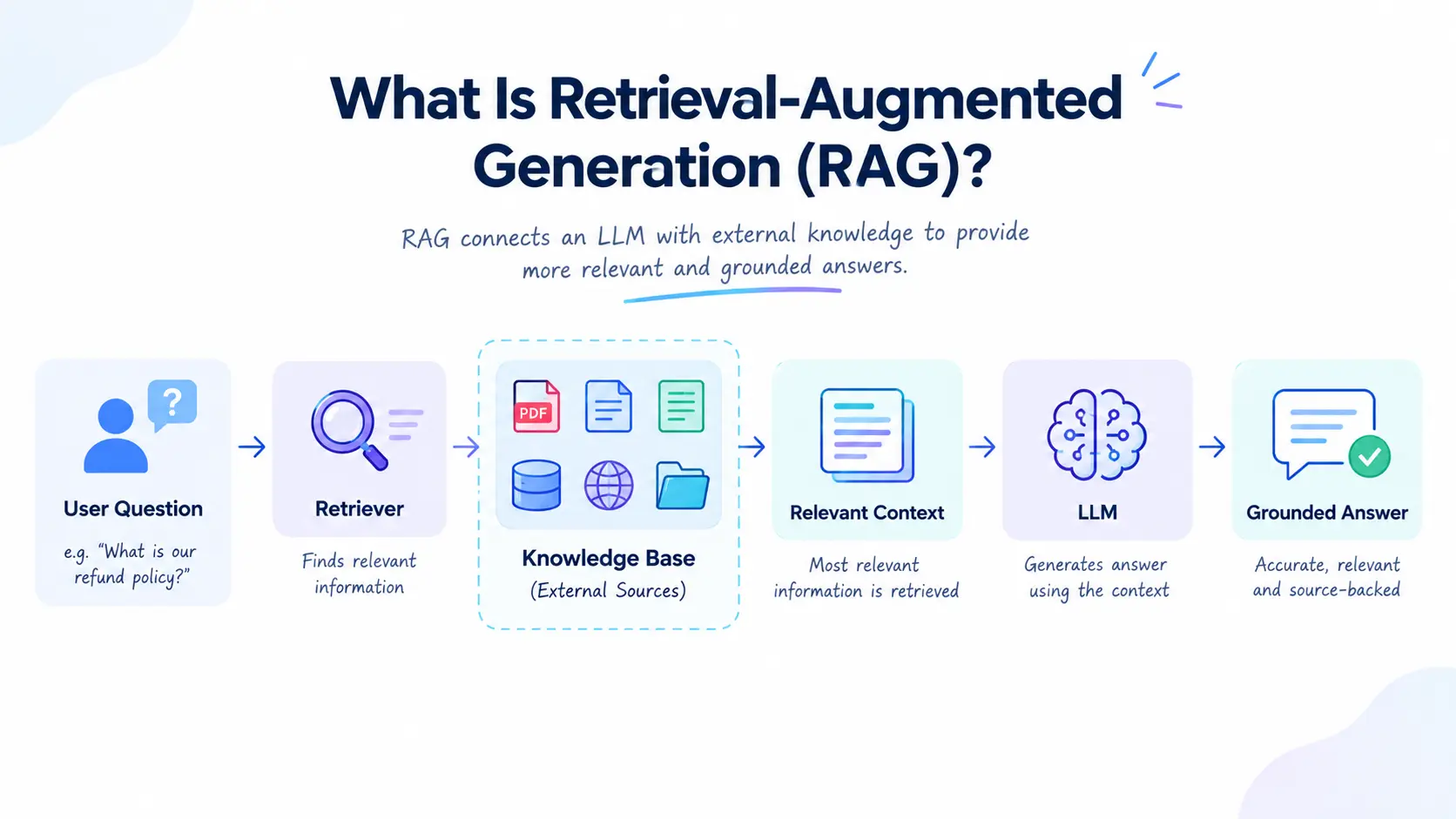
RAG allows an LLM to retrieve relevant information from an external knowledge source and use that information while generating an answer.
Instead of asking an LLM to answer only from what it learned during training, RAG gives it access to a separate knowledge source at query time.
A simple way to think about it is:
LLM + External Knowledge + Retrieval = RAG
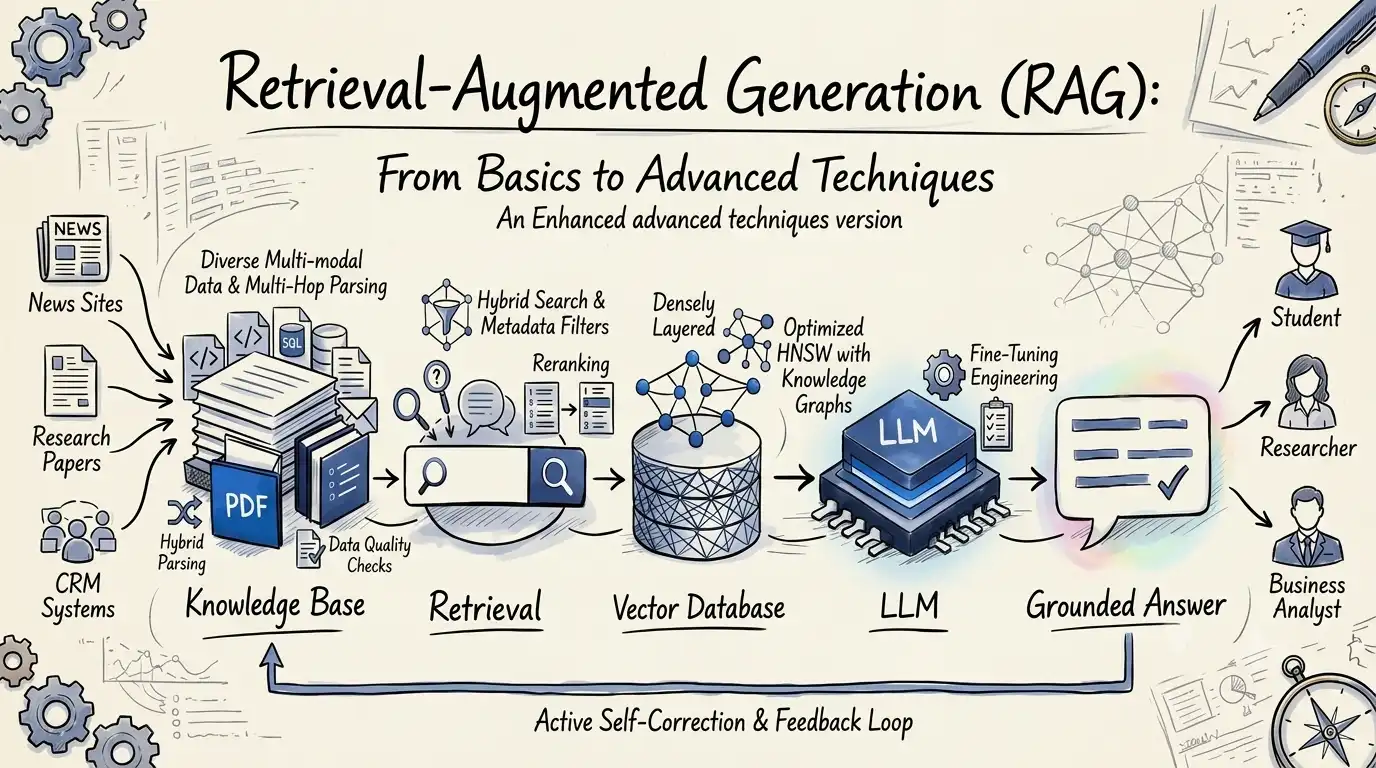
RAG has evolved significantly since the original 2020 architecture. Modern systems can use vector search, keyword search, hybrid retrieval, reranking, query rewriting, GraphRAG, multimodal retrieval, corrective retrieval, and even agentic workflows.
A 2025 systematic literature review examined a large body of RAG research and highlighted how the field has expanded across retrieval methods, vector databases, chunking strategies, evaluation metrics, multimodal systems, graph-based retrieval, and iterative retrieval-generation approaches.
In this guide, we will start with the basics and gradually move toward advanced RAG.
What Is RAG?
Retrieval-Augmented Generation is an architecture that connects a language model with an external information source.
The three words explain the idea:
Retrieval → Find relevant information.
Augmented → Add that information to the model's context.
Generation → Generate an answer using the retrieved information.
Imagine you build a chatbot for a company.
The company has:
HR policies
Product documentation
Customer-support manuals
Internal FAQs
Technical documentation
Training materials
PDF files
Database records
You could try to train an LLM on all this information.
But that creates several problems.
Every time a document changes, the model would need some way to receive the new information. Training can also be expensive and does not naturally provide a simple mechanism for controlling which private documents a particular user can access.
With RAG, you can keep the knowledge outside the model.
When someone asks:
"What is our refund policy for enterprise customers?"
the system searches the company's knowledge base, retrieves relevant sections, and provides those sections to the LLM.
The LLM then generates the response using that retrieved context.
This general architecture is also described in the literature as combining a retriever with a generator so that external information can supplement the model's learned knowledge.
Simple example
Without RAG:
User → LLM → Answer
With RAG:
User → Retrieval System → Relevant Documents → LLM → Answer
That additional retrieval step is what makes RAG powerful.
Why Do We Need RAG?
To understand RAG, we first need to understand some limitations of LLMs.
1. LLM knowledge can become outdated
An LLM is trained on a particular dataset and training period.
Suppose a company changes its vacation policy today.
A general-purpose LLM will not automatically know about that change.
RAG can retrieve the updated policy from the company's document repository.
2. LLMs may hallucinate
A hallucination happens when an AI system produces information that sounds convincing but is unsupported or incorrect.
For example:
User:
"What is the company's 2026 refund policy?"
Without access to the company's actual policy, the model may generate a plausible answer.
With RAG, the system can retrieve the relevant policy document and provide it as context.
RAG does not automatically eliminate hallucinations. Retrieval quality, document quality, prompt design, model behavior, and evaluation all still matter.
Research on RAG consistently identifies reliability and factual grounding as important challenges.
3. Private company information is not normally part of a public model
Imagine an organization has thousands of internal documents.
A general LLM does not automatically have access to:
Internal databases
Employee handbooks
Private product documentation
Internal engineering tickets
Customer records
Company procedures
RAG provides a mechanism for connecting those sources to an LLM.
4. Fine-tuning is not the same as adding knowledge
This is an important distinction.
RAG is primarily about giving the model access to external information.
Fine-tuning changes model behavior by training the model further on examples.
For example:
RAG can help an AI assistant answer questions using the latest company documentation.
Fine-tuning can help a model follow a particular style, format, or task pattern.
The two approaches can also be combined.
RAG vs Traditional LLM
Let's compare the basic approaches.
Traditional LLM | RAG |
|---|---|
Relies primarily on learned parameters | Uses learned parameters + external knowledge |
Knowledge can become outdated | External knowledge can be updated |
Does not automatically know private documents | Can retrieve authorized private documents |
May hallucinate unsupported facts | Retrieved evidence can improve grounding |
Large context may be required | Relevant information can be retrieved |
Updating knowledge can be difficult | Update the knowledge source/index |
RAG therefore acts as a bridge between an LLM and external information.
How Does RAG Work?
A typical RAG pipeline contains several stages.
Basic workflow
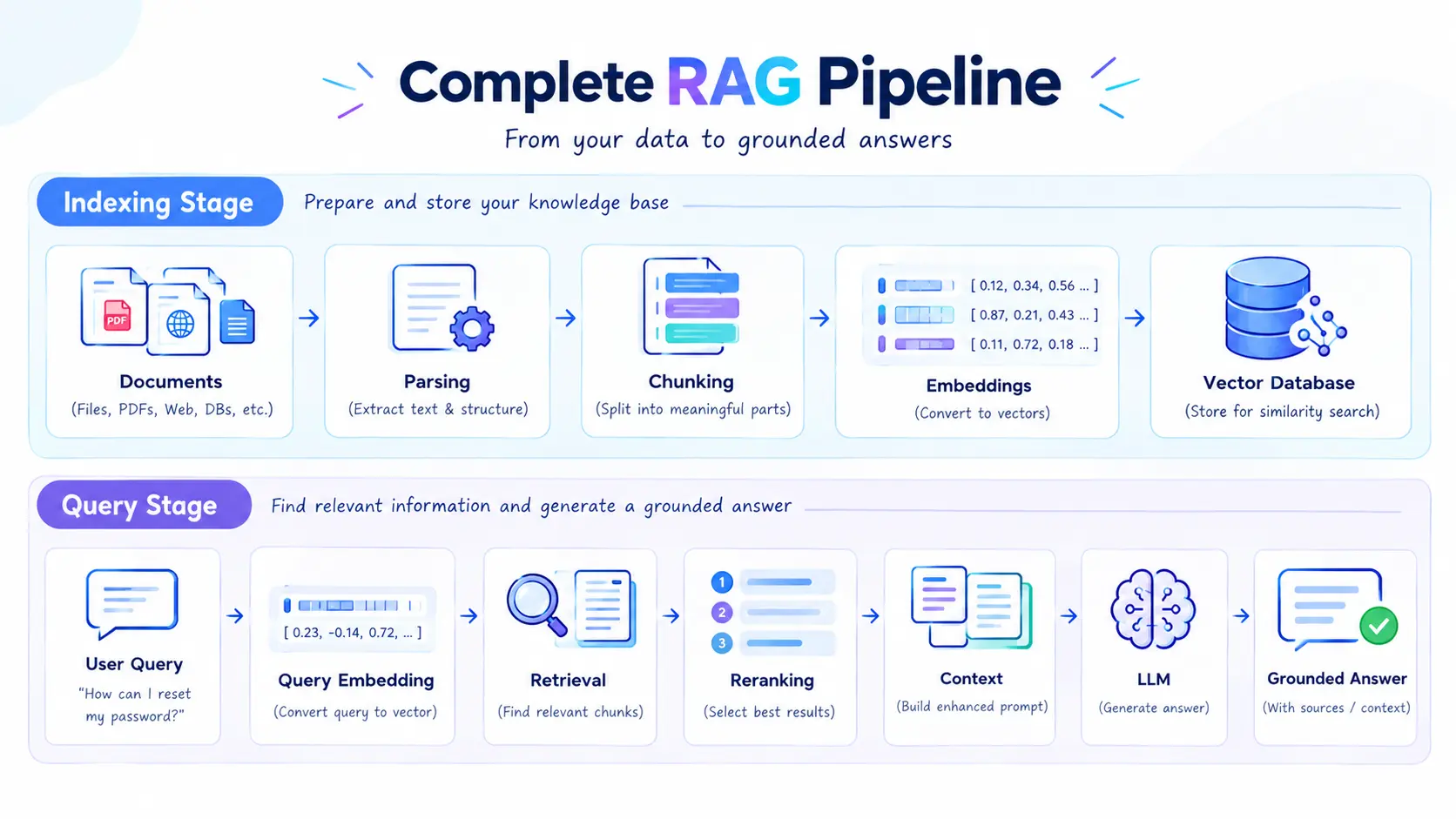
Documents → Chunking → Embeddings → Vector Database → User Query → Retrieval → Context → LLM → Answer
Let's understand every step.
Step 1: Collect Your Data
First, you need a knowledge source.
This could include:
PDF documents
Web pages
Word documents
Markdown files
Product documentation
Database records
Support tickets
Research papers
Internal company documents
Code repositories
This stage is sometimes called data ingestion.
The quality of this data matters enormously.
If your knowledge base contains outdated, duplicated, incomplete or incorrect information, your RAG system can retrieve that information and produce a poor answer.
A useful principle is:
Bad data → Bad retrieval → Bad context → Bad answer
Step 2: Split Documents Into Chunks
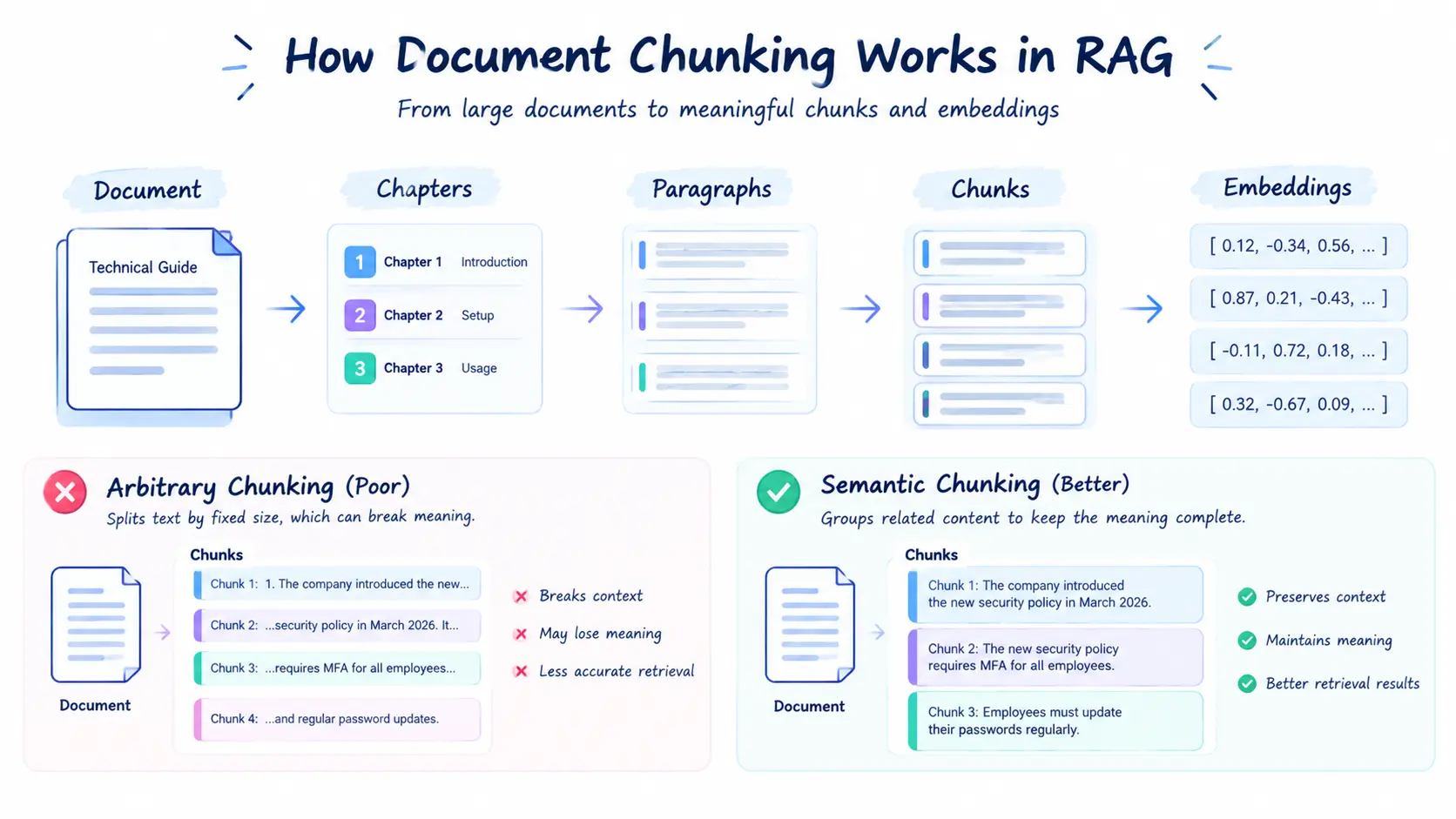
Large documents are usually divided into smaller pieces called chunks.
Why?
Suppose you have a 200-page technical manual.
You probably do not want to send the entire manual to the LLM for every question.
Instead, you divide it into meaningful sections.
For example:
Document
│
├── Chapter 1
│   ├── Chunk 1
│   ├── Chunk 2
│   └── Chunk 3
│
├── Chapter 2
│   ├── Chunk 4
│   ├── Chunk 5
│   └── Chunk 6
│
└── Chapter 3
    ├── Chunk 7
    └── Chunk 8
The goal is to create chunks that are small enough for accurate retrieval but large enough to preserve meaning.
Research surveys identify fixed-length, sentence-level, sliding-window, hierarchical and other chunking strategies as common approaches.
Common Chunking Strategies
Fixed-size chunking
Split documents according to a fixed number of characters or tokens.
Example:
Chunk size = 500 tokens
Overlap = 50 tokens
This is simple and easy to implement.
Sentence-based chunking
Instead of cutting text at arbitrary positions, the system groups complete sentences.
This can preserve semantic meaning better.
Paragraph-based chunking
Documents are split according to paragraphs.
This works well when the original document structure is meaningful.
Recursive chunking
The system tries different separators hierarchically.
For example:
Document
↓
Sections
↓
Paragraphs
↓
Sentences
↓
Smaller chunks
This can preserve document structure better than simply cutting every N characters.
Semantic chunking
Semantic chunking attempts to identify sections that are conceptually related.
For example, instead of:
Chunk 1: half of an explanation
Chunk 2: other half of the explanation
the system tries to create:
Chunk 1: Complete explanation of authentication
Chunk 2: Complete explanation of authorization
This can improve retrieval because each chunk represents a more meaningful concept.
Step 3: Create Embeddings
After documents are divided into chunks, each chunk can be converted into a numerical representation called an embedding.
An embedding represents the semantic meaning of text as a vector.
For example:
"How do I reset my password?"might become something conceptually like:
[0.21, -0.14, 0.72, 0.09, ...]The actual vector contains many dimensions.
The important idea is that semantically related text can have similar representations.
For example:
"How can I change my password?"and
"I forgot my password. How do I reset it?"use different words but have similar meanings.
Semantic embeddings can help the retrieval system recognize that relationship.
Step 4: Store Embeddings
The embeddings are stored in a system capable of similarity search.
This is commonly a vector database or vector search system.
Examples include:
FAISS
Pinecone
Weaviate
Qdrant
Chroma
Milvus
PostgreSQL with vector extensions
A systematic review notes that vector infrastructure commonly uses approximate nearest-neighbor techniques such as HNSW and FAISS-style indexes to support large-scale similarity search, while managed vector services can simplify deployment but introduce operational and cost considerations.
Step 5: Convert the User Query Into an Embedding
Now the user asks a question.
For example:
"How can I reset my company password?"
The query is also converted into an embedding.
The system then compares the query vector against stored document vectors.
The objective is to find the chunks that are most relevant to the question.
Step 6: Retrieve Relevant Information
Suppose the database contains:
Chunk 1:
Company password policy

Chunk 2:
Laptop security policy

Chunk 3:
Password reset instructions

Chunk 4:
Employee vacation policy
The user's question is:
"How can I reset my company password?"
The retrieval system should identify:
Chunk 3
as highly relevant.
It may retrieve several chunks rather than only one.
For example:
Top 5 results
↓
Chunk 3
Chunk 1
Chunk 8
Chunk 12
Chunk 17
These results are then passed into the generation stage.
Step 7: Add Retrieved Context to the Prompt
The LLM receives something like:
User Question:
How can I reset my company password?

Relevant Context:
[Retrieved document 1]

[Retrieved document 2]

[Retrieved document 3]

Instructions:
Answer the user's question using the provided context.
The model then generates the final response.
This is the generation stage.
Step 8: Generate the Final Answer
The LLM uses:
User question
Retrieved information
System instructions
Its language-generation capabilities
to produce the final answer.
The result might be:
"You can reset your company password from the employee portal. Select 'Forgot Password', verify your identity, and follow the reset instructions."
The important difference is that the answer is grounded using information retrieved from the organization's knowledge base.
The Complete RAG Pipeline
Putting everything together:
                    OFFLINE / INDEXING

Documents
    ↓
Document Processing
    ↓
Chunking
    ↓
Embeddings
    ↓
Vector Database


                    ONLINE / QUERY TIME

User Question
    ↓
Query Processing
    ↓
Query Embedding
    ↓
Retriever
    ↓
Relevant Chunks
    ↓
Reranking / Filtering
    ↓
Context Construction
    ↓
LLM
    ↓
Grounded Answer
This distinction between indexing and query-time retrieval is important when designing production RAG systems.
Sparse Retrieval vs Dense Retrieval
Retrieval itself can work in different ways.
Two important approaches are:
Sparse retrieval
and
Dense retrieval
There is also:
Hybrid retrieval
which combines them.
Sparse Retrieval
Sparse retrieval focuses primarily on keyword or lexical matching.
A common algorithm is BM25.
Suppose the user searches:
"CVE-2026-12345 Apache vulnerability"
Exact keyword matching can be extremely useful.
Sparse retrieval is often:
Fast
Interpretable
Good at exact terminology
Useful for identifiers and technical keywords
But it may struggle when the query and document use different words for the same concept.
Research literature commonly identifies BM25 as a major sparse retrieval approach.
Dense Retrieval
Dense retrieval converts queries and documents into embeddings.
It focuses more on semantic similarity.
For example:
Query:
"How do I recover access to my account?"
Document:
"Instructions for resetting forgotten login credentials."
There may be little exact word overlap, but the meanings are closely related.
Dense retrieval can identify that semantic relationship.
Hybrid Retrieval
Hybrid retrieval combines sparse and dense approaches.
For example:
User Query
    ↓
 ┌───────────────┐
 │               │
BM25          Vector Search
 │               │
 └───────┬───────┘
         ↓
    Candidate Set
         ↓
      Reranker
         ↓
   Best Documents
This can be especially useful for technical systems where both exact terms and semantic meaning matter.
A 2025 RAG review describes sparse, dense and hybrid retrieval as major retrieval categories, with hybrid systems combining their strengths.
What Is Reranking?
Retrieval does not always return the best results in the perfect order.
Imagine the first retrieval stage returns 20 documents.
You only want the best 5.
A reranker evaluates the query and retrieved documents again and produces a better ordering.
So the pipeline becomes:
Query
 ↓
Initial Retrieval
 ↓
Top 20 Candidates
 ↓
Reranker
 ↓
Top 5 Relevant Documents
 ↓
LLM
This is often called two-stage retrieval.
The first stage emphasizes speed.
The second stage emphasizes precision.
Modern RAG systems increasingly use multi-stage retrieval and reranking to improve the quality of context supplied to the generator.
Metadata Filtering
Not every document should be searched for every user.
Suppose your knowledge base contains:
Department = HR
Department = Finance
Department = Engineering
Department = Legal
A query from an engineering employee might first filter:
department = engineeringThen perform semantic retrieval.
Other metadata might include:
Date
Department
Document type
Customer
Product
Region
Access level
Language
Version
This can reduce irrelevant results and improve security.
Query Rewriting
Sometimes the user's original question is not ideal for retrieval.
For example:
User:
"How does it work?"
The system does not know what "it" refers to.
A query-rewriting stage can transform the question into something more useful.
Original:
"How does it work?"

↓

Rewritten:
"How does the company's employee password reset system work?"
The improved query can then be sent to the retriever.
Multi-Query Retrieval
Another technique is to generate multiple versions of the user's question.
For example:
Original:
"What are the AWS security requirements?"

Query 1:
"AWS security compliance requirements"

Query 2:
"AWS security controls"

Query 3:
"AWS cloud security policies"

Query 4:
"AWS security best practices"
Each query can retrieve different documents.
The results can then be combined.
This improves coverage when one query formulation is not enough.
HyDE
HyDE, or Hypothetical Document Embeddings, takes query transformation a step further.
Instead of directly embedding the question, an LLM generates a hypothetical answer or document.
That hypothetical text is then embedded and used for retrieval.
Conceptually:
User Question
      ↓
LLM creates hypothetical answer
      ↓
Embedding
      ↓
Vector Search
      ↓
Relevant Documents
The idea is to bridge vocabulary differences between a user's question and the documents in the knowledge base.
Contextual Retrieval
A major challenge with chunking is that a chunk can lose important context.
Imagine the original document says:
"The company introduced the new security policy in March 2026."
A chunk might contain:
"The new security policy requires MFA."
If the chunk is retrieved independently, the phrase "the new security policy" may lack context.
Contextual retrieval techniques attempt to enrich chunks with information from their surrounding document before indexing.
The goal is to make individual chunks more understandable to the retrieval system.
Parent-Child Retrieval
Another approach is to retrieve a small chunk but provide a larger parent section to the LLM.
For example:
Large Parent Document
        │
        ├── Child Chunk 1
        ├── Child Chunk 2
        ├── Child Chunk 3
        └── Child Chunk 4
The system may retrieve:
Child Chunk 2
but send:
Parent section
to the LLM.
This creates a balance:
Precise retrieval + richer context
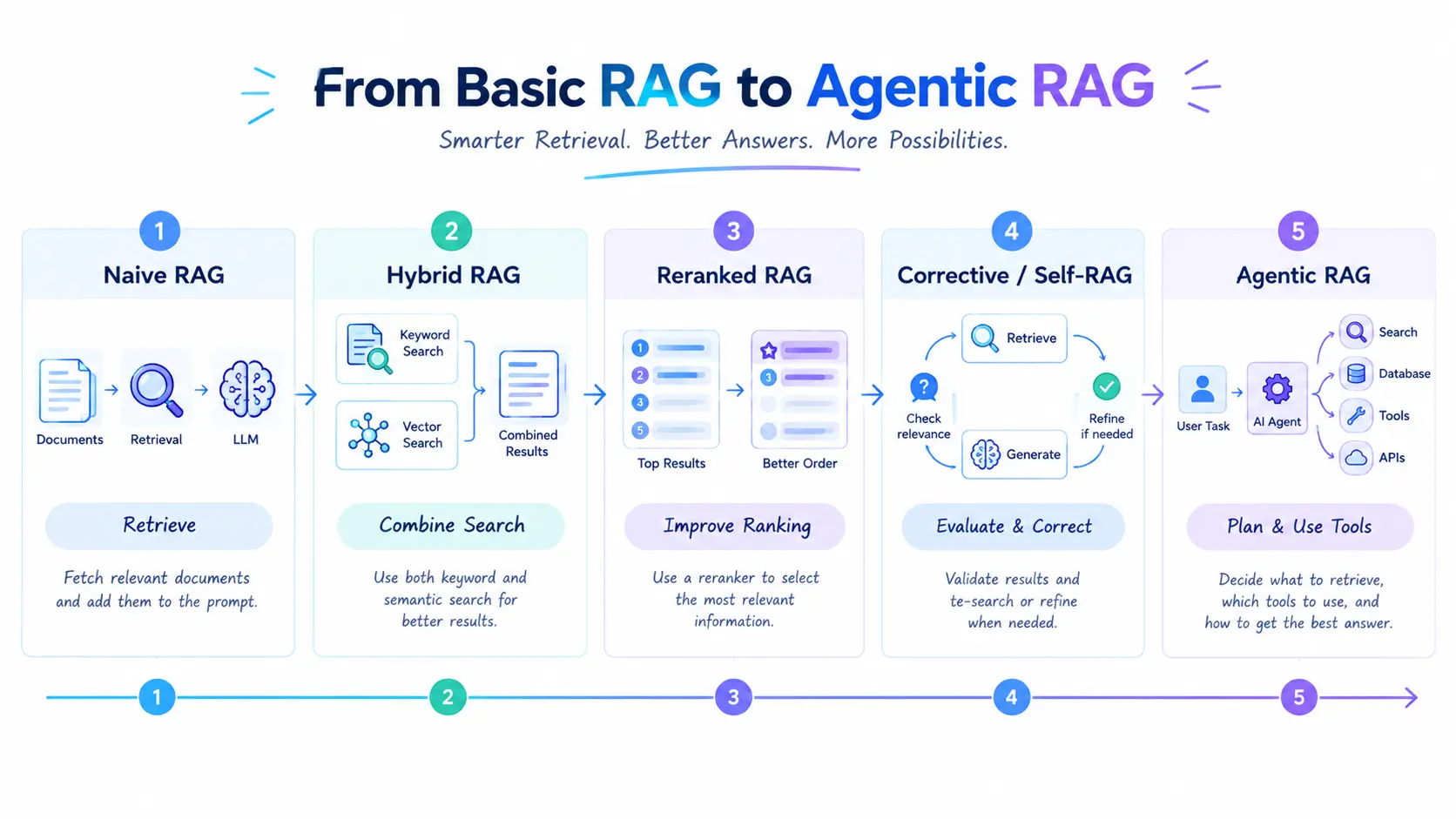
Corrective RAG
What happens if the retrieval results are poor?
A basic RAG pipeline may simply continue.
A more advanced system can evaluate the retrieved information.
For example:
Question
   ↓
Retrieve
   ↓
Are results relevant?
   ↓
 ┌───────┴───────┐
Yes              No
 ↓                ↓
Generate       Rewrite Query
                  ↓
               Search Again
This idea is often associated with Corrective RAG, where retrieval quality influences the next step.
Self-RAG
Self-RAG introduces more adaptive behavior.
Instead of always retrieving the same way, the system can decide when retrieval is useful and can evaluate the generated response against available evidence.
Conceptually:
Question
   ↓
Should I retrieve?
   ↓
Retrieve
   ↓
Generate
   ↓
Check evidence
   ↓
Improve response
This moves RAG from a fixed pipeline toward a more adaptive architecture.
Agentic RAG
The next evolution is Agentic RAG.
Traditional RAG often follows:
Question
 ↓
Retrieve
 ↓
Answer
Agentic RAG can involve:
User Task
    ↓
AI Agent
    ↓
Plan
    ↓
Choose Tool
    ↓
Retrieve
    ↓
Analyze
    ↓
Retrieve Again
    ↓
Compare Information
    ↓
Generate Answer
An agent might decide:
Which knowledge source to use
Whether retrieval is necessary
Whether another search is required
Which tool should be called
Whether the retrieved information is sufficient
Whether the answer needs additional verification
Recent RAG research describes iterative retrieval-generation systems that refine queries based on previous outputs, while also noting the additional latency and risk of error propagation.
GraphRAG
Traditional RAG often represents knowledge as chunks.
But some questions are about relationships.
For example:
"Which projects are connected to the engineers who worked on Product X?"
This involves multiple relationships.
A graph can represent:
Person
  ↓
Works On
  ↓
Project
  ↓
Uses
  ↓
Technology
This can be useful for multi-hop questions.
GraphRAG combines retrieval with graph-based representations of entities and relationships.
The research literature identifies graph retrieval as particularly useful for multi-hop reasoning, although graph construction, entity linking and pruning introduce their own challenges.
Multimodal RAG
RAG is not limited to text.
A knowledge base can contain:
Text
Images
Tables
Charts
Audio
Video
Documents
Code
A multimodal RAG system can retrieve information across different modalities.
For example, a user could ask:
"What does this architecture diagram show?"
The system could retrieve:
The diagram
Its surrounding documentation
Related technical descriptions
and provide those to a multimodal model.
The 2025 literature review identifies multimodal retrieval as an expanding area of RAG research.
RAG for Education
One particularly useful application is education.
Imagine an AI tutor connected to:
Course notes
Textbooks
Lecture slides
Assignments
University policies
Curriculum materials
A student asks:
"Explain this topic according to our course material."
The system retrieves relevant course content and generates an explanation based on that material.
A 2025 systematic survey specifically examined RAG applications in education and highlighted its potential for addressing hallucination and static knowledge limitations in educational AI systems.
Possible applications include:
AI tutors
Personalized learning
Question answering
Quiz generation
Curriculum-based explanations
Assignment assistance
Educational search
Real-World Applications of RAG
RAG can be used in many industries.
Customer Support
Connect an AI assistant to:
Product manuals
FAQs
Troubleshooting guides
Support documentation
The assistant can retrieve the relevant information before responding.
Healthcare
RAG can retrieve information from approved medical or institutional knowledge sources.
However, healthcare applications require strong controls around:
Privacy
Data quality
Source validation
Access control
Human oversight
Legal
A legal assistant can retrieve:
Case law
Regulations
Contracts
Internal legal documents
and generate summaries based on those sources.
The IJNRD paper also identifies legal case summarization as a potential RAG application.
Software Development
RAG can be connected to:
Source code
API documentation
Git repositories
Issue trackers
Architecture documents
Developers can then ask:
"Where is authentication implemented?"
or:
"Which API handles user registration?"
The system retrieves relevant code and documentation before generating an explanation.
Enterprise Search
Instead of manually searching thousands of documents, employees can ask natural-language questions.
For example:
"What is our remote-work policy for employees in India?"
The system retrieves relevant HR documents and generates an answer.
RAG Evaluation
Building a RAG pipeline is only half the job.
You also need to measure whether it works.
Some important evaluation dimensions include:
Retrieval Quality
Did the system retrieve the correct documents?
A common metric is:
Recall@k
It measures how often relevant information appears within the top-k retrieved results.
Answer Quality
Did the generated answer correctly address the question?
Faithfulness
Is the generated response supported by the retrieved context?
Relevance
Did the retrieved information actually relate to the user's question?
Latency
How long does the complete process take?
A RAG system can be accurate but frustrating if every question takes too long.
The literature identifies retrieval quality, generation quality, factual consistency and latency as important evaluation considerations.
Common RAG Problems
RAG sounds simple:
Retrieve → Generate
But production systems are much more complicated.
1. Bad Chunking
If chunks are too small:
Context can be lost.
If chunks are too large:
Irrelevant information can enter the context.
2. Poor Retrieval
If the retriever finds the wrong documents, the LLM receives bad context.
The LLM may then produce an incorrect answer even if the model itself is capable of generating a good response.
3. Noisy Data
Duplicate or outdated documents can confuse retrieval.
This is why data preparation is extremely important.
4. Wrong Embedding Model
An embedding model that does not perform well for your domain can produce poor similarity matches.
For example, a specialized legal or medical corpus may have different requirements from a general conversational corpus.
5. Too Much Context
More context does not automatically mean a better answer.
If you retrieve 30 irrelevant chunks, the LLM has more information but potentially less useful information.
The goal is:
Relevant context, not maximum context.
6. Security Problems
RAG systems can access private information.
That means access control matters.
For example:
Employee A
   ↓
HR Documents Allowed

Employee B
   ↓
Finance Documents Allowed
The retrieval system should not simply search everything available.
7. Prompt Injection Through Retrieved Documents
Retrieved documents themselves can contain malicious or unintended instructions.
For example, a document could contain text designed to manipulate the model.
Therefore, production RAG systems should treat retrieved content as data, not automatically trusted instructions.
How to Build a Better RAG System
A practical development strategy is to improve the system layer by layer.
Start with the basics
Documents
 ↓
Chunking
 ↓
Embeddings
 ↓
Vector Database
 ↓
Top-k Retrieval
 ↓
LLM
Then measure the results.
If retrieval is poor, improve retrieval.
If answers are poor despite good retrieval, investigate generation and prompt design.
Then consider advanced techniques.
A practical improvement path
Level 1: Basic RAG
Good document parsing
Reasonable chunking
Embeddings
Vector search
Prompt construction
Level 2: Better Retrieve
Metadata filtering
Hybrid search
Query rewriting
Reranking
Level 3: Advanced Retrieval
Multi-query retrieval
HyDE
Parent-child retrieval
Contextual retrieval
Query decomposition
Level 4: Adaptive RAG
Corrective RAG
Self-RAG
Adaptive retrieval
Agentic RAG
Level 5: Specialized Architectures
GraphRAG
Multimodal RAG
Domain-specific retrieval
Long-document retrieval
The important lesson is that advanced RAG should solve a measured problem rather than being added simply because it is more sophisticated.
Current RAG research emphasizes trade-offs involving retrieval quality, latency, memory, cost, scalability and complexity.
RAG vs Fine-Tuning
This is one of the most common questions.
RAG | Fine-Tuning |
|---|---|
Adds external knowledge | Changes model behavior |
Knowledge can be updated easily | Requires additional training |
Useful for private documents | Useful for specialized behavior |
Can provide source context | Does not inherently provide live sources |
Good for knowledge retrieval | Good for style/task adaptation |
Often easier to update | Training process can be more involved |
They are not necessarily competitors.
You can use both.
For example:
Fine-tuned Model
       +
RAG Knowledge Base
       ↓
Specialized AI Assistant
Fine-tuning can help the model behave correctly for a specific task, while RAG can provide current or private information.
RAG Architecture in a Production System
A production architecture might look like this:
             DATA SOURCES
                  │
       ┌──────────┼──────────┐
       ↓          ↓          ↓
      PDFs      APIs       Database
       │          │          │
       └──────────┼──────────┘
                  ↓
           Data Processing
                  ↓
              Chunking
                  ↓
             Embeddings
                  ↓
        Vector / Hybrid Store
                  │
                  │
User → Query → Retrieval
                  ↓
             Reranking
                  ↓
           Context Filtering
                  ↓
                LLM
                  ↓
        Grounded Response
                  ↓
        Citations / Sources
In larger systems, additional layers can include:
Authentication
Authorization
Metadata filtering
Query routing
Observability
Caching
Evaluation
Feedback loops
Guardrails
Audit logging
The Future of RAG
RAG is moving beyond the simple:
"Search some documents and put them into a prompt."
Modern research is exploring systems that can dynamically decide:
When to retrieve
What to retrieve
Where to retrieve from
How many documents to retrieve
Whether retrieved information is sufficient
Whether another search is required
How to combine different sources
How to verify the final answer
The research landscape now includes hybrid retrieval, reranking, graph-based retrieval, multimodal RAG, iterative retrieval, adaptive systems and agentic workflows.
At the same time, these systems introduce additional costs and complexity.
For example, iterative retrieval can improve multi-step reasoning but also increases latency. Hybrid systems can improve retrieval but require careful score combination and ranking. Graph systems can help with relationships but introduce challenges around entity linking and graph maintenance.
So the future of RAG is not simply about making retrieval more complicated.
It is about making retrieval more relevant, adaptive, reliable and efficient.
Final Takeaway
Retrieval-Augmented Generation provides a practical way to connect LLMs with external knowledge.
The basic idea is simple:
Retrieve relevant information → Give it to the LLM → Generate a grounded answer.
But production RAG involves much more than a vector database.
A reliable system requires attention to:
Data quality
Document parsing
Chunking
Embeddings
Retrieval
Hybrid search
Reranking
Metadata
Context management
Prompt design
Evaluation
Security
Latency
Cost
Basic RAG provides the foundation.
Advanced techniques such as hybrid retrieval, reranking, query rewriting, contextual retrieval, Corrective RAG, Self-RAG, GraphRAG and Agentic RAG can address specific weaknesses when they are actually needed.
The most important concept to remember is:
An LLM provides the language intelligence. RAG connects that intelligence to relevant external knowledge.
That combination is one of the key architectural patterns behind modern knowledge-intensive AI applications.
Frequently Asked Questions
1. Is RAG the same as a vector database?
No.
A vector database is one component that can be used inside a RAG system.
RAG is the overall architecture involving retrieval and generation.
2. Does RAG eliminate hallucinations?
No.
RAG can improve grounding by supplying relevant external information, but it does not guarantee that every generated statement is correct.
Retrieval quality and generation quality must both be evaluated.
3. Is RAG better than fine-tuning?
They solve different problems.
RAG is primarily useful for connecting a model to external, changing or private information.
Fine-tuning is useful for adapting model behavior, style or task performance.
They can also be combined.
4. Does RAG require a vector database?
No.
RAG can use:
Vector search
Keyword search
SQL databases
Graph databases
Search engines
Hybrid retrieval
Multiple knowledge sources
Modern systems often combine multiple retrieval methods.
5. What should beginners learn first?
A good learning sequence is:
LLMs → Embeddings → Vector Databases → Basic RAG → Chunking → Retrieval → Reranking → Hybrid Search → Advanced RAG → Agentic RAG
Once you understand the basic pipeline, advanced techniques become much easier to understand.
Ready to go deeper?
Professional Training
Hands-on, mentor-led training aligned with industry certifications.
About the Author
Sharper every day
Daily tutorials, analysis, and career playbooks across all 12 Xcademia disciplines, straight to your inbox. No spam.