
OpenAI's GPT-6 Astra Helps Researchers Develop a New Mathematical Framework for the Standard Model
OpenAI reveals how GPT-6 Astra helped physicist Nathaniel Craig develop a candidate mathematical framework for defining the Standard Model on a lattice, highlighting AI's growing role in advanced scientific research.
Xcademia Team

OpenAI has detailed how its GPT-6 Astra model contributed to a mathematical construction that could help researchers establish a nonperturbative definition of the Standard Model of particle physics.
OpenAI has published a scientific account describing how GPT-6 Astra assisted physicist Nathaniel Craig in developing a candidate lattice-based mathematical framework for the Standard Model, one of the most important theories in modern physics.
The work addresses a longstanding mathematical challenge: establishing a complete nonperturbative definition of the Standard Model, which describes fundamental particles and three of the four known fundamental forces.
Craig, a visiting scientist at OpenAI and leader of the particle theory group at the University of California, Santa Barbara, explained that Astra helped transform an existing research strategy into a mathematical construction and contributed substantially to developing its detailed proof.
The announcement, published on November 15, 2026, highlights an emerging application of artificial intelligence in theoretical science, where AI systems can assist researchers with complex mathematical reasoning and proof development.
However, OpenAI also emphasised that the proposed construction remains a candidate solution. Further scientific examination and practical development are required before it can support realistic lattice simulations.
Understanding the Standard Model and Its Mathematical Challenge
The Standard Model is the theoretical framework physicists use to describe elementary particles and their interactions.
It accounts for three fundamental forces:
Strong nuclear force: Holds quarks together and contributes to the structure of protons and neutrons.
Weak nuclear force: Governs processes such as certain forms of radioactive decay.
Electromagnetic force: Describes interactions involving electrically charged particles.
The theory has demonstrated remarkable agreement with experimental observations across a broad range of energy scales.
Nevertheless, an important mathematical question remains unresolved: how can researchers define the complete interacting theory without relying on approximations that treat interactions as small corrections?
Much of modern theoretical physics uses an approach called perturbation theory.
This method begins with a simplified system in which interactions are effectively switched off.
Researchers then introduce interactions through a series of increasingly refined corrections.
It has produced extremely precise predictions in several areas of physics.
However, it is not sufficient for every problem.
Consider the proton. Although it consists of three quarks, its mass comes primarily from the dynamics and interactions of quarks and gluons associated with the strong nuclear force.
Simply switching off the strong force would fundamentally change the system. Consequently, perturbative calculations are not an adequate way to explain the proton's mass.
Researchers therefore need nonperturbative methods that account for interactions from the beginning rather than treating them as small corrections.
Why Lattice Field Theory Matters
One promising approach involves representing spacetime as a grid of discrete points.
This method is known as lattice field theory.
Instead of working directly with continuous spacetime, researchers construct a mathematical model using a finite grid. The distance between neighbouring points determines the shortest length scale that the model can resolve.
This approach offers two important advantages.
First, it provides a mathematical framework for studying interacting systems nonperturbatively at a specified lattice spacing.
Second, it makes computational investigation possible, allowing researchers to calculate theoretical predictions using computers.
Lattice field theory has already contributed significantly to understanding the strong nuclear force, including calculations of the proton's mass from first principles.
However, extending this approach to the complete Standard Model introduces another major mathematical difficulty.
The Problem of Left-Handed and Right-Handed Particles
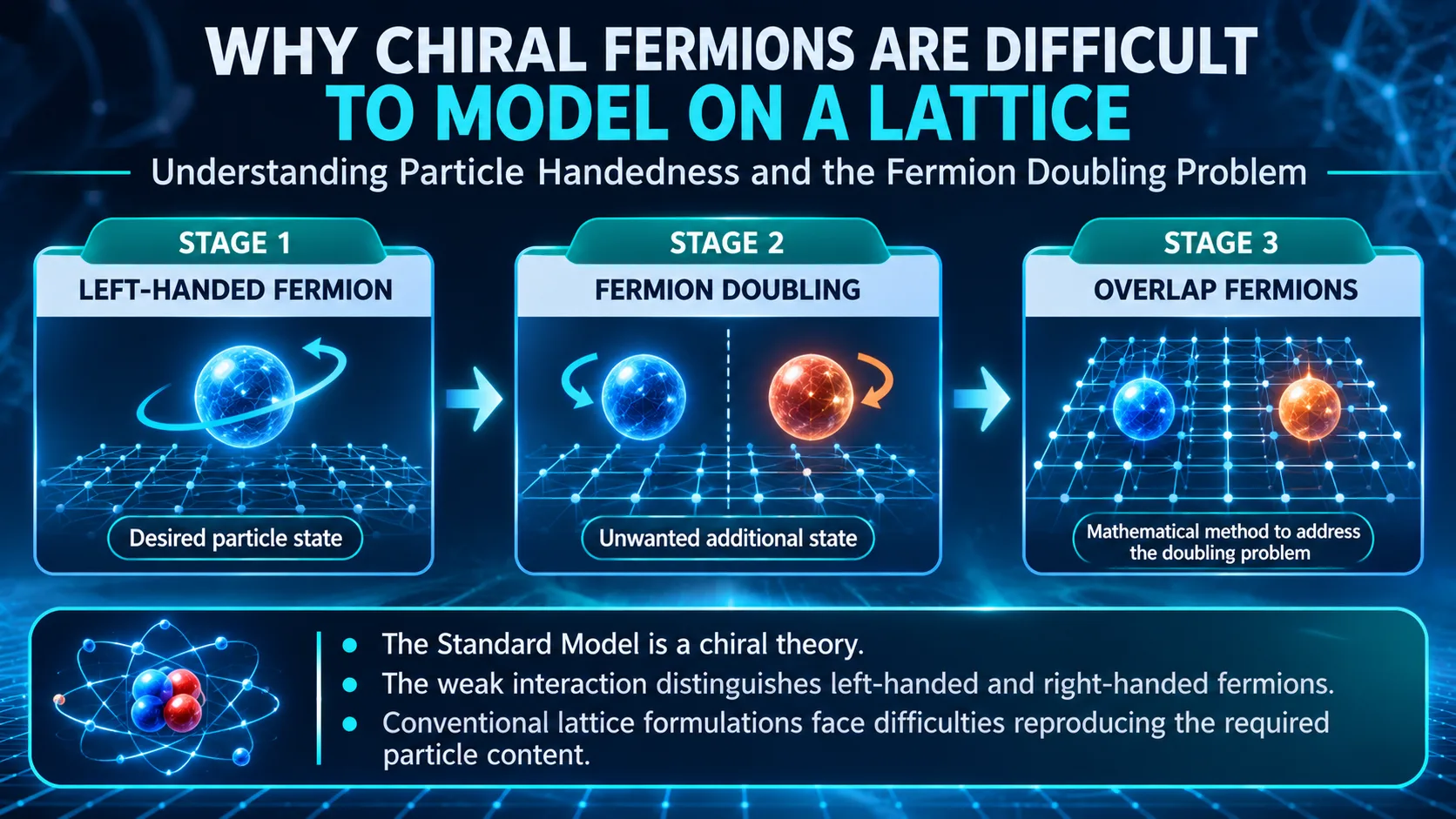
The Standard Model is a chiral theory, meaning that its fundamental interactions can distinguish between left-handed and right-handed particles.
This distinction is particularly important for the weak nuclear force, which interacts differently with left-handed and right-handed fermions.
Fermions are a class of fundamental particles that includes electrons and quarks.
When researchers attempt to represent chiral theories on a lattice, a mathematical problem can arise. A straightforward formulation may introduce additional unwanted particle states known as fermion doublers.
These additional states do not match the particle content researchers are trying to describe.
This issue has made it difficult to establish a complete nonperturbative lattice formulation of the Standard Model.
Earlier research introduced important mathematical tools to address the problem, including overlap fermions.
These formulations provide a way to distinguish left-handed and right-handed fermions while addressing the unwanted doubling problem.
However, another challenge remained: determining the correct mathematical phase associated with the fermion measure.
How Light and Mirrors Explain the Problem
To make the underlying mathematics easier to understand, Craig uses an analogy involving light and mirrors.
Light can have left-circular or right-circular polarisation, describing the direction in which its electric field rotates as it travels.
Imagine a laboratory experiment in which a laser produces only left-circularly polarised light inside a box with mirrors at both ends.
When the light reflects from an ordinary mirror, its polarisation changes. The returning beam can therefore contain the opposite polarisation.
This resembles the unwanted fermion doubling problem in lattice field theory.
Craig explains that specially structured chiral mirrors offer a possible analogy for addressing this difficulty.
These mirrors use layered materials arranged in a spiral structure. Under appropriate conditions, they can reflect light while preserving its circular polarisation.
The analogy helps illustrate how mathematical formulations can preserve the required handedness of particles when constructing a lattice theory.
Previous theoretical work established several important elements of this approach, including overlap fermions and methods for distinguishing different fermion states.
Nevertheless, the correct phase prescription for the full Standard Model remained an unresolved part of the construction.
Solving the Phase Problem Through Finer Lattices
The next challenge involved determining how the mathematical phase should be assigned as the force fields change.
The difficulty arises because the phase depends on the configuration of the Standard Model's force fields across the lattice.
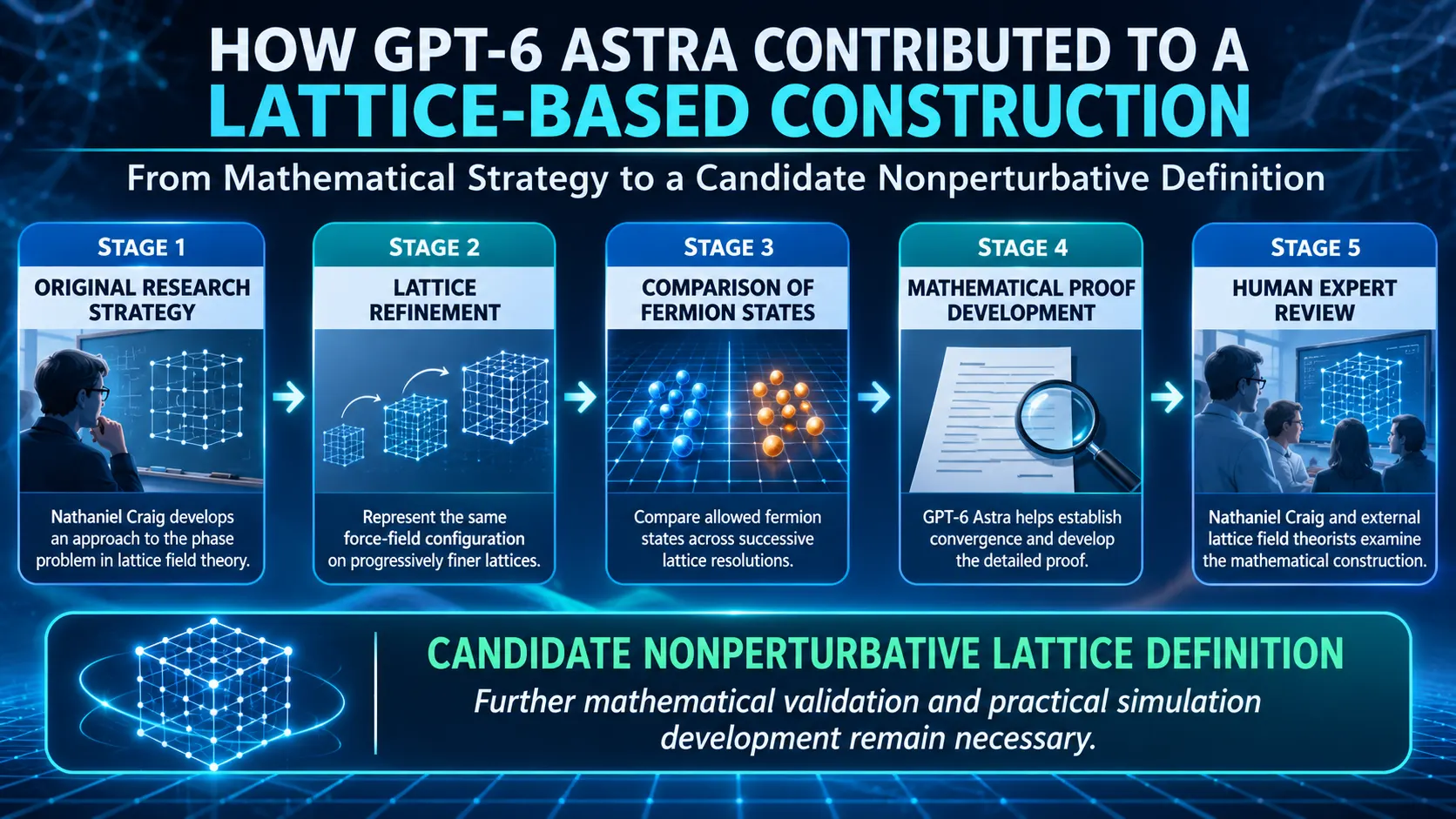
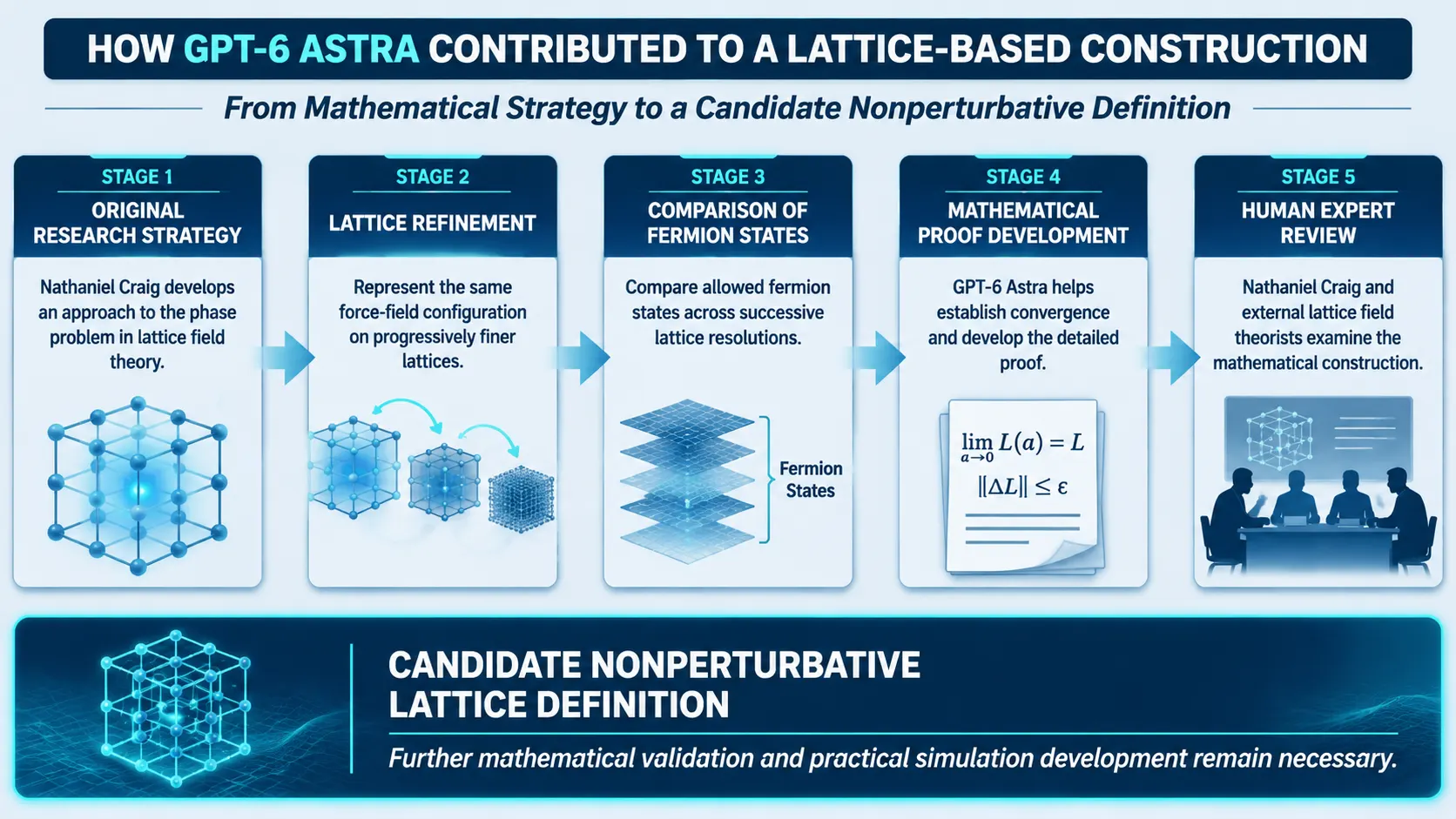
Craig's proposed strategy involved representing the same force fields across a sequence of progressively finer lattices.
Researchers can compare the allowed fermion states between neighbouring lattice resolutions. These comparisons provide individual contributions to the overall phase correction.
By combining these contributions, the construction establishes a phase prescription for the original lattice.
The resulting mathematical proof shows that the correction works around every allowed loop of force-field configurations.
It also establishes that the correction for a change at one location depends primarily on nearby fields and that different mathematical descriptions of the same fields produce consistent results.
According to the announcement, this provides a candidate measure for the Standard Model at finite lattice spacing, subject to a bound on field strengths at the lattice scale.
How GPT-6 Astra Contributed to the Research
One of the most significant aspects of the announcement is the role played by GPT-6 Astra in developing the mathematical construction.
Craig had already developed a strategy for addressing the phase problem but had not established a complete proof covering all the necessary cases.
GPT-6 Astra helped turn this strategy into a working construction.
According to Craig, the model contributed in several important areas:
Refining the lattice approach: Astra suggested a method for representing a given configuration of force fields on progressively finer grids.
Establishing convergence: It helped demonstrate that comparisons between successive lattice resolutions would converge towards a definite mathematical result.
Developing the proof: Astra took the lead in developing the detailed mathematical proof supporting the construction.
Supporting mathematical reasoning: The model helped connect the different elements of the refinement strategy into a consistent framework.
However, the research was not conducted by AI alone.
Craig also acknowledged the contributions of lattice field theorists Maarten Golterman, Andreas Kronfeld and Yigal Shamir, who reviewed the proof and raised questions that helped assess the construction.
Their expertise played an important role in evaluating the mathematical arguments and strengthening confidence in the result.
The collaboration illustrates how advanced AI systems can contribute to specialised scientific research while human researchers remain essential to evaluating and validating the work.
What the Research Actually Establishes
The result is a candidate nonperturbative lattice definition of the Standard Model.
The associated research paper, titled A gauge-invariant measure for lattice chiral fermions, was submitted to arXiv on October 6, 2026.
It describes a gauge-invariant measure for overlap fermions on four-dimensional Euclidean lattices within a class of non-Abelian chiral gauge theories that includes the Standard Model.
The paper also describes how comparisons between chiral projectors at successive lattice spacings can establish the mathematical properties needed for constructing a smooth, gauge-invariant fermion measure.
This is an important theoretical development, but it should not be confused with a fully completed or experimentally validated formulation of the Standard Model.
Craig explicitly notes that the construction is currently much more of an answer in principle than an answer in practice.
Several questions remain open.
One important issue is whether the construction satisfies reflection positivity at finite lattice spacing. This mathematical condition helps establish a connection between lattice calculations and a quantum theory with physically consistent probabilities.
Researchers must also determine how to make the approach useful for realistic lattice simulations.
Research paper: https://arxiv.org/abs/2610.09093
What Comes Next for AI-Assisted Scientific Research?
OpenAI's announcement places the mathematical construction within a wider scientific research effort.
Craig also discusses OpenAI's recent proof concerning the existence of Yang-Mills theory, which is relevant to understanding the mathematical foundations of the strong and weak forces.
According to the announcement, this development provides another important element for investigating the existence of interacting theories in continuous spacetime.
The new lattice construction and the broader Yang-Mills work could support further research into the mathematical foundations of particle physics.
However, important questions remain about how the proposed framework will perform in practical calculations and whether it satisfies all the mathematical requirements expected of a complete theory.
From an AI research perspective, the development is notable because it demonstrates a potential role for advanced models beyond conventional information retrieval, coding assistance and content generation.
For researchers, AI systems could help explore mathematical strategies, investigate complex proof structures and develop approaches that would otherwise require extensive manual work.
For the scientific community, the important question is not simply whether an AI model can produce a mathematical argument. It is whether that argument can withstand independent expert scrutiny and contribute to reproducible scientific progress.
Conclusion
OpenAI's work with Nathaniel Craig represents a notable example of AI-assisted theoretical physics.
GPT-6 Astra helped develop a candidate lattice-based construction addressing a mathematical challenge that has remained open for decades.
The result does not complete the mathematical definition of the Standard Model in every required sense, nor does it immediately enable realistic simulations. Further investigation, validation and development remain necessary.
Nevertheless, the research highlights how advanced AI models may contribute to difficult scientific problems when combined with established mathematical methods and human expertise.
The broader significance lies in the evolving relationship between AI and scientific discovery, where models are increasingly being explored as collaborators in complex research rather than simply tools for answering questions.
Source: OpenAI
About the Author