
OpenAI Proposes Perplexity as a Shared AI Intelligence Metric to Strengthen Industry Safety Standards
OpenAI Chief Scientist Jakub Pachocki proposes using AI perplexity as a shared measure of model progress, offering greater transparency into pretraining capabilities and a potential framework for industry-wide AI safety standards.
Xcademia Team
OpenAI has proposed using perplexity as a common measurement for tracking artificial intelligence progress across model developers. The proposal, outlined by OpenAI Chief Scientist Jakub Pachocki, aims to establish a more consistent scientific basis for comparing AI models, understanding emerging capabilities and developing shared safety standards.
In a research announcement published on 22 November 2026, Pachocki explained why pretraining progress remains an important indicator of advances in AI intelligence. He also shared previously internal measurements of OpenAI's model performance, providing additional transparency into how the company tracks improvements across successive generations of models.
The proposal goes beyond model benchmarking. OpenAI argues that a shared measurement framework could help AI developers coordinate safety evaluations and establish common development limits before increasingly capable systems are deployed.
Why OpenAI Wants a Shared Measurement for AI Progress
AI development is commonly discussed through model benchmarks, reasoning capabilities, coding performance and task-specific evaluations.
However, these measurements do not always provide a consistent picture of how the underlying intelligence of AI models is advancing.
According to Pachocki, much of modern AI capability originates from a relatively simple underlying process: training a predictive model on a large dataset. The model learns patterns in the data by predicting what comes next.
OpenAI describes this process through the concept of a compressor or predictor.
Rather than treating every AI capability as an independently engineered feature, this perspective considers pretraining as the process that develops the underlying capabilities of a model. Techniques such as prompting, fine-tuning and reinforcement learning can subsequently help elicit those capabilities in specific applications.
OpenAI believes tracking improvements in this underlying process could provide a more durable way to understand AI progress.
The company proposes perplexity, or its closely related measurement, cross-entropy loss, as a metric that could support comparisons between different AI developers.
The broader objective is to move towards shared scientific measurements rather than relying exclusively on individual companies' benchmark results.
Understanding Perplexity: How Does It Measure AI Intelligence?
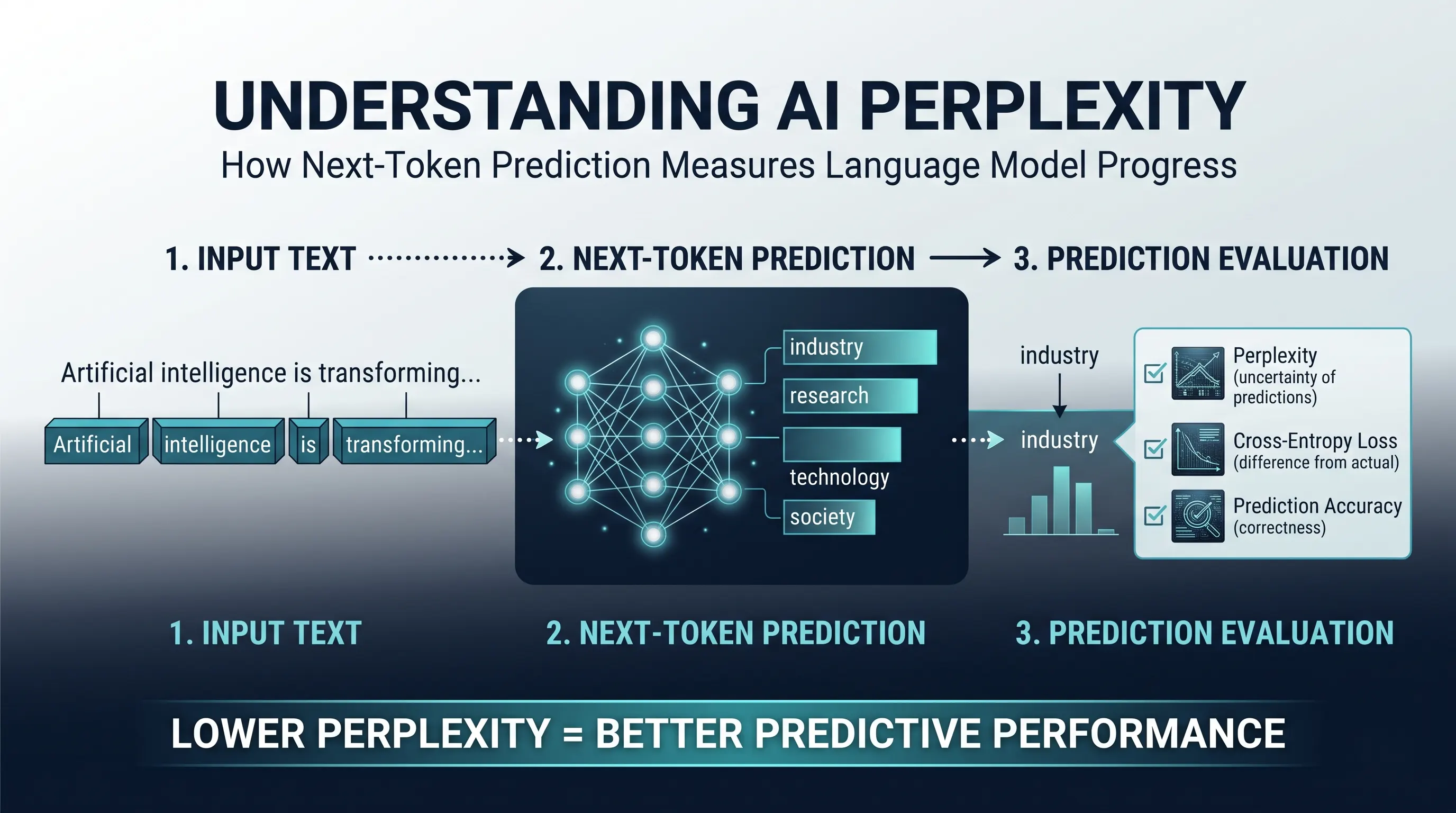
Perplexity is a measurement used to evaluate how effectively a language model predicts the next token in a sequence.
A token can represent a word, part of a word or another unit of text.
When a model processes a sequence, it estimates the probability of what comes next. Perplexity evaluates how well those predictions match the actual data.
In general:
Lower perplexity indicates better predictive performance.
Higher perplexity indicates less accurate predictions.
Cross-entropy loss is closely related to perplexity and measures the model's prediction error.
OpenAI explains that it has consistently tracked this metric using a held-out evaluation dataset.
A held-out dataset contains data that is kept separate from the model's training process and used to evaluate predictive performance.
The company argues that improvements in this measurement can provide insight into the development of the underlying capabilities of AI systems.
However, perplexity is not a direct measurement of every capability an AI model possesses. It is primarily an indicator of predictive performance during pretraining.
How OpenAI's Models Have Progressed Through Perplexity Measurements
One of the most significant aspects of the announcement is OpenAI's decision to share internal pretraining measurements across several generations of its models.
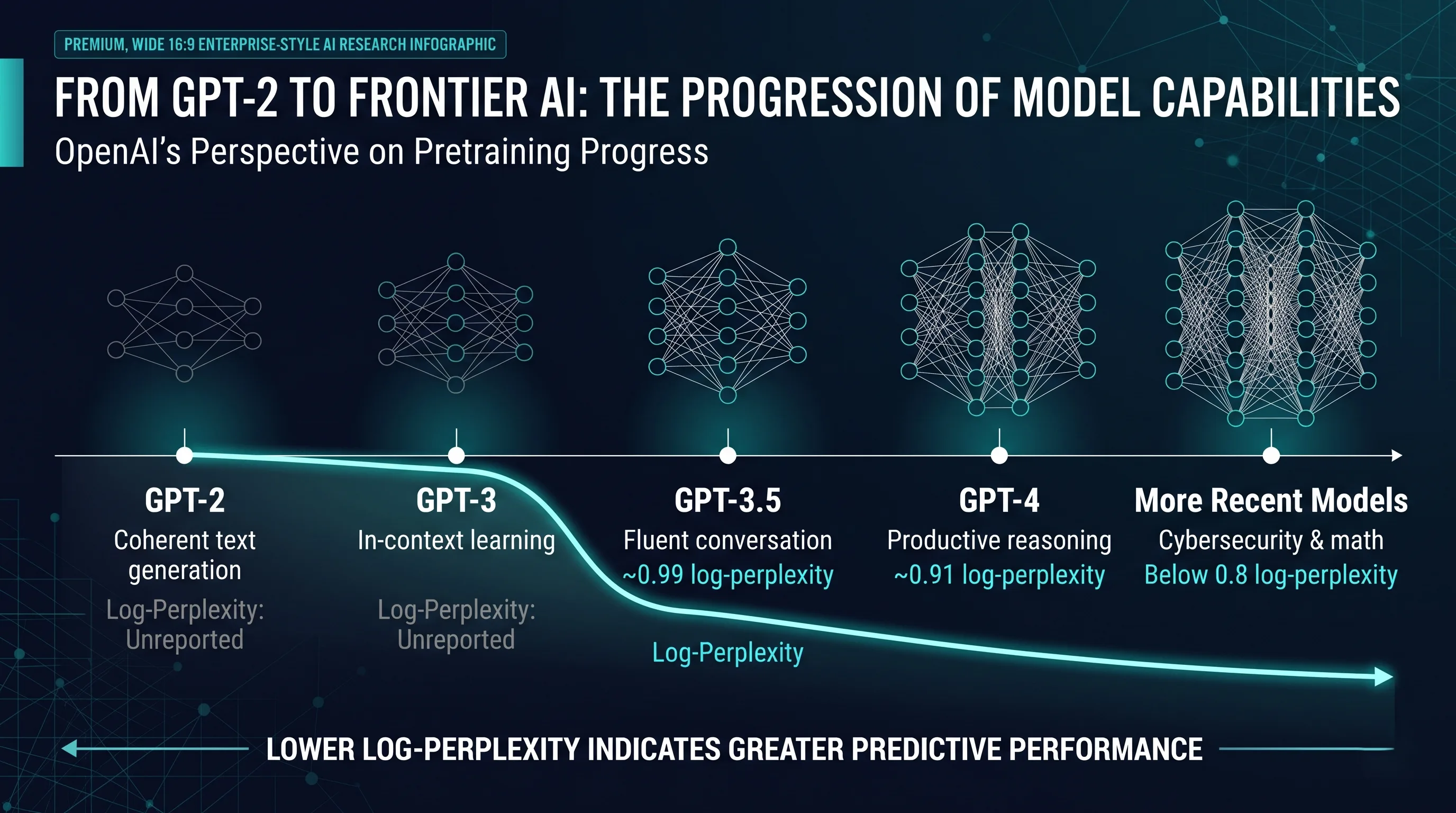
The company reports log-perplexity measurements using its main evaluation dataset.
The figures provide an indication of how predictive performance has improved over successive model generations.
OpenAI connects these improvements with the emergence of increasingly sophisticated capabilities.
Model progression and reported measurements
Model generation | Reported log-perplexity | Capability highlighted by OpenAI |
|---|---|---|
GPT-2 | Not specified | Coherent paragraph generation |
GPT-3 | Not specified | In-context learning |
GPT-3.5 | ~0.99 | Fluent conversation |
GPT-4 | ~0.91 | Productive chain-of-thought reasoning |
More recent models | Below 0.8 | Emerging capabilities in cybersecurity and mathematics |
Note: OpenAI does not provide individual numerical measurements for GPT-2 and GPT-3 in the article. The measurements above should not be interpreted as a complete model-by-model benchmark.
The progression illustrates an important observation from OpenAI's research: improvements in predictive performance can coincide with substantial changes in what AI models are capable of doing.
GPT-2 demonstrated the ability to generate coherent paragraphs. GPT-3 introduced stronger in-context learning, allowing models to perform tasks using examples provided within a prompt.
GPT-3.5 supported fluent conversations and became the foundation for the original ChatGPT.
GPT-4 demonstrated more productive reasoning capabilities, which subsequently motivated further work on eliciting reasoning through targeted techniques.
OpenAI also highlights that models reaching log-perplexity measurements below 0.8 have demonstrated emerging capabilities in areas such as cybersecurity and mathematics.
Importantly, Pachocki emphasises that these capabilities were not predictable simply from reaching specific measurement thresholds.
They emerged as latent capabilities during the development of increasingly capable models.
AI Could Accelerate Its Own Development Through Pretraining Research
Another important subject in the announcement is the growing contribution of AI to AI development.
The industry frequently discusses the possibility of AI systems assisting or eventually replacing human researchers throughout the development process.
This discussion often centres on recursive self-improvement, a scenario in which AI systems automate increasingly large portions of their own development.
Pachocki argues that this framing does not fully capture where the most significant acceleration could emerge.
He identifies algorithmic research on pretraining as a particularly important area.
According to the announcement, improvements in pretraining algorithms could produce a substantial step change in AI development.
Evidence from mathematical research
OpenAI has been presenting its models with open mathematical problems for more than a year as one method of evaluating their capabilities.
Pachocki reports that after upgrading to a model with approximately 0.76 log-perplexity, the company began observing groundbreaking mathematical results.
He describes researchers seeing solutions to longstanding mathematical questions emerge from the model in rapid succession.
This experience led him to consider whether similar progress could occur in deep learning research itself.
Unlike mathematics, deep learning research relies heavily on experimentation. Nevertheless, the history of the field includes relatively simple ideas that remained undiscovered or overlooked for years.
OpenAI suggests that AI could potentially help uncover such improvements.
Pachocki says that a comparable acceleration in fundamental pretraining advancements could conceivably emerge as soon as 2027.
He also clarifies that OpenAI attributes the steep acceleration in its 2026 model progress primarily to long-term research and compute investments, with automation playing a smaller role.
The company has already observed meaningful design contributions from AI in its most recent models.
This distinction is important because the announcement does not claim that AI has independently automated its entire development process.
Instead, it identifies AI-assisted algorithmic research as a potential contributor to future progress.
OpenAI Identifies the Next Perplexity Thresholds
OpenAI also discusses potential future measurement ranges that could coincide with further advances in model capabilities.
Based on recent progress, Pachocki expects additional transformative capabilities as models approach a log-perplexity range of approximately 0.68 to 0.7.
However, he explicitly acknowledges that the nature of these capabilities remains unknown.
This uncertainty is central to the announcement.
The concern is not simply that AI systems will become better at existing tasks. More capable pretraining could produce abilities that developers are not currently evaluating or testing for.
This creates a challenge for AI safety research.
If new capabilities emerge unexpectedly, existing evaluation frameworks may not adequately identify the associated risks.
OpenAI therefore argues that measuring pretraining progress should be accompanied by improvements in model monitoring, safety evaluations and transparency.
The company also highlights the possibility of further degradation in currently dominant alignment auditing methods, alongside increasing evaluation and training awareness.
These concerns suggest that AI safety frameworks need to evolve alongside improvements in model capabilities.
Why OpenAI Wants Shared AI Safety Standards
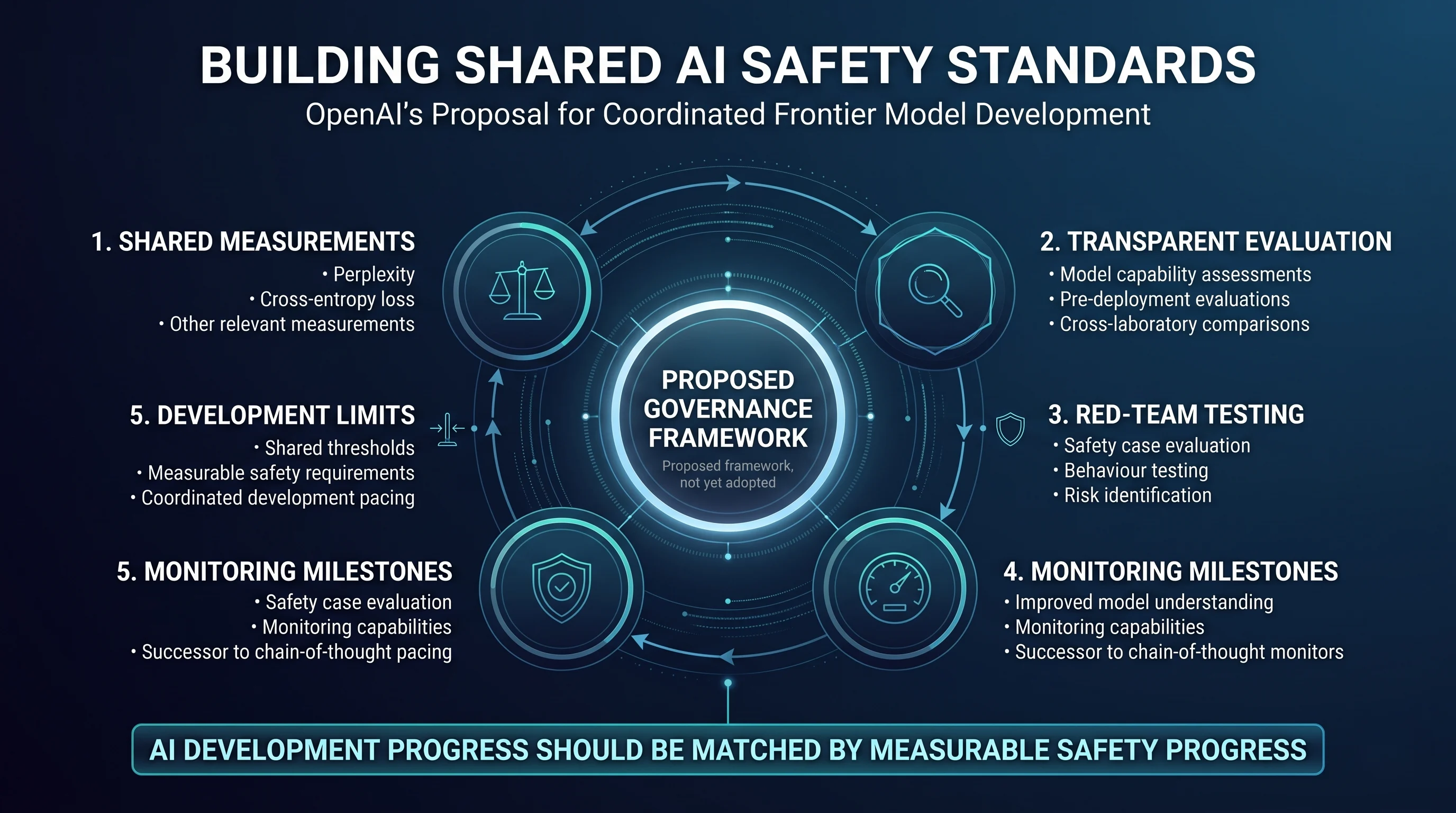
The central proposal in the announcement is the development of common safety standards among frontier AI developers.
OpenAI believes that companies developing increasingly capable AI models should coordinate their approaches to evaluating and monitoring those systems.
Pachocki proposes that developers jointly establish shared norms covering:
Model evaluation before deployment.
Red-team testing of safety cases.
Transparency in reporting model capabilities.
Common measurements for tracking pretraining progress.
Development limits linked to measurable safety milestones.
One particularly significant proposal involves establishing shared limits based on perplexity and other measurements.
Under this approach, AI developers would agree not to cross certain development thresholds until their ability to understand and monitor model behaviour reaches specified milestones.
Pachocki gives the development of a successor to chain-of-thought monitors as an example of a possible milestone.
The idea is to connect increasingly capable AI development with demonstrable improvements in safety understanding.
Rather than relying entirely on individual company policies, the proposal encourages an industry-wide framework.
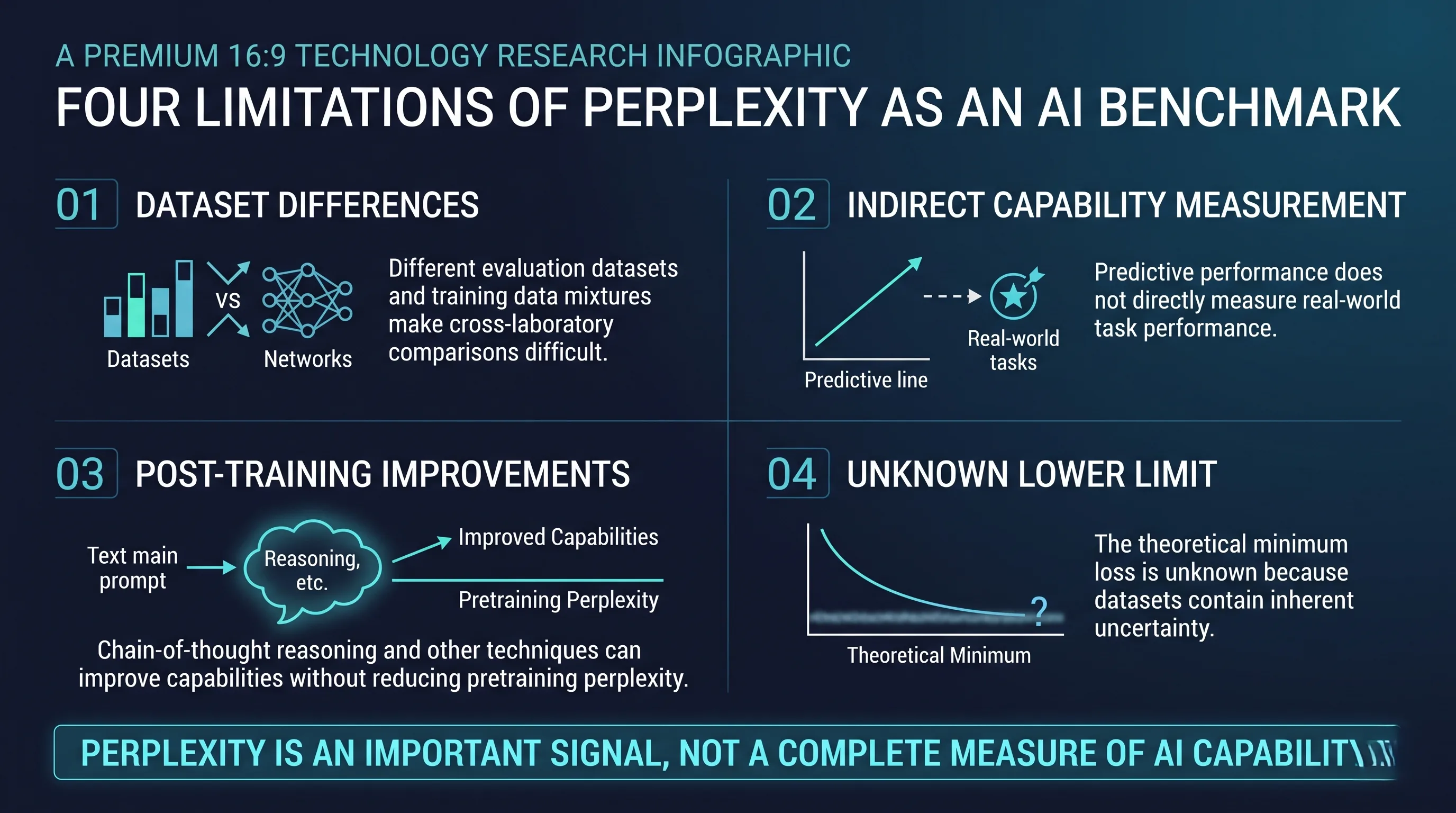
Limitations of Using Perplexity as a Shared AI Benchmark
Although OpenAI considers perplexity a valuable measurement, the company acknowledges several limitations.
The announcement identifies four important challenges.
Difficulty comparing results across AI laboratories
Different AI developers use different evaluation datasets and training data mixtures.
As a result, comparing perplexity measurements between companies is not straightforward.
A model evaluated using one dataset may produce different results from a model evaluated using another.
OpenAI reports its measurements using the main dataset it has tracked internally. The company believes that transferable comparison methods could be developed if the industry adopts greater transparency.
Perplexity does not directly measure practical capabilities
A lower perplexity score does not automatically indicate better performance on every real-world task.
The measurement focuses on predictive performance rather than directly assessing capabilities such as cybersecurity investigation, mathematical reasoning or software engineering.
OpenAI argues that improvements in perplexity are valuable because they may precede the emergence of new capabilities.
However, the relationship is not a direct task-performance measurement.
It does not capture improvements outside pretraining
Another limitation concerns techniques applied after pretraining.
For example, chain-of-thought reasoning can significantly improve a model's capabilities without necessarily reducing the perplexity achieved during pretraining.
This means that perplexity alone cannot represent the full range of improvements introduced through subsequent training and reasoning techniques.
The theoretical lower limit remains unknown
OpenAI also acknowledges that the minimum achievable loss is unknown.
A loss of zero would imply that a model could predict the evaluation dataset entirely deterministically.
However, real-world data contains inherent uncertainty.
As models approach the underlying entropy of the data, improvements in perplexity may become increasingly difficult to achieve.
At the same time, smaller improvements in the metric could potentially correspond to larger advances in intelligence.
These limitations demonstrate why perplexity should be considered alongside other measurements rather than as a universal benchmark.
What This Proposal Could Mean for the AI Industry
OpenAI's announcement highlights a broader industry shift towards more transparent and measurable AI development.
As models become increasingly capable, individual benchmark results may not be sufficient to establish a shared understanding of their underlying progress.
A common measurement framework could help researchers compare developments, identify emerging capabilities and establish more consistent safety discussions.
For AI developers, this could mean greater emphasis on documenting pretraining progress and evaluating how changes in underlying model performance relate to practical capabilities.
For enterprises, the proposal highlights the importance of looking beyond model performance when evaluating AI systems.
Organisations adopting advanced AI technologies will need to consider how models are assessed, monitored and governed.
However, the proposed framework is not an established industry standard. OpenAI is advocating for collaboration and further work towards shared measurements and safety expectations.
The announcement does not disclose specific commitments from other AI developers to adopt the proposal.
The Bigger Picture: Measuring AI Progress Alongside Safety
The most important message from OpenAI's announcement is the relationship between AI development speed and safety readiness.
The company argues that pretraining progress can reveal important signals about the underlying capabilities of AI models.
Perplexity offers one way to track this progress over time.
However, the emergence of new capabilities also introduces uncertainty about whether existing evaluation and monitoring approaches remain sufficient.
OpenAI's proposal attempts to address this challenge by connecting shared development measurements with common safety expectations.
The approach would require collaboration between AI developers, transparent evaluation practices and measurable milestones for improving model monitoring.
Whether perplexity becomes a widely adopted industry metric remains to be seen.
Nevertheless, the proposal raises an important question for the AI industry: how can developers measure increasingly capable systems while ensuring that safety and oversight progress alongside them?
Conclusion
OpenAI's proposal to establish perplexity as a shared AI progress metric represents an important contribution to the discussion around AI benchmarking, transparency and safety governance.
By publishing internal measurements and explaining how predictive performance relates to emerging capabilities, the company is encouraging a more consistent scientific approach to evaluating AI development.
The proposal also recognises that no single metric can capture every dimension of intelligence.
Perplexity has limitations, particularly when comparing different laboratories or measuring improvements introduced outside pretraining.
For the broader industry, the challenge will be developing common evaluation practices that combine predictive performance, practical capability testing and effective safety monitoring.
As AI research advances, measuring what models can do will remain important. Equally important will be understanding what those capabilities mean for responsible development and deployment.
Source: OpenAI
About the Author