
NVIDIA Expands AI Infrastructure Capacity Across Australia
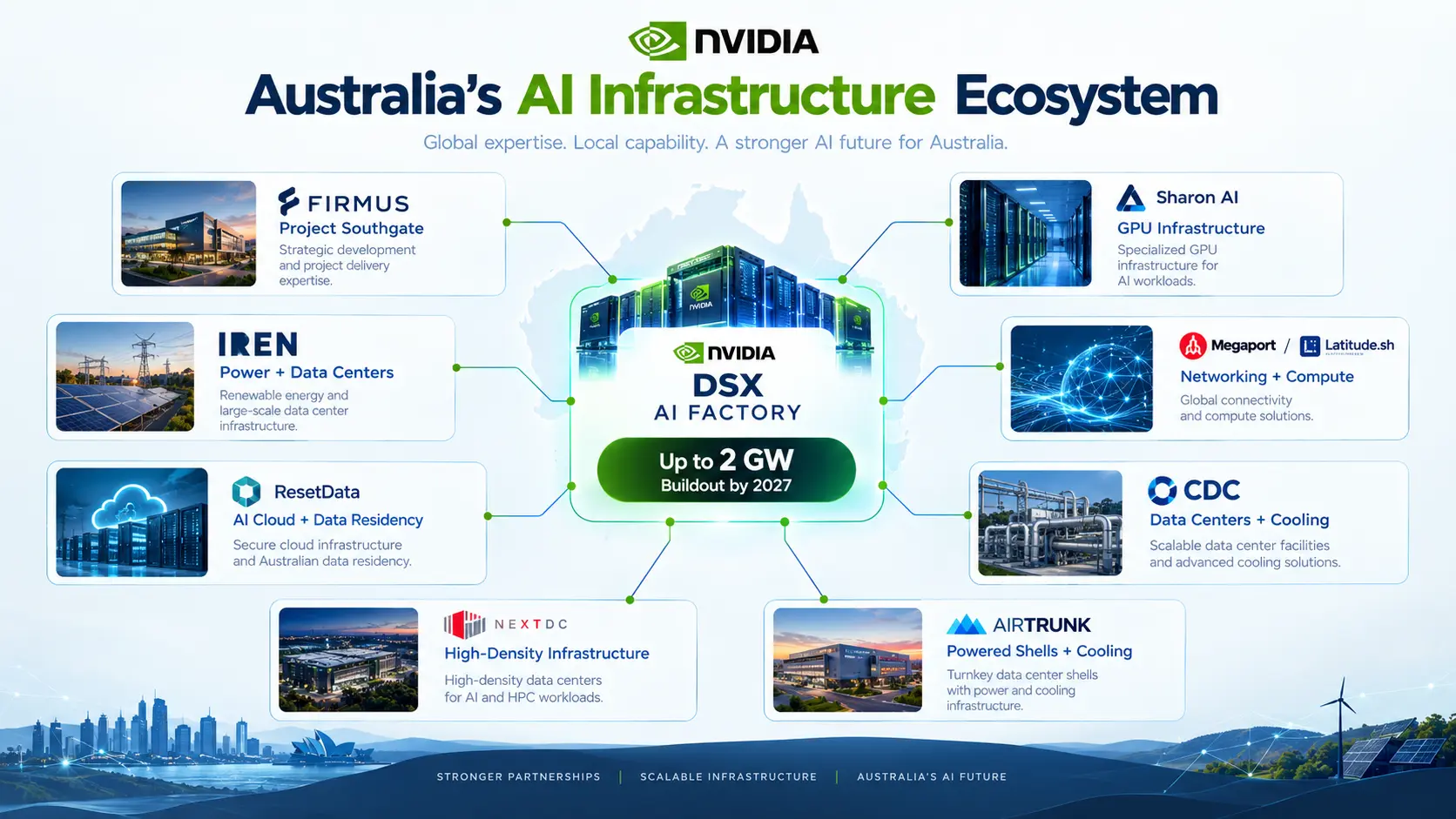
NVIDIA is expanding Australia’s AI infrastructure ecosystem with partners including Firmus, Sharon AI, IREN, Megaport, ResetData, CDC, NEXTDC and AirTrunk, targeting up to 2 gigawatts of AI factory capacity by 2027.
Xcademia Team
Xcademia Research Team
NVIDIA Expands AI Infrastructure Capacity in Australia
NVIDIA is expanding its AI infrastructure footprint in Australia through a growing network of cloud and infrastructure partners.
The company announced on September 9 that it is working with Australian NVIDIA Cloud Partners and AI infrastructure providers including Firmus, Sharon AI, IREN, Megaport, ResetData, CDC, NEXTDC and AirTrunk.
Together, the participating companies are expanding land, power and data center shell capacity designed to support multiple generations of NVIDIA DSX AI factories.
The announced buildout is expected to reach up to 2 gigawatts by 2027, reflecting the growing demand for high-performance computing from AI labs, startups, enterprises, researchers and other organizations.
Rather than operating all of these facilities itself, NVIDIA will provide the DSX platform along with accelerated computing, networking, software and ecosystem support. The participating infrastructure providers will operate the AI factories.
The announcement connects three important parts of the AI ecosystem: physical data center infrastructure, accelerated computing and AI software.
What Is NVIDIA DSX?
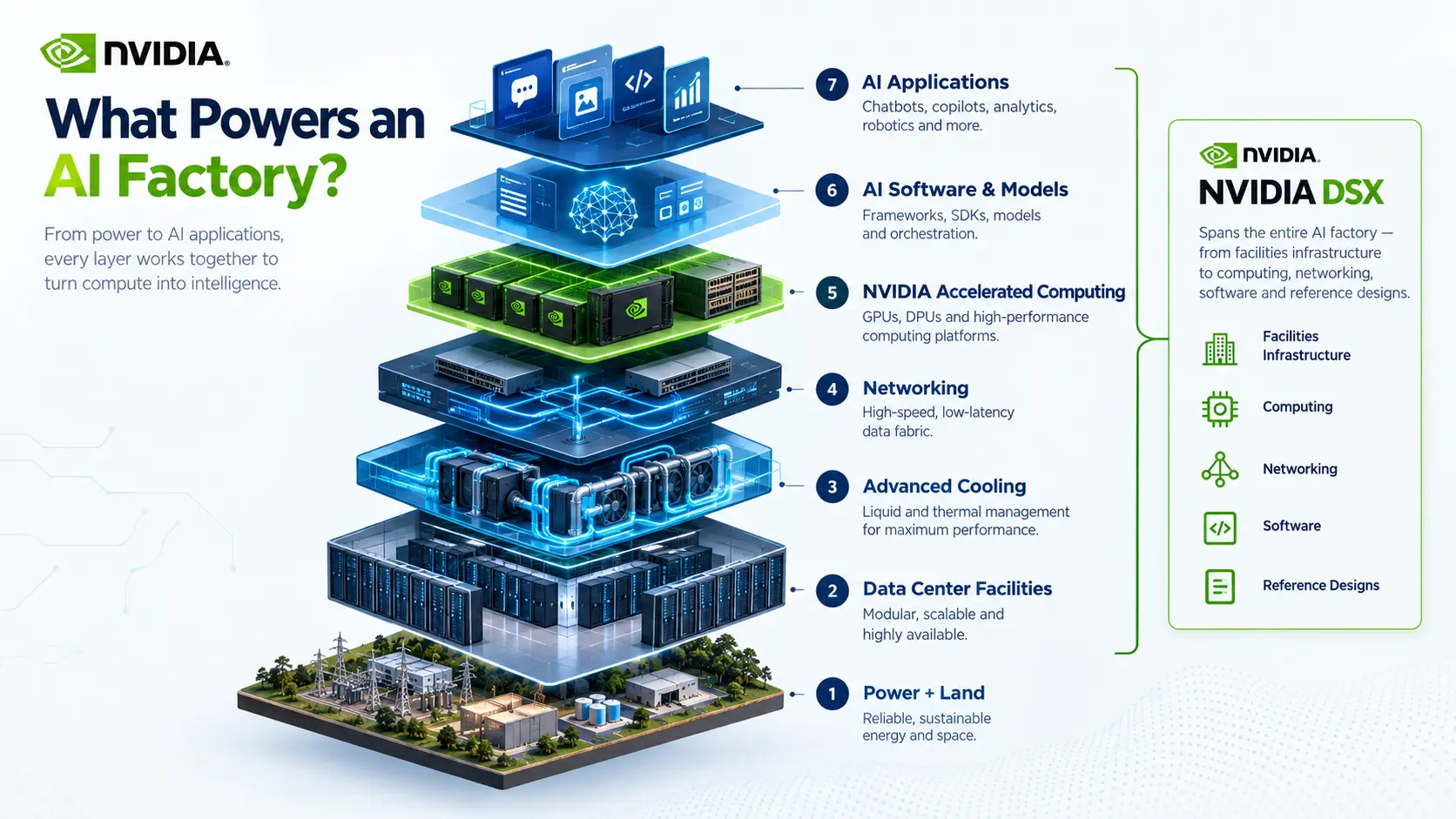
At the center of the announcement is NVIDIA DSX, described by NVIDIA as a full-stack AI factory platform.
The platform spans several layers of infrastructure, including:
Facilities infrastructure
Computing
Networking
Software
Reference designs
NVIDIA says DSX is compatible with its CUDA ecosystem and can be enhanced through software over the life of the infrastructure.
The company says this approach is intended to help operators serve different workloads and customers, improve performance and utilization, and extend the useful life of infrastructure assets.
This is important because modern AI systems require more than GPUs alone. AI infrastructure also depends on data center facilities, power, cooling, networking and software working together.
The Australian expansion therefore represents an infrastructure-level approach to increasing access to AI computing.
Australia Builds Out AI Factory Capacity
NVIDIA's announcement brings together several Australian and international infrastructure providers, each contributing different capabilities to the emerging AI factory ecosystem.
Firmus Expands Project Southgate
Firmus is expanding its Project Southgate initiative, which is developing NVIDIA-powered AI factories intended to support hyperscale and AI-native demand across Australia and the Asia-Pacific region.
According to Firmus, the project is intended to give Australian businesses, researchers and innovators access to high-performance computing capacity within Australia.
The company also positions the initiative as part of Australia's broader AI infrastructure development.
Sharon AI Plans Large GPU Deployment
Sharon AI is deploying up to 68,000 NVIDIA GPUs connected through NVIDIA Quantum InfiniBand and NVIDIA Spectrum-X Ethernet networking.
The company says its infrastructure will use the NVIDIA DSX platform to support startups, enterprises and research organizations.
Sharon AI also highlighted the importance of security, sovereignty and access to computing infrastructure for Australian organizations developing AI systems.
IREN Combines Power, Land and Data Center Expertise
IREN is partnering with NVIDIA to accelerate the deployment of large-scale AI factories.
Its approach combines NVIDIA's DSX AI factory architecture with IREN's capabilities across:
Power
Land
Data centers
GPU deployment
Infrastructure operations
IREN specifically referenced its 800-megawatt Bundey campus in South Australia as part of its development portfolio.
The partnership demonstrates how AI infrastructure projects increasingly depend on coordination between computing technology and physical infrastructure.
Megaport Brings AI Computing Closer to Users
Megaport is expanding access to NVIDIA accelerated computing through its wholly owned subsidiary, Latitude.sh.
The company says the combination of Latitude.sh's compute platform with Megaport's software-defined network can bring AI processing closer to users.
The focus is particularly relevant to AI inference, where applications need to process requests and return results efficiently.
Megaport says the infrastructure will support Australian organizations building and deploying AI locally while also allowing them to scale through its global platform.
Sovereign AI Infrastructure Becomes a Key Focus
Another major theme in the announcement is local access to computing infrastructure.
ResetData is building AI infrastructure in Australia through its AI cloud platform, providing NVIDIA accelerated computing for enterprise, government and research customers that require high-performance computing and Australian data residency.
This creates an important connection between AI infrastructure and data location.
Organizations operating in sectors with specific data residency requirements may need computing environments located within particular jurisdictions. NVIDIA's Australian ecosystem is therefore being developed not only around computing capacity but also around local infrastructure requirements.
NVIDIA says Australia's energy resources, digital infrastructure, technology talent and position as a global economic partner provide a foundation for AI development.
The announcement also emphasizes access for startups, universities, researchers, enterprises, developers and AI-native companies.
Data Centers Adapt for AI Workloads
AI computing places different demands on data center infrastructure compared with many traditional workloads.
NVIDIA's Australian partners are therefore developing facilities designed for increasingly compute-intensive systems.
CDC Focuses on High-Density Computing
CDC has developed AI-ready data center infrastructure across Australia and New Zealand.
The company says its facilities are designed to support high-density AI and high-performance computing workloads.
CDC also highlighted advanced cooling technologies, including direct liquid-to-chip cooling, for NVIDIA accelerated computing infrastructure.
According to CDC, it operates more than 550 megawatts of capacity across Australia and New Zealand, with another 800 megawatts under construction and additional growth planned.
CDC also states that its facilities use 100% renewable electricity and incorporate zero-water advanced cooling technologies certified for NVIDIA accelerated computing infrastructure.
NEXTDC Develops AI-Ready Facilities
NEXTDC is developing AI-ready data center infrastructure designed to provide the power, cooling, connectivity and physical infrastructure needed for high-density AI factories.
The company says it is operating and developing liquid-cooled, high-density infrastructure, including AI factories built on NVIDIA DSX.
These facilities are also interconnected with major cloud platforms.
AirTrunk Expands AI-Ready Capacity
AirTrunk is expanding AI-ready powered shells across the region.
Its infrastructure includes direct-to-chip liquid-cooling capabilities designed to support high-density AI workloads.
The company says AI is changing requirements around data center location, capacity, cooling, power and connectivity in Australia.
From Infrastructure to AI Applications
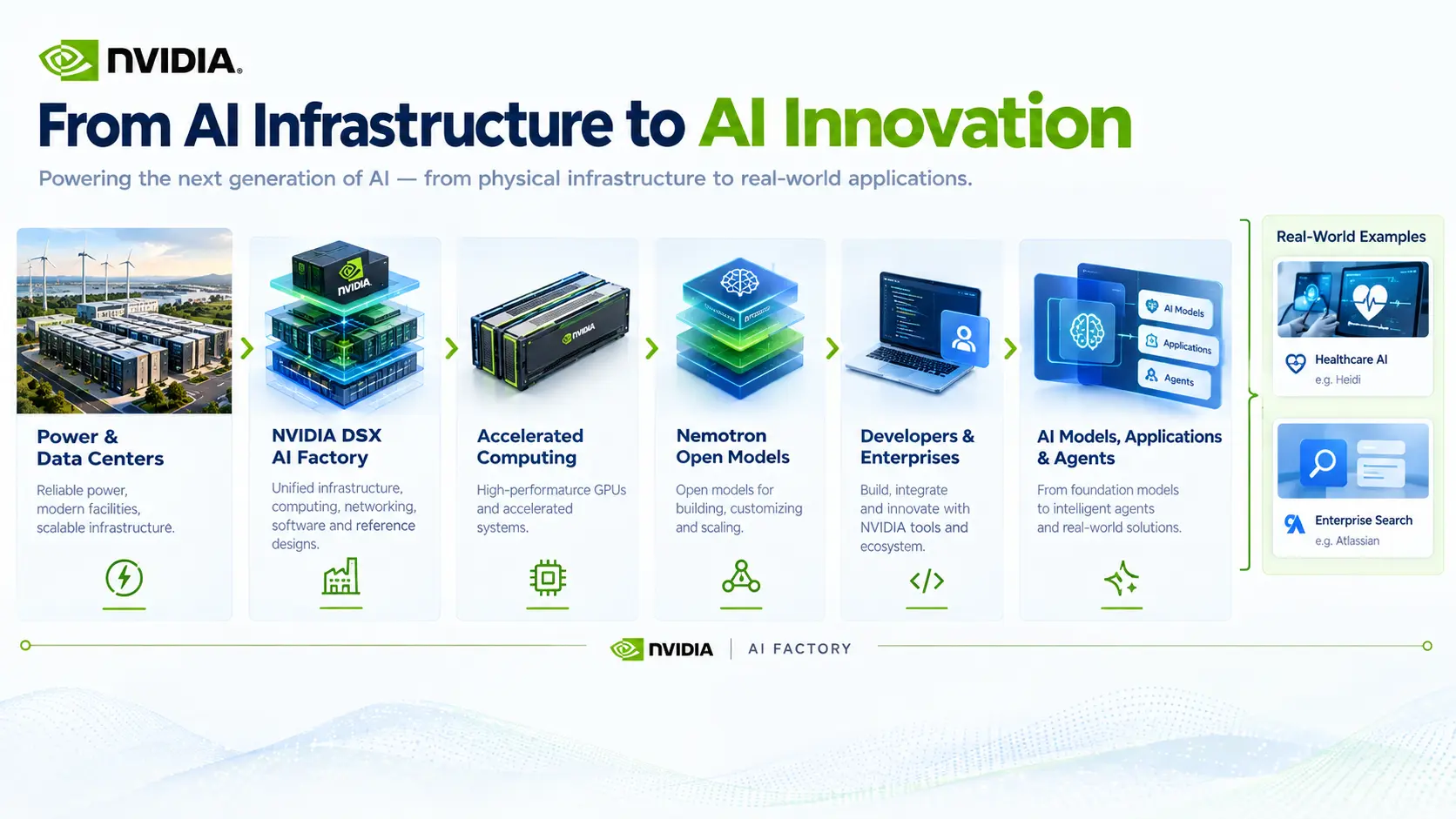
The purpose of expanding computing infrastructure is not simply to increase data center capacity.
NVIDIA says the expanded access will help Australian developers, AI-native companies and enterprises build models, applications and agents tailored to local industries and communities.
The announcement specifically highlights NVIDIA Nemotron open models, datasets and tools.
Organizations including Heidi and Atlassian are using NVIDIA Nemotron technology to develop and customize AI across areas including language, reasoning, speech and multimodal applications.
This illustrates the relationship between infrastructure and software.
More computing capacity provides the foundation, while models, datasets and development tools allow organizations to turn that capacity into practical AI systems.
Heidi Uses Nemotron for Healthcare AI
Heidi combines NVIDIA Nemotron models with its specialized clinical knowledge for voice-driven AI applications in healthcare.
According to the company, its work involves building and post-training models for the complexity of healthcare.
Heidi says its approach combines Nemotron with clinical training and fine-tuning capabilities to reason across patient histories, clinical context and guidelines.
The company also highlighted trust and privacy considerations for healthcare applications.
The NVIDIA announcement does not provide additional technical details about Heidi's deployment beyond the information described above.
Atlassian Applies NVIDIA AI to Enterprise Search
Atlassian is another organization highlighted in NVIDIA's announcement.
The company is advancing Rovo's semantic search using NVIDIA AI.
According to Atlassian, the goal is to make enterprise search more intelligent and context-aware while helping surface relevant insights across complex data and workflows.
Atlassian says NVIDIA accelerated computing infrastructure and its open model ecosystem are part of how the company develops and delivers AI.
The announcement also references activities including supervised fine-tuning and reinforcement learning.
Additional details about the specific infrastructure configuration used by Atlassian were not disclosed in the announcement.
Why the Australian AI Infrastructure Push Matters
The announcement highlights a broader industry shift toward building AI infrastructure closer to the organizations and users that need it.
AI development increasingly depends on access to high-performance computing, and that requirement extends beyond the availability of individual GPUs.
Data centers need sufficient power, cooling, networking and physical capacity. At the same time, organizations may require local infrastructure, data residency and connectivity options.
NVIDIA's approach in Australia brings these elements together through a network of infrastructure and cloud partners.
The company is providing the computing platform and supporting technologies, while participating providers develop and operate the physical infrastructure.
For Australian businesses and researchers, the stated objective is greater local access to accelerated computing and open AI models.
For infrastructure providers, the announcement reflects increasing demand for facilities designed specifically around high-density AI workloads.
A Multi-Partner Approach to AI Infrastructure
One of the notable aspects of the announcement is the number of companies involved.
The participating organizations cover different layers of the infrastructure ecosystem:
Partner | Focus Highlighted in the Announcement |
|---|---|
Firmus | Project Southgate and NVIDIA-powered AI factories |
Sharon AI | Large-scale GPU deployment and AI infrastructure |
IREN | Power, land, data centers and GPU deployment |
Megaport | AI compute and software-defined networking |
ResetData | AI cloud infrastructure and Australian data residency |
CDC | AI-ready data centers and advanced cooling |
NEXTDC | High-density, liquid-cooled AI infrastructure |
AirTrunk | AI-ready powered shells and direct-to-chip cooling |
This distributed model allows different infrastructure companies to contribute specialized capabilities while operating within the broader NVIDIA DSX ecosystem.
What Comes Next for Australia's AI Infrastructure
NVIDIA's announcement sets out an infrastructure expansion involving multiple Australian cloud and data center providers, with capacity designed to support multiple generations of NVIDIA DSX AI factories.
The announced buildout of up to 2 gigawatts by 2027 represents the scale NVIDIA and its partners are targeting.
The participating companies are expected to contribute different elements of the infrastructure, from power and land to data centers, networking, cooling and cloud computing.
At the application level, organizations such as Heidi and Atlassian demonstrate how access to accelerated computing can connect infrastructure investments with AI development.
The announcement highlights a broader industry shift toward treating AI computing as an integrated infrastructure challenge rather than simply a hardware requirement.
For Australia, the development could support greater domestic access to AI computing and create infrastructure capable of serving startups, researchers, enterprises, developers and AI-native companies.
The company did not provide specific information about the complete deployment schedule, final capacity allocation or detailed customer access models for every participating provider.
Conclusion
NVIDIA's latest Australian expansion brings together AI computing, data center infrastructure, networking, cooling and software under a broader AI factory strategy.
The company is working with Firmus, Sharon AI, IREN, Megaport, ResetData, CDC, NEXTDC and AirTrunk as these providers develop and expand AI-ready infrastructure across the region.
The announced plans target up to 2 gigawatts of AI factory capacity by 2027, while NVIDIA will provide the DSX platform, accelerated computing, networking, software and ecosystem support.
The development also connects infrastructure growth with AI application development. NVIDIA says organizations such as Heidi and Atlassian are using its Nemotron ecosystem and accelerated computing to develop AI applications for healthcare and enterprise workflows.
For Australia, the announcement represents an effort to expand local AI infrastructure and access to high-performance computing.
For the wider technology industry, it highlights how the next phase of AI development increasingly depends on the combination of computing power, data centers, energy, networking, cooling and software.
Additional details were not disclosed in the announcement.
Source: NVIDIA
About the Author