
Google Introduces AISeal, a Hardware-Isolated Enclave for More Private On-Device AI on Android
Google has introduced AISeal, a hardware-isolated secure vault for personalized on-device AI. Built on Android virtualization and pKVM, it is designed to keep sensitive personal context isolated even if the host operating system is compromised.
Xcademia Team
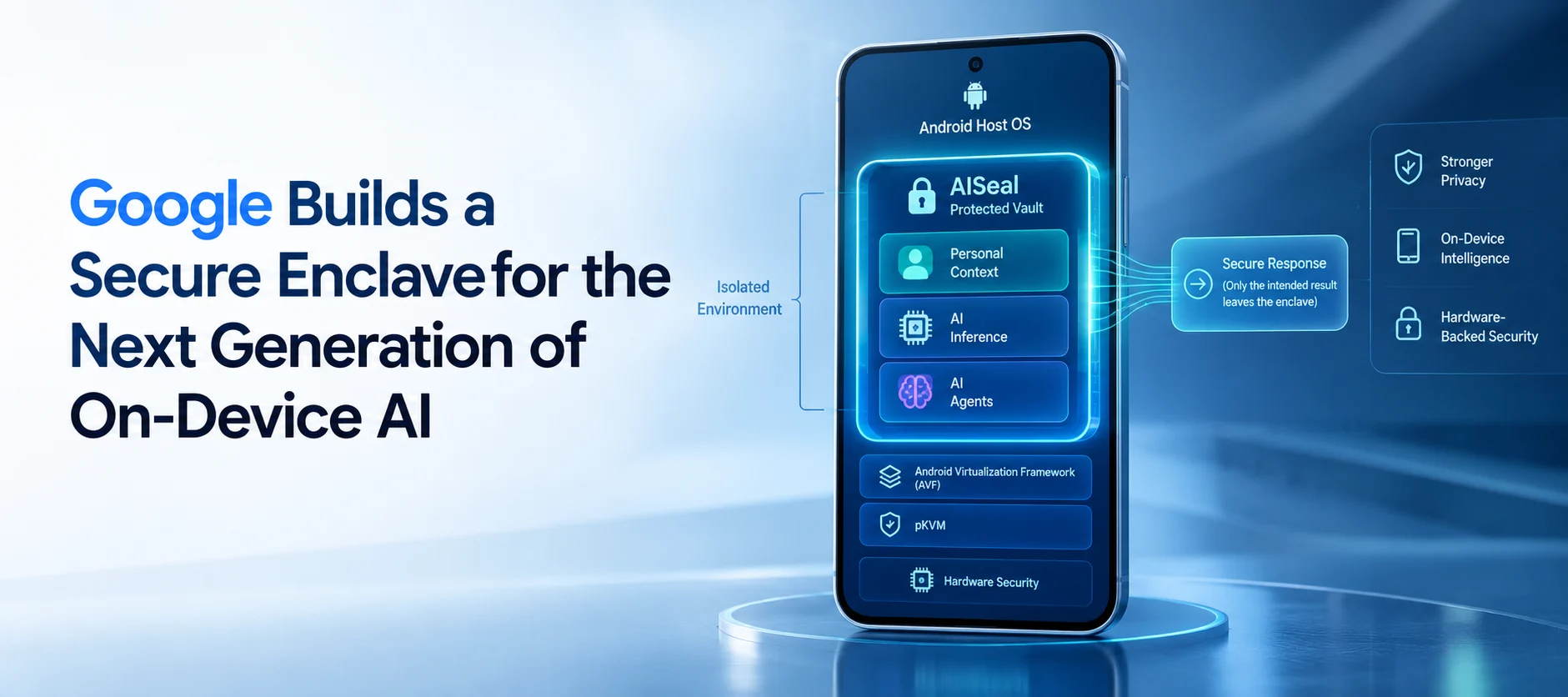
Google is introducing a new security architecture designed to protect the sensitive personal data that increasingly powers on-device artificial intelligence.
Called Android on-device AI seal, or AISeal, the architecture creates a hardware-isolated secure vault for personalized AI workloads. Google says the system is designed to separate sensitive AI processing and personal context from the main Android operating system, helping protect that information even if the host OS is fully compromised.
The announcement was published on October 7, 2026, by Irene Ang, Product Manager for Android Virtualization & AISeal, and Helen Jiang, Software Engineer.
Google's approach comes as mobile devices increasingly move beyond traditional application models toward assistants that can work across personal information such as emails, messages, calendar events and cross-app interactions.
That shift creates a security challenge: the more useful an AI assistant becomes, the more sensitive information it may need to access.
AISeal is Google's proposed architecture for addressing that challenge at the infrastructure level.
Why Google is building a secure enclave for on-device AI
Modern AI assistants can become significantly more useful when they have access to relevant personal context.
Google describes a future in which an on-device knowledge graph can connect information across emails, messages, calendar events and interactions between applications. Keeping this information on the device can reduce the need to move personal context elsewhere, but it also makes the device itself an important security boundary.
Android already uses application sandboxing and SELinux policies to isolate applications and protect user data.
AISeal adds another security layer by introducing a protected environment specifically designed for personalized on-device AI workloads.
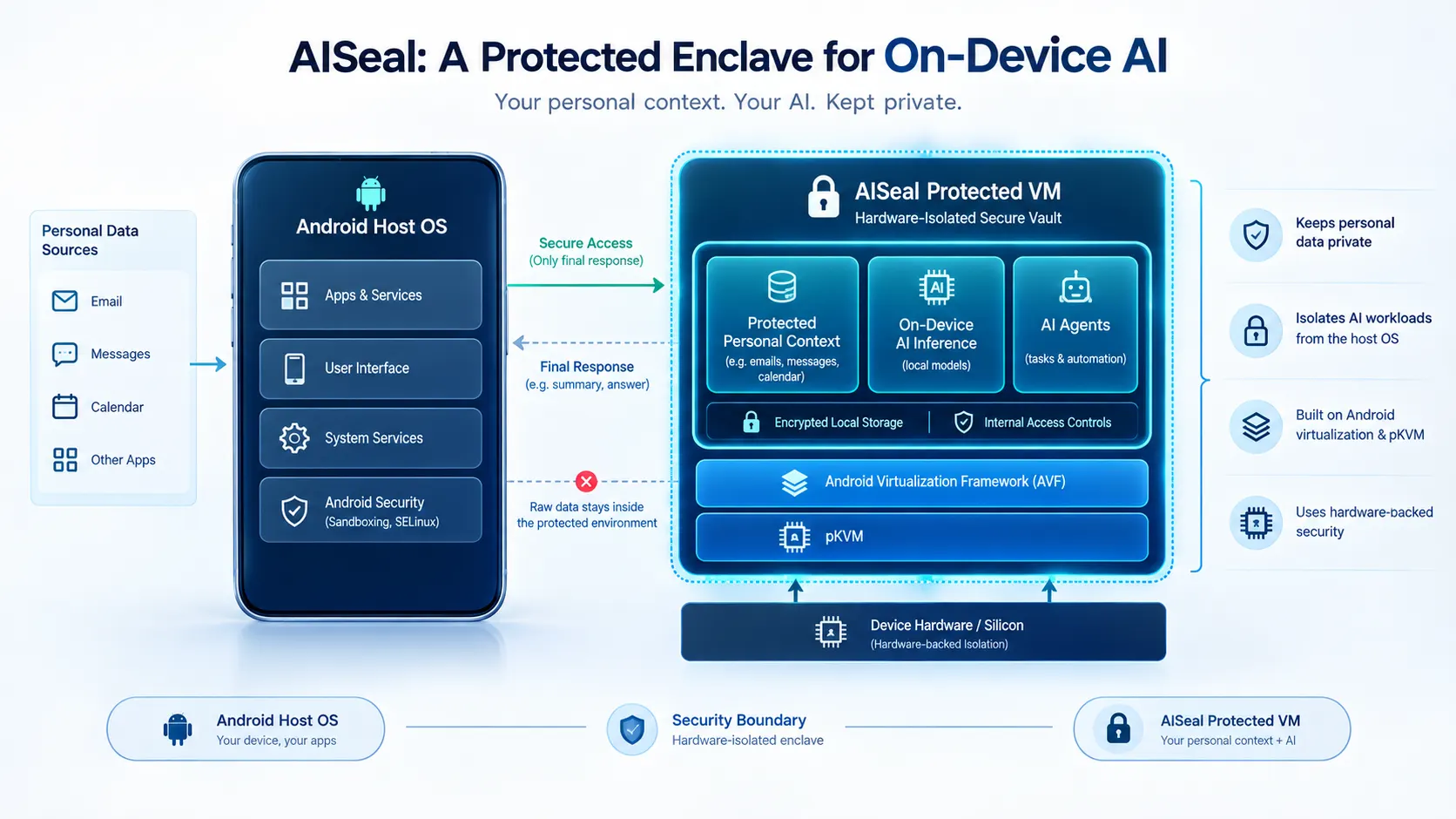
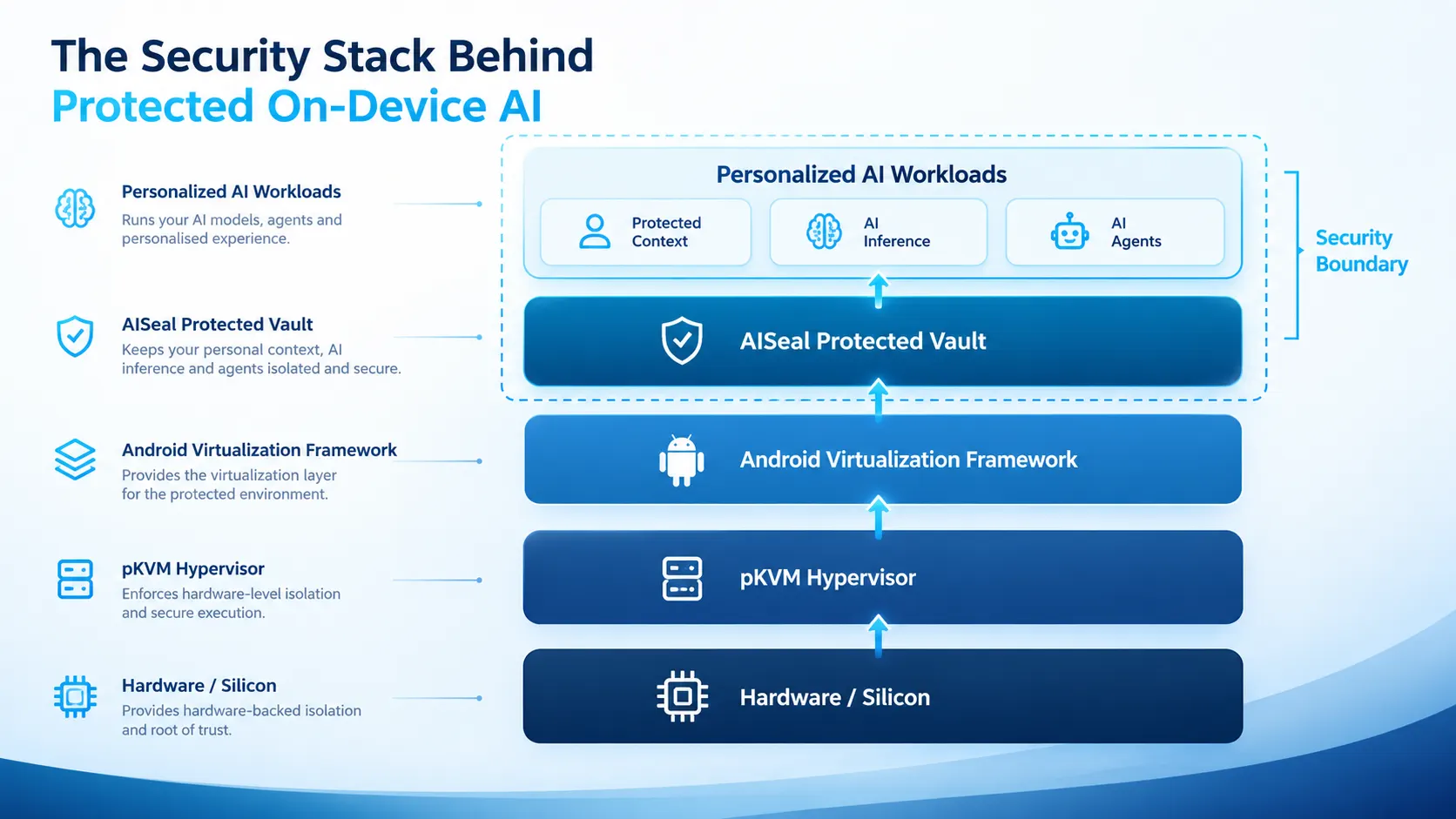
The architecture is built using the Android Virtualization Framework (AVF) and the protected Kernel-based Virtual Machine (pKVM) hypervisor. Google describes the resulting environment as a centrally managed, hardware-isolated secure vault that separates sensitive AI workloads from the host operating system.
The key security objective is isolation.
According to Google, even if the host operating system were fully compromised, personal data stored and processed within the protected environment is designed to remain cryptographically isolated from unauthorized access.
A multi-tenant vault for different AI workloads
AISeal is not described as a dedicated environment for a single AI function.
Google says it is developing a multi-tenant protected environment, allowing different AI-related services to operate within a shared secure vault while maintaining isolation between them. The architecture is also designed with mobile resource constraints such as memory and battery consumption in mind.
Google identifies three major workload categories.
1. Protected databases
The secure environment can store and index personal context using encrypted local storage.
Google currently uses AppSearch as an optimised reference implementation, while stating that the architecture can support other databases, including proprietary databases used by device manufacturers.
2. On-device inference
The architecture is designed to support local execution of foundation models through future integrations with AICore.
This is important because keeping inference inside the protected environment could allow AI systems to use sensitive local context without exposing that context to the normal host environment.
Google describes this as a future integration rather than saying that the entire capability is already available.
3. AI agents
AISeal is also designed to support assistants that combine private personal context with local inference.
Google provides a simple example: an assistant could retrieve information from a protected database and use inference to summarise a user's schedule entirely within the secure vault.
The architecture is designed so that only the intended final response leaves the protected environment.
Internal access controls limit what leaves the vault
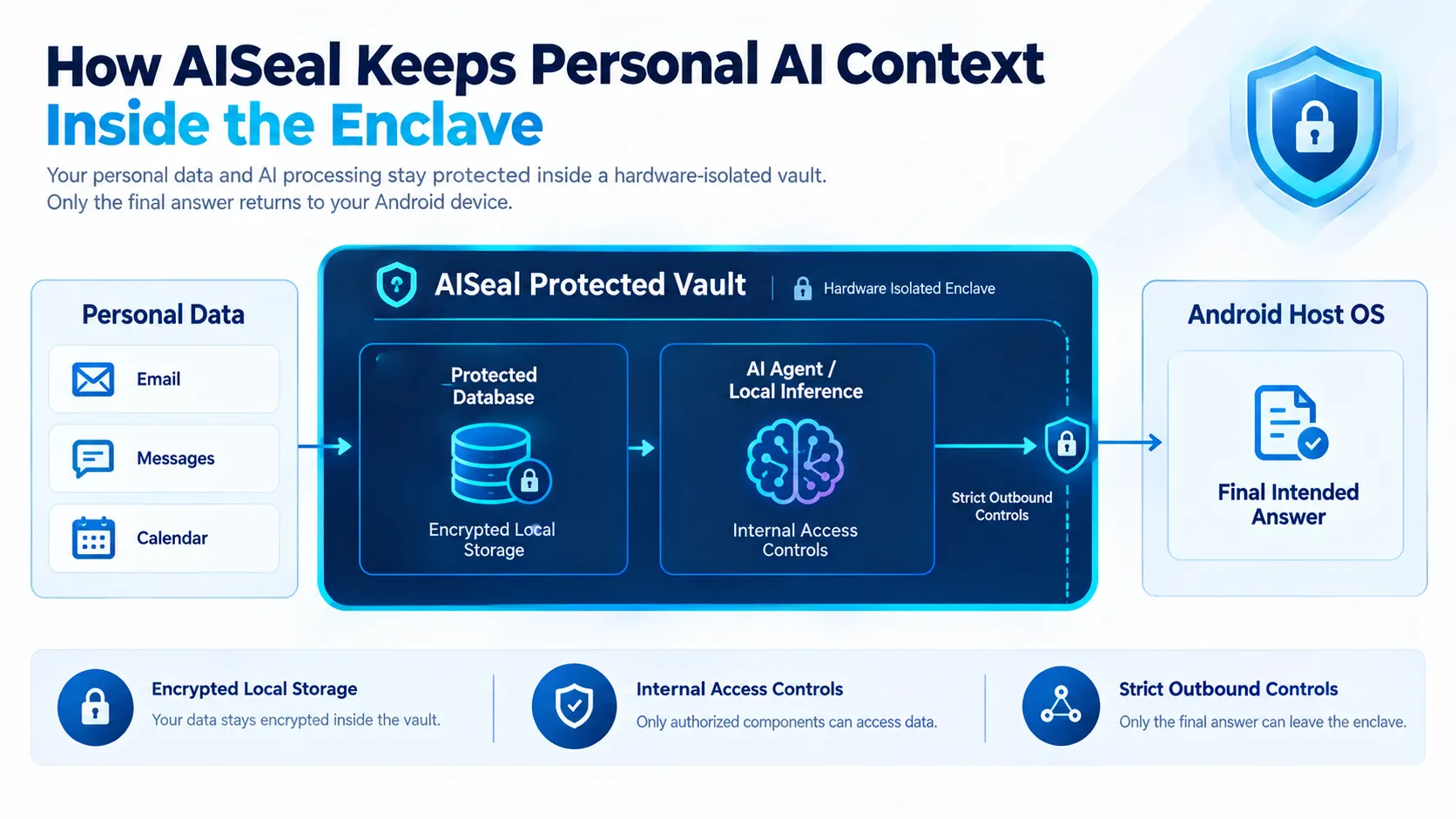
A central element of Google's design is controlling communication between the protected components and the outside system.
The protected database, inference workloads and AI agents can interact within the secure environment. However, Google says outbound controls are designed to prevent raw data from being exposed to the main operating system.
In its schedule-summary example, the assistant can access the relevant personal information, perform the inference and generate the summary within the vault. The intended answer can then cross back to Android, rather than exposing the underlying personal context.
This creates a distinction between access to data and access to the result of processing that data.
For security-sensitive AI systems, that distinction can be important because an AI assistant may need broad contextual access to produce a useful result, while other parts of the operating environment should not receive that raw information.
AISeal builds on Android virtualization
Google is using existing Android virtualization technologies as the foundation of the architecture.
AISeal is built around the Android Virtualization Framework and pKVM, Google's protected virtualization approach for isolating workloads.
Google says its foundational open-source implementation is anchored in pKVM and delivered through Android's Generic Kernel Image. The implementation has also been certified to SESIP Assurance Level 5 (AVA_VAN.5), which Google describes as the industry's highest vulnerability-testing tier under ISO 15408.
The architecture therefore does not represent a completely separate security model detached from Android.
Instead, Google is extending Android's virtualization and hardware-backed isolation capabilities toward a specific use case: protecting increasingly sensitive on-device AI workloads.
Device silicon is becoming part of the AI security model
Protecting on-device AI requires more than operating-system software.
The underlying silicon and device architecture also need to support the required isolation mechanisms.
Google says it is working with silicon providers and device manufacturers to bring AISeal into practical Android implementations.
MediaTek has announced support for the pKVM-backed AISeal architecture on its Dimensity 9600 Pro platform. Google also says Qualcomm Snapdragon chipsets will support the architecture through AVF as the company expands across the silicon ecosystem.
This reflects an important characteristic of secure on-device AI: the trust boundary increasingly extends across the operating system, virtualization layer, processor hardware and device manufacturer implementations.
Google is currently focusing on protected personal context
Google says the current foundational milestone is hardware-isolated personal context storage, which is actively rolling out across Android.
This is an important distinction when evaluating the announcement.
Google is outlining a broader architecture for secure on-device AI, but some of the capabilities described in the announcement remain part of its future roadmap.
The company says it is continuing to work with silicon and OEM partners to move more of the on-device AI lifecycle into the protected environment.
What Google plans to bring inside the protected environment
Google identifies three areas for further development.
In-vault inference and autonomous agents
The company plans to move model execution and system-level AI agents directly into the protected virtual machine.
The objective is to allow sensitive context to be processed without touching host memory.
Direct NPU assignment
Google is also exploring direct assignment of an on-chip neural processing unit to the enclave.
This would give the protected environment a private hardware path to the NPU for AI processing.
The company describes this as a future direction rather than a currently completed capability.
Confidential cloud extension
Google also outlines a hybrid model in which protected on-device environments could communicate with OEM confidential cloud servers through end-to-end encrypted inference.
This could extend protected AI processing beyond the device while maintaining a security model designed around encrypted communication between the on-device and cloud environments.
Analysis: What AISeal means for on-device AI security
The announcement highlights a broader industry shift toward treating AI data protection as an infrastructure problem, rather than relying only on application-level controls.
Traditional mobile security mechanisms such as sandboxing remain important, but AI assistants introduce a different type of workload. Instead of an application accessing a limited set of files or services, future assistants may need to combine context from multiple sources to complete a task.
That increases the importance of protecting the environment where the data is aggregated and processed.
AISeal's architecture addresses this by creating a dedicated protected environment around personal context and AI workloads.
For enterprises, this could mean a stronger architectural foundation for deploying AI features that need access to sensitive information directly on devices.
For consumers, the approach could help address one of the fundamental tensions around personal AI: assistants become more useful when they understand more about the user, but greater contextual awareness also increases the consequences of a security compromise.
The announcement does not establish that every future AI workload on Android will operate inside AISeal. Instead, Google is describing an architecture and roadmap for progressively bringing more of the AI lifecycle into hardware-isolated environments.
The bigger picture: security becomes part of the AI architecture
Google's AISeal announcement illustrates how AI security is moving deeper into the computing stack.
Instead of relying solely on application permissions or traditional OS isolation, the proposed architecture combines:
Hardware-backed isolation
Protected virtualization
Encrypted local storage
Controlled access between AI components
Restricted outbound data flows
Protected AI inference
Potential NPU isolation
Potential confidential cloud connectivity
The broader direction is clear: as AI systems gain access to increasingly personal information, protecting the model alone is not enough.
The data, inference environment, supporting databases and AI agents also become part of the security boundary.
Google's AISeal is an effort to establish that boundary at the Android platform level.
What to watch next
The most important developments will likely be practical implementation and ecosystem adoption.
Google says the current focus is protected personal context storage, while future work includes in-vault inference, autonomous agents, direct NPU assignment and confidential cloud extensions.
The company is also positioning AISeal as an open enclave approach intended to expand across the mobile industry through collaboration with silicon providers and OEMs.
How broadly these capabilities are implemented across Android devices, and which AI workloads ultimately operate inside the protected environment, will determine the practical impact of the architecture.
Conclusion
Google's AISeal architecture represents an attempt to solve a growing security challenge created by personalized on-device AI.
By combining Android virtualization, pKVM and hardware isolation, Google is creating a protected environment where personal context, AI processing and agent workloads can operate separately from the main operating system.
The current milestone is focused on hardware-isolated personal context storage. Google's longer-term roadmap extends that protection toward AI inference, autonomous agents, NPU access and confidential cloud processing.
For the mobile industry, the underlying message is straightforward: as AI assistants gain access to more sensitive personal information, the security boundary around that information needs to evolve with them.
Source: Google Security Blog
About the Author