
Google Cloud Outlines Secure Networking Architectures for AI Inference Across GKE and Hybrid Backends
Google Cloud has published two reference architectures for AI inference networking, covering GKE-only deployments and mixed backends such as Cloud Run, Agent Platform, on-premises systems and external clouds.
Xcademia Team
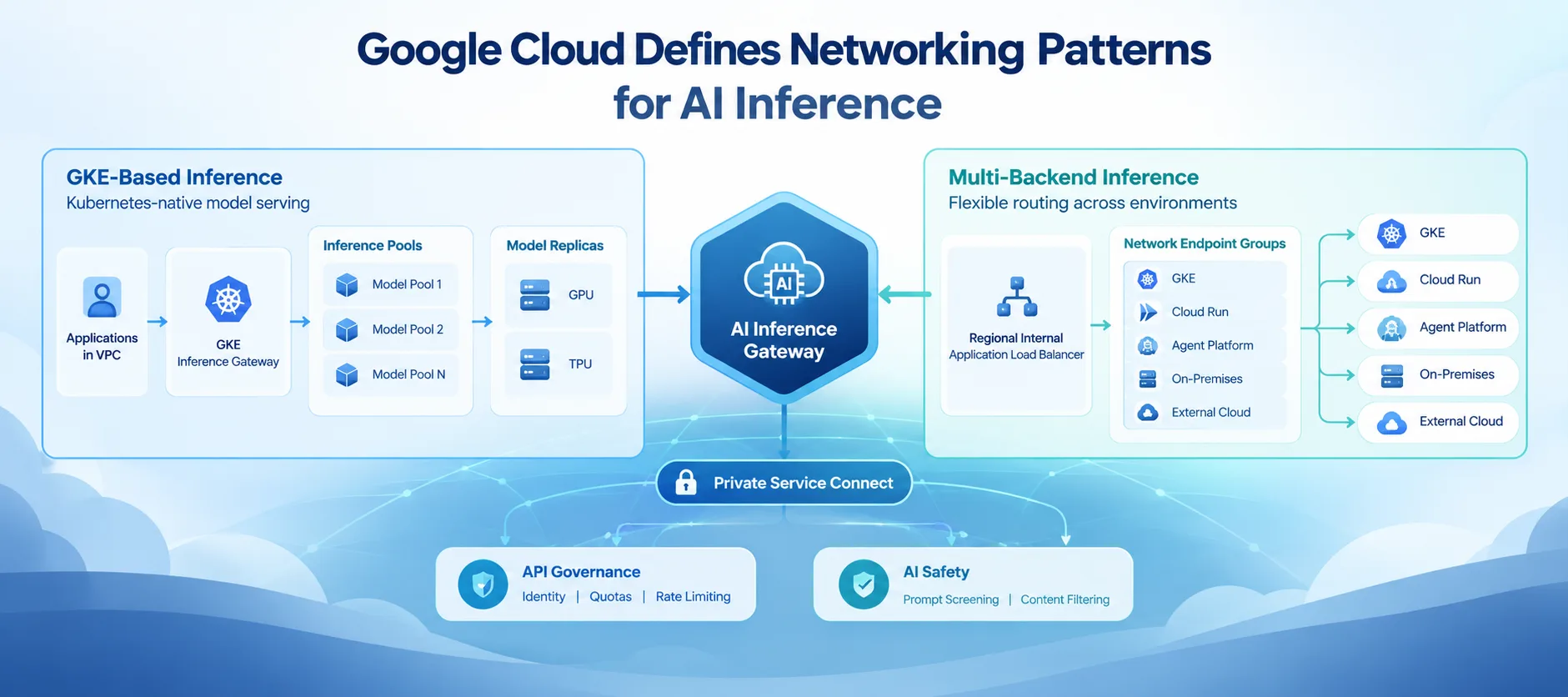
As organisations deploy more AI models, the networking layer connecting applications to inference workloads becomes increasingly important. Google Cloud has published two reference architectures designed to simplify how AI inference requests are routed, governed and secured across different model-serving environments.
The architecture guidance, published by Google Cloud Developer Relations Engineer Ammett Williams, covers two scenarios: deployments where models are served exclusively through Google Kubernetes Engine (GKE), and environments where inference workloads span multiple backend types.
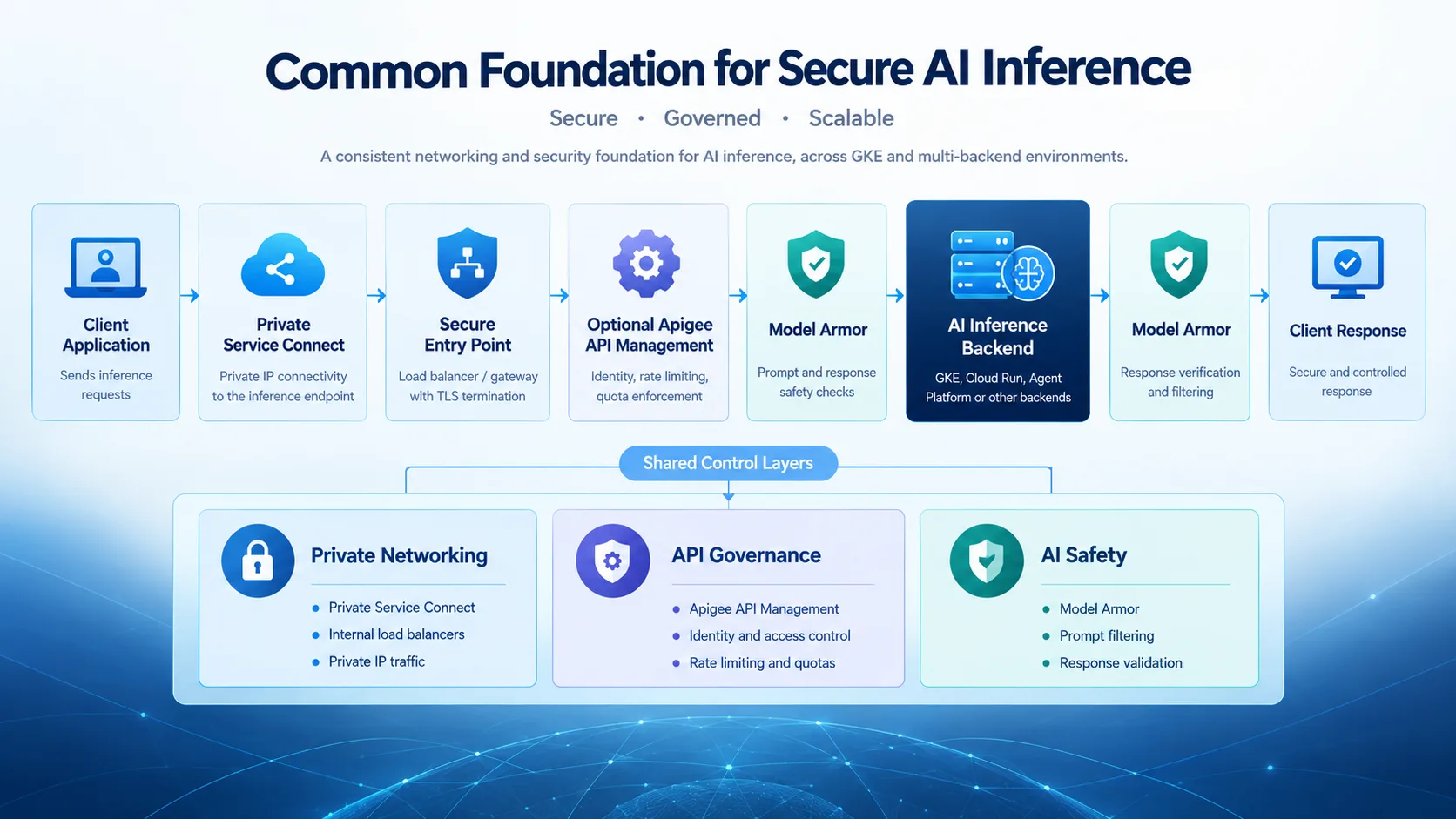
The designs share several foundational components, including Private Service Connect, optional Apigee API Management and Model Armor. The GKE-specific architecture then adds the GKE Inference Gateway and inference pools, while the broader architecture uses a regional internal Application Load Balancer, a payload-processing service extension and Network Endpoint Groups to route requests across different backends.
A common entry point for AI inference
Google Cloud's reference architectures place a stable entry point in front of model deployments.
This entry point can provide a control zone where networking, policy and security functions are applied before requests reach inference infrastructure. Depending on the architecture, this role can be handled by a Cloud Load Balancer or the GKE Inference Gateway. These entry points can also terminate TLS connections, integrate with API management components and use service extensions.
The approach is intended to separate the client-facing inference interface from the underlying model infrastructure.
That separation becomes particularly relevant when organisations operate several models or need to route requests to different inference environments.
Private connectivity and centralised controls
Both reference architectures use Private Service Connect as the starting point for the inference endpoint.
The endpoint is anchored inside the consumer Virtual Private Cloud network, allowing inference traffic to reach a private internal IP address rather than requiring the client to communicate directly with the model-serving infrastructure.
Google Cloud also identifies Apigee API Management as an optional component. Where used, it can handle functions such as client identity verification, rate limiting and quota enforcement before requests reach compute resources.
Model Armor provides another control layer in both designs. Google Cloud describes it as an inline AI safety checkpoint that screens prompts and model completions for issues such as prompt injection and sensitive data leakage.
Architecture 1: AI inference on GKE
The first design focuses specifically on organisations serving AI models through GKE.
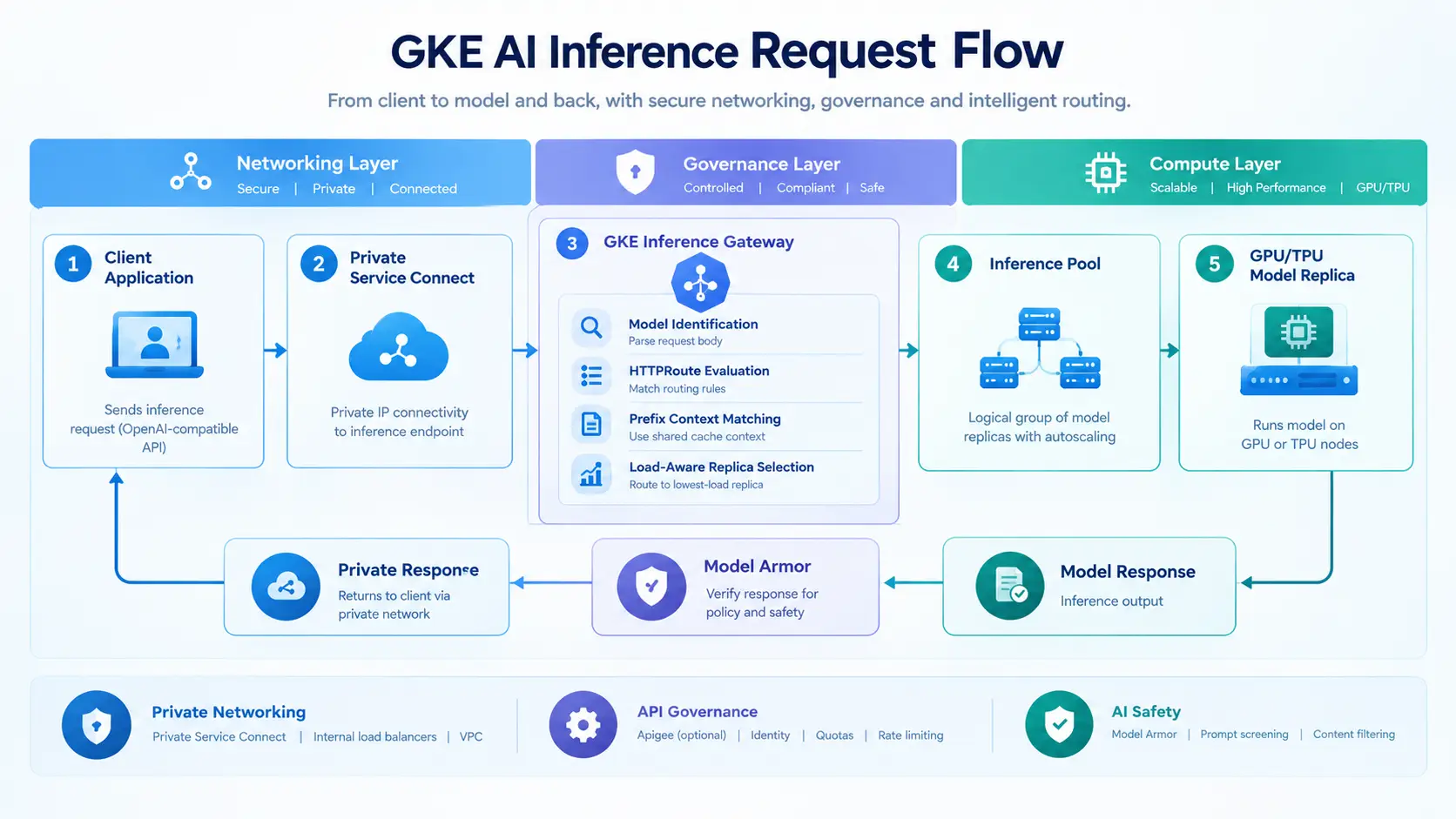
At its centre is the GKE Inference Gateway, deployed as an internal Application Load Balancer. Google Cloud describes it as a specialised ingress engine capable of parsing incoming request payloads, evaluating HTTPRoute rules and directing queries to appropriate model-serving targets.
The architecture also introduces inference pools. These are logical groups containing replicas of the same model. When an inference request arrives, the gateway can use the model identifier to determine the appropriate inference pool. Pools can have an initial size and can be configured for dynamic autoscaling.
Behind the pools are model replica sets. These consist of individual model replicas deployed across single-node or multi-node GPU or TPU node pools. A replica set represents a uniform group of model-serving instances.
How a GKE inference request moves through the architecture
The GKE design follows a defined request path.
First, an application in the consumer VPC sends an OpenAI-compatible API request to the Private Service Connect endpoint. The request is then routed to the GKE Inference Gateway through a regional internal Application Load Balancer.
The gateway examines the request body to identify the requested model and adds that model information to the HTTP headers.
If Apigee is enabled, the request can then undergo client credential and quota validation. Model Armor provides an additional checkpoint for prompt policy violations and potential sensitive data leakage.
The gateway subsequently evaluates HTTPRoute mappings to identify the appropriate inference pool. Google Cloud's architecture also describes matching shared prefix cache context and routing requests towards the lowest-load GPU or TPU replica using real-time Prometheus data.
After the model processes the request, the output passes through Model Armor for final response verification before being returned through the private connection.
Architecture 2: AI inference across multiple backend types
The second reference architecture is designed for more heterogeneous environments.
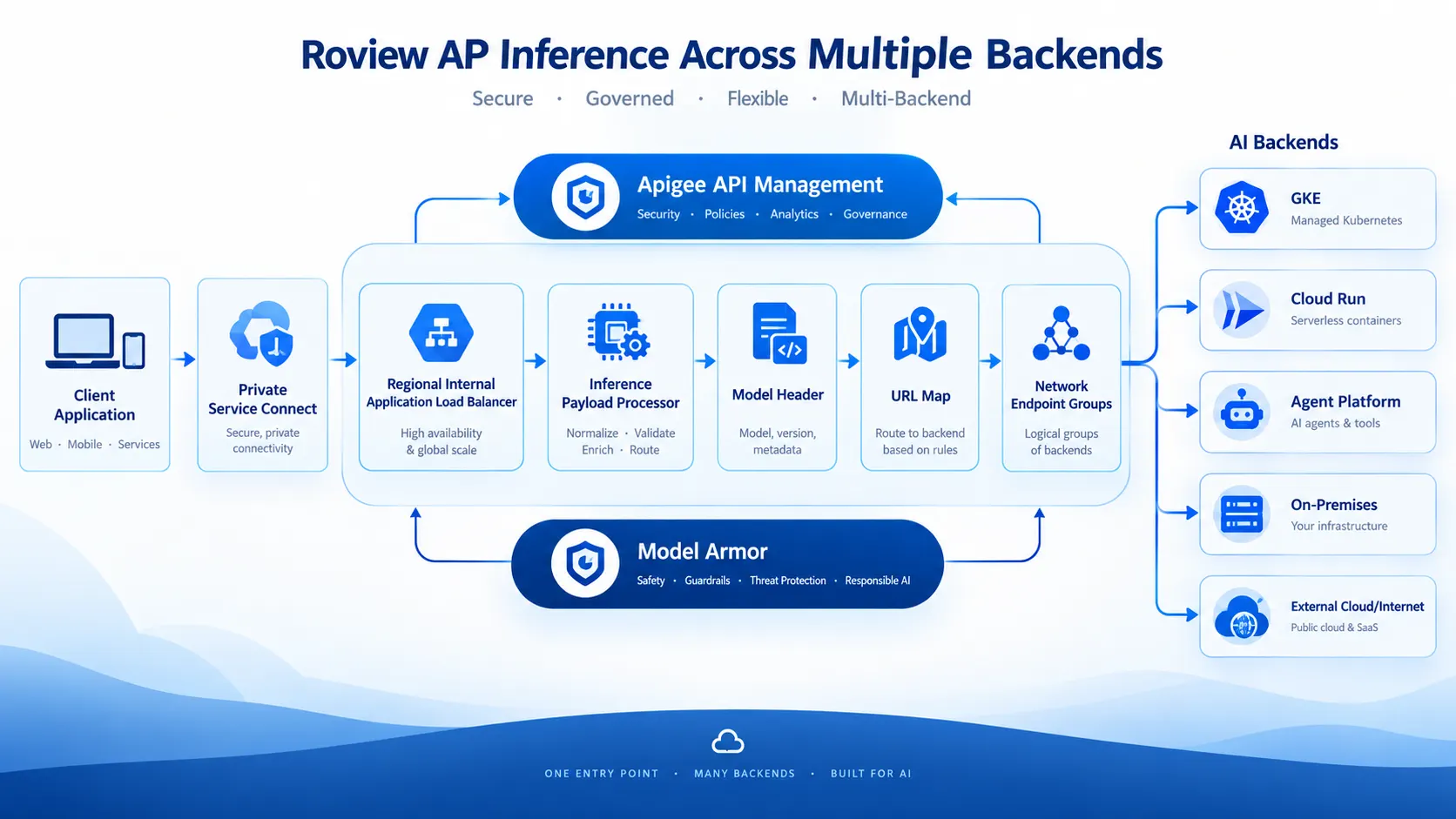
Google Cloud specifically identifies scenarios involving GKE, Cloud Run, Agent Platform, on-premises data centres and external clouds. Instead of relying on the GKE Inference Gateway, this design uses a regional internal Application Load Balancer as the central Layer 7 routing proxy.
The load balancer manages routing logic, SSL termination and Service Extensions callouts.
A key component is the Inference Payload Processor. Google Cloud describes this as a Service Extension that enables body-based routing on the Application Load Balancer.
A lightweight Cloud Run callout examines the JSON body of incoming OpenAI API requests, extracts the target model identifier and writes an X-Gateway-Model-Name header. The header can then be used by the URL map to determine where the request should go.
Network Endpoint Groups provide the mechanism for flexible routing to the heterogeneous backend environments.
From model identifier to backend
The multi-backend request flow starts in much the same way as the GKE architecture.
The client targets a Private Service Connect endpoint using private IP space. The regional internal Application Load Balancer receives the request and sends the payload to the Cloud Run-based routing callout.
The payload processor extracts the model name and injects the model header.
The request can then pass through Apigee for identity and quota validation before Model Armor provides AI safety controls.
The load balancer's URL map uses the model header to select the appropriate Network Endpoint Group. According to Google Cloud, the target can be an Agent Platform environment, GKE, Cloud Run, a hybrid environment or an Internet-based backend.
The selected backend executes the inference request. Model Armor can then screen the completion before the result returns through the private networking path.
GKE-only versus multi-backend architecture
The two designs address different infrastructure requirements.
Area | GKE-only architecture | Multi-backend architecture |
|---|---|---|
Primary routing component | GKE Inference Gateway | Regional internal Application Load Balancer |
Model identification | Gateway inspects request body | Cloud Run payload processor extracts model name |
Backend environment | GKE | GKE, Cloud Run, Agent Platform, hybrid and external environments |
Routing mechanism | HTTPRoute and inference pools | URL maps and Network Endpoint Groups |
Compute targeting | GPU or TPU model replicas | Heterogeneous inference backends |
Private entry | Private Service Connect | Private Service Connect |
Optional governance | Apigee | Apigee |
AI safety layer | Model Armor | Model Armor |
The distinction is primarily architectural. The GKE pattern concentrates inference routing around Kubernetes-native components, while the broader pattern provides a mechanism for routing requests across different infrastructure environments.
Why the networking layer matters for AI inference
AI inference introduces networking requirements that can differ from conventional application traffic.
A single organisation may operate several models, model versions or deployment environments. Requests may also need to be governed before they reach expensive accelerator infrastructure.
Google Cloud's designs place routing, identity, quota management and AI safety controls around the inference path rather than treating the model-serving endpoint as an isolated application component.
For GKE environments, the architecture provides model-aware routing and inference pools. For mixed environments, the architecture uses model-aware headers and Layer 7 routing to direct requests towards different backend types.
This approach reflects a broader industry shift toward treating AI inference as an infrastructure and networking problem as well as a model-serving problem.
For enterprises, this could mean that decisions around private connectivity, request routing, identity, quotas and AI safety need to be considered alongside model deployment choices.
What the announcement does not specify
The reference architectures describe design patterns rather than providing a benchmark comparison between the two approaches.
Google Cloud does not provide specific performance figures for the architectures in this announcement. It also does not disclose customer deployment statistics, adoption figures or quantified cost differences between the approaches.
Additional details were not disclosed in the announcement.
The broader significance
The guidance highlights an emerging need for infrastructure that can connect AI applications to models while maintaining centralised control over how requests are handled.
For teams using GKE, the GKE Inference Gateway and inference pools provide a model-aware routing architecture around Kubernetes-based inference workloads.
For organisations operating across several infrastructure environments, the broader design introduces a common networking pattern that can direct requests towards different backend types based on the requested model.
The announcement highlights a broader industry shift toward dedicated networking architectures for AI inference, particularly as organisations combine private infrastructure, managed cloud services and heterogeneous model-serving environments.
Google Cloud has also pointed readers toward its wider AI architecture documentation, including guidance covering agentic AI architectures, private networking patterns for multi-agent systems and networking access for Gemini Enterprise Agent Platform.
Conclusion
Google Cloud's latest architecture guidance presents two approaches for networking AI inference workloads.
The GKE-only design centres on the GKE Inference Gateway, inference pools and model replica sets. The multi-backend design instead uses a regional internal Application Load Balancer, an inference payload processor and Network Endpoint Groups to connect different inference environments.
Both approaches share a common foundation built around private connectivity, API governance and AI safety controls.
For organisations building production AI systems, the guidance reinforces the importance of designing the networking and governance layers alongside the model-serving infrastructure rather than treating connectivity as an afterthought.
Source: Google Cloud Blog
About the Author