
Google Cloud Modernize Brings Agentic AI to Enterprise Infrastructure and Application Modernization
Google Cloud has launched Modernize, a portfolio that uses AI and agentic capabilities to help enterprises assess infrastructure, migrate platforms and modernize legacy applications across VMware, EKS, Java, .NET and mainframe environments.
Xcademia Team
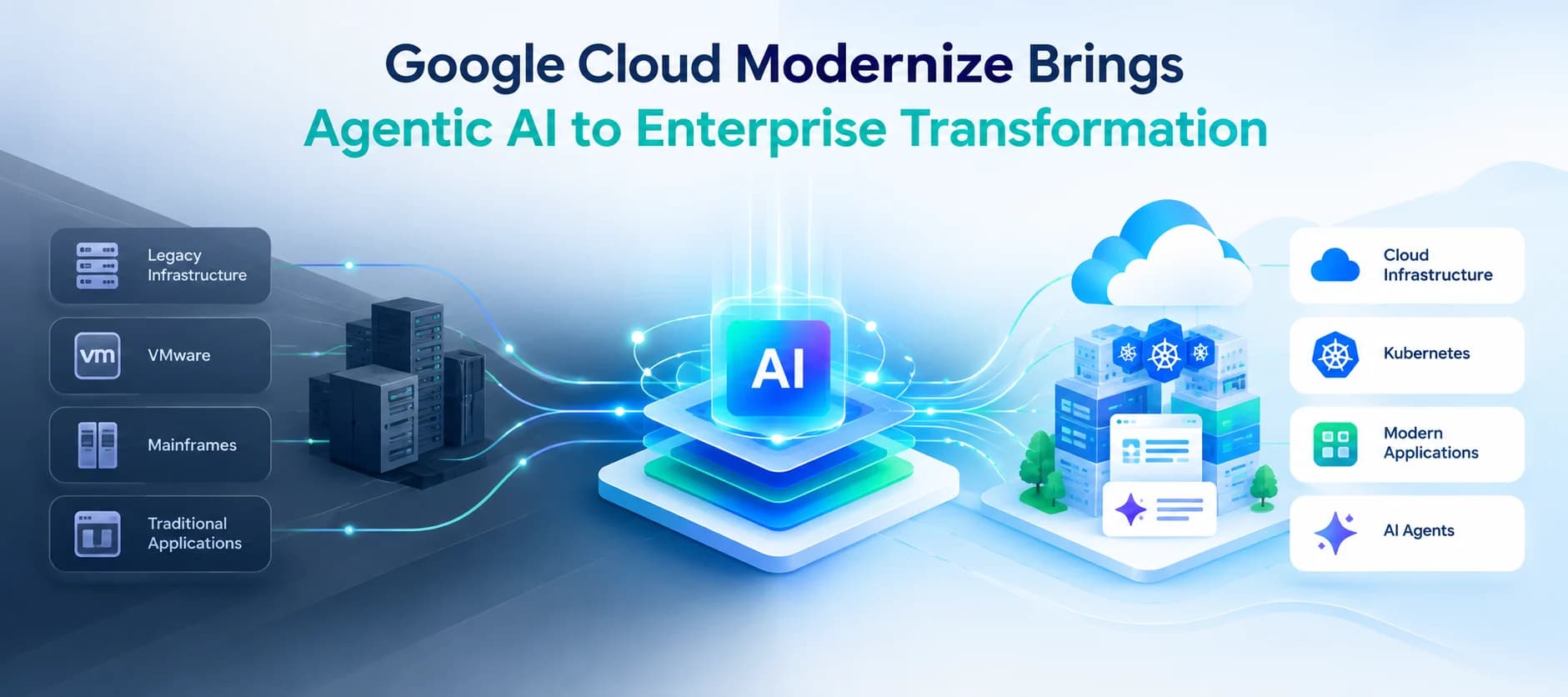
Google Cloud has introduced Google Cloud Modernize, a new end-to-end portfolio designed to help enterprises assess, migrate and modernize infrastructure and applications with AI-driven and agentic capabilities.
Announced on October 5, 2026, the portfolio brings together existing Google Cloud migration and modernization tools with new capabilities covering infrastructure assessment, platform modernization and application modernization.
At the centre of the announcement is Modernization Hub, a new in-console experience that allows developers and architects to analyse source code, map dependencies and support modernization projects involving Java, .NET and mainframe applications.
From cloud migration to AI-ready modernization
Google Cloud's announcement reflects a broader industry shift toward treating infrastructure modernization as part of an enterprise AI strategy.
Many organisations still operate applications and infrastructure built around older architectures. Modern AI workloads can introduce additional requirements around compute, data access, application dependencies and infrastructure scalability.
Google Cloud Modernize is positioned as a portfolio that addresses these stages together rather than treating migration, infrastructure and application modernization as completely separate activities.
The portfolio brings together Migration Center, Google Cloud VMware Engine, Google Cloud Mainframe Modernization and the new EKS-to-GKE Migration Agent.
AI-powered infrastructure assessment
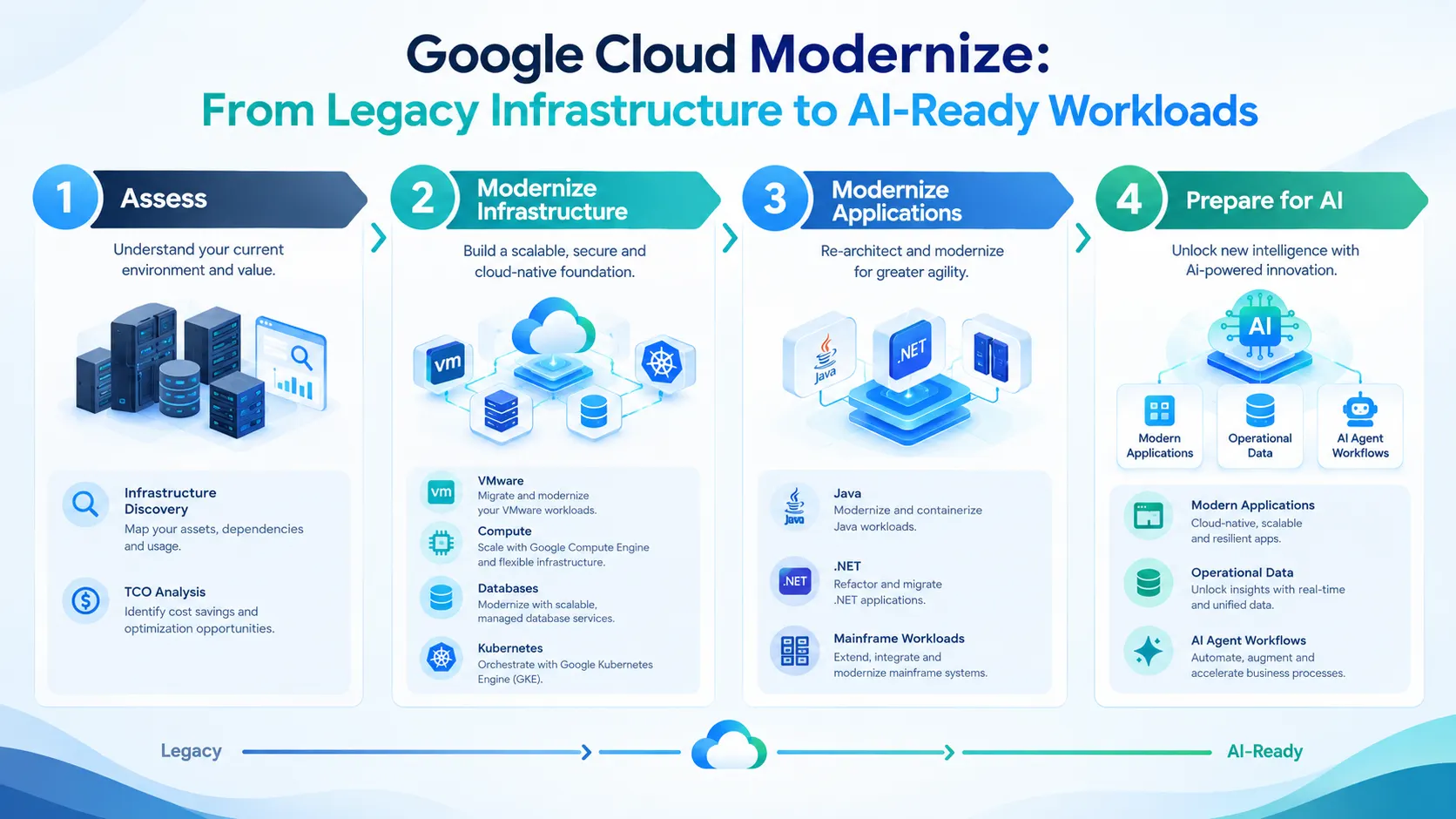
One of the first challenges in modernization is understanding the existing environment and building a business case for change.
Google Cloud says new Gemini capabilities in Migration Center introduce an Agentic Quick Estimator, which is generally available. The tool can use VMware inventory exports such as RVTools and other infrastructure inputs to generate total cost of ownership projections for Compute Engine environments.
The interactive interface allows teams to test assumptions, including multi-region deployments and different licensing approaches such as bring-your-own-license compared with pay-as-you-go.
According to Google Cloud, this approach can reduce a process that traditionally involves weeks of spreadsheet modelling to a business case produced in minutes.
Google Cloud also says organisations can receive a comprehensive modernization assessment through its Rapid Migration & Modernization Program, or RaMP, at no cost.
Modernizing the infrastructure layer
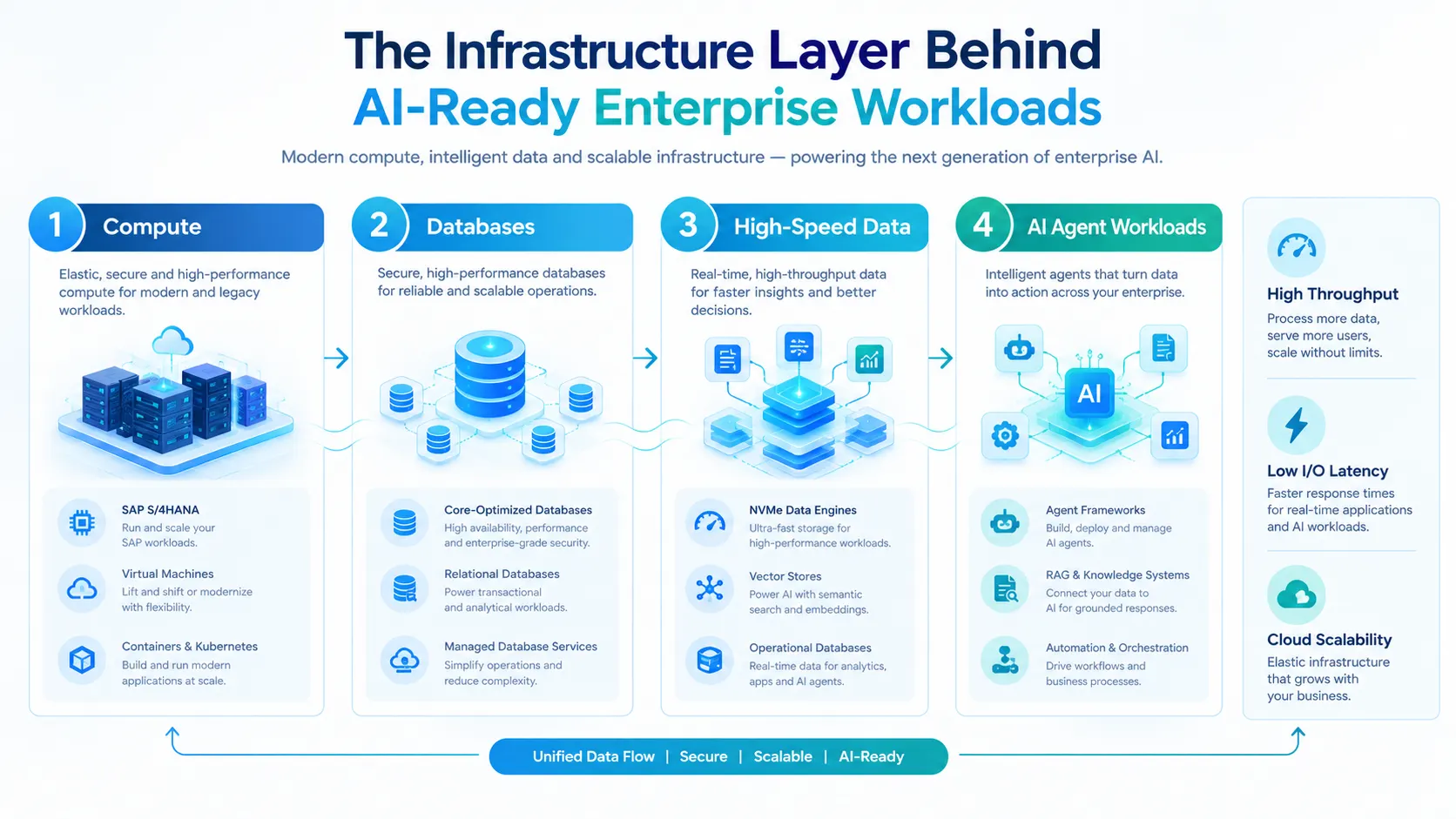
The announcement also introduces several infrastructure options aimed at workloads that require high throughput and reduced I/O bottlenecks.
For SAP S/4HANA workloads, Google Cloud says its X5 Series supports single-node configurations with up to 43 TiB of memory.
The M4N Series is positioned around database workloads, with 26.57 GiB of RAM per vCPU and Hyperdisk Extreme. Google Cloud says this configuration can reduce the need to provision additional compute cores simply to obtain more memory, potentially lowering software licensing costs for core-licensed databases.
Google Cloud also highlights Z4D, which is generally available, and Z4M, which is in preview. The systems provide large amounts of local NVMe SSD storage and 400 Gbps networking, while Z4M also supports RDMA.
The company connects these capabilities to workloads such as vector stores, operational databases and large-scale data pipelines that can be accessed by real-time AI agents.
VMware environments get a cloud migration path
For organisations that still operate VMware environments but want greater cloud elasticity without immediately re-architecting applications, Google Cloud is also highlighting its self-managed VMware offering.
The announcement says the solution provides administrative control using Bare Metal Z3 shapes with VMware Cloud Foundation 9.1.
Native global VPC links can connect VMware environments with services including Compute Engine, Google Kubernetes Engine, BigQuery and Gemini Enterprise.
Google Cloud positions this as a way to connect existing VMware estates with cloud services and operational data while avoiding application code changes in the described scenario.
Agentic migration from EKS to GKE
Another major element of the announcement is the EKS-to-GKE Agentic Migration, currently listed as a public preview.
The capability is designed to automate parts of the migration process from Amazon Elastic Kubernetes Service to Google Kubernetes Engine.
Google Cloud says the migration workflow can manage discovery, Kubernetes manifest translation, and storage and network mappings between cloud environments.
The workflow also includes human-in-the-loop approval gates and in-memory credential security, which Google Cloud says are designed to support GitOps compliance.
Once migrated, workloads can use GKE capabilities including model serving, autoscaling and multi-agent orchestration.
Google Cloud also cites NetEase Games as an example. The company says NetEase reduced infrastructure scaling times from hours to five minutes during peak launches and cut server costs by 40% after containerizing services on GKE. These figures are claims from the Google Cloud announcement and represent the cited customer example rather than a general performance guarantee.
Modernization Hub brings application analysis into the console
Infrastructure modernization is only one part of the challenge. Enterprises also need to understand and update the applications running on that infrastructure.
Google Cloud's Modernization Hub is designed to bring several modernization capabilities into the Google Cloud console.
For Java and .NET applications, Modernization Hub integrates the Google Cloud App Modernization CLI, also referred to as CodMod.
Google Cloud says the tool uses Gemini to analyse large source-code repositories, understand legacy application architectures, map hidden dependencies, identify modernization challenges and generate recommendations.
For .NET workloads, Google Cloud describes a migration path from legacy .NET Framework applications toward modern .NET Core running in Linux containers.
This approach focuses on understanding application dependencies before modernization rather than treating legacy code as an isolated conversion task.
Mainframe modernization remains part of the strategy
Mainframes remain an important part of many enterprise technology environments, particularly where applications contain complex business rules and dependencies.
Google Cloud is extending its mainframe modernization approach through several capabilities.
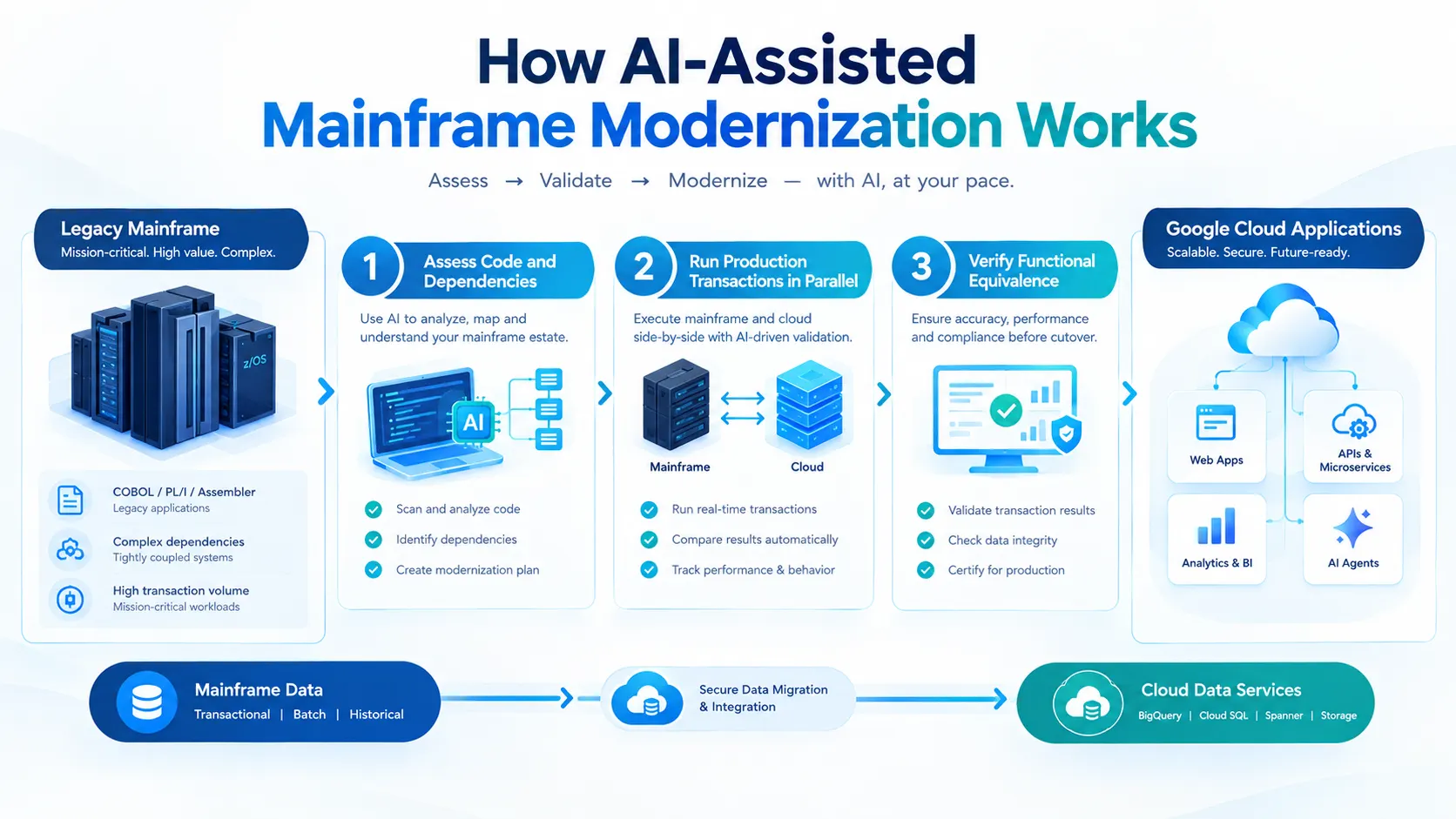
The Mainframe Assessment Tool can parse legacy mainframe codebases, extract business rules and map application and data dependencies.
Dual Run is designed to reduce cutover risk by replaying live production transaction streams across both the existing mainframe and new cloud applications. Google Cloud says this allows organisations to verify functional equivalence before moving into production.
The Mainframe Connector can move mainframe data into Google Cloud services including BigQuery, AlloyDB and Google Cloud Storage, supporting hybrid architectures.
Google Cloud cites Intesa Sanpaolo as a customer using its mainframe modernization technologies. The company says Dual Run has helped provide evidence for internal stakeholders and regulatory approval processes during its transformation.
Customer and partner ecosystem
Google Cloud also highlighted customer and partner examples as part of the announcement.
Deutsche Börse Group is cited as having moved its mission-critical SAP S/4HANA environment and DAX index calculations to Google Cloud. According to Google Cloud, the organisation reduced disaster recovery times from hours to minutes, reduced aggregation latency by more than 50% and shortened development cycles from months to days.
Google Cloud also says it is working with its global partner ecosystem to integrate Modernize with enterprise delivery frameworks, including Cognizant.
These examples illustrate how Google Cloud is positioning modernization as a combination of infrastructure migration, application transformation, operational processes and partner-supported delivery.
What Google Cloud Modernize means for enterprises
The announcement highlights a broader industry shift toward AI-assisted infrastructure and application modernization.
Rather than using AI only to build new applications, cloud providers are increasingly applying AI to the work required to understand existing technology estates.
For enterprises, this could mean using AI to assist with activities such as infrastructure discovery, dependency mapping, cost modelling, code analysis and migration planning.
However, modernization remains a complex enterprise process. Existing dependencies, regulatory requirements, operational constraints and business-critical applications can make large-scale transformation difficult.
Google Cloud's approach is therefore notable because it combines AI-assisted analysis with migration tooling, infrastructure options and application modernization capabilities within a broader portfolio.
The company has also retained human approval mechanisms in areas such as the EKS-to-GKE migration workflow, indicating that automation does not necessarily remove human oversight from enterprise modernization processes.
The bigger picture
Google Cloud Modernize represents Google's effort to connect cloud migration with the growing requirement for AI-ready enterprise infrastructure.
The portfolio spans the modernization lifecycle from assessment and cost modelling to infrastructure migration, Kubernetes transitions, application analysis and mainframe transformation.
The announcement also shows how agentic AI is moving beyond experimentation into infrastructure and application management workflows.
For technology leaders, the practical question is no longer simply whether AI can generate new code or assist developers. It is increasingly whether AI can help organisations understand and transform the large, interconnected technology environments they already operate.
Google Cloud says enterprises can explore Modernization Hub through the Google Cloud console and can request a modernization assessment through its programmes. The company also announced an upcoming November 17 session featuring demonstrations of Modernization Hub and its agentic migration tools.
Source: Google Cloud Blog
About the Author