
Google Cloud Introduces GKE Pod Snapshots to Speed AI Workload Scaling
Google Cloud has introduced GKE Pod snapshots, a feature that captures running CPU and GPU memory so AI workloads can resume without repeating lengthy initialization, reducing inference startup time by up to 89%.
Xcademia Team
Xcademia Research Team
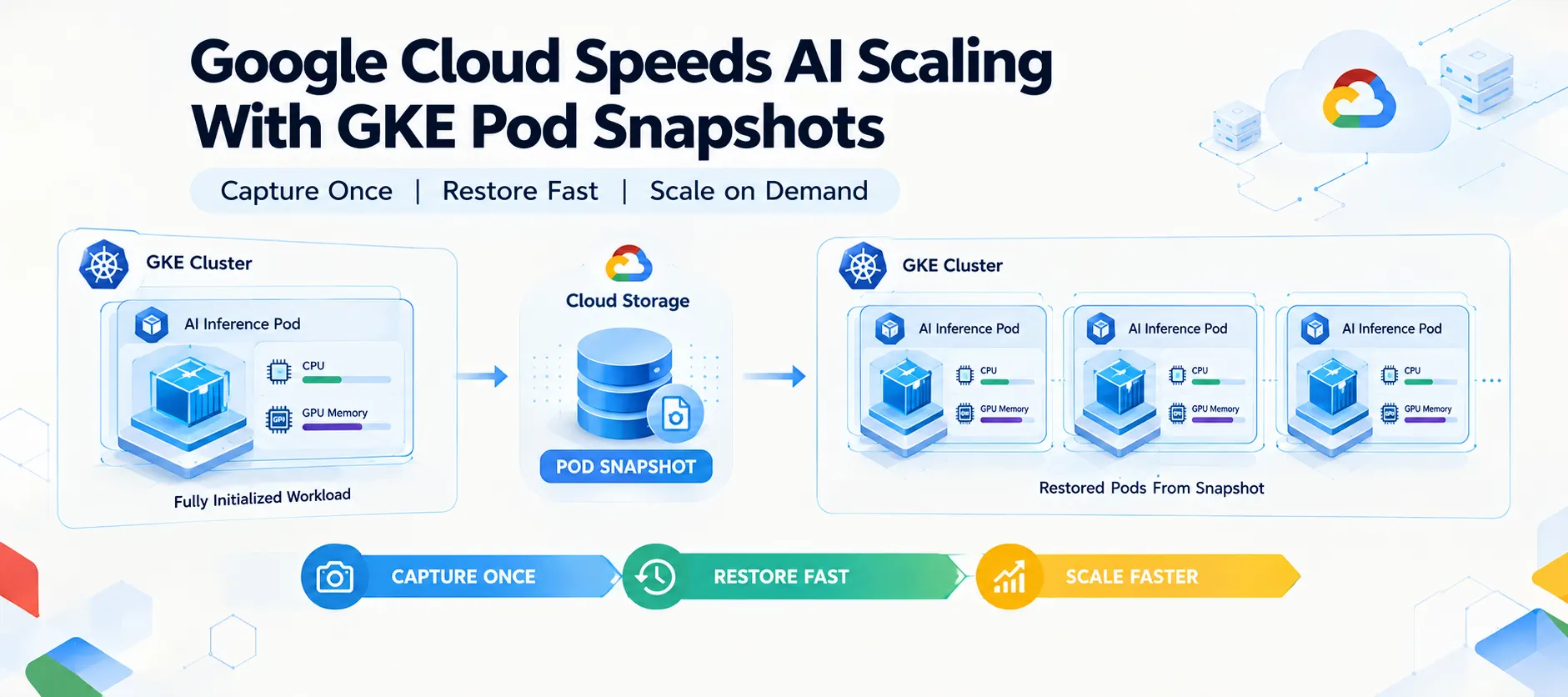
Scaling AI workloads can create a difficult trade-off between performance and infrastructure cost.
Large language models can require substantial initialization before they are ready to serve requests. AI agents may also need isolated environments that can be started quickly, suspended when idle and restored when needed.
Google Cloud says GKE Pod snapshots address this problem by allowing organizations to save the running state of a workload, including CPU and GPU memory, and restore that state on demand.
According to Google Cloud's benchmarks, the feature can reduce AI inference startup time by as much as 89%. The company says 70-billion-parameter models can be loaded in 37 seconds, while 8-billion-parameter models can be loaded in 15 seconds.
The stated goal is to let infrastructure scale closer to actual demand without requiring the same level of overprovisioning.
Why AI Workloads Face a Cold Start Problem
The cold start problem is not unique to artificial intelligence.
Applications that require substantial initialization can experience delays whenever a new instance has to prepare its environment before accepting work. Google Cloud cites examples ranging from game servers to complex Java applications.
The challenge becomes particularly significant for AI inference.
An inference server needs to initialize and then download and load potentially gigabytes of model weights into GPU memory. Google Cloud says this process can take several minutes for some workloads.
Agentic AI introduces another scenario.
AI agents that execute code or use computer interaction tools may require isolated sandboxes for individual requests or workflows. Those environments need to start quickly and may need to be suspended when they become idle.
When startup latency is high, rapid autoscaling becomes more difficult.
Google Cloud says engineering teams may respond by overprovisioning infrastructure or building custom systems designed to restore application state more quickly.
GKE Pod snapshots are designed to address the initialization portion of this problem at the infrastructure level.
How GKE Pod Snapshots Work
The basic concept is to initialize a workload once and capture its running state.
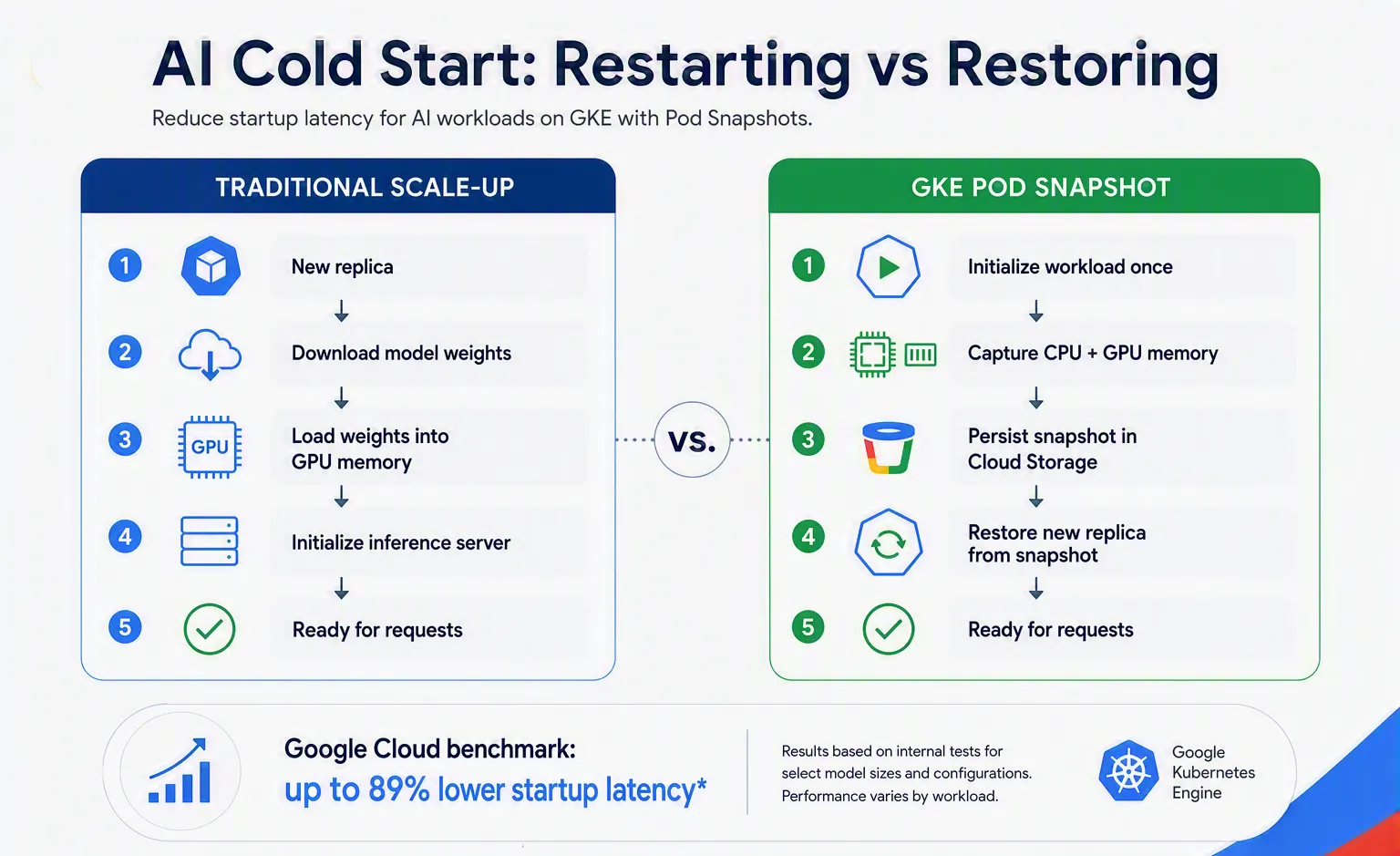
Normally, when an additional replica of an AI inference workload is created, the new instance must independently perform the initialization process. That can include downloading model weights and loading them into accelerator memory.
With GKE Pod snapshots, the workflow changes.
First, the workload is initialized and a snapshot is created.
GKE captures the running state, including CPU and GPU memory, and persists the snapshot in high-throughput Google Cloud Storage.
When additional capacity is required, new replicas can restore from that saved state instead of repeating the complete initialization process.
This changes the scaling pattern from repeated initialization toward state restoration.
Google Cloud says its benchmarks showed startup latency reductions of up to 89% for large models such as llama3-70b.
For platform teams, the company says the approach can support more on-demand autoscaling and reduce the need to maintain idle accelerator capacity.
The 89% figure is from Google Cloud's own benchmark results and should be understood as a company-reported performance result rather than a universal improvement for every workload.
Scaling AI Inference Without Repeating Model Loading
For generative AI inference, Google Cloud says Pod snapshots address what it describes as the linear scaling penalty associated with model loading.
Without snapshots, each new replica needs to perform its own initialization.
For large models with tens of billions of parameters, loading model weights into accelerator memory can represent a significant part of startup time.
With a snapshot already available, additional replicas can restore from the captured workload state.
This means the model initialization process does not have to be repeated from scratch for every new replica.
Google Cloud says this can help platform teams move toward on-demand autoscaling while reducing idle GPU capacity.
The source specifically positions the feature around helping teams meet service-level objectives while reducing infrastructure that would otherwise remain provisioned to handle demand spikes.
GKE Pod Snapshots for Agentic AI Sandboxes
Google Cloud also highlights agentic AI as a second major use case.
AI agents increasingly delegate tasks such as code execution and computer use to isolated environments. These sandboxes provide separation for potentially untrusted, AI-generated code and commands.
A typical setup may require a separate sandbox for a user or discrete workflow.
That creates two infrastructure challenges:
New sandboxes need to start quickly.
Idle sandboxes consume resources while waiting for additional work.
Google Cloud says Pod snapshots can address both.
Faster Sandbox Startup
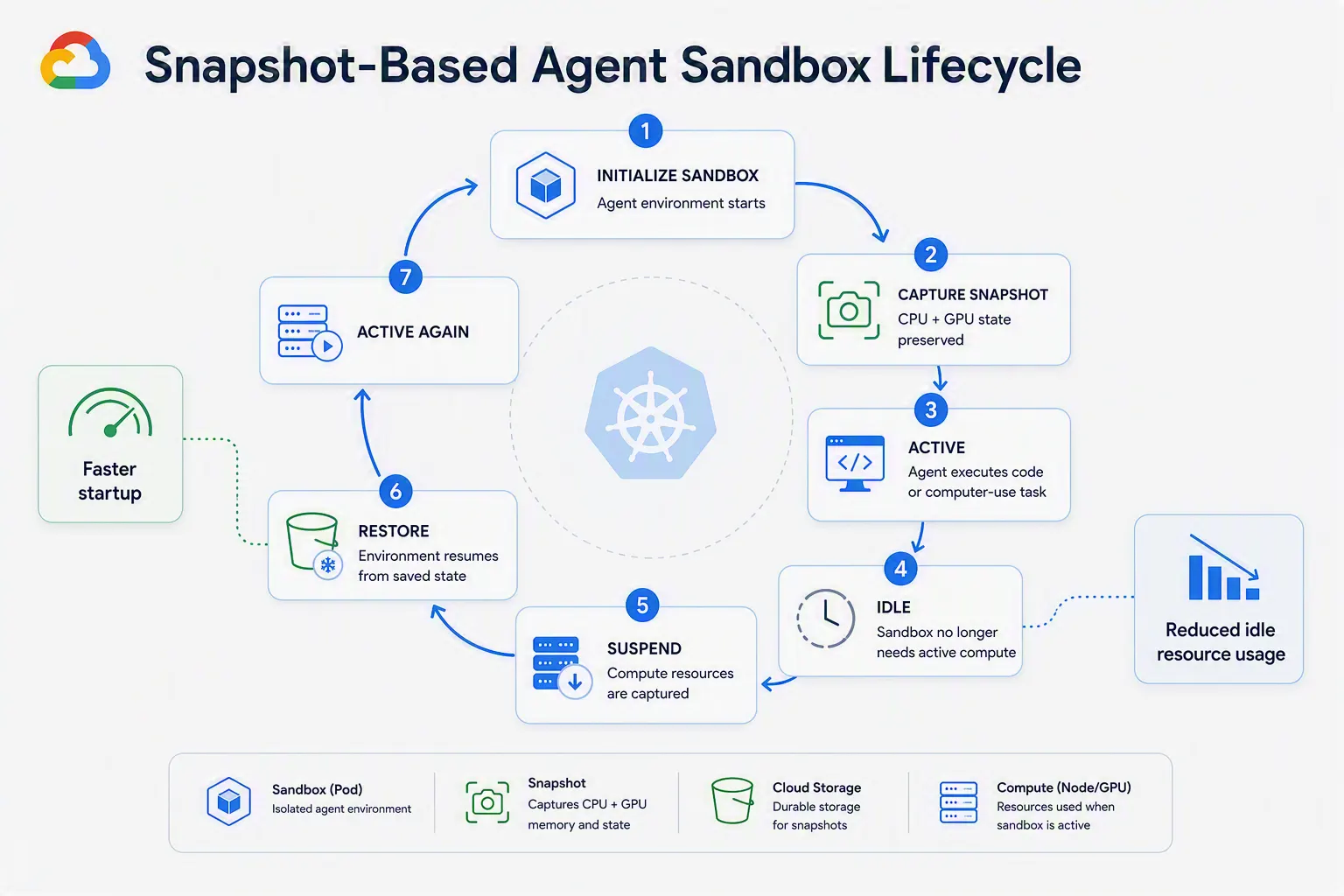
An initial agent sandbox can be initialized and captured as a snapshot.
That snapshot can then be used to quickly initialize additional sandboxes without repeating the complete setup process.
Suspending Idle Sandboxes
A sandbox can also be suspended when it becomes idle.
The snapshot captures its compute resources, allowing the environment to be restored when it is needed again.
This gives teams another option for managing workloads that fluctuate between active and idle states.
Retake Uses Pod Snapshots to Reduce GPU Startup Time
Google Cloud highlights Retake, an AI-powered photo editing platform built by Codeway, as a customer example.
Retake was using GPU workloads on A3 H100 infrastructure and had developed a custom caching layer for compiled artifacts.
According to the customer quote published by Google Cloud, the custom system reduced startup time to approximately one minute, but introduced maintenance overhead and still limited aggressive autoscaling.
After adopting GKE Pod snapshots, Retake reports reducing startup latency to 8 seconds.
The company's Lead DevOps Engineer, Ahmet Furkan Çomak, said the change allowed Retake to dynamically start H100 instances for specific fine-tuning or inference jobs and shut them down after the work was complete.
Google Cloud presents this as an example of how restoring workload state can replace some application-level caching complexity.
The reported 8-second result is specific to Retake's workload and configuration. It should not be treated as a guaranteed startup time for other GKE workloads.
Declarative Configuration Through Pod Snapshot CRDs
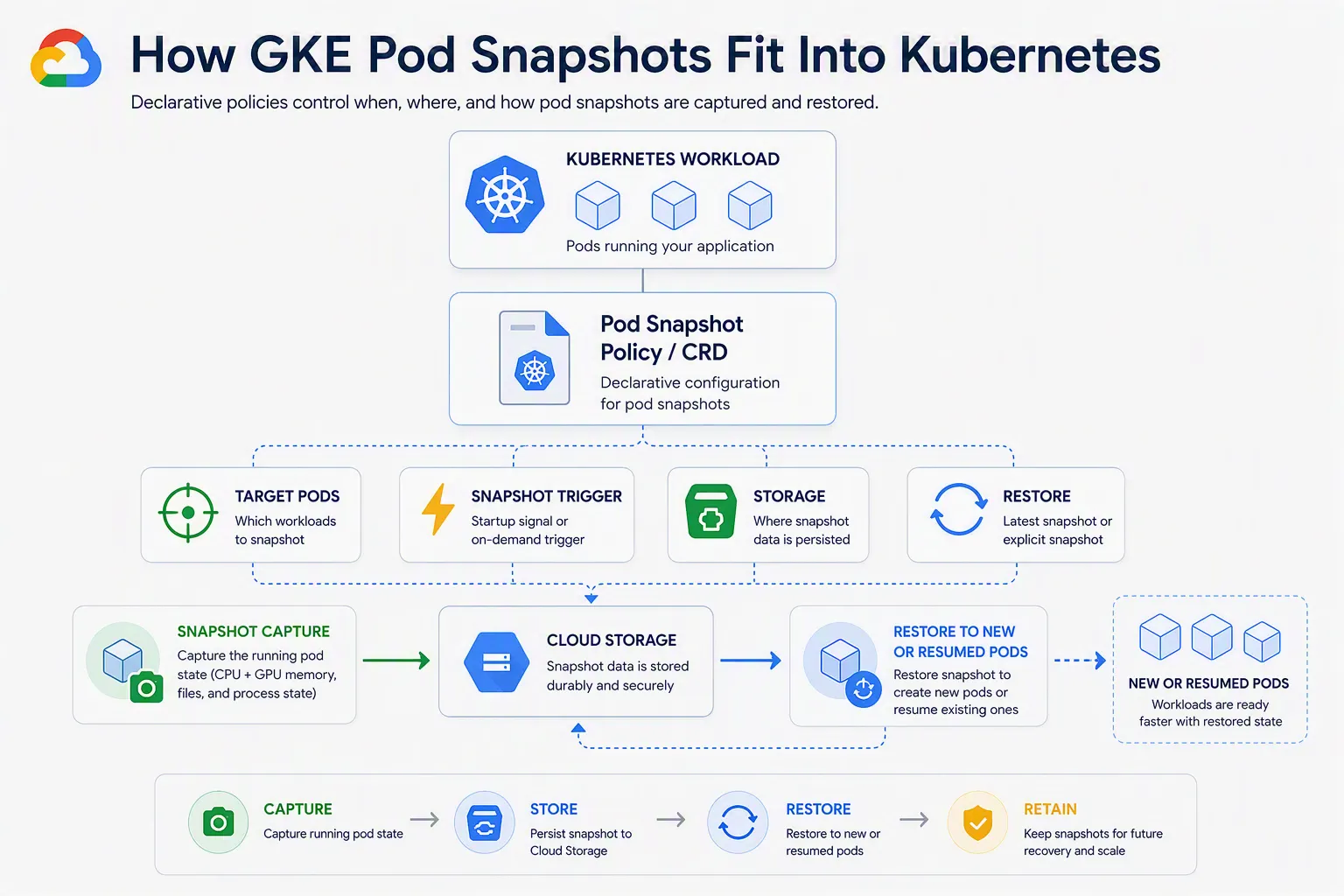
Google Cloud says Pod snapshots are designed to fit into existing Kubernetes workflows through declarative configuration.
Organizations can define a policy using Pod snapshot Custom Resource Definitions, or CRDs.
The policy determines:
Which Pods should be snapshotted
Where snapshot data should be stored
How the storage lifecycle is managed
How snapshots are restored
This allows snapshot behavior to be managed through Kubernetes configuration rather than requiring a separate application-level caching architecture.
Snapshots Can Be Captured at Different Points
Google Cloud says snapshots can be created at different stages of a workload's lifecycle.
A snapshot can be captured during workload startup using a workload signal.
It can also be triggered on demand while a Pod is running.
This gives teams control over when the captured state should represent the workload.
The source also describes controls for storage and restore behavior.
Organizations can configure snapshot retention for cost optimization and choose whether new deployments restore from the latest snapshot or from a specific snapshot.
Pod Snapshots Are Not Limited to AI
Although Google Cloud positions AI inference and agent sandboxes as the primary use cases, the company says the feature is workload-agnostic.
The same approach can be used for applications with long initialization phases.
Google Cloud specifically mentions:
Complex Java applications
Game servers
Legacy monoliths
The underlying principle is the same: instead of repeatedly rebuilding a workload's initialized state, the system can preserve that state and restore it when needed.
This makes the feature relevant beyond GPU-intensive AI infrastructure.
What GKE Pod Snapshots Change for AI Infrastructure
The main infrastructure change described by Google Cloud is a shift from repeatedly initializing workloads toward restoring previously initialized state.
For AI inference, this can reduce the amount of time required before a new replica becomes available.
For agentic workloads, it can help address both rapid sandbox creation and the cost of keeping idle environments active.
For Kubernetes teams, the feature also moves some of the state-management process into the platform layer through Pod snapshot policies and CRDs.
The approach does not eliminate the need for workload-specific configuration or capacity planning. Instead, it provides another mechanism for handling workloads where initialization is expensive or time-consuming.
A Broader Pattern: Preserve State Instead of Rebuilding It
The announcement highlights a broader infrastructure pattern: when workload initialization becomes expensive, preserving an initialized state can reduce the repeated work required during scaling.
This is particularly relevant to AI systems because model weights and accelerator memory can represent a substantial part of startup preparation.
Agentic workloads add another dimension because isolated execution environments may frequently transition between active and idle states.
GKE Pod snapshots address both scenarios through the same underlying concept of capturing and restoring workload state.
What Google Cloud Provides With GKE Pod Snapshots
The feature described in the source includes several capabilities:
Capturing running workload state
Capturing CPU and GPU memory
Persisting snapshots in high-throughput Cloud Storage
Restoring new replicas from saved state
Creating snapshots through startup signals or on-demand triggers
Defining snapshot policies through Kubernetes CRDs
Controlling snapshot retention
Choosing the snapshot used for restoration
Suspending and restoring idle agent sandboxes
Supporting workloads beyond AI inference
Google Cloud says the feature is intended to integrate into existing Kubernetes workflows rather than require application-level caching for every use case.
Final Takeaway
Google Cloud's GKE Pod snapshots target one of the recurring infrastructure challenges in AI workloads: the time and resources required to initialize new instances.
By capturing the running state of a workload, including CPU and GPU memory, GKE can restore that state when additional capacity is needed instead of repeating the full initialization process.
Google Cloud reports up to 89% lower AI inference startup latency in its benchmarks, including 37-second startup for 70B parameter models and 15 seconds for 8B parameter models.
The company also highlights agentic AI sandboxes, where snapshots can be used both to start isolated environments quickly and to suspend idle environments until they are needed again.
The Retake customer example provides one reported implementation result, with startup latency reduced from around one minute with its previous caching approach to 8 seconds after adopting Pod snapshots.
Beyond AI, Google Cloud says the feature can also support applications with lengthy initialization phases, including complex Java applications, game servers and legacy monoliths.
For Kubernetes teams running workloads where startup state is expensive to rebuild, GKE Pod snapshots introduce a platform-level approach to preserving and restoring that state.
Source: Google Cloud Blog
About the Author