
Google Cloud Introduces Filestore Agent Volumes for AI Workspaces
Google Cloud has introduced Filestore agent volumes, a fully managed storage capability designed for isolated, persistent and elastic workspaces supporting AI agent workloads on GKE.
Xcademia Team
Xcademia Research Team
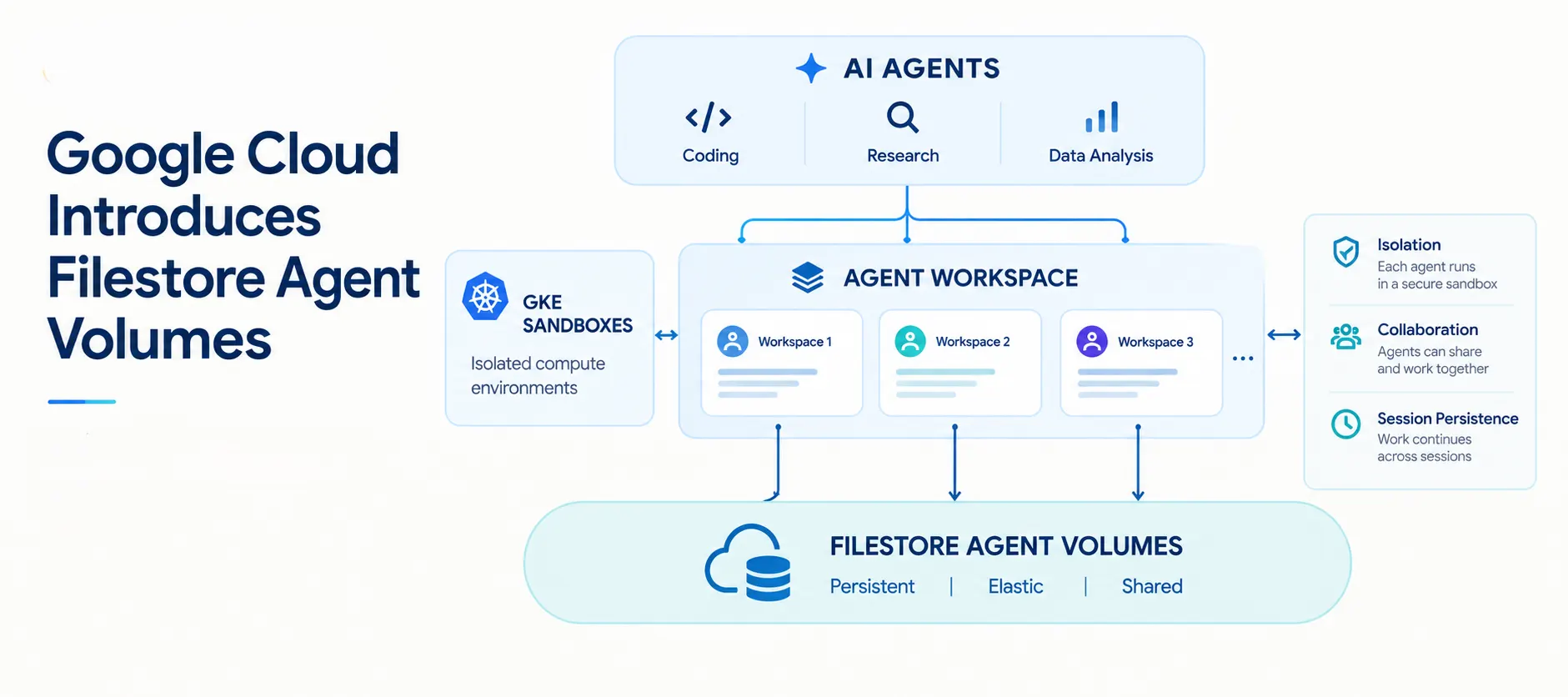
Google Cloud has announced Filestore agent volumes, a new capability designed to provide fully managed file storage for AI agent workspaces.
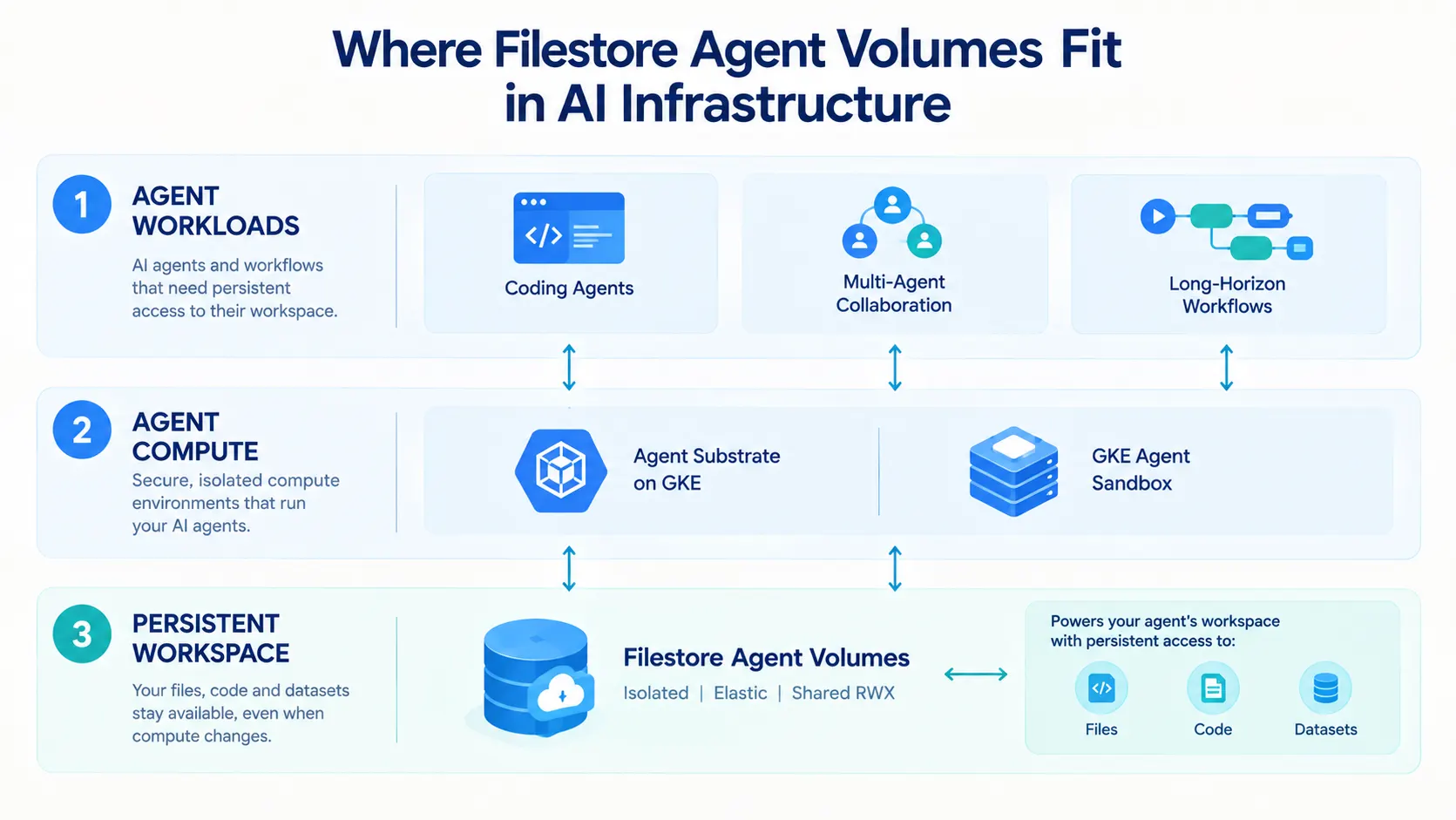
The offering is part of Google Cloud's expanding AI infrastructure portfolio and is designed to complement agent compute environments such as Agent Substrate on GKE and GKE Agent Sandbox.
As enterprises deploy larger numbers of autonomous agents, those agents need more than compute resources. They also require workspaces where they can store code, datasets, packages and other task-related files while maintaining isolation between workloads.
Google Cloud says existing approaches often involve moving state between agent sandboxes and centralized storage or manually managing local disks and self-hosted file systems. At larger scales, these approaches can create trade-offs involving cold-start latency, operational complexity and idle storage.
Filestore agent volumes are designed to address these storage requirements through dynamic provisioning and automated lifecycle management.
Storage That Follows the Agent Workspace
Filestore agent volumes are integrated with Google Cloud Filestore and designed specifically for agentic workloads.
The architecture is also co-designed with Agent Substrate to support large agent fleets.
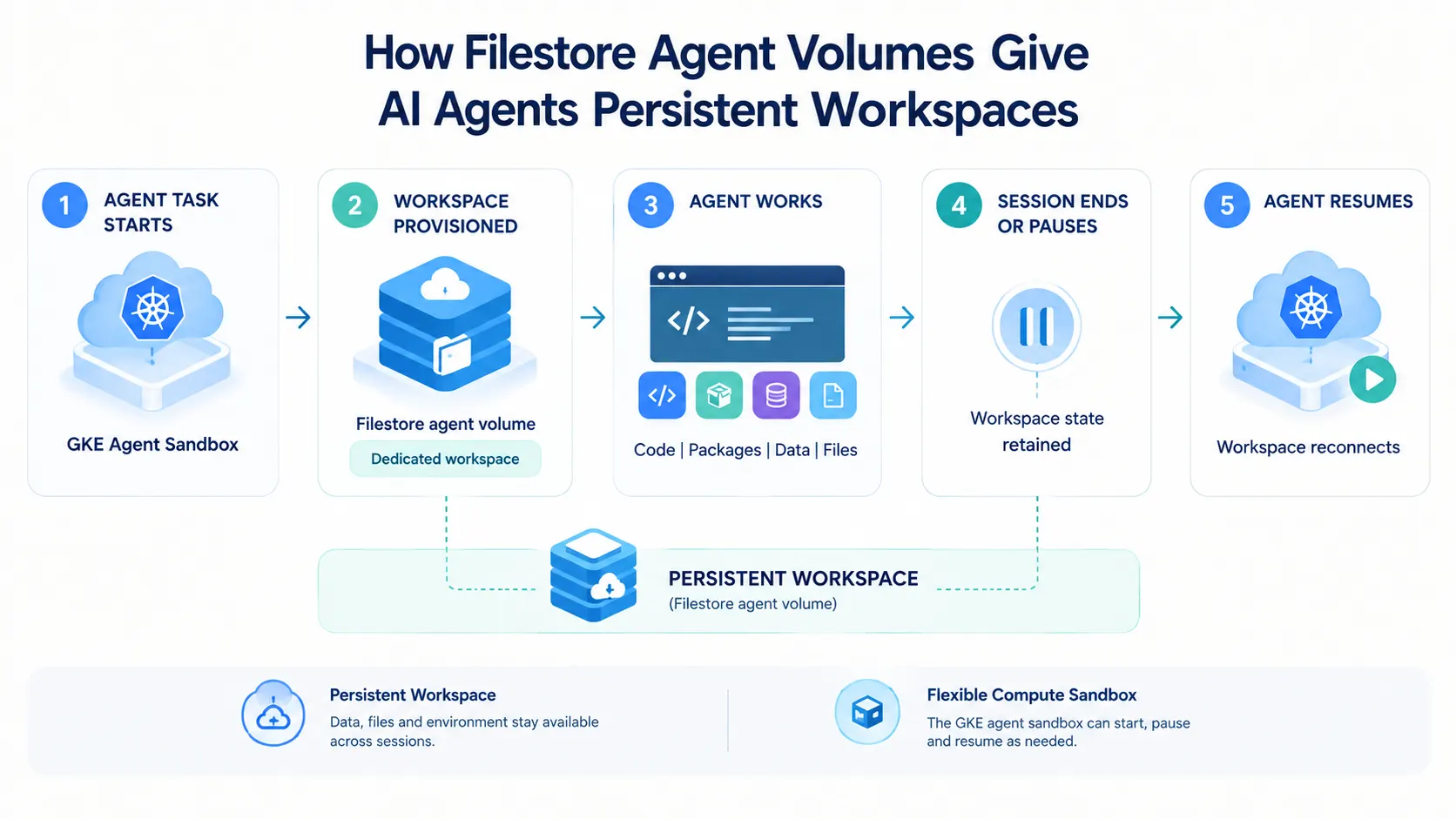
When GKE launches a sandbox for a new agent task, Filestore can automatically allocate and attach a dedicated file workspace to that environment.
Google Cloud says this process happens in milliseconds.
The storage lifecycle is also managed automatically. Platform teams do not need to manually create, attach or remove individual storage volumes for each agent run.
This creates a storage layer designed to scale alongside agent workloads rather than requiring storage resources to be manually provisioned for every session.
Four Capabilities Designed for Agent Fleets
Google Cloud highlights four characteristics of Filestore agent volumes.
1. Granular Isolation and Enterprise Guardrails
Autonomous agents may execute dynamic code, install third-party packages and interact with tools.
That creates a need to keep individual workspaces separated.
Google Cloud says Filestore agent volumes provide boundary controls and granular access permissions for each workspace. Agents operate within their designated directories, helping isolate dynamic toolchains across tenants.
The storage model is therefore designed around workspace-level separation rather than simply providing a shared storage location for an entire agent platform.
2. Sub-Second Session Resumption
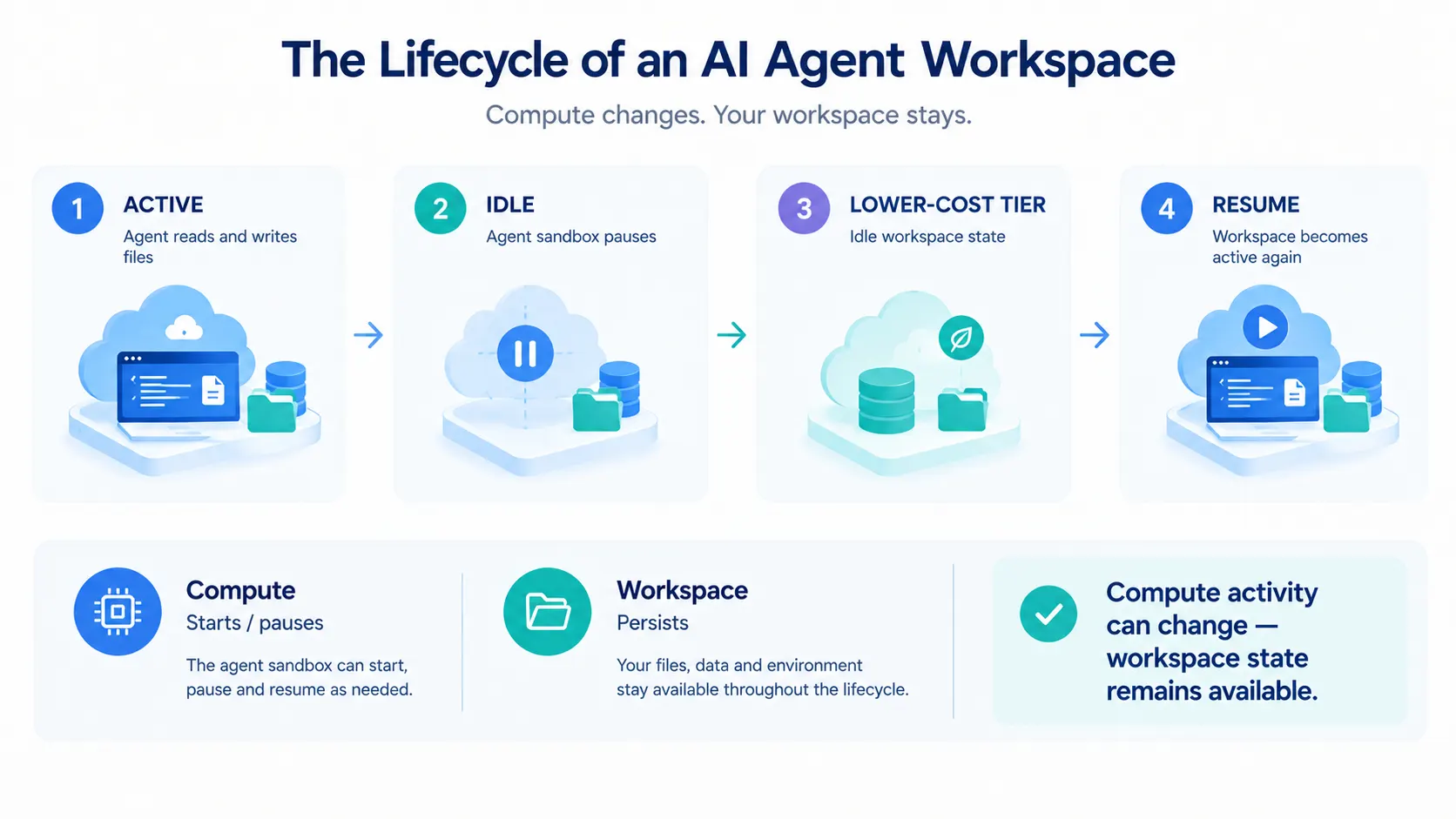
Agent workloads can be intermittent. A sandbox may not need to remain active while an agent is waiting for additional input or an external event.
Google Cloud says agent volumes can attach and detach in milliseconds.
This allows orchestrators to suspend idle sandboxes while retaining workspace state, then resume sessions when additional tasks or user input arrives.
The announcement describes this as enabling sub-second session resumption.
The company does not provide independent benchmark data beyond the performance characteristics stated in the announcement.
3. Lifecycle Management and Pay-Per-Use Storage
Another focus is storage utilization.
Fixed-size, high-performance storage can remain allocated even when short-lived or intermittent agent tasks are inactive.
Google Cloud says Filestore agent volumes use storage capacity based on what is consumed and provide automatic lifecycle tiering.
When agents are not actively reading or modifying code or analyzing datasets, idle workspace state can automatically move to lower-cost storage.
This approach is intended to reduce the need to maintain continuously provisioned high-performance storage for workloads that are not always active.
The announcement does not provide specific pricing figures or quantified savings.
4. Multi-Agent Collaboration With RWX
Filestore agent volumes also support collaborative workflows involving multiple agents.
Google Cloud says the volumes provide native Read-Write-Many (RWX) support and POSIX file locking.
This allows multiple agents to attach to a shared workspace and work with the same project files.
For multi-agent systems, that can support workflows in which different agents handle different stages of a task.
For example, an orchestrator could delegate work to research, code-generation and validation agents that operate against a shared file tree.
POSIX file locking is designed to provide file-level consistency and protection against write conflicts when agents work concurrently.
Supporting Different Agentic Workloads
Google Cloud identifies several workloads that can use Filestore agent volumes.
Software Engineering and Coding
Coding agents can use isolated workspaces to install libraries, create multi-file changes, run build tools and execute unit tests.
The storage environment uses standard POSIX file semantics, meaning applications do not need storage-specific customization for these operations.
Collaborative Multi-Agent Systems
Multi-agent workflows can use a shared file tree for collaboration.
An orchestrator can delegate tasks to specialized agents while allowing those agents to work with common project files.
RWX support is designed to enable concurrent access to that shared workspace.
Interactive Long-Horizon Workflows
Some agent applications may operate over extended periods and require users to provide input or approval before continuing.
Google Cloud says platforms can suspend idle agent sandboxes in these scenarios and resume them when needed, while retaining the workspace state.
This model is also relevant to multi-hour data analysis workflows described in the announcement.
Availability and Getting Started
Filestore agent volumes are now available to all Google Cloud customers for non-production workloads.
Google Cloud says GA support for production workloads is available through an allowlist.
The capability includes out-of-the-box integrations with:
Agent Substrate on GKE
GKE Agent Sandbox
Google Cloud says these integrations are intended to help organizations build agent platforms with responsive and scalable storage infrastructure.
Customers can request access through the form provided in the Google Cloud announcement and refer to the Filestore and GKE documentation for additional information.
Additional details were not disclosed in the announcement regarding production allowlist criteria, pricing figures or capacity limits.
What This Means for AI Infrastructure
The announcement highlights a broader industry shift toward infrastructure designed specifically for increasingly dynamic AI agent workloads.
Traditional application storage often assumes relatively predictable workloads and longer-lived compute environments. Agent platforms can instead create and terminate workspaces frequently, pause sessions and coordinate multiple autonomous processes.
Filestore agent volumes are designed around that model by combining persistent workspaces with dynamically managed agent sandboxes.
For enterprises building agent platforms, this could mean storage becomes more closely integrated with the agent lifecycle rather than being managed as a separate infrastructure layer.
The announcement does not provide independent measurements of performance, cost savings or operational improvements, so the practical impact will depend on how organizations deploy the capability.
Conclusion
Google Cloud's Filestore agent volumes introduce a managed storage layer specifically designed for AI agent workspaces.
The capability combines isolated workspaces, automated volume lifecycle management, fast attachment and detachment, lifecycle tiering and RWX support for multi-agent collaboration.
It is designed to work with Agent Substrate on GKE and GKE Agent Sandbox, giving agent platforms a persistent file layer alongside their compute environments.
The offering is available for non-production workloads across Google Cloud, while production GA access is currently available through an allowlist.
As agent platforms become more dynamic, the announcement shows how cloud infrastructure providers are adapting storage around the lifecycle and collaboration requirements of autonomous workloads.
Source: Google Cloud Blog
About the Author