
Anthropic Creates Public Benefit Fund With 5% of Company Shares
Anthropic plans to allocate 5% of its shares to a new Public Benefit Fund, with potential increases as the company grows. The initiative aims to support public-interest projects, including efforts to address AI's impact on workers.
Xcademia Team
Anthropic Commits Company Shares to a New Public Benefit Fund
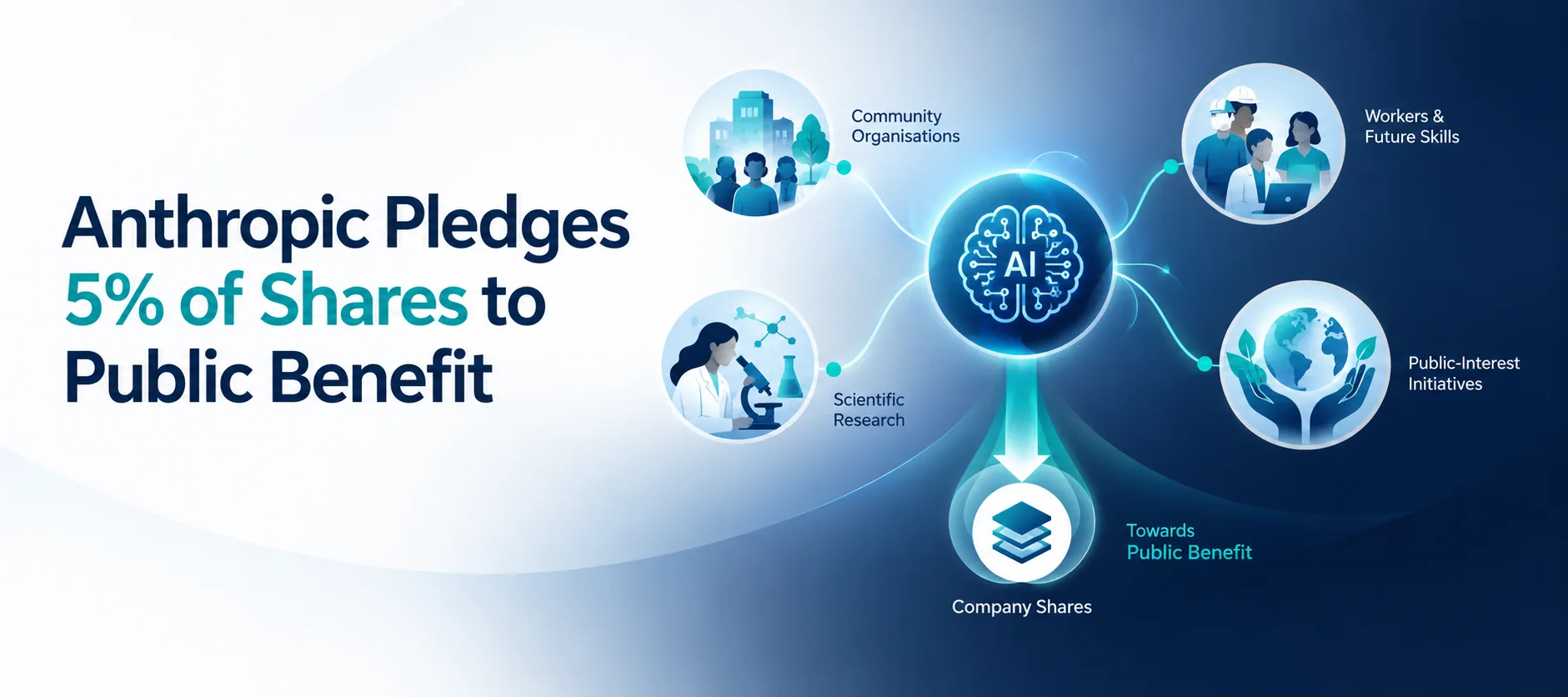
Artificial intelligence company Anthropic has announced a new initiative that will dedicate a portion of its company shares to public-interest activities. The company plans to commit 5% of its shares to the Anthropic Public Benefit Fund, a new entity designed to support initiatives that benefit society as AI technology advances.
Announced on October 18, 2026, the proposal is subject to stockholder approval. Anthropic also outlined a mechanism that could increase the fund's stake as the company's value grows, subject to board discretion.
The initiative reflects Anthropic's approach to balancing commercial growth with its stated public-benefit mission. It also comes amid growing discussion about how the economic gains from AI should be shared and how society might respond to the technology's potential effects on employment.
1. How the Public Benefit Fund will work
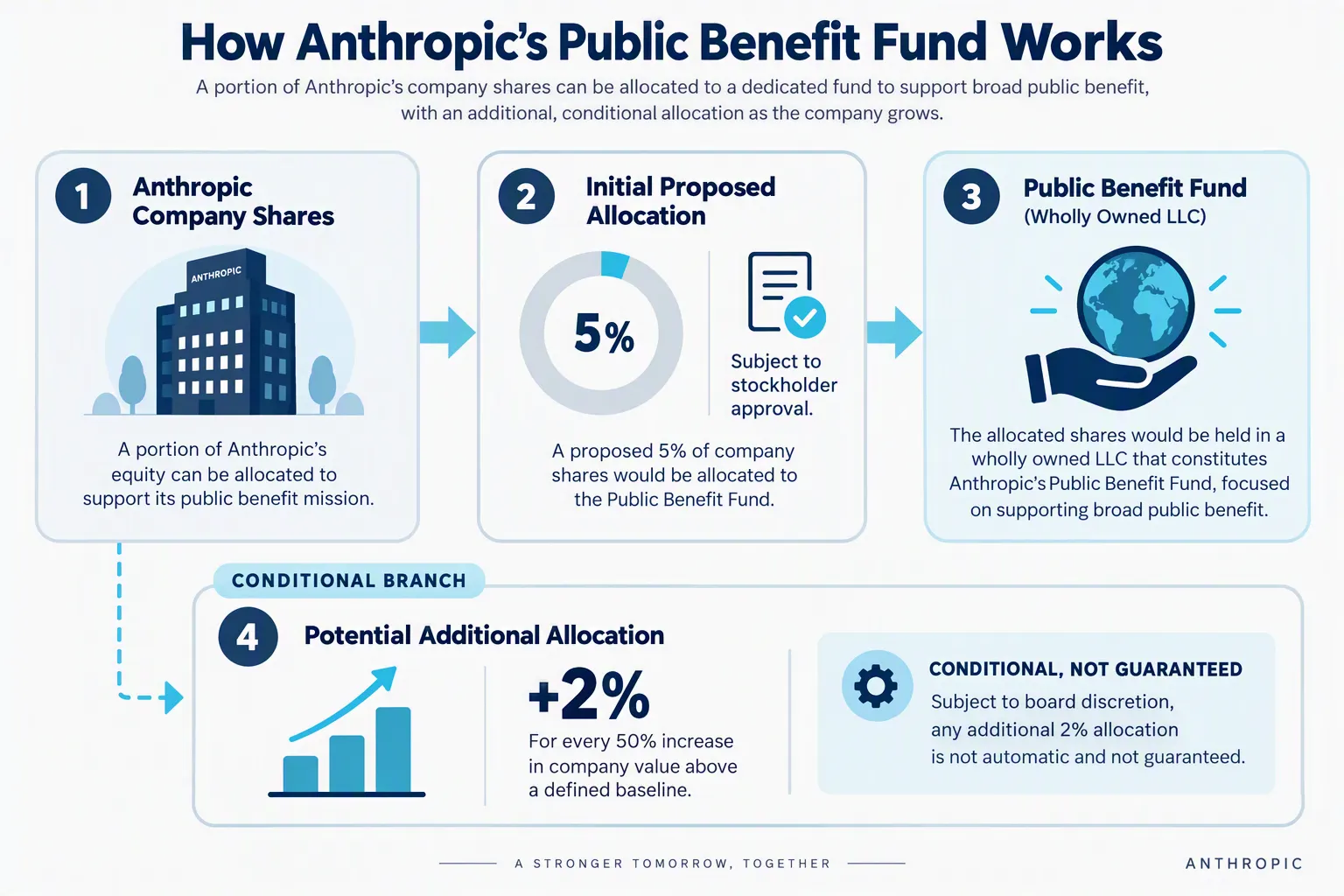
Anthropic says the fund will initially receive 5% of the company's shares, subject to stockholder approval. Its structure also allows for potential increases as the company's valuation rises.
Under the announced arrangement, an additional 2% stake could be added at the board's discretion for every 50% increase in the company's value above a defined baseline.
The mechanism is intended to connect Anthropic's growth with its ability to dedicate more resources to public-benefit initiatives. However, the company has not yet published all the details needed to assess how the arrangement will operate over time.
The fund will be established as a wholly owned limited liability company (LLC), rather than as a conventional 501(c)(3) charitable organisation. Anthropic says this structure offers flexibility across different forms of giving.
The company has also stated that the equity held by the fund will not be used for lobbying or political contributions in the United States or internationally.
2. Addressing the potential impact of AI on workers
One of the announcement's key themes is the economic disruption that AI could create.
Anthropic acknowledges that AI could generate substantial economic value while also causing instability for some workers. The company says its existing commitment of $200 million to studying and addressing AI's labour-market impact is an example of its efforts in this area.
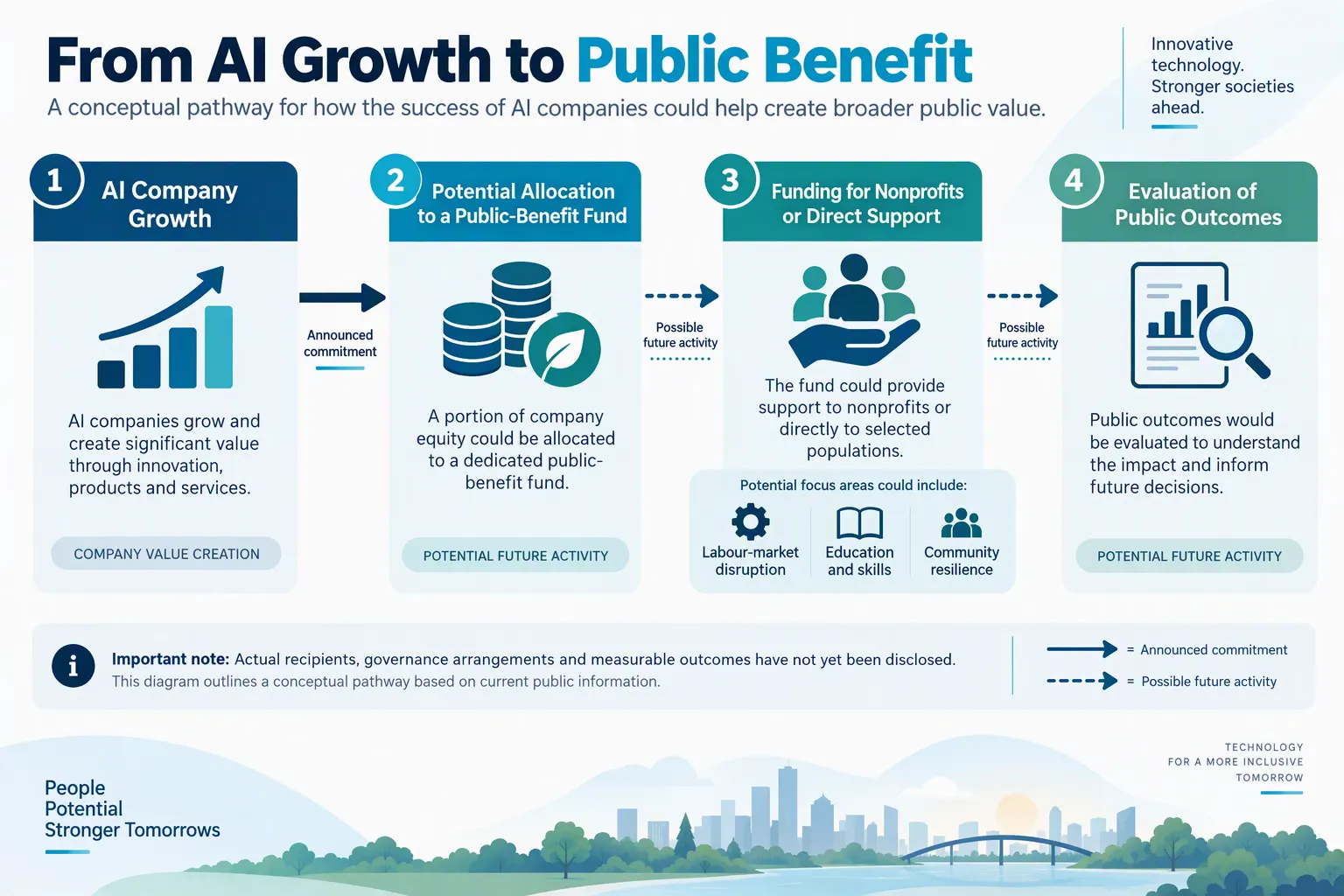
The new fund could provide additional flexibility to explore different responses. Anthropic identified large donations to established nonprofit organisations and direct distributions to specific populations as possible approaches.
These are examples of potential activities, rather than a confirmed list of funded programmes. The announcement does not identify specific recipients, eligibility requirements, payment amounts or a timetable for distributing support.
Why this matters
AI adoption is creating questions beyond technical performance and business productivity. Policymakers, employers and researchers are also examining how automation may affect jobs, skills and economic security.
Anthropic's proposal introduces one possible funding mechanism for addressing some of these concerns. Its eventual impact will depend on the initiatives it supports, how funding decisions are made and whether the resulting programmes deliver measurable benefits.
3. Building on existing public-benefit commitments
Anthropic says the new fund builds on commitments made by its founders and employees.
According to the announcement:
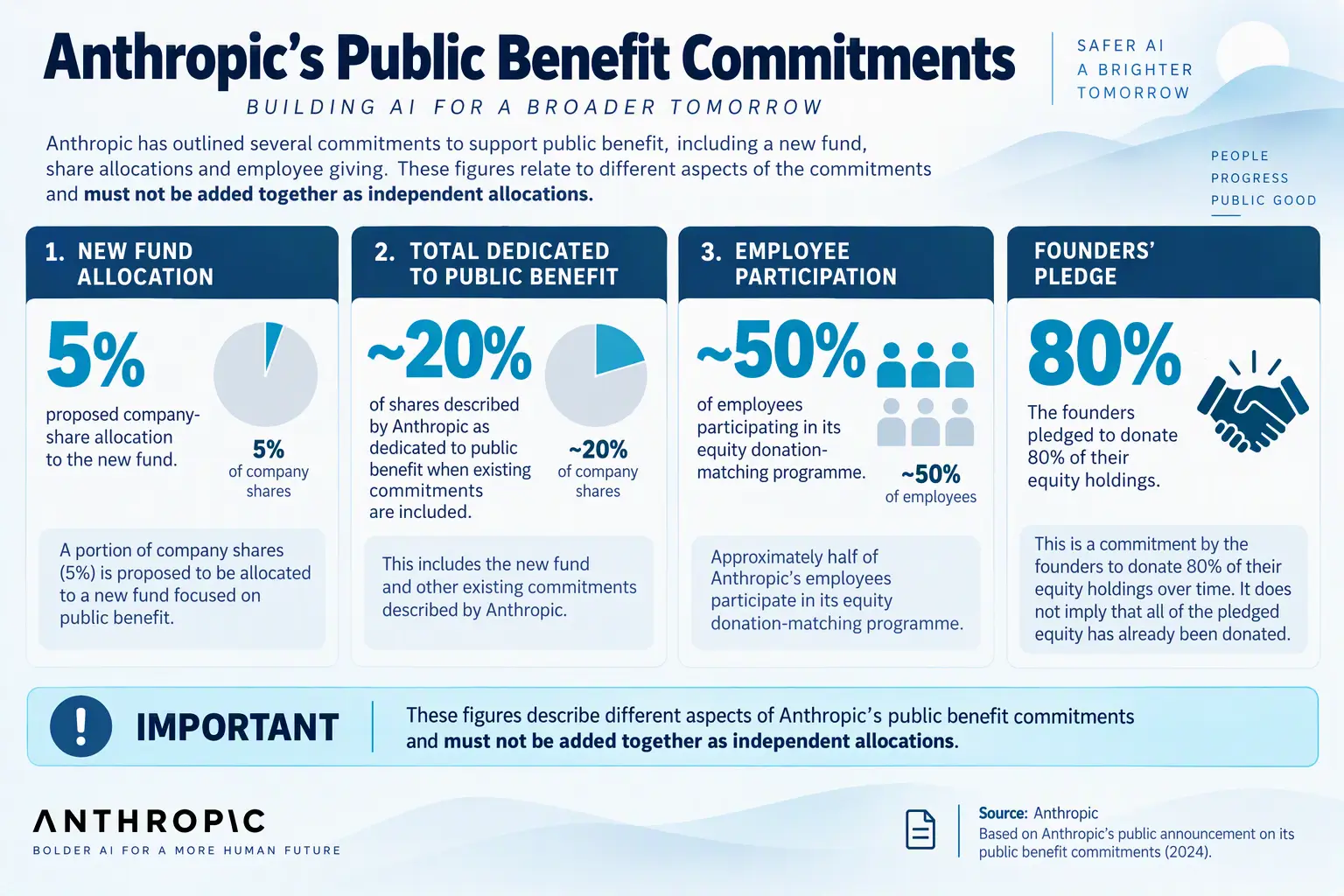
Founders' equity commitments: Anthropic's co-founders pledged to donate 80% of their equity holdings when the company was founded.
Employee participation: The company operates an equity donation-matching programme through which employees can pledge equity that Anthropic matches.
Participation level: Approximately half of Anthropic's employees participate in the programme, according to the company.
Combined commitment: Anthropic estimates that roughly 20% of its shares will be dedicated to public benefit when the new allocation is combined with existing commitments, with the possibility of additional allocations if valuation milestones are reached.
These figures describe equity commitments, not cash already distributed to beneficiaries. The announcement does not provide a full breakdown of the valuation, realised donations or the amount of funding that will be available for immediate distribution.
4. Why Anthropic chose a wholly owned LLC
Anthropic plans to establish the Public Benefit Fund as a wholly owned LLC instead of using a 501(c)(3) structure or another organisational format.
The company says this approach will provide greater flexibility in choosing how to distribute support. Its examples range from donations to established nonprofits to direct distributions to specific groups of people.
This is an important distinction because the fund is not being presented solely as a conventional charitable grant-making organisation. Its proposed structure is intended to accommodate different forms of giving as the company's circumstances and public-benefit priorities evolve.
Anthropic has committed to excluding lobbying and political giving from the fund's use of its equity. Further details about the fund's governance, decision-making arrangements and valuation milestones are expected in future disclosures.
What remains unclear?
The announcement does not yet establish which organisations or populations will receive support, how recipients will be selected, who will oversee individual funding decisions or how outcomes will be evaluated.
5. What the announcement means for the AI industry
Anthropic's initiative highlights a broader industry question: how should AI companies distribute some of the value they create while addressing potential negative consequences of their technology?
For enterprises and technology leaders, the announcement offers three areas worth watching.
Connecting company growth with public benefit
Anthropic's proposed mechanism links potential increases in its public-benefit allocation to growth in company value. This creates a stated connection between commercial performance and the resources potentially reserved for public-interest initiatives.
Addressing economic disruption
The company has specifically identified labour-market impacts as an area where more ambitious responses may be needed. The fund could create options for supporting research, nonprofits or affected populations, although the precise programmes remain undecided publicly.
Demonstrating accountability through disclosure
The announcement promises further information about governance and valuation milestones, alongside a future public-benefit report. These disclosures will help readers assess how the fund is managed and how the company's stated objectives translate into activity.
These are potential implications, not evidence that the fund has already delivered social or economic outcomes.
6. What happens next?
Anthropic says it plans to publish more information about the fund's structure and governance in the coming months. This includes details about the valuation milestones that could allow additional shares to be allocated.
The company has also said it will report on progress towards its mission in an upcoming public-benefit report.
Until those disclosures are available, several important questions remain open:
How will the fund prioritise competing public-interest needs?
What criteria will determine which organisations or populations receive support?
How will the company measure and report the outcomes of funded initiatives?
How will the proposed valuation-linked allocations work in practice?
The answers will be important in determining how the fund operates beyond its initial announcement.
Conclusion
Anthropic's Public Benefit Fund represents a proposed expansion of the company's approach to supporting public-interest activities. The initial 5% share commitment, subject to stockholder approval, and the potential for further allocations link the initiative to the company's future growth.
The announcement also identifies AI's potential labour-market effects as an area requiring attention. However, the fund's practical impact will depend on its governance, distribution decisions and the outcomes of the programmes it ultimately supports.
For the wider AI industry, the initiative adds to an ongoing discussion about how technology companies can balance commercial success with their responsibilities to society. Future disclosures should provide a clearer picture of how Anthropic intends to turn this commitment into measurable public benefit.
Source: Anthropic
About the Author