
AI Agents Are Becoming Privileged Insiders: Why Runtime Security Matters
AI agents can now access data, invoke tools, call APIs and execute workflows. Check Point argues that securing them requires more than identity controls, with runtime governance and action-level enforcement becoming increasingly important.
Xcademia Team
Xcademia Research Team
AI Agents Are Moving From Assistants to Digital Workers
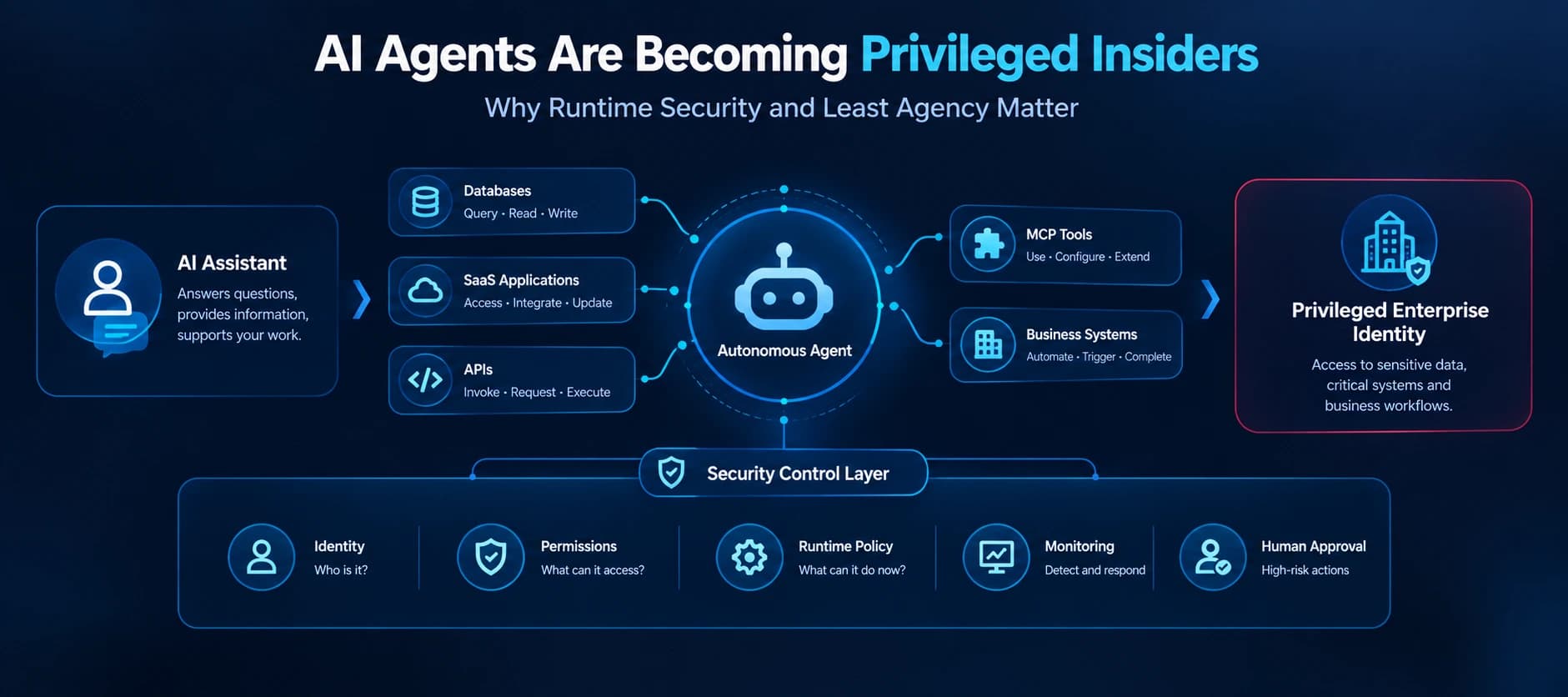
AI agents are becoming capable of much more than generating text or answering questions. According to Check Point, enterprise agents can access email and SaaS applications, query databases, invoke APIs, use MCP tools, modify records and execute business workflows.
That shift changes the security model.
A traditional AI assistant may provide information to a human who makes the final decision. An agent can potentially take the next step itself. It can retrieve information, select a tool, authenticate to a service and execute an action.
This creates a new security challenge: how much authority should an AI agent have, and how can that authority be controlled while the agent is operating?
Check Point frames this concern around the idea of AI agents becoming potential "privileged insiders" because they can combine access to sensitive systems with a degree of autonomous decision-making.
Why AI Agents Create a Different Security Problem
A privileged human account is generally protected through controls such as identity management, authentication and least-privilege access.
AI agents can use similar credentials and permissions, but their operating model is different.
An agent may be able to:
Retrieve sensitive information
Access business applications
Invoke APIs
Use MCP tools
Modify records
Execute workflows
Make decisions based on information supplied to it
The risk does not necessarily require a malicious agent.
Check Point's argument is that excessive access combined with excessive autonomy and insufficient oversight can create insider-like risk.
IAM Answers Who Can Access Something, But Not Always What They Should Do
Identity and access management remains an important part of AI security.
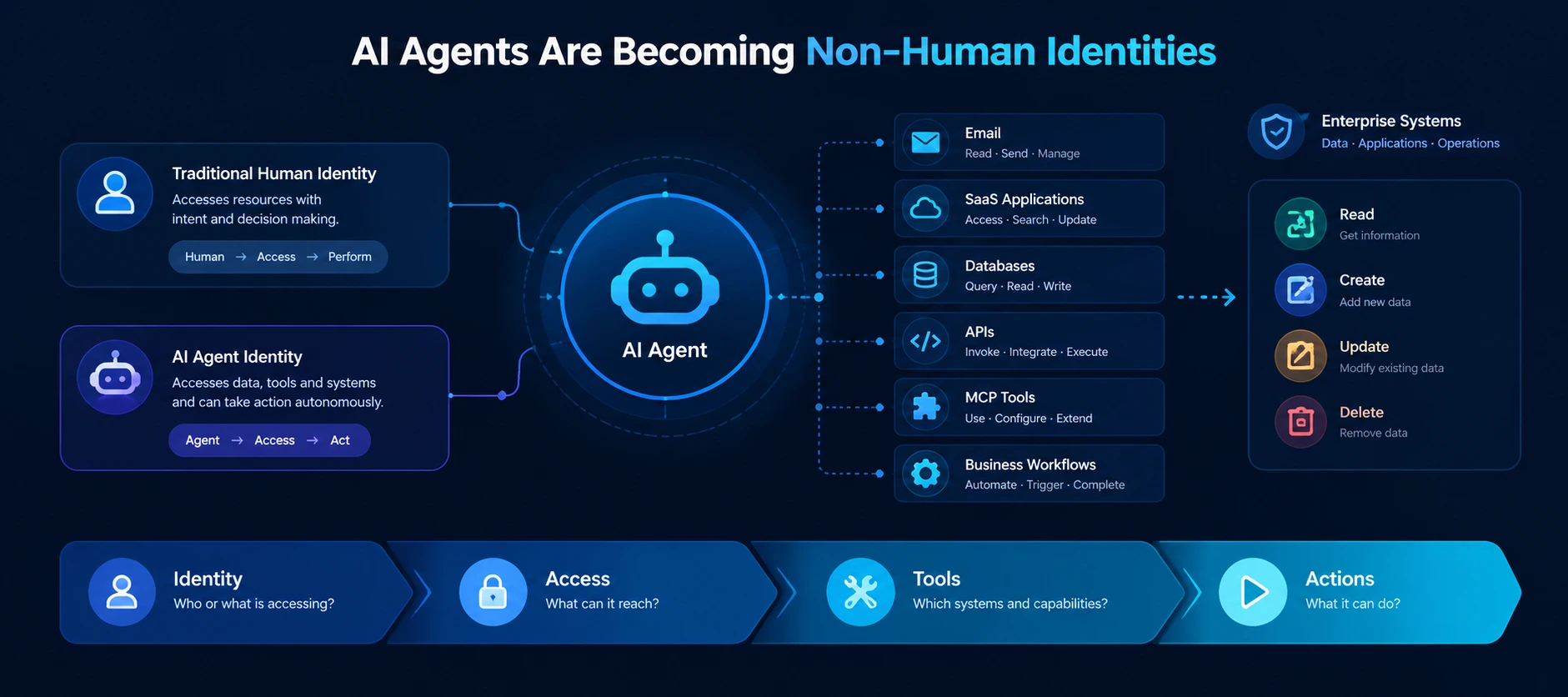
However, Check Point argues that traditional IAM addresses a different question:
What is this identity allowed to access?
Agentic AI introduces another question:
Should this agent perform this particular action right now?
Consider an AI agent that legitimately has access to a customer database.
It may need permission to read customer records. But that permission does not necessarily mean the agent should be allowed to delete those records.
This creates a distinction between access control and action-level control.
An authenticated agent can have legitimate permissions and still attempt an inappropriate operation.
For example:
Operation | Example policy |
|---|---|
CREATE | Allow |
READ | Allow |
UPDATE | Allow under defined conditions |
DELETE | Block or require human approval |
Check Point recommends that these restrictions should exist outside the AI agent itself and be technically enforced. A system prompt asking an agent not to delete production data is not the same as an external security policy that can prevent the operation.
Runtime Enforcement Adds Another Security Layer
Runtime enforcement becomes important because AI agents can operate quickly and across multiple connected systems.
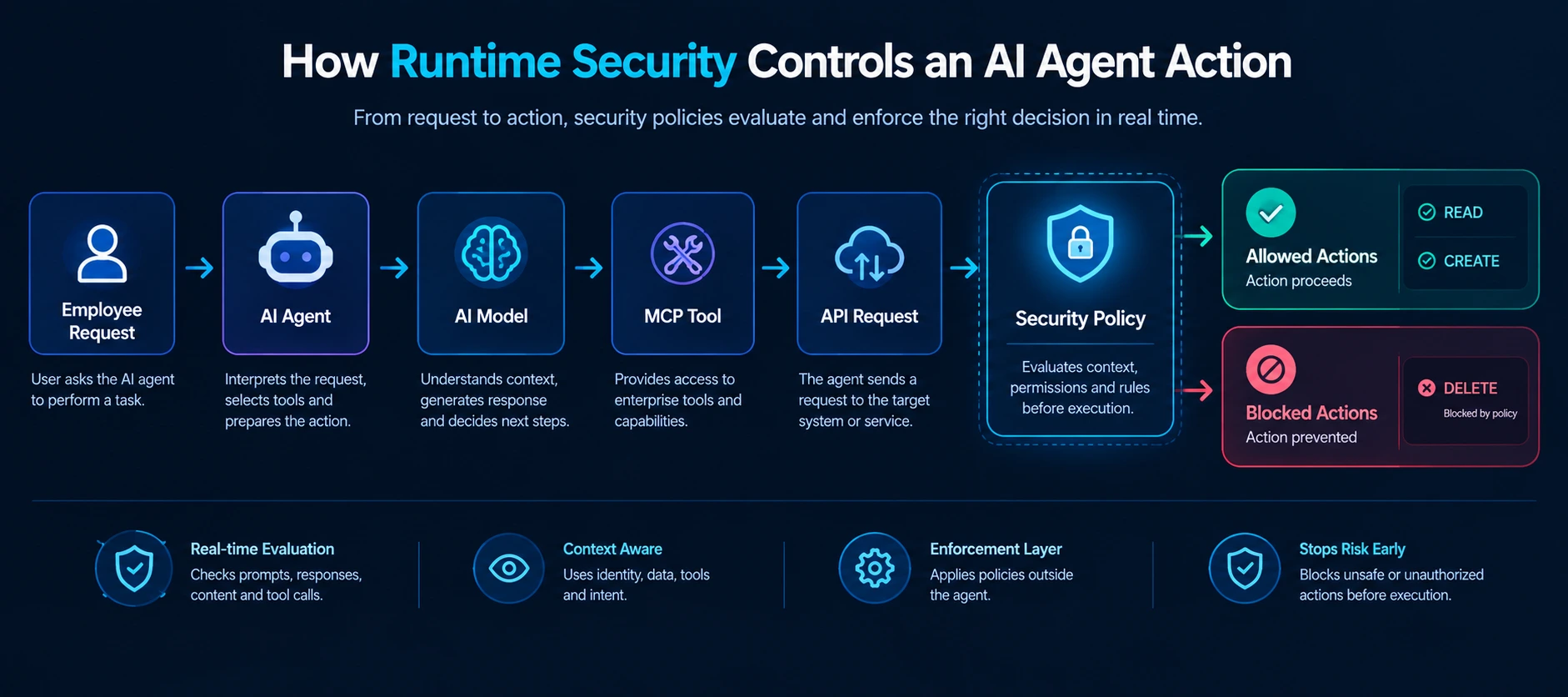
Check Point illustrates a possible sequence:
Employee → AI Agent → Model → MCP Tool → API → DELETE
The agent may be authenticated. The API request may also be technically valid.
But if organizational policy says autonomous agents cannot delete production records, the request should be stopped before the operation occurs.
This creates an important distinction:
Permissions define what an agent can potentially do. Runtime policy can determine whether it should perform an action in a particular situation.
Check Point says its AI Agent Security approach evaluates prompts, model responses, external content, tool calls and agent actions in real time, with policies capable of blocking unsafe or unauthorized behavior before execution.
Prompt Injection Can Change What an Agent Attempts to Do
Another concern is prompt injection.
An AI agent may encounter information from documents, websites, messages or other external sources. If malicious content manipulates the agent into using a legitimate tool in an unintended way, the agent could potentially perform an action using valid credentials.
In that scenario:
Authentication may have worked.
Authorization may have worked.
The resulting behavior may still be inappropriate.
Check Point identifies prompt injection, indirect attacks, sensitive-data exposure and unauthorized tool use among the risks that require contextual runtime controls.
This illustrates why simply authenticating an AI agent does not establish permanent trust.
The context surrounding an action also matters.
Zero Trust Needs Context for AI Agents
The principles behind Zero Trust do not necessarily disappear in an agentic environment. Instead, the decision-making context becomes broader.
Check Point presents the following model:
Identity + Context + Data + Tool + Requested Action + Behavior = Trust Decision
For example, an HR agent reading a limited number of employee records may be performing its expected task.
A sudden request for a much larger volume of employee information could require additional scrutiny.
Similarly, a development agent writing application code could be expected behavior. Attempting to modify identity and access policies would represent a different type of operation.
The underlying principle is that authentication alone should not automatically make every subsequent action trustworthy.
Every AI Agent Needs a Human Owner
Another important part of the security model is accountability.
Check Point argues that every production AI agent should have an identifiable owner. For higher-risk agents, it suggests considering both a business owner and a technical owner.
The responsibilities are different.
Business ownership can address:
Why does the agent exist?
What business purpose does it serve?
What authority should it have?
Technical ownership can address:
How is the agent configured?
What systems does it connect to?
How does it authenticate?
How is it monitored?
How is it secured?
The important point is that autonomous execution does not mean autonomous accountability.
An agent that no longer has a clear owner can create governance problems similar to an abandoned privileged account.
From Least Privilege to "Least Agency"
Traditional security relies heavily on the principle of least privilege.
The idea is straightforward: an identity should receive only the permissions required to perform its job.
Check Point proposes extending this concept for agentic AI through what it calls "Least Agency." The idea is to give an AI agent only the autonomy required to accomplish its authorized business purpose.
That could mean dividing actions into different levels:
Allowed actions
The agent can perform them autonomously.
Controlled actions
The agent can perform them only when certain conditions are met.
Human-approved actions
The agent can request the action, but a person must approve it.
Prohibited actions
The agent cannot perform them.
This approach shifts the security discussion from simply asking what an AI agent can access to asking what it is actually allowed to do.
AI Agent Security Requires Lifecycle Governance
AI agent governance should not end when an agent is deployed.
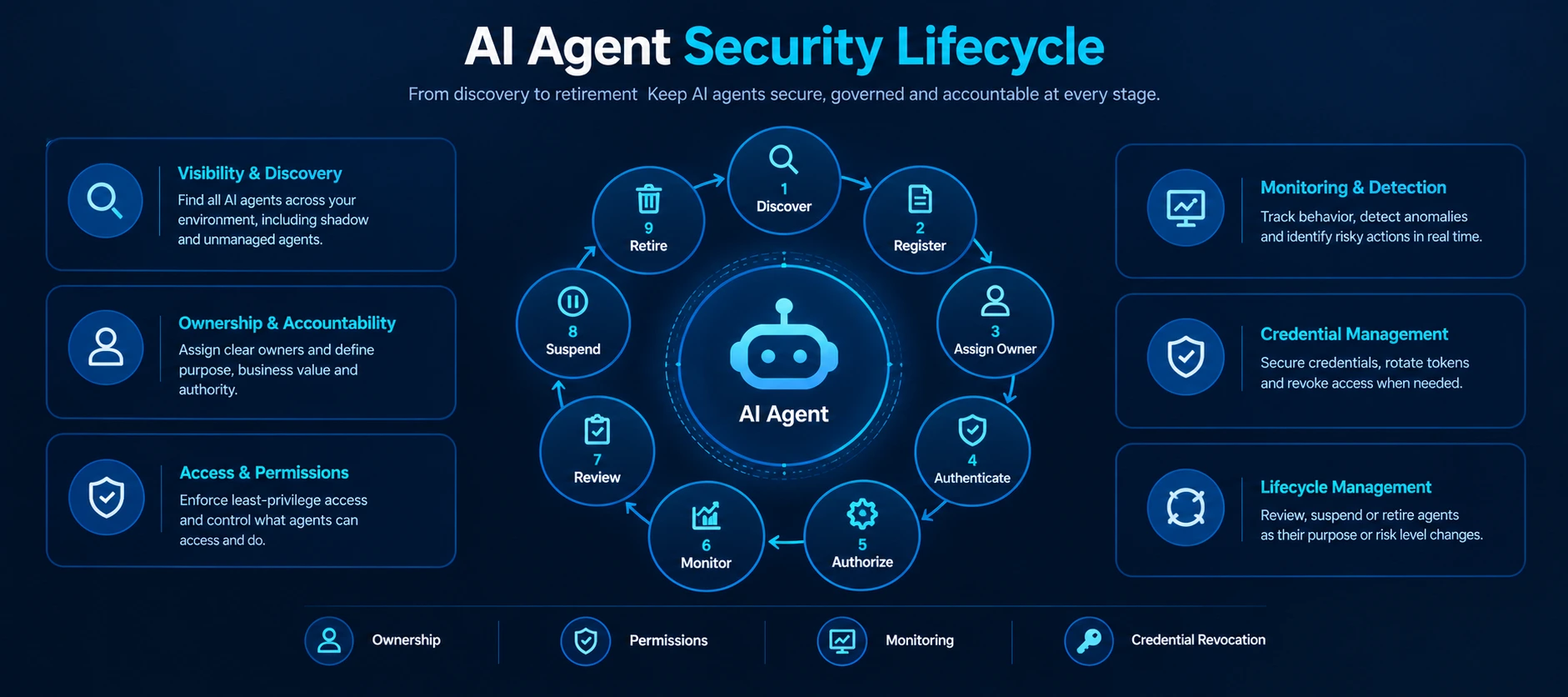
Check Point outlines a lifecycle approach:
Discover → Register → Assign Owner → Authenticate → Authorize → Monitor → Review → Suspend → Retire
Each stage addresses a different governance requirement.
When an agent is created, ownership should be established.
When it receives access, permissions should follow least-privilege principles.
If its purpose changes, its permissions should be reviewed.
If its behavior changes, its trust level may need to be reassessed.
When the agent is retired, associated credentials, tokens, API permissions and tool access should be revoked.
This lifecycle approach is particularly relevant as organizations move from isolated AI experiments toward agents that interact with production systems.
What Security Teams Should Ask About Their AI Agents
Check Point recommends that security and business leaders ask practical questions about the AI agents operating in their environments.
These include:
How many AI agents are operating in the environment?
Who owns each agent?
Which agents have access to sensitive or privileged systems?
What tools and MCP servers can they invoke?
Which operations can they perform?
Which actions are explicitly prohibited?
Can abnormal agent behavior be detected?
Can dangerous actions be stopped before execution?
Can an agent be disabled immediately?
Can the organization reconstruct what happened afterward?
These questions are important because organizations cannot effectively govern AI agents they cannot identify or understand.
Check Point's Approach to AI Agent Security
The article also describes Check Point's Workforce AI Security as an example of an approach focused on AI agent visibility and control.
According to Check Point's documentation, the platform provides visibility into AI agents operating through MCP servers and the tools available to them. Administrators can examine agent operations using Create, Read, Update and Delete categories and apply policies to control higher-risk operations.
The company's AI Agent Security approach also focuses on runtime evaluation of prompts, model responses, external content, tool calls and agent actions.
These capabilities are presented by Check Point as part of its broader discover, govern and protect approach to AI security.
For specific product capabilities and configuration details, organizations should refer to the vendor's current documentation.
What This Means for Enterprise Security
The broader issue is not simply whether companies use AI agents.
The more difficult question is how organizations govern agents once those systems receive access to business data and operational tools.
An AI agent can be treated as another software component, but its ability to interpret information, select tools and execute actions introduces additional security considerations.
For enterprises, this could mean expanding existing identity governance programs to include:
AI agent inventories
Explicit ownership
Least-privilege permissions
Tool-level restrictions
Action-level policies
Runtime monitoring
Human approval for sensitive operations
Prompt injection protections
Credential and token lifecycle management
Agent retirement procedures
The exact controls will depend on the agent's purpose, connected systems and level of autonomy.
The Bigger Shift: Controlling Agency, Not Just Access
AI security is increasingly moving beyond the question of whether an AI system has permission to access something.
The more complex question is whether the agent should be allowed to perform a particular action under specific circumstances.
That distinction becomes increasingly important as AI agents interact with enterprise applications, databases, APIs and business workflows.
Check Point's central argument is that organizations need to identify, govern, monitor and control AI agents before those systems become effectively privileged identities inside enterprise environments.
The concept of Least Agency provides one way to think about that challenge: give agents enough autonomy to perform their intended tasks, but establish technical boundaries around actions that require additional oversight.
As agentic AI adoption expands, security programs will need to consider not only who or what is accessing a system, but also what the AI is attempting to do, why it is doing it and whether that action should be permitted at that moment.
Source: Check Point Blog
About the Author