What Is Leadership? Types, Styles and Essential Skills
Understand what leadership means, explore its major types and styles, and learn the essential skills that help leaders guide teams, make decisions, manage change and achieve shared goals.

Leadership plays an important role in how people work together, make decisions and achieve shared objectives. In an organisation, a leader does more than assign tasks or supervise employees. They provide direction, help teams understand priorities, encourage collaboration and create an environment where people can contribute effectively.
Consider a workplace where a team is struggling to complete an important project. One manager may respond by setting clear instructions and closely monitoring progress. Another may bring the team together, discuss the challenges and invite suggestions before deciding what to do. Both are demonstrating leadership, but their approaches are different.
This illustrates an important aspect of leadership: the way people are guided can influence their motivation, performance and willingness to take responsibility.
Leadership is relevant not only to managers and business owners but also to team members, project coordinators, entrepreneurs, educators and individuals working towards common goals. Understanding its principles can help people develop stronger communication, decision-making and problem-solving abilities.
This guide explains what leadership is, its importance, major types and styles, essential leadership skills, and practical ways to become a more effective leader.
What Is Leadership?
Leadership is the ability to influence, guide and support individuals or groups towards achieving a shared objective. It involves setting direction, communicating expectations, making decisions, motivating people and helping them work together.
Leadership is not limited to holding a senior position or having formal authority. An individual can demonstrate leadership by taking initiative, helping colleagues solve problems, coordinating a project or encouraging others to work towards a common goal.
For example, when a project team encounters an unexpected delay, a person who identifies the problem, brings the right people together and helps establish a practical solution is demonstrating leadership, even without a managerial title.
In an organisational setting, leadership connects individual contributions with broader business objectives. It helps employees understand what needs to be achieved, why the work matters and how their responsibilities contribute to the overall outcome.
Key Elements of Leadership
Leadership involves several connected elements:
Direction: Establishing clear objectives and helping people understand what they need to accomplish.
Influence: Encouraging individuals to contribute towards a shared purpose.
Communication: Explaining expectations, sharing information and listening to different perspectives.
Decision-making: Evaluating available information and selecting an appropriate course of action.
Motivation: Supporting people and encouraging them to maintain their commitment.
Accountability: Taking responsibility for decisions, actions and outcomes.
Adaptability: Adjusting the approach when circumstances, priorities or team requirements change.
These elements work together. A leader may have a clear vision, but without communication and accountability, it can be difficult to turn that vision into meaningful results.
What Is the Role of Leadership in Organisational Behaviour?
Organisational behaviour examines how individuals and groups act within a workplace and how organisational structures, relationships and working conditions influence their behaviour.
Leadership is an important part of this field because leaders influence how employees communicate, cooperate, respond to challenges and approach their responsibilities.
For example, a leader who encourages employees to share ideas may create a more participative working environment. A leader who relies heavily on strict instructions may create a more controlled environment.
Leadership can influence:
Employee motivation: The way leaders recognise contributions, provide feedback and support employees can affect their willingness to perform.
Workplace communication: Leaders help establish how information, feedback and concerns are shared across teams.
Team relationships: Fair treatment and mutual respect can strengthen cooperation and trust.
Decision-making: Leaders determine how decisions are made and how much involvement employees have.
Organisational culture: Their everyday behaviour helps establish expectations around responsibility, collaboration and professional conduct.
Change management: Leaders help employees understand organisational changes and adjust to new processes or priorities.
Leadership does not determine every aspect of employee behaviour. Organisational policies, resources, working conditions and individual differences also matter. However, leadership can significantly influence the environment in which people work.
Why Is Leadership Important?
Effective leadership helps organisations coordinate people, manage responsibilities and move towards their objectives. Its importance can be understood through several practical contributions.
1. Provides Direction and Clear Objectives
Employees need to understand what they are working towards. Leaders translate organisational priorities into team objectives and individual responsibilities.
For example, when a company introduces a new product, its leaders may establish launch targets, define departmental responsibilities and communicate important deadlines.
2. Improves Team Coordination
Different employees and departments often work on connected activities. Leadership helps coordinate these efforts, clarify responsibilities and reduce unnecessary confusion.
A project leader, for instance, ensures that designers, developers and marketing professionals understand how their work connects to the final delivery.
3. Encourages Employee Motivation
People may respond differently to challenges, recognition and feedback. Effective leaders try to understand these differences and provide appropriate support.
Recognising progress, offering constructive guidance and giving employees opportunities to develop can help strengthen engagement.
4. Supports Better Decision-Making
Leaders often need to make decisions involving limited time, incomplete information or competing priorities. They evaluate the situation, consider relevant perspectives and take responsibility for the outcome.
Good decision-making also involves recognising when specialist advice or additional information is necessary.
5. Helps Manage Change
Organisations regularly introduce new technologies, processes, strategies and working methods. These changes can create uncertainty among employees.
Leaders help explain the reasons for change, communicate expected outcomes and support teams as they adjust.
6. Builds Trust and Accountability
Employees are more likely to trust leaders who communicate honestly, apply expectations fairly and take responsibility for their actions.
Clear accountability also helps teams understand who is responsible for particular tasks and what standards they are expected to maintain.
7. Encourages Innovation and Problem-Solving
When employees feel comfortable sharing ideas and raising concerns, organisations can identify problems and explore alternative solutions.
Leaders support this process by encouraging constructive discussion and evaluating suggestions rather than automatically rejecting unfamiliar approaches.
8. Develops Future Leaders
Leadership also involves helping other people grow. Through mentoring, delegation, feedback and development opportunities, experienced leaders can prepare employees to take on greater responsibilities.
This supports long-term organisational capability rather than making a team dependent on one individual.
What Are the Different Types of Leadership?
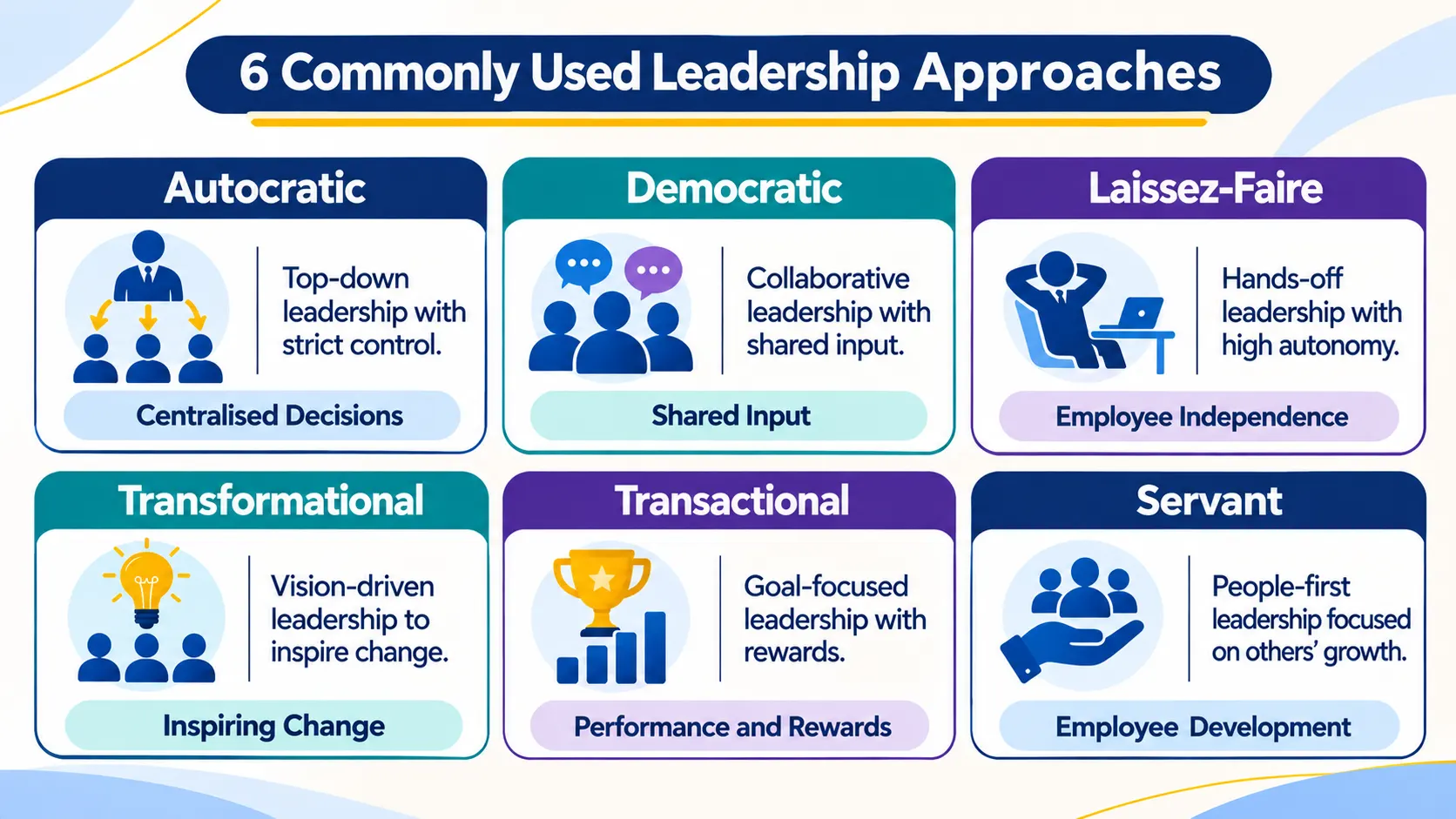
Leadership can be classified in several ways depending on the theory, framework or organisational context being used. There is no single universally accepted number of leadership types.
Some classifications describe how authority is distributed, while others focus on motivation, employee development, organisational change or decision-making.
The following are commonly discussed approaches in management and organisational behaviour.
1. Autocratic Leadership
Autocratic leadership is an approach in which the leader retains most decision-making authority. Team members are generally expected to follow instructions, with limited involvement in major decisions.
Example: A production supervisor notices a safety risk on the factory floor and immediately stops the operation, assigns corrective tasks and directs employees to follow safety procedures.
Advantages:
Enables quick decisions.
Establishes clear instructions and responsibilities.
Can be useful during emergencies or time-sensitive situations.
Limitations:
May reduce employee participation.
Can discourage new ideas and independent thinking.
Excessive control may weaken morale and trust.
This approach can be useful when immediate direction is necessary, but relying on it continuously may restrict team development.
2. Democratic Leadership
Democratic leadership, also known as participative leadership, involves employees in discussions and decision-making. The leader considers team perspectives while remaining responsible for the final decision when required.
Example: A marketing manager asks team members to evaluate different campaign ideas before selecting the approach that best fits the available budget and business objectives.
Advantages:
Encourages employee involvement.
Brings different perspectives into discussions.
Can improve team commitment and collaboration.
Limitations:
Decisions may take longer.
Discussions can become difficult to manage.
It may be unsuitable when immediate action is required.
3. Laissez-Faire Leadership
Laissez-faire leadership gives employees considerable independence in managing their work. The leader provides broad direction but allows team members to make many day-to-day decisions themselves.
Example: A senior software development team receives project objectives and deadlines but has the freedom to decide how to organise its development process.
Advantages:
Encourages independence and ownership.
Allows experienced employees to use their expertise.
Can create space for creativity and experimentation.
Limitations:
Unclear expectations may create confusion.
Less experienced employees may need more guidance.
Insufficient supervision can affect coordination and progress.
This approach is generally more suitable when employees have the knowledge and confidence to manage their responsibilities.
4. Transformational Leadership
Transformational leadership focuses on inspiring people to work towards a broader vision and encouraging improvements in how they think and perform.
Transformational leaders communicate a meaningful direction, support new ideas and encourage employees to develop their capabilities.
Example: A business leader introduces a long-term digital transformation initiative, explains how it will improve customer services and encourages departments to explore better ways of working.
Advantages:
Encourages innovation and learning.
Supports organisational development.
Can strengthen commitment to shared goals.
Limitations:
Ambitious goals may create pressure.
A strong vision needs practical planning and resources.
Employees may become uncertain if expectations are not clearly communicated.
5. Transactional Leadership
Transactional leadership is based on clearly defined responsibilities, performance expectations and outcomes. Employees are guided through established procedures, targets, rewards and corrective actions.
Example: A sales manager sets monthly performance targets and uses an incentive structure to recognise employees who meet or exceed their goals.
Advantages:
Establishes measurable expectations.
Makes performance responsibilities clearer.
Can support consistency in routine activities.
Limitations:
Too much focus on targets may restrict creativity.
Employees may concentrate mainly on rewards.
It may not provide enough support for long-term development.
Transactional leadership can be effective where responsibilities and results are clearly measurable. It may need to be combined with other approaches when innovation and employee growth are important.
6. Servant Leadership
Servant leadership places considerable emphasis on supporting employees and helping them develop. Rather than treating authority as the main source of influence, the leader focuses on understanding team needs and removing obstacles.
Example: A team leader notices that employees lack access to the training required for a new project. The leader arranges learning opportunities and provides the resources needed to improve their performance.
Advantages:
Encourages trust and mutual respect.
Supports employee development.
Promotes collaboration and a sense of belonging.
Limitations:
Excessive focus on individual needs may delay difficult decisions.
Leaders may struggle to balance support with performance expectations.
It requires clear boundaries and accountability.
7. Bureaucratic Leadership
Bureaucratic leadership places strong emphasis on established rules, policies, procedures and formal responsibilities. Decisions and activities are expected to follow defined organisational requirements.
Example: A compliance manager ensures that employees follow documented procedures when handling confidential customer information.
Advantages:
Supports consistency and standardisation.
Helps maintain regulatory and procedural compliance.
Clarifies formal responsibilities.
Limitations:
Can slow down decision-making.
May discourage experimentation.
Strict adherence to established procedures can make adaptation difficult.
This approach can be valuable in environments where safety, compliance and consistency are essential.
8. Coaching Leadership
Coaching leadership focuses on improving employees' knowledge, confidence and professional abilities. Leaders provide guidance, constructive feedback and opportunities to learn.
Example: A team manager regularly reviews an employee's work, identifies areas for improvement and provides opportunities to practise new skills.
Advantages:
Supports continuous learning.
Helps employees recognise their strengths and development needs.
Encourages long-term professional growth.
Limitations:
Requires time and regular interaction.
Progress may be gradual.
It may be difficult to apply extensively during urgent situations.
9. Visionary Leadership
Visionary leadership focuses on communicating a clear picture of the future and helping people understand how their efforts contribute to reaching it.
A visionary leader connects present activities with longer-term objectives and gives teams a sense of direction.
Example: A renewable energy company leader communicates a long-term plan to expand clean energy solutions and aligns teams around the research, investment and operational changes required.
Advantages:
Provides a clear sense of direction.
Helps align people around long-term goals.
Can encourage commitment during periods of change.
Limitations:
A vision may remain unrealistic without a practical execution plan.
Employees may lose confidence if progress is not communicated.
Leaders must consider operational constraints and available resources.
10. Charismatic Leadership
Charismatic leadership relies significantly on a leader's ability to influence and inspire others through communication, confidence and personal appeal.
Such leaders can create enthusiasm around an idea or objective and encourage people to support a shared direction.
Example: An entrepreneur presents a compelling business idea and motivates employees, investors and partners to support the company's growth plans.
Advantages:
Can generate enthusiasm and commitment.
Helps communicate ideas persuasively.
May bring people together around a common purpose.
Limitations:
Teams may become overly dependent on one personality.
Strong communication does not always guarantee sound decisions.
The leader's influence needs to be supported by competence and accountability.
11. Situational Leadership
Situational leadership is based on adapting leadership behaviour to the needs of a particular task, team and working environment.
A leader may provide close direction to an inexperienced employee but offer greater independence to someone who has the necessary skills and confidence.
Example: A project manager gives detailed instructions to a new team member while allowing an experienced specialist to decide how to complete a complex technical task.
Advantages:
Recognises differences in employee experience and ability.
Allows leaders to respond to changing circumstances.
Balances guidance and independence.
Limitations:
Requires good judgement and awareness.
Inconsistent behaviour may confuse employees if changes are not explained.
Leaders need to understand the team's actual needs before adjusting their approach.
Situational leadership highlights why one fixed approach may not work equally well across every team or circumstance.
What Are the Different Leadership Styles?
Leadership styles describe the way leaders communicate, make decisions, motivate employees and manage working relationships. They are often discussed alongside leadership types, and some terms overlap.
A useful way to understand leadership styles is to examine the behaviours a leader uses in everyday situations.
The following styles are commonly discussed in leadership development and management literature.
1. Authoritative or Visionary Style
An authoritative leader provides a clear direction and explains the purpose behind it. The leader helps employees understand the desired outcome while allowing flexibility in how they contribute.
Best suited for: Situations where teams need a new direction, a shared purpose or clarity during organisational change.
Possible limitation: It may be less effective if the leader communicates the vision without considering employee feedback or practical constraints.
Note: In this context, authoritative leadership means vision-led guidance. It is not the same as authoritarian or autocratic leadership, which relies more heavily on centralised control.
2. Democratic or Participative Style
This style encourages employees to contribute ideas and participate in discussions before decisions are made.
Best suited for: Brainstorming, planning, problem-solving and situations where employees have useful knowledge to contribute.
Possible limitation: Reaching agreement can take time, particularly when opinions differ.
3. Coaching Style
A coaching leader focuses on helping employees improve through feedback, guidance and regular development conversations.
Best suited for: Employee training, professional development and situations where people need support to build new capabilities.
Possible limitation: Coaching requires time and may not be the first priority during an emergency.
4. Affiliative Style
Affiliative leadership gives importance to relationships, cooperation and emotional support. Leaders using this style try to maintain positive working relationships and address tensions within the team.
Best suited for: Rebuilding trust, resolving relationship difficulties and supporting employees during stressful periods.
Possible limitation: Avoiding difficult conversations to maintain harmony can allow performance or conduct problems to continue.
5. Pacesetting Style
Pacesetting leaders establish demanding performance standards and expect employees to work towards them. They often demonstrate the level of performance they want others to achieve.
Best suited for: Short-term assignments involving highly capable and motivated teams.
Possible limitation: Constant pressure to meet demanding standards can cause stress and burnout if employees do not receive adequate support.
6. Coercive or Commanding Style
This style relies on direct instructions and close control. The leader expects employees to follow immediate directions rather than participate in extended discussions.
Best suited for: Emergencies, serious safety concerns or situations where immediate action is necessary.
Possible limitation: Frequent use can damage trust, discourage employee participation and reduce independent problem-solving.
Understanding the Difference Between Leadership Types and Styles
The terms leadership type and leadership style are sometimes used interchangeably in management resources. However, they can be understood through a useful distinction:
Leadership types or approaches | Leadership styles or behaviours |
|---|---|
Describe broader ways of leading people. | Describe how leadership is demonstrated in practice. |
Often include autocratic, democratic, servant and transformational leadership. | Often include coaching, affiliative, pacesetting and commanding behaviours. |
Help explain the overall approach to authority, motivation and employee involvement. | Help explain how a leader communicates, guides and responds in specific situations. |
The categories are not completely separate. For example, a transformational leader may use coaching behaviours to develop employees and democratic behaviours when gathering ideas.
The most useful approach is to understand what each term describes rather than assume that every textbook or organisation uses the same classification.
Essential Leadership Skills
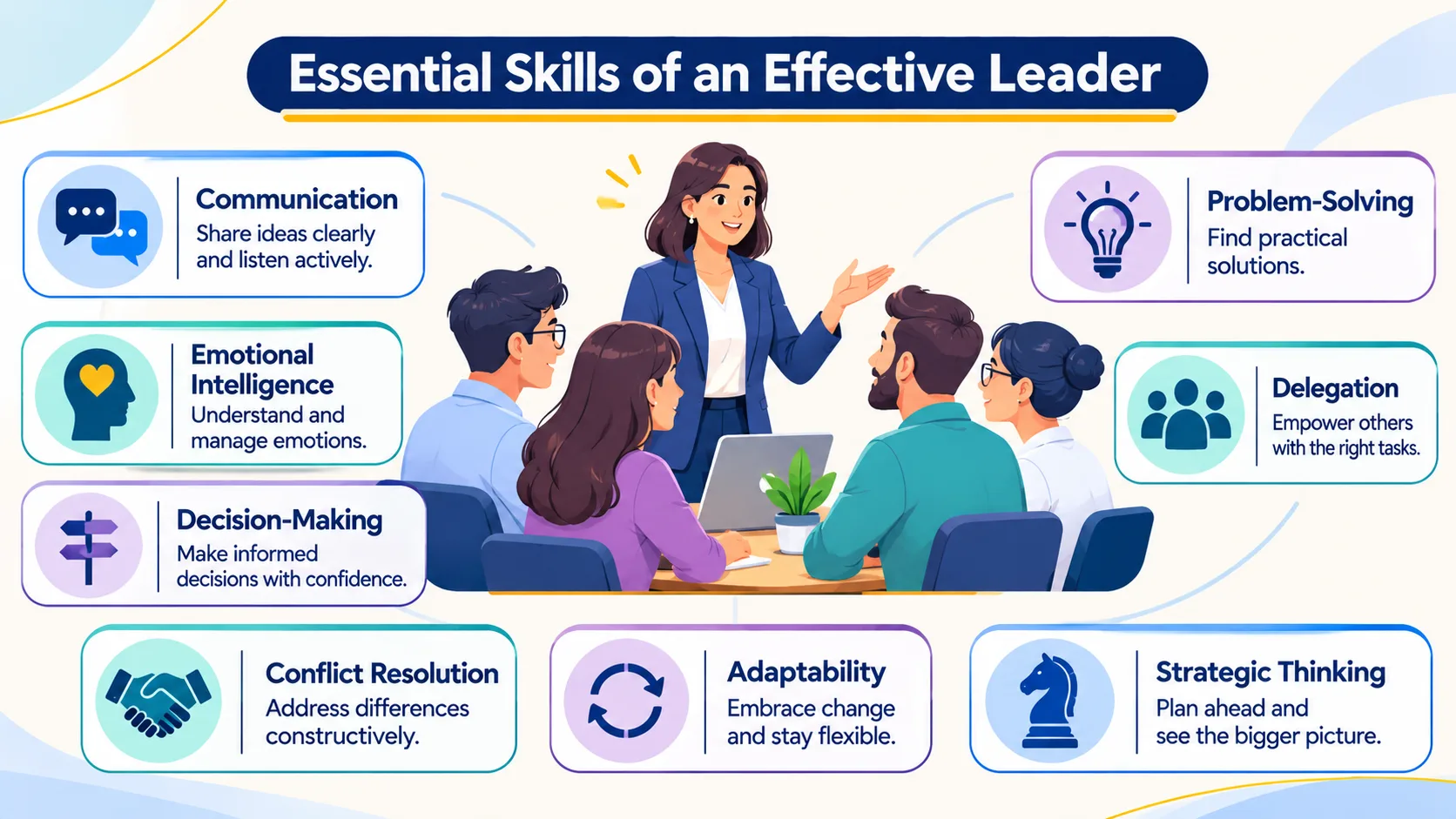
Effective leadership requires more than subject knowledge or formal authority. Leaders need a combination of interpersonal, analytical and organisational skills to guide people and handle responsibilities.
The following skills are particularly valuable across different industries and professional roles.
1. Communication Skills
Leaders must explain objectives, responsibilities and expectations clearly. They also need to listen carefully, ask relevant questions and make sure employees understand important information.
Good communication reduces misunderstandings and helps teams coordinate their work.
2. Emotional Intelligence
Emotional intelligence involves recognising and managing one's own emotions while understanding the feelings and perspectives of others.
A leader with emotional intelligence can respond more thoughtfully to disagreements, workplace pressure and employee concerns.
3. Decision-Making Skills
Leaders regularly make decisions about priorities, resources, responsibilities and potential risks.
Effective decision-making involves gathering relevant information, comparing available options and considering the possible consequences before choosing a course of action.
4. Problem-Solving Skills
Unexpected challenges can affect projects, teams and business operations. Leaders need to identify the underlying issue, evaluate possible solutions and coordinate the actions required to resolve it.
For example, if a project repeatedly misses deadlines, the leader should examine workload, resource availability and communication gaps rather than immediately blaming individual employees.
5. Delegation Skills
Delegation means assigning responsibilities to suitable team members while providing the necessary authority, resources and support.
It helps distribute work, develop employee capabilities and prevent unnecessary dependence on one person.
Effective delegation also involves setting expectations and following up without controlling every minor activity.
6. Conflict Resolution
Differences in opinions, priorities and working methods can create disagreements within a team.
Leaders need to listen to the people involved, understand the source of the conflict and guide discussions towards a fair and practical resolution.
7. Strategic Thinking
Strategic thinking involves looking beyond immediate tasks and considering long-term objectives, opportunities and potential risks.
It helps leaders connect daily decisions with the organisation's broader direction.
8. Adaptability
Workplace conditions can change because of new technologies, customer expectations, market developments or organisational priorities.
Adaptable leaders are willing to review their assumptions, learn new approaches and adjust plans when necessary.
9. Time and Priority Management
Leaders often manage multiple responsibilities at once. They need to identify urgent tasks, allocate resources appropriately and ensure that important work receives sufficient attention.
Good time management also helps prevent teams from becoming overwhelmed by competing demands.
10. Integrity and Accountability
Integrity means acting honestly, fairly and consistently with professional and ethical principles. Accountability means accepting responsibility for decisions and outcomes.
These qualities help establish credibility and strengthen working relationships.
11. Collaboration and Teamwork
Leadership requires working with people who have different skills, experiences and perspectives.
Collaborative leaders encourage participation, share information and help employees coordinate their contributions.
12. Learning Agility
Learning agility is the ability to learn from experience, respond to new challenges and apply knowledge in unfamiliar situations.
Leaders who remain open to feedback and continuous learning are better prepared to handle changing responsibilities.
Qualities of an Effective Leader
Leadership skills describe what a person can do, while leadership qualities reflect the personal characteristics and behaviours that influence how they lead.
Some important qualities include:
Self-awareness: Understanding personal strengths, limitations, emotions and behaviour.
Confidence: Making decisions and communicating direction without relying on constant approval.
Empathy: Considering other people's experiences and understanding their concerns.
Respect: Treating employees fairly and valuing different perspectives.
Courage: Addressing difficult situations and making responsible decisions.
Resilience: Remaining focused and learning from setbacks.
Vision: Understanding long-term objectives and communicating a meaningful direction.
Humility: Recognising that leaders do not have every answer and can learn from others.
Gratitude: Acknowledging the contributions and efforts of team members.
Consistency: Applying expectations and principles fairly across situations.
These qualities are not fixed personality requirements. They can be strengthened through experience, feedback, reflection and deliberate practice.
How to Choose the Right Leadership Style
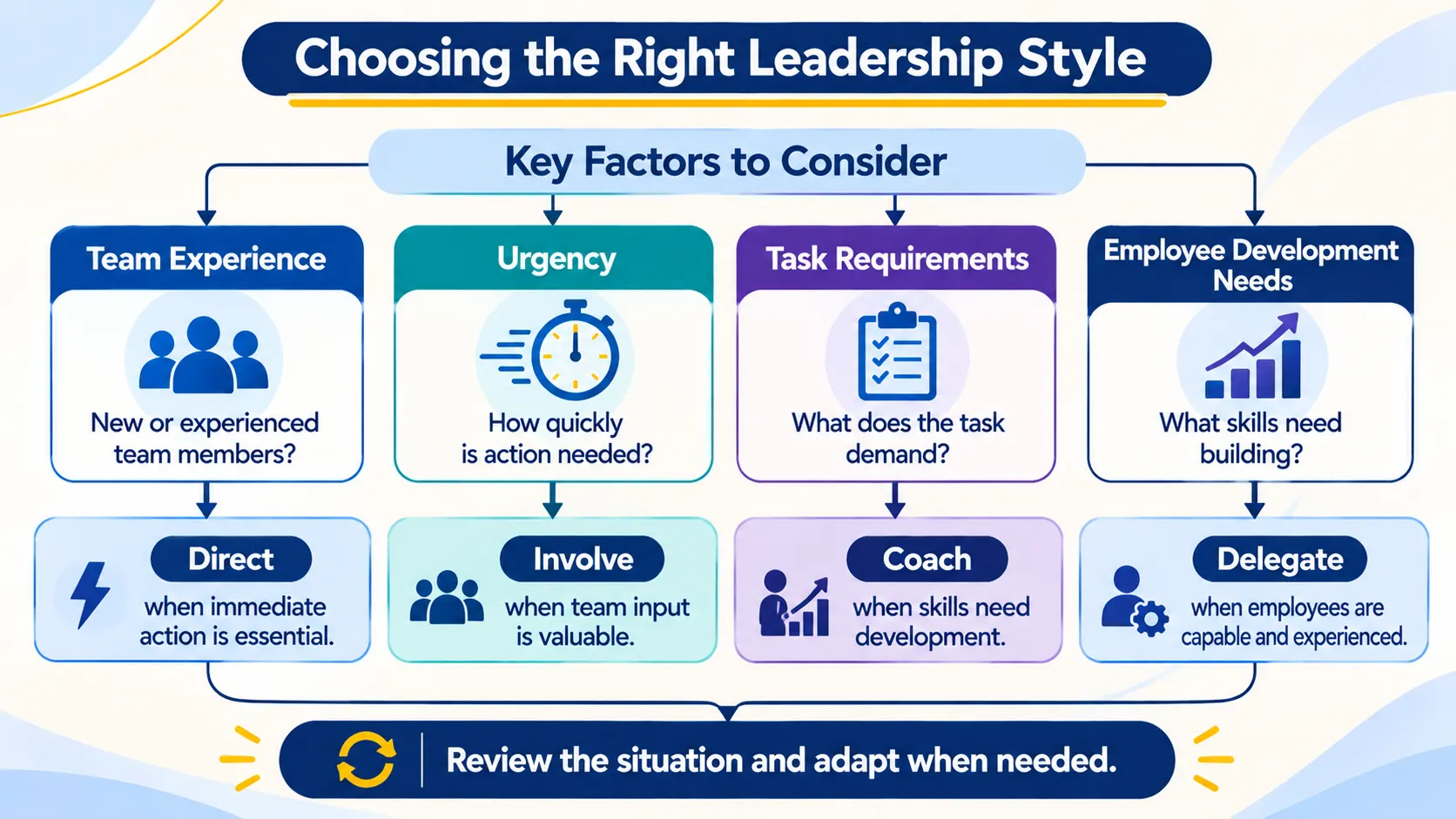
There is no single leadership style that guarantees success in every situation. The most appropriate approach depends on the work, the team's capabilities, the urgency of the decision and the organisational environment.
Leaders can consider the following factors before deciding how to guide their teams.
1. Understand the Team's Experience
A new employee may need clear instructions and regular guidance, while an experienced professional may perform better with greater independence.
2. Consider the Urgency of the Situation
An emergency may require immediate direction. A long-term planning decision may benefit from discussion and employee participation.
3. Evaluate the Nature of the Task
Routine work with established procedures may require consistency and clear performance expectations. Creative projects may benefit from collaboration and experimentation.
4. Identify Employee Development Needs
If the team needs to improve its skills, a coaching approach may be useful. If employees already have the necessary expertise, delegation may be more appropriate.
5. Balance Results with Employee Well-Being
Performance expectations should be realistic and supported by adequate resources. Leaders need to consider both organisational outcomes and the conditions in which employees work.
6. Review and Adjust the Approach
A leadership approach that works at the beginning of a project may not remain suitable as the team gains experience or circumstances change.
Leaders should observe team responses, seek feedback and adjust their behaviour when necessary.
How to Develop Leadership Skills
Leadership development is a continuous process. People can strengthen their abilities through practical experience, learning opportunities and regular reflection.
Here are some useful ways to begin.
1. Take Initiative
Look for opportunities to contribute beyond assigned tasks. This could involve organising a small activity, identifying a problem or helping colleagues coordinate their work.
2. Practise Active Listening
Pay attention when others share ideas or concerns. Ask questions to understand their perspective before responding.
3. Request Constructive Feedback
Ask colleagues, supervisors or mentors about areas where your communication, decision-making or teamwork could improve.
4. Learn to Make Informed Decisions
Practise comparing options, evaluating risks and explaining the reasons behind your decisions. Review the results to understand what worked and what could be improved.
5. Develop Delegation and Collaboration Skills
When working on group assignments or projects, distribute responsibilities according to people's strengths and encourage everyone to contribute.
6. Learn from Experienced Leaders
Observe how effective leaders communicate, manage disagreements, support employees and respond to unexpected situations.
7. Invest in Continuous Learning
Leadership books, professional training, workshops, mentoring and management courses can provide useful frameworks and practical knowledge.
8. Reflect on Your Experiences
After completing a project or handling a difficult situation, consider what went well, what challenges occurred and how you could respond differently next time.
Leadership development becomes more meaningful when learning is connected to real situations.
Leadership vs Management: What Is the Difference?
Leadership and management are closely connected, but they do not mean the same thing.
Leadership focuses on influencing people, providing direction and encouraging progress towards shared goals. Management focuses more on planning, organising resources, coordinating activities and monitoring performance.
Basis | Leadership | Management |
|---|---|---|
Primary focus | Direction, influence and people | Planning, processes and resources |
Main purpose | Build commitment towards shared goals | Coordinate work and achieve defined objectives |
Approach | Inspires, guides and influences | Organises, supervises and monitors |
Decision-making | May encourage participation and initiative | Often follows established responsibilities and procedures |
Change | Encourages new direction and improvement | Helps plan and implement operational changes |
Authority | Can exist without a formal title | Usually linked to an assigned organisational role |
For example, a project manager uses management skills to prepare schedules, allocate resources and track deadlines. The same person uses leadership skills to motivate the team, resolve disagreements and help employees understand the project's purpose.
Organisations benefit when leadership and management work together. A clear vision needs planning and execution, while well-managed processes need people who understand and support the objectives.
Conclusion
Leadership is an important part of individual, team and organisational success. It involves more than assigning responsibilities or making decisions. Effective leaders provide direction, communicate clearly, build trust, support employee development and help people respond to challenges.
Different leadership approaches serve different purposes. Autocratic leadership may be useful when immediate decisions are necessary, democratic leadership can encourage participation, coaching leadership supports development, and transformational leadership can help organisations pursue change.
The ability to recognise when an approach is appropriate is just as important as understanding the approaches themselves.
Leadership is also a skill that can grow through experience. By practising communication, accountability, adaptability and collaboration, individuals can become more effective contributors and prepare themselves for greater responsibilities.
Frequently Asked Questions (FAQs)
1. What is leadership in simple words?
Leadership is the ability to guide, influence and support people in working towards a common goal. It involves communication, decision-making, motivation and responsibility.
2. What are the main types of leadership?
Commonly discussed types include autocratic, democratic, laissez-faire, transformational, transactional, servant, bureaucratic, coaching, visionary, charismatic and situational leadership. Different frameworks may use different classifications.
3. What are the five main leadership skills?
Five important leadership skills are communication, decision-making, problem-solving, emotional intelligence and delegation. Other valuable skills include adaptability, strategic thinking, conflict resolution and collaboration.
4. What is the difference between leadership and management?
Leadership focuses on guiding and influencing people towards shared objectives, while management focuses on planning, organising and coordinating resources and activities. Both are important for achieving organisational goals.
5. Can leadership skills be developed?
Yes. Leadership skills can be developed through practical experience, feedback, mentoring, professional learning and self-reflection. People can improve their ability to communicate, make decisions, resolve conflicts and support teams over time.
Ready to go deeper?
Professional Training
Hands-on, mentor-led training aligned with industry certifications.
About the Author
Sharper every day
Daily tutorials, analysis, and career playbooks across all 12 Xcademia disciplines, straight to your inbox. No spam.