What Is Ethical Hacking? Techniques, Tools and Career Opportunities
Ethical hacking helps organisations identify and fix security vulnerabilities before cybercriminals exploit them. Explore how it works, the techniques and tools professionals use, essential certifications and career opportunities in this comprehensive guide.

Introduction: Why Ethical Hacking Matters
Imagine an online business storing customer records, processing payments and managing confidential information. It has invested in firewalls, antivirus software and security monitoring. Everything appears secure.
However, an attacker discovers an outdated application component or incorrectly configured server and gains access to information that should never have been publicly available.
The problem is not necessarily a lack of security technology. It is that nobody identified how the existing controls could fail under a realistic attack.
This is where ethical hacking becomes important.
As organisations adopt websites, mobile applications, cloud platforms, APIs and connected devices, their digital attack surfaces continue to expand. Cybercriminals exploit weaknesses through techniques such as phishing, credential theft, ransomware and software vulnerability exploitation.
Traditional security controls remain essential, but organisations also need to understand how an attacker might approach their infrastructure.
Ethical hackers provide this perspective by examining systems from an attacker's point of view, using approved techniques within a clearly defined legal and technical framework.
Their work helps organisations:
Identify vulnerabilities before malicious attackers exploit them.
Evaluate existing security controls.
Protect sensitive information and business systems.
Strengthen applications, networks and cloud infrastructure.
Improve security awareness and incident preparedness.
Prioritise remediation according to business risk.
Ethical hacking is therefore not simply about finding vulnerabilities. It is about understanding their potential consequences and helping organisations improve their defences.
What Is Ethical Hacking?
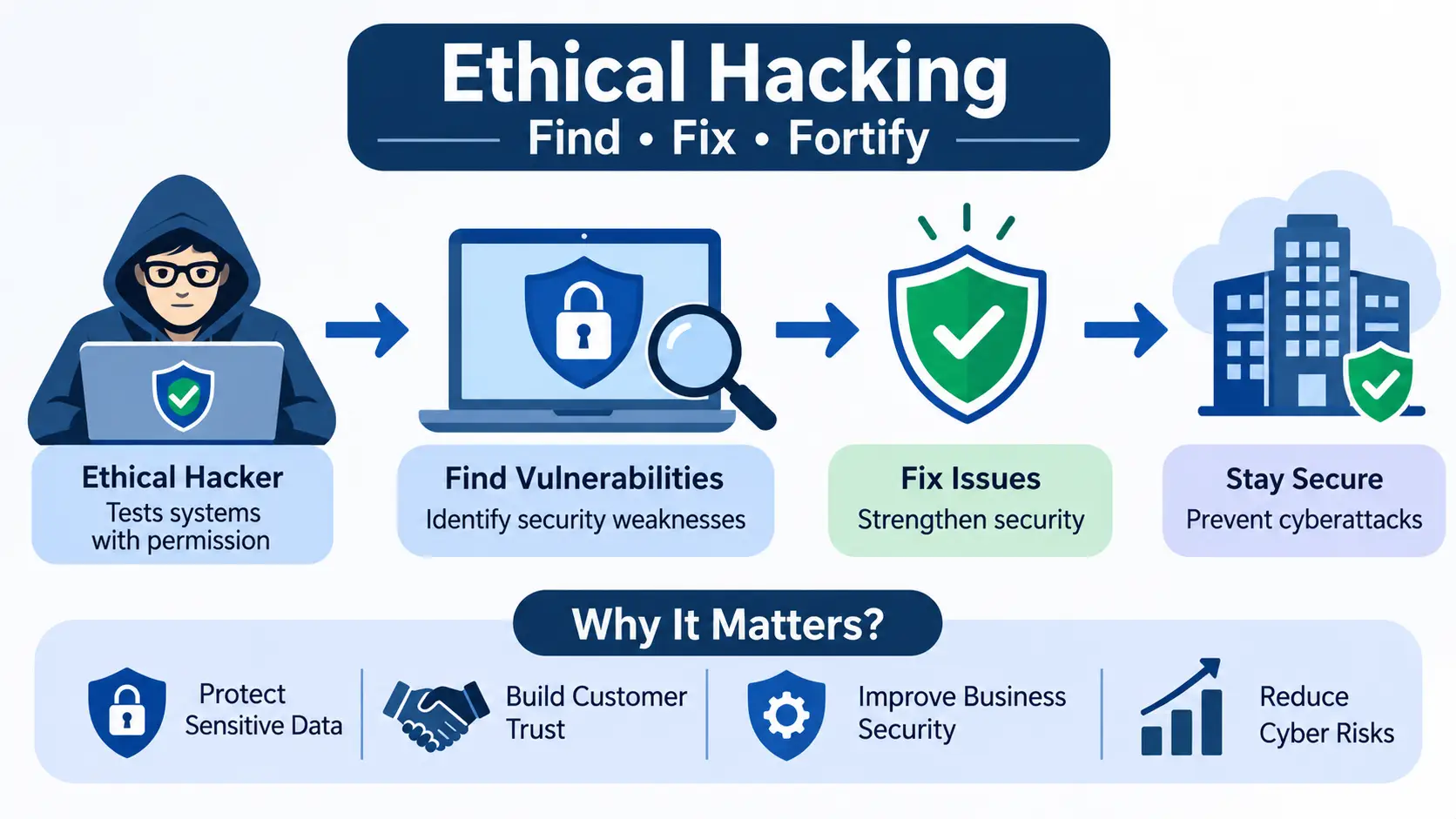
Ethical hacking is the authorised process of identifying, analysing and safely testing security weaknesses in computer systems, networks, applications and digital infrastructure to help organisations prevent cyberattacks.
An ethical hacker uses techniques similar to those employed by malicious attackers but operates with explicit permission, agreed objectives and defined testing boundaries.
The primary objective is to discover weaknesses before individuals with harmful intentions can exploit them.
Ethical hacking is closely associated with white hat hacking, security testing and penetration testing.
However, these terms are not always interchangeable. Penetration testing is a structured form of security assessment that attempts to demonstrate the practical impact of vulnerabilities under controlled conditions.
What Does an Ethical Hacker Do?
Depending on the engagement, an ethical hacker may:
Investigate publicly exposed systems and services.
Identify open network ports and unnecessary services.
Test authentication and access control mechanisms.
Examine websites and APIs for vulnerabilities.
Evaluate password policies and credential protection.
Review cloud configurations and identity permissions.
Simulate authorised attack scenarios.
Document findings and recommend remediation.
For example, a tester assessing an e-commerce website might discover that the application does not properly verify whether a customer is authorised to view a particular order. Using approved test accounts, the tester demonstrates the access control weakness so developers can correct it.
Ethical Hacking vs Malicious Hacking
Comparison | Ethical Hacking | Malicious Hacking |
|---|---|---|
Objective | Improve security | Exploit systems for unauthorised purposes |
Permission | Explicit authorisation | No legitimate authorisation |
Target | Agreed systems and environments | Unauthorised targets |
Approach | Controlled and documented | May involve stealth or disruption |
Data handling | Protects sensitive information | May steal or misuse information |
Outcome | Findings and remediation | Harm, theft or other unauthorised activity |
The essential distinction is that technical capability does not create legal authority. Ethical hacking requires permission, a defined scope and responsible information handling.
Why Is Ethical Hacking Important?
Cybersecurity incidents can affect business operations, financial stability, customer relationships and organisational reputation. Ethical hacking helps organisations understand potential weaknesses before they become serious incidents.
Data Protection
Businesses process customer details, payment information, employee records, intellectual property and confidential operational data.
Ethical hackers examine how this information is stored, transmitted and accessed. They assess whether authentication, encryption and access controls are implemented correctly.
For example, an application might expose sensitive files through predictable URLs. Identifying and correcting this weakness helps reduce the risk of unauthorised data access.
Improved Business Security
A weakness in one application can sometimes create a pathway into a wider corporate network.
Security testing can cover websites, internal applications, cloud infrastructure, remote access systems, APIs and third-party integrations. This helps organisations understand how individual weaknesses may combine to create larger security risks.
Risk Mitigation
Not every vulnerability presents the same level of risk. An exposed internet-facing service may be more concerning than a minor issue on an isolated internal system.
Ethical hackers help organisations prioritise findings according to:
Technical severity and exploitability.
Business impact.
Exposure to potential attackers.
Sensitivity of affected information.
Existing security controls.
This supports more effective remediation planning.
Regulatory and Customer Confidence
Security testing can contribute to risk management and compliance activities involving frameworks and regulations such as GDPR, ISO/IEC 27001, PCI DSS and applicable national requirements.
However, completing a penetration test does not automatically establish regulatory compliance. Organisations must meet all applicable requirements.
Regular assessments and timely remediation can also demonstrate that a business takes the protection of customer and partner information seriously.
Types of Hackers: White Hat, Grey Hat and Black Hat
Hackers are often categorised according to their intentions, authorisation and activities.
White Hat Hackers
White hat hackers are security professionals who identify and help resolve security weaknesses with permission from system owners.
Typical activities include penetration testing, vulnerability research, security assessments and consulting.
Example: A company hires a penetration tester to assess its web applications before a major release.
Grey Hat Hackers
Grey hat hackers may investigate systems without prior permission, sometimes intending to disclose discovered vulnerabilities rather than cause harm.
However, good intentions do not make unauthorised access lawful. Responsible disclosure programmes should be followed where available.
Black Hat Hackers
Black hat hackers use technical skills for unauthorised and harmful purposes. Their activities may include data theft, ransomware deployment, financial fraud, account compromise and disruption of business operations.
Hacker Type | Permission | Main Intention |
|---|---|---|
White Hat | Authorised | Improve security |
Grey Hat | Often absent | May seek to expose weaknesses |
Black Hat | Unauthorised | Harm, theft or personal gain |
Professional cybersecurity requires technical knowledge, legal awareness and responsible conduct.
How Does Ethical Hacking Work?
Ethical hacking follows a structured methodology. A professional should not simply begin running tools against a target. Every engagement should start with written authorisation, clear objectives and an agreed scope.
Step 1: Reconnaissance
Reconnaissance is the information-gathering stage. The tester collects relevant information about the target's digital footprint and potential attack surface.
Two common approaches are:
Passive reconnaissance: Gathering publicly available information, such as public DNS records, company websites and published technology details.
Active reconnaissance: Interacting with authorised target infrastructure to identify reachable hosts, services and application endpoints.
The objective is to understand the environment before more detailed testing begins.
Step 2: Scanning
Scanning examines authorised systems to identify active hosts, open ports and running services.
It helps answer questions such as:
Which devices are reachable?
Which network ports are open?
Which services are running?
Are unnecessary services exposed?
Are outdated software versions present?
Tools such as Nmap support network discovery and service identification.
Step 3: Enumeration
Enumeration gathers more detailed information about discovered systems and services. Depending on the scope, this may include user and group information, network shares, application endpoints, service configurations and authentication mechanisms.
This information helps testers understand potential weaknesses and attack paths.
Step 4: Vulnerability Assessment
The tester identifies and evaluates potential weaknesses, including outdated software, weak authentication, incorrect permissions, insecure application code and misconfigured cloud resources.
Automated scanners can identify known vulnerabilities and configuration problems. However, their results require validation because some findings may be false positives or may not apply to the actual environment.
Step 5: Controlled Exploitation
Where permitted, the tester attempts to demonstrate whether an identified vulnerability can be used to compromise a system.
For example, a web application might allow one authenticated user to access another user's records. An authorised tester can demonstrate this using controlled test accounts and non-sensitive data.
Not every engagement requires exploitation. Some assessments specifically restrict intrusive testing.
Step 6: Reporting and Remediation
A professional report turns technical findings into actionable improvements. It generally includes:
Executive summary.
Testing scope and methodology.
Identified vulnerabilities and severity.
Technical evidence.
Potential business impact.
Recommended remediation.
Retesting results, where applicable.
The organisation addresses the findings, after which the tester may verify whether the fixes are effective.
Practical Example: Testing an E-Commerce Website
Stage | Activity | Possible Finding |
|---|---|---|
Reconnaissance | Review public application entry points | Multiple exposed endpoints |
Scanning | Identify reachable services | Unnecessary public service |
Enumeration | Examine application functions | User-specific order endpoints |
Vulnerability assessment | Review access controls | Potential authorisation weakness |
Exploitation | Validate with test accounts | Access to another test user's order |
Reporting | Document evidence and fixes | Server-side authorisation checks required |
This example demonstrates that ethical hacking is a structured process that converts technical observations into security improvements.
Common Ethical Hacking Techniques
Ethical hackers use different techniques according to the target, business requirements and assessment objectives.
Penetration Testing
Penetration testing simulates authorised attack scenarios to determine whether vulnerabilities can be exploited.
Common types include:
Network penetration testing: Examines network devices, services and infrastructure.
Web application testing: Evaluates authentication, access controls and application vulnerabilities.
Mobile application testing: Examines mobile applications and their backend communication.
Cloud penetration testing: Assesses authorised cloud resources, identities and configurations.
Internal testing: Evaluates security from an internal network position.
External testing: Examines internet-facing systems.
Vulnerability Assessment
A vulnerability assessment identifies, classifies and prioritises security weaknesses. It commonly combines automated scanning with manual verification.
Unlike penetration testing, it does not necessarily attempt to exploit every identified weakness. Its primary purpose is to provide visibility into vulnerability exposure and support remediation.
Social Engineering
Social engineering targets human behaviour rather than directly attacking technical systems.
Common examples include phishing, spear phishing, pretexting, impersonation, baiting and tailgating.
An authorised phishing simulation, for example, can help an organisation evaluate whether employees recognise suspicious messages and report them through the correct process.
Password Auditing
Password auditing evaluates password practices, credential storage, password policies and multi-factor authentication adoption.
Testing should use authorised datasets and controlled environments. Organisations may assess test password hashes to identify weaknesses in password selection or storage.
Wireless Security Testing
Wireless assessments examine Wi-Fi authentication, encryption, access points, network segmentation and administrative credentials.
For example, testing may reveal that a guest Wi-Fi network can communicate with internal business resources, indicating a need for stronger network separation.
Web Application and Network Security Testing
Web application testing examines authentication, session management, access control, input validation, injection vulnerabilities, file uploads and business logic.
Network security testing examines routers, switches, firewalls, servers, protocols and exposed management interfaces.
Both help organisations reduce their attack surface and strengthen technical controls.
Vulnerability Assessment vs Penetration Testing
Factor | Vulnerability Assessment | Penetration Testing |
|---|---|---|
Objective | Identify and prioritise weaknesses | Demonstrate practical exploitability |
Approach | Scanning and validation | Controlled attack simulation |
Exploitation | Usually limited or excluded | Used where authorised |
Output | Vulnerability inventory | Evidence-based findings and attack paths |
Best use | Vulnerability management | Evaluating real-world exposure |
Both approaches are valuable and are often used together.
Essential Ethical Hacking Tools
Security tools help professionals investigate systems, analyse network traffic and identify vulnerabilities.
However, tools do not replace technical understanding. Testers must know what a tool is doing and how to interpret its results.
Tool | Purpose | Common Use |
|---|---|---|
Kali Linux | Security-focused Linux distribution | Penetration testing workstation |
Nmap | Network discovery and port scanning | Identifying hosts and services |
Metasploit Framework | Security testing and exploitation framework | Controlled vulnerability validation |
Burp Suite | Web application testing platform | Analysing HTTP/S traffic and application behaviour |
Wireshark | Network protocol analyser | Investigating packet captures |
John the Ripper | Password auditing tool | Evaluating authorised password hashes |
Aircrack-ng | Wireless security assessment suite | Testing authorised Wi-Fi configurations |
OWASP ZAP | Open-source web security testing tool | Discovering common application vulnerabilities |
Tools Beginners Should Learn First
A practical starting sequence is:
Kali Linux: Become familiar with a security testing environment.
Nmap: Learn network discovery and service identification.
Wireshark: Understand network communication.
OWASP ZAP: Explore introductory web application testing.
Burp Suite: Develop deeper application testing skills.
Metasploit, John the Ripper and Aircrack-ng can be explored as your understanding develops.
Always use these tools in a personal lab, an intentionally vulnerable training environment or infrastructure for which you have explicit authorisation.
Skills Required to Become an Ethical Hacker
Successful ethical hackers combine technical expertise with analytical thinking and professional communication.
Networking Fundamentals
Understand IP addressing, subnetting, TCP and UDP, DNS, HTTP/HTTPS, routing, switching, firewalls,
VPNs and common network ports.
Networking knowledge helps you understand how systems communicate and where weaknesses may occur.
Operating Systems and Linux
Learn how Windows and Linux manage users, groups, files, permissions, processes and services.
For Linux, practise terminal commands, file management, package management, shell scripting and log analysis.
Programming and Scripting
Programming helps ethical hackers understand application behaviour and automate repetitive tasks.
Language | Relevance |
|---|---|
Python | Automation and security scripting |
JavaScript | Browser and web application security |
Bash | Linux command-line automation |
PowerShell | Windows administration |
SQL | Database queries and injection risks |
C/C++ | Memory management and low-level software |
You do not need to become an expert developer, but understanding how applications are built makes it easier to identify how they can fail.
Web and Cloud Technologies
Learn HTML, JavaScript, HTTP requests, cookies, sessions, REST APIs, authentication, authorisation and databases.
Cloud knowledge is also increasingly useful. Focus on identity and access management, storage permissions, network security groups, virtual machines, logging, secrets management and container security across platforms such as AWS, Microsoft Azure and Google Cloud.
Analytical Thinking and Communication
Ethical hackers must investigate unusual behaviour, test hypotheses, validate findings and distinguish false positives from genuine risks.
They must also explain technical problems clearly to developers, system administrators and business leaders:
What is the vulnerability?
How was it identified?
Why does it matter?
What could happen if it remains unresolved?
How should it be fixed?
How can remediation be verified?
A technically accurate report has limited value if its readers cannot understand or act on it.
Important Ethical Hacking Certifications
Certifications can demonstrate cybersecurity knowledge and support career progression. However, they do not replace practical experience.
Certified Ethical Hacker (CEH)
Issuing organisation: EC-Council
CEH introduces ethical hacking concepts, common attack techniques, security tools and assessment methodologies. It is relevant to beginners, IT professionals moving into cybersecurity and candidates seeking structured ethical hacking knowledge.
CompTIA Security+
Issuing organisation: CompTIA
Security+ covers broad cybersecurity fundamentals, including threats, vulnerabilities, security architecture, identity management, network security, risk management and incident response.
It is useful for people building a foundation before specialising in penetration testing or another security discipline.
Offensive Security Certified Professional (OSCP)
Issuing organisation: OffSec
OSCP is a practical penetration testing qualification that assesses hands-on technical capabilities. It is more suitable for candidates who already have established networking, Linux and security foundations.
GIAC Penetration Tester (GPEN)
Issuing organisation: GIAC
GPEN focuses on penetration testing methodologies, reconnaissance, exploitation and professional security assessment practices. It is relevant to experienced security professionals and penetration testers.
Certified Information Systems Security Professional (CISSP)
Issuing organisation: ISC2
CISSP covers broader information security topics, including risk management, security architecture, identity management, security operations and governance.
It is aimed at experienced professionals pursuing senior security, architecture or management roles. Full certification has professional experience requirements; candidates who pass the examination without meeting them may qualify for Associate of ISC2 status.
Certification Comparison
Certification | General Level | Best Suited To |
|---|---|---|
CEH | Beginner–Intermediate | Ethical hacking fundamentals |
Security+ | Beginner–Intermediate | General cybersecurity foundations |
OSCP | Advanced | Practical penetration testing |
GPEN | Intermediate–Advanced | Professional penetration testing |
CISSP | Advanced | Security leadership and architecture |
Which should you choose? Beginners can start with networking, Linux and security fundamentals, then consider Security+ or CEH. After developing practical experience, OSCP or GPEN may be appropriate. CISSP is more relevant to experienced professionals pursuing broader security responsibilities.
Always check the issuing organisation's current eligibility, examination and renewal requirements.
Career Opportunities in Ethical Hacking
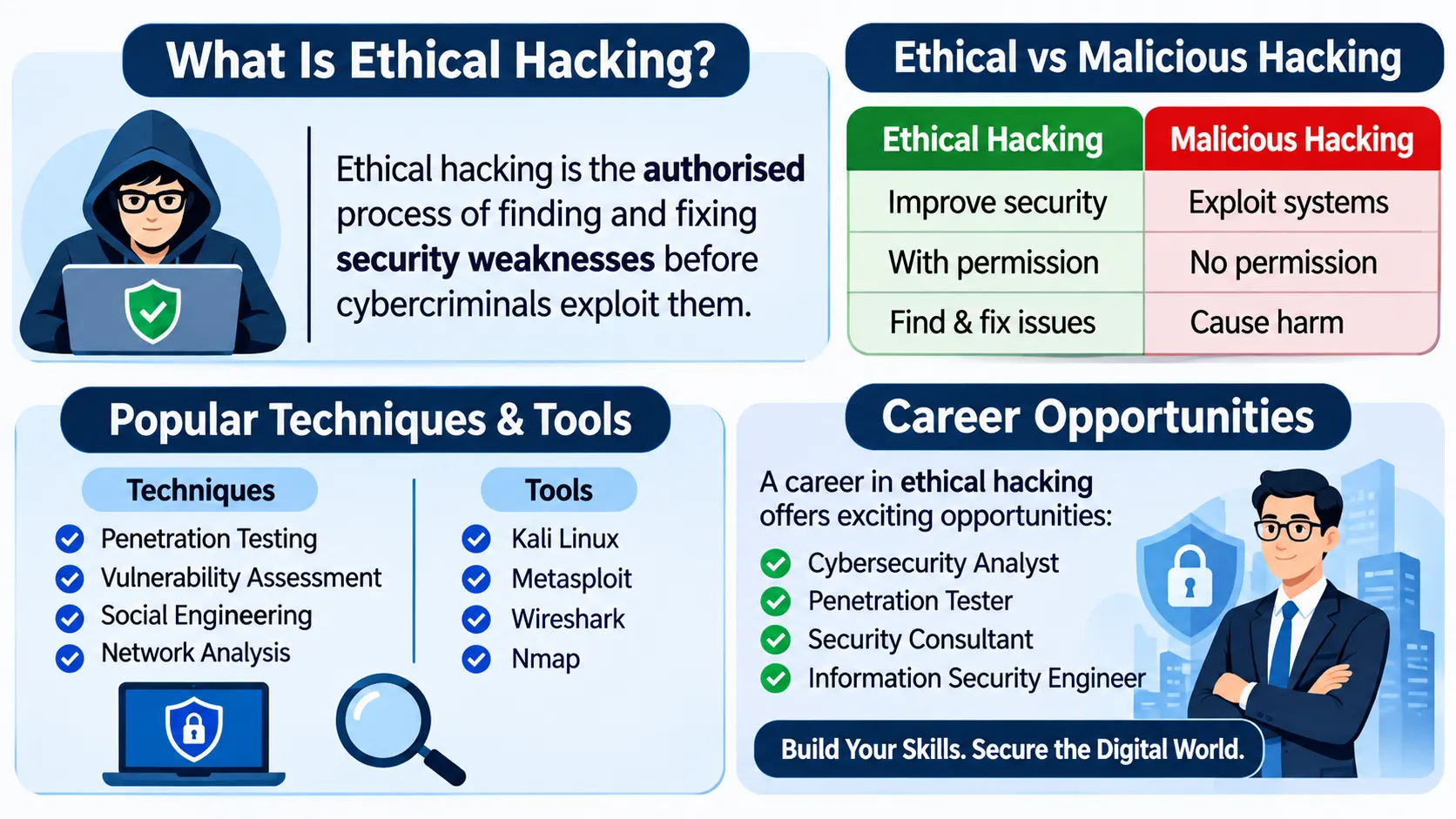
Ethical hacking knowledge supports several cybersecurity career paths. Penetration testing is the most directly associated role, but organisations also need professionals who monitor threats, engineer security controls and respond to incidents.
Role | Main Responsibilities | Possible Career Progression |
|---|---|---|
Ethical Hacker | Identify and validate vulnerabilities | Senior Ethical Hacker, Security Consultant |
Penetration Tester | Conduct authorised attack simulations | Senior Pentester, Red Team Lead |
Security Analyst | Monitor and investigate security events | SOC Lead, Threat Analyst |
Security Engineer | Design and maintain security controls | Senior Engineer, Security Architect |
Incident Responder | Investigate and contain incidents | Incident Response Lead, DFIR Specialist |
Red Team Specialist | Simulate adversary behaviour | Red Team Lead, Offensive Security Manager |
Cybersecurity Consultant | Advise on security risks | Principal Consultant, Security Director |
Choosing a Career Path
Your interests can help determine which role to pursue:
Enjoy finding vulnerabilities? Explore penetration testing.
Prefer monitoring systems and investigating suspicious activity? Consider security analysis.
Enjoy building technical solutions? Explore security engineering.
Interested in advanced attack simulations? Consider red teaming.
Prefer investigating complex security incidents? Explore incident response.
Enjoy combining technical expertise with business advice? Consider cybersecurity consulting.
Demand varies by geography, experience, industry and specialisation. Practical skills and demonstrable experience are important across these roles.
Ethical Hacking Career Roadmap: From Beginner to Professional
Starting a career in ethical hacking can feel overwhelming. A staged learning plan makes the process more manageable.
Stage 1: Build Computer and Networking Fundamentals
Learn computer systems, IP addressing, subnetting, TCP/IP, DNS, HTTP/HTTPS, network protocols, routers, switches and firewalls.
Practical exercise: Draw a simple home network diagram showing how your computer, router and internet connection communicate.
Stage 2: Learn Linux and Windows
Understand command-line operations, user management, file permissions, processes, services and system logs.
Practical exercise: Install a Linux virtual machine and practise navigating directories, managing files and reviewing system information.
Stage 3: Develop Programming Skills
Start with Python, then explore Bash, JavaScript, SQL and PowerShell.
Practical exercise: Write a simple Python programme that reads a text file, extracts selected information and produces a summary.
Stage 4: Understand Cybersecurity Fundamentals
Study the CIA Triad, authentication, authorisation, encryption, vulnerability management, network security, access control and risk management.
Practical exercise: Review a sample application architecture and identify where authentication, encryption and access controls should be implemented.
Stage 5: Learn Security Tools
Start with Kali Linux, Nmap, Wireshark, Burp Suite and OWASP ZAP. Later, explore Metasploit and other specialised tools.
Focus on understanding what each tool does, its limitations and how to interpret its output.
Stage 6: Practise in Legal Cybersecurity Labs
Hands-on practice is essential. Use intentionally vulnerable applications and authorised training environments, such as:
TryHackMe.
Hack The Box.
PortSwigger Web Security Academy.
OWASP Juice Shop.
Document your objectives, methodology, observations, findings and recommended fixes.
Stage 7: Build a Professional Portfolio
Create a portfolio containing laboratory assessment reports, vulnerability analysis exercises, secure configuration projects, Python scripts and permitted technical write-ups.
Never publish confidential client information, private credentials or details that could enable harm.
Stage 8: Choose Relevant Certifications
Consider Security+ or CEH for foundational knowledge, followed by practical qualifications such as OSCP or GPEN when your experience supports them. CISSP may be relevant later if you pursue security leadership.
Stage 9: Apply for Entry-Level Roles
Possible starting positions include Junior Security Analyst, SOC Analyst, Vulnerability Management Analyst, Junior Penetration Tester and IT Security Support Specialist.
Experience in IT support, networking or systems administration can also provide a useful route into cybersecurity.
Stage 10: Specialise and Progress
As your experience develops, consider web application security, cloud security, API security, network penetration testing, red teaming, Active Directory security, mobile application security or digital forensics and incident response.
Suggested Learning Timeline
Learning Stage | Indicative Time | Main Focus |
|---|---|---|
Fundamentals | Months 1–2 | Networking and computer systems |
Operating systems | Months 3–4 | Linux and Windows |
Programming | Months 5–6 | Python and web fundamentals |
Cybersecurity basics | Months 7–8 | Security principles and vulnerabilities |
Security tools | Months 9–10 | Practical tool usage |
Laboratory practice | Months 11–12 | Controlled assessments |
Portfolio and certification | Months 13–15 | Projects and professional validation |
Job preparation | Months 16–18 | Interviews and applications |
This is an illustrative plan, not a guaranteed employment timeline. Progress depends on previous experience, study time and practical exposure.
Challenges and Responsibilities in Ethical Hacking
Ethical hacking involves significant legal, operational and professional responsibilities.
Legal Authorisation
Testing systems without permission can have legal consequences, even when the intention is to help an organisation.
Before beginning an engagement, establish:
Written authorisation and defined target systems.
Testing dates and permitted techniques.
Prohibited activities and operational safeguards.
Data handling and confidentiality requirements.
Emergency contact and reporting procedures.
Special care is required when cloud providers, third-party services or shared infrastructure are involved. Permission from one organisation does not automatically authorise testing another party's systems.
Continuous Learning
New vulnerabilities, technologies, attack techniques and defensive controls emerge regularly. Ethical hackers must keep developing their knowledge of operating systems, cloud platforms, applications, security tools and testing methodologies.
Professional Ethics
Testers may encounter confidential information and personal data. They must avoid unnecessary access, protect evidence, follow agreed boundaries, prevent avoidable disruption and disclose findings responsibly.
Access to a system is a professional responsibility, not permission for unrestricted exploration.
The Future of Ethical Hacking
Emerging technologies are changing both the risks organisations face and the methods professionals use to assess security.
AI-Powered Cybersecurity
Artificial intelligence can assist with analysing security data, vulnerability triage, code review, technical summaries and selected testing workflows.
However, AI-generated findings require human verification. Automated systems may produce false positives, misunderstand application context or overlook business logic weaknesses.
As organisations deploy AI models and agents that interact with sensitive data and external tools, AI security testing is also becoming an important specialisation.
Cloud and Container Security
Cloud adoption increases the importance of assessing identities, permissions, storage, containers, Kubernetes environments, APIs and secrets management.
Ethical hackers need to understand how cloud services are configured and how weaknesses in one component may affect the wider environment.
Internet of Things Security
Connected cameras, industrial sensors, medical devices and smart building systems can introduce risks through outdated firmware, weak authentication, insecure communication and poor update mechanisms.
IoT security professionals help evaluate these weaknesses throughout the device lifecycle.
Zero Trust Security
Zero Trust emphasises verifying identities, devices and access requests rather than trusting users simply because they are inside an organisational network.
Ethical hackers can assess identity permissions, authentication policies, network segmentation and access enforcement to identify weaknesses that could allow attackers to misuse legitimate accounts.
API and Application Security
Modern applications rely on APIs to exchange information between frontend systems, backend services and third-party platforms.
Insecure authentication, authorisation, rate limiting, input validation or business logic can expose sensitive information and functionality.
Professionals who understand both cybersecurity and software engineering will be well positioned to assess these environments.
Career Outlook
Digital adoption, cloud infrastructure, data protection requirements, software supply chain risks and AI-related security challenges continue to create cybersecurity responsibilities across industries.
Opportunities exist in penetration testing, security engineering, incident response, cloud security and consulting. However, career progression depends on relevant skills, practical experience and the ability to demonstrate technical competence.
The future of ethical hacking will favour professionals who can understand complex systems, identify meaningful risks and help organisations improve their security.
Conclusion: Is Ethical Hacking a Good Career Choice?
Ethical hacking is an important part of modern cybersecurity because organisations need to understand their vulnerabilities before malicious attackers exploit them.
Through authorised testing, ethical hackers identify weaknesses, evaluate defensive controls and recommend practical improvements.
The profession combines networking, operating systems, programming, web technologies, cloud security and vulnerability analysis. It also requires sound judgement, communication skills and a strong commitment to legal and ethical responsibilities.
For beginners, the best approach is to build networking and operating system fundamentals, develop programming and cybersecurity knowledge, and practise with security tools in authorised laboratory environments.
Certifications such as Security+, CEH, OSCP and GPEN can support professional development when selected according to experience and career goals. Equally important are practical projects, a clear portfolio and the ability to explain security findings.
Whether you aim to become a penetration tester, security analyst, red team specialist or cybersecurity consultant, ethical hacking offers several routes into a challenging and evolving profession.
The most effective ethical hackers are not simply those who know how to find vulnerabilities. They are the professionals who understand why those vulnerabilities matter and know how to help organisations fix them.
Frequently Asked Questions (FAQs)
1. What is ethical hacking in simple terms?
Ethical hacking is the authorised process of testing computer systems, networks and applications to identify security vulnerabilities before malicious attackers can exploit them.
2. What is the main purpose of ethical hacking?
The main purpose is to identify security weaknesses, evaluate existing protection mechanisms and help organisations strengthen their cybersecurity defences.
3. What are the three main types of hackers?
The three commonly recognised categories are white hat, grey hat and black hat hackers. They differ primarily in their authorisation, intentions and activities.
4. What are the most common ethical hacking techniques?
Common techniques include penetration testing, vulnerability assessment, social engineering testing, password auditing, wireless security testing, web application testing and network security testing.
5. Which tools are commonly used in ethical hacking?
Popular tools include Kali Linux, Nmap, Metasploit Framework, Burp Suite, Wireshark, John the Ripper, Aircrack-ng and OWASP ZAP.
6. Can beginners learn ethical hacking?
Yes. Beginners can start with computer networking, Linux, Windows, programming and cybersecurity fundamentals before progressing to security tools and practical exercises in authorised laboratories.
7. Do you need programming skills to become an ethical hacker?
Programming is not always mandatory for entry-level learning, but knowledge of Python, JavaScript, Bash, SQL and PowerShell can help with automation, application analysis and advanced security testing.
8. Which certification is best for ethical hacking?
The right certification depends on experience and career goals. Security+ and CEH can support foundational learning, while OSCP and GPEN are more relevant to practical penetration testing. CISSP is designed for broader, experienced security professionals.
9. Is ethical hacking a good career choice?
Ethical hacking can be a rewarding career for people interested in technology, cybersecurity and problem-solving. Opportunities include penetration testing, security analysis, security engineering, red teaming and cybersecurity consulting.
10. Is ethical hacking legal?
Ethical hacking is lawful when performed with explicit authorisation, within an agreed scope and in accordance with applicable laws. Testing systems without permission can have legal consequences, even when the intention is to identify vulnerabilities.
11. What is the difference between ethical hacking and penetration testing?
Ethical hacking is a broad term for authorised security testing activities. Penetration testing is a specific assessment method that attempts to demonstrate whether vulnerabilities can be exploited under controlled conditions.
12. How long does it take to learn ethical hacking?
The learning time varies according to previous experience, study hours and practical exposure. A structured learning plan may take several months to build foundational skills, while professional readiness often requires sustained practice and experience.
Ready to go deeper?
Professional Training
Hands-on, mentor-led training aligned with industry certifications.
About the Author
Sharper every day
Daily tutorials, analysis, and career playbooks across all 12 Xcademia disciplines, straight to your inbox. No spam.