
Course Overview
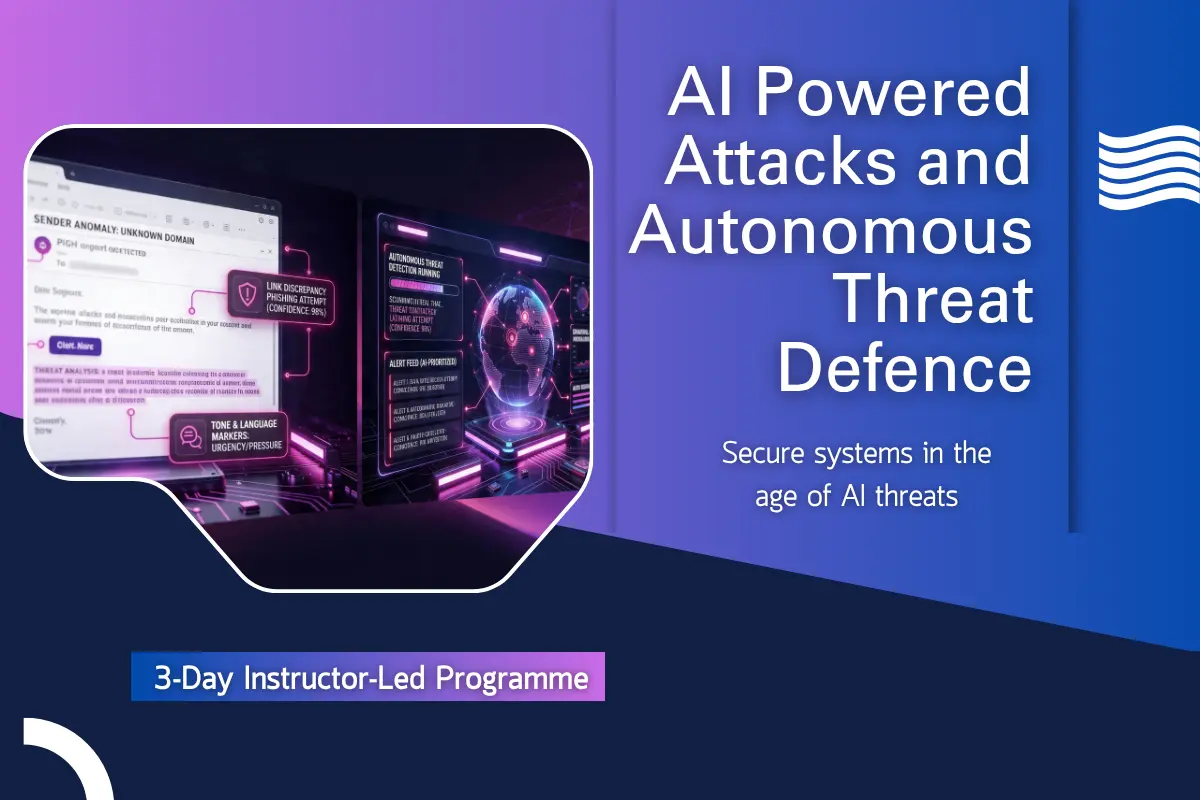
Artificial intelligence has fundamentally changed the economics and speed of cyberattacks. Over 82% of phishing emails now contain AI-generated elements. Adaptive malware can modify its behaviour during an active attack using language-model-based components. Autonomous reconnaissance operates at a scale and speed impossible for human operators, discovering and exploiting vulnerabilities faster than defenders can respond. Security teams that do not understand these capabilities cannot build effective defences against them.
Over three mentor-led days, participants identify AI-generated attacks across the full attack lifecycle, apply AI-powered defensive tools to detect threats at machine speed, assess and defend AI and ML systems against adversarial attacks including poisoning, evasion, and model theft, build detection rules for AI-assisted attack patterns, secure LLM deployments against prompt injection, and evaluate AI security tooling against organisational requirements.
The programme concludes with a capstone designing a complete AI-augmented SOC playbook for a mid-size enterprise, defining tool roles, human escalation points, and adversarial ML defences. This course is aligned with MITRE ATLAS, NCSC AI security guidance, and MLSecOps industry standards.
Hands-On Learning
AI-powered phishing sample analysis lab, adversarial ML attack demonstration exercises, AI-assisted threat detection platform hands-on session, prompt injection defence practical, and an AI SOC design capstone.
Mentor-Led Sessions
Practitioner-led sessions on AI attack tooling categories, adversarial ML techniques used against security systems, and AI defensive platform evaluation with live 2025-2026 AI threat landscape commentary.
Career-Ready Skills
AI threat identification across the attack lifecycle, adversarial ML defence, MLSecOps fundamentals, prompt injection mitigation, AI SOC playbook design, and AI security tooling evaluation methodology.
Learning Outcomes
Identify AI-generated attacks including adaptive malware, synthetic phishing, and autonomous reconnaissance.
Apply AI-powered defensive tools to detect threats at machine speed across enterprise SOC environments.
Assess AI and ML systems against adversarial ML attacks including poisoning, evasion, and model theft.
Build detection rules and monitoring strategies specifically for AI-assisted attack patterns.
Apply MLSecOps principles to secure AI systems deployed in production security operations contexts.
Design an AI-augmented SOC playbook with clear human-AI interaction boundaries and escalation workflows.
Evaluate AI security tooling against your organisation's specific threat profile and operational requirements.
Prerequisites
Active professional experience in a SOC, security architecture, or security engineering role.
Basic understanding of machine learning concepts, preferably with some exposure to AI or ML tools.
Familiarity with cybersecurity fundamentals including threat detection, SIEM platforms, and incident response.
Detailed Syllabus
Step-by-step learning journey from basics to professional practice
Topics Covered
- Pre-reading: MITRE ATLAS framework overview and NCSC AI security guidance
- Introduction to the AI attack and defence taxonomy used throughout the programme
- Accessing the lab environment, AI threat intelligence datasets, and detection platform access
- Course objectives, AI security knowledge baseline self-assessment, and pathway alignment
Skills You'll Gain
Master these in-demand skills through hands-on practice
Career Progression
A clear view of the roles this programme supports, what typically comes next, and where learners progress over time
Ways to Learn
Choose the learning format that works best for you and your team
Live Online
Instructor-Led Training
Join live instructor-led sessions from anywhere. Interactive, engaging, and flexible.
- Live instructor interaction (real-time)
- Trainer-led walkthroughs and real examples
- Guided resources and session notes provided
- Structured Q&A and practical discussion
Price per person
Group enrolments and early planning options available.
All prices are exclusive of VAT where applicable. Group enrolments and custom packages available on request.
Prefer a Faster, Personalised Route into IT?
Not everyone learns best in a group. If you want focused guidance, faster clarity, and confidence you can use on the job, our 1-to-1 Fast-Track Training gives you private, mentor-led support tailored to your experience and goals.
"Many learners choose 1-to-1 when they want understanding, not memorisation."
Exam & Certification Information
Everything you need to know about the certification exams
Important Information
You will receive an Xcademia certificate of completion based on participation and successful completion of labs and scenario simulations.
Credential
Certificate of Completion
On successful completion of AI-Powered Attacks and Autonomous Threat Defence, learners receive an Xcademia Certificate of Completion. This standalone certificate is issued directly by Xcademia and is aligned with globally recognised frameworks and best practices.
Frequently Asked Questions
Everything you need to know about this course
No. Basic familiarity with AI and ML concepts is helpful but not required. Adversarial ML and AI security content is taught from accessible first principles for security professionals without a data science background.
Ready to Start Your Learning Journey?
Take the next step in your professional development