
Tesla Reportedly Prepares August Cybercab Launch, Starting With Employee Rides
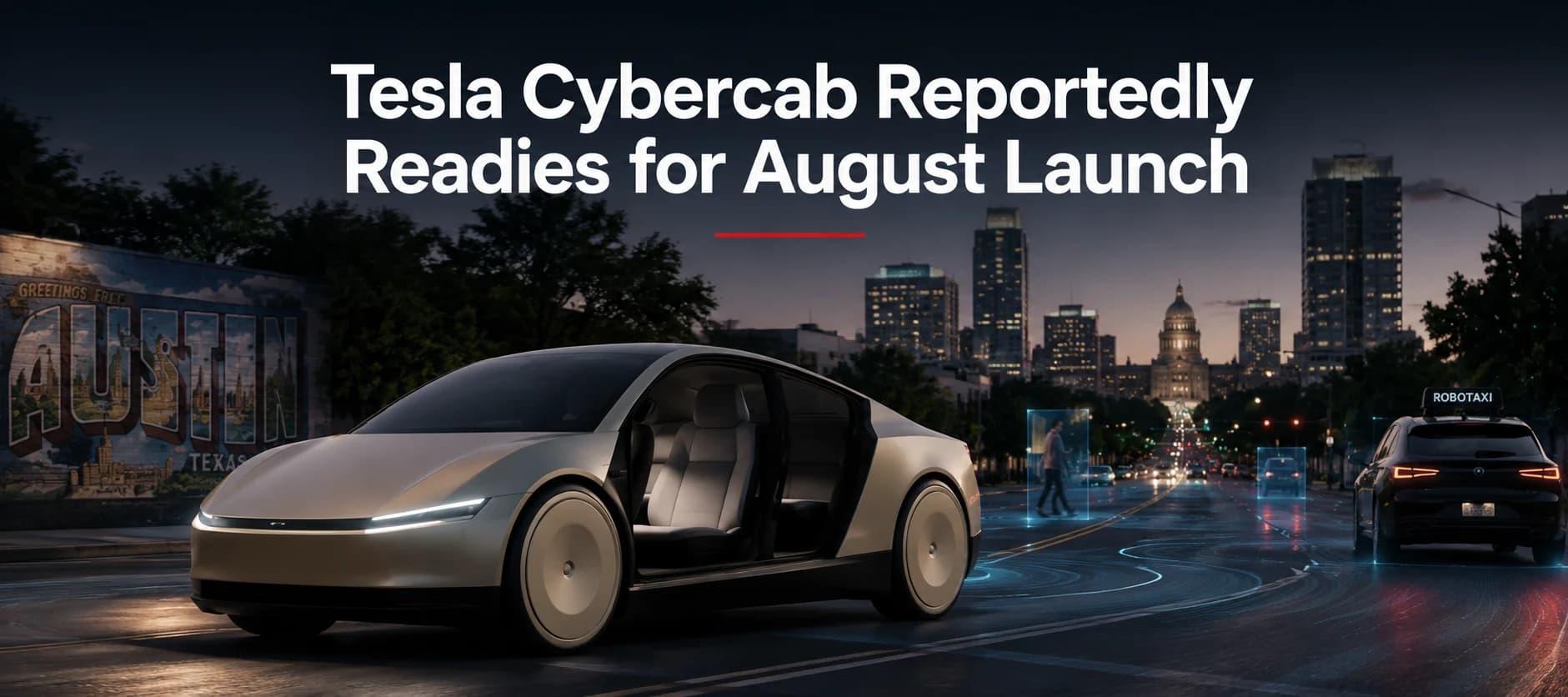
Tesla is reportedly preparing to launch its purpose-built Cybercab in Austin this month, beginning with employee rides before adding the vehicles to its robotaxi service.
Xcademia Team
Tesla Reportedly Prepares August Cybercab Launch
Tesla is reportedly moving toward the public rollout of its purpose-built Cybercab robotaxi, with the first rides expected to involve employees before the vehicles enter Tesla's autonomous ride-hailing service in Austin, Texas.
According to The Information, Tesla has told employees it is preparing for a Cybercab rollout as soon as August. The reported plan would begin with employee rides on public roads before Cybercabs are incorporated into the company's robotaxi service in Austin a few days later. Reuters separately reported the same details, citing The Information and people familiar with the plans.
The Cybercab is designed specifically for autonomous operation and differs from Tesla's existing vehicles by having no steering wheel or pedals. Tesla has positioned the vehicle as an important part of its longer-term robotaxi strategy.
However, the reported August rollout has not been publicly confirmed by Tesla. Reuters said the company did not immediately respond to a request for comment.
What Tesla's Reported Cybercab Rollout Could Look Like
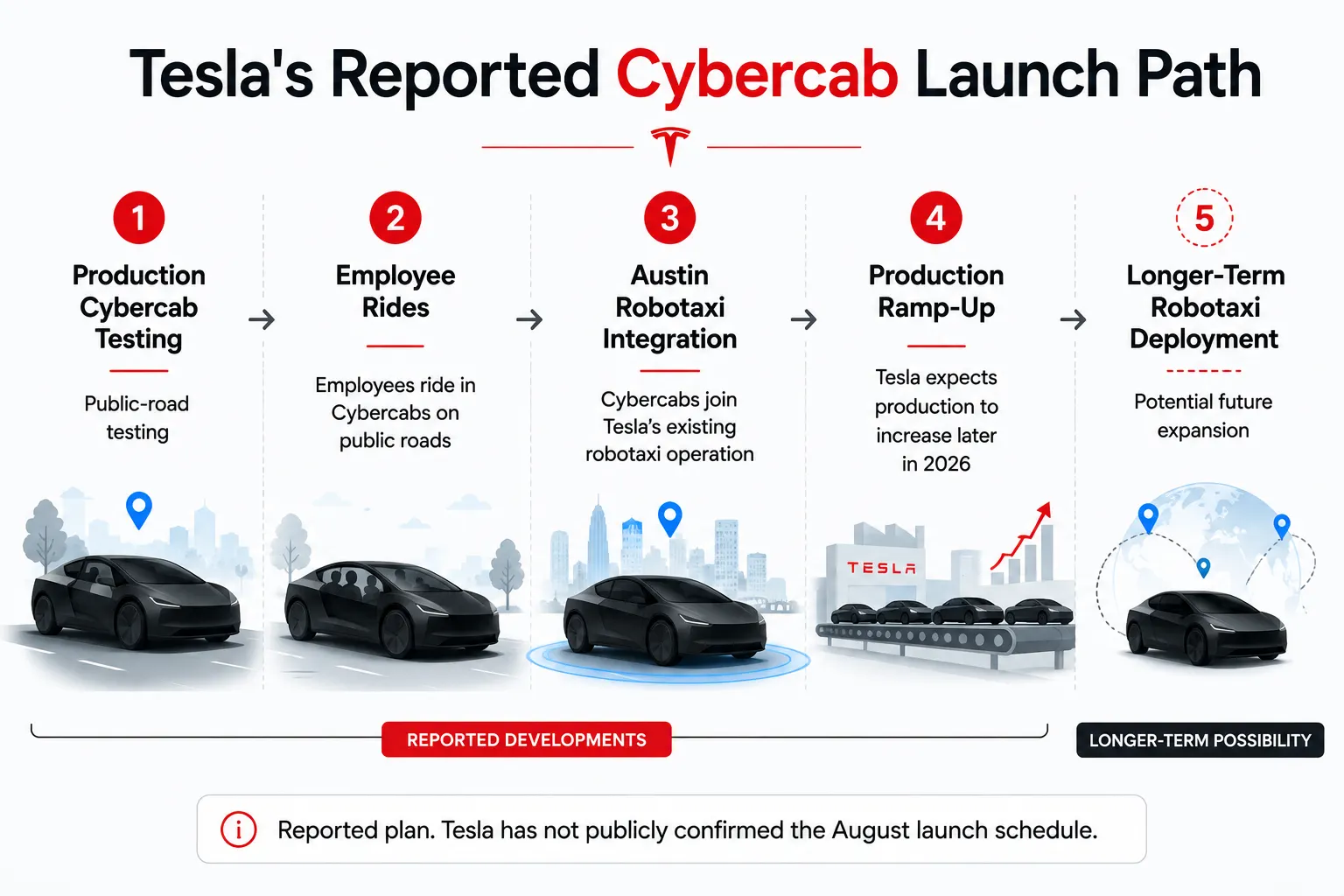
The reported launch sequence would begin with employee rides before moving toward robotaxi operations in Austin.
According to The Information's reporting, Tesla has told staff that it plans to:
Offer Cybercab rides to employees on public roads
Begin incorporating Cybercabs into the Austin robotaxi service
Ramp up Cybercab production later in 2026
Reuters reported that the transition from employee rides to the Austin robotaxi service could happen only a few days after the initial employee rollout.
This would place the reported employee rides between Tesla's testing activities and wider passenger operations.
The Reported Launch Would Begin With Employees
The reported sequence is notable because Tesla would not move directly from testing to a broad public robotaxi rollout.
According to The Information's report, Tesla has told employees that Cybercab rides on public roads would come first. The vehicles would then be incorporated into the company's Austin robotaxi service a few days later. Reuters reported the same sequence while noting that Tesla had not immediately responded to its request for comment.
This makes the employee rides an important part of the reported rollout plan. Rather than treating the Cybercab's first public-road passenger operations as a full commercial deployment, Tesla appears to be planning an initial stage involving its own employees before the vehicles enter the Austin robotaxi service.
The distinction is important because the Cybercab is not simply another Tesla vehicle being added to the existing fleet. It is a purpose-built autonomous vehicle without pedals or a steering wheel, and Tesla plans to eventually use it for autonomous ride-hailing.
The available reporting does not specify how many employees would participate, how many Cybercabs would be involved or exactly where the initial public-road rides would take place within Austin.
Additional details were not disclosed in the announcement.
Why the Cybercab Matters to Tesla's Robotaxi Strategy
The Cybercab represents a different approach from Tesla's existing Robotaxi fleet.
Tesla's current robotaxi operations have relied on existing Tesla vehicles, while the Cybercab was designed from the beginning around autonomous transportation. Tesla has previously described Cybercab as a purpose-built Robotaxi product and has said it plans to mass-produce the vehicle.
The vehicle's lack of a steering wheel and pedals is one of its most significant differences.
Instead of adapting a conventional vehicle for autonomous driving, the Cybercab is being developed around autonomous operation without conventional driving controls.
That makes the Cybercab an important part of Tesla's longer-term robotaxi strategy. If the vehicle enters wider service, it would represent a purpose-built approach to autonomous ride-hailing rather than simply adapting an existing consumer vehicle.
Tesla's broader autonomous-driving strategy includes expanding its Robotaxi service while developing Cybercab as a purpose-built robotaxi product.
Tesla Has Already Been Testing the Production Cybercab
The reported August rollout follows months of preparation.
Reuters reported that Tesla began testing the production version of the Cybercab on public roads in June 2026, while production is expected to ramp up later this year.
The Information's reporting also describes preparations ahead of the potential rollout, including test driving, employee rides on private roads and training with local first responders.
Training first responders is particularly relevant for a vehicle without conventional driver controls.
Tesla has published first-responder information for its robotaxi vehicles, providing guidance intended to help emergency personnel interact with Tesla autonomous vehicles during incidents.
The preparation therefore extends beyond the vehicle itself. Autonomous vehicle deployments also require procedures for emergency situations and interactions with first responders.
A Multi-Step Preparation Process
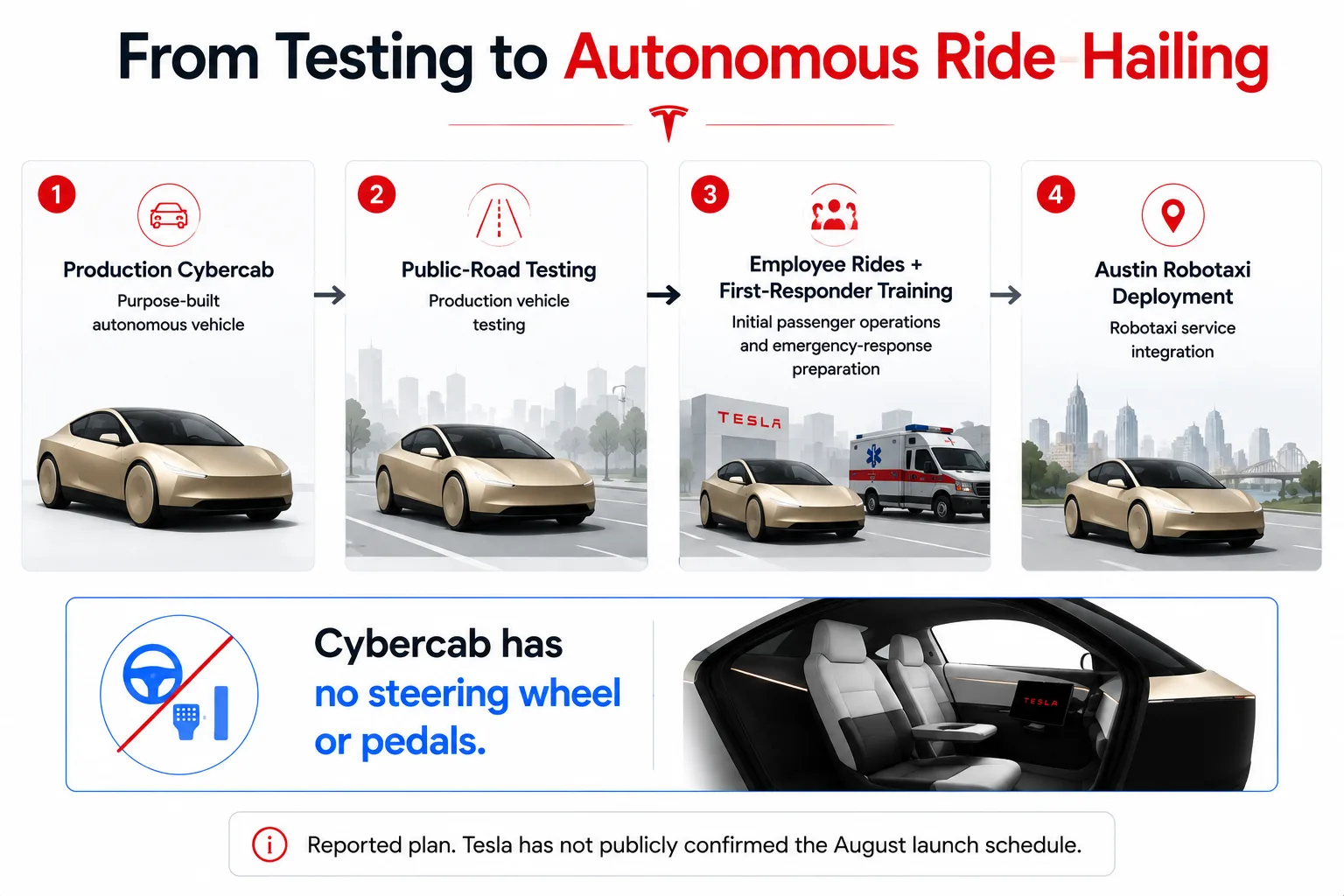
The reported August rollout follows several preparation steps.
Reuters said Tesla has recently been conducting test drives, offering employees rides on private roads and training with local first responders. The company also began testing the production version of the Cybercab on public roads in June.
That creates a clear progression in the reported development:
Private-road employee rides → public-road production testing → employee rides on public roads → reported Austin robotaxi integration
The sequence does not establish that Tesla has completed every requirement for a broader autonomous deployment. It shows only the preparation and testing activities described in the available reporting.
Reuters also reported that Cybercab production is expected to ramp up later this year. The report did not provide a production volume, launch fleet size or detailed timetable for that ramp-up.
Austin Is the Next Major Test
Austin is central to the reported Cybercab rollout.
The company already operates a Robotaxi service in the city, giving it an existing operational environment in which to introduce the Cybercab. Tesla's filings say its Robotaxi service launched in Austin in June 2025 and has since been expanded and refined.
That means the reported Cybercab rollout would not represent the creation of Tesla's robotaxi service from scratch.
Instead, the company would be adding its purpose-built autonomous vehicle to an existing service.
That distinction matters because Tesla would be introducing the Cybercab into a city where its Robotaxi operations are already established.
The reported plan to start with employee rides would also provide an intermediate stage before the vehicles are incorporated into the broader Austin robotaxi operation.
The Cybercab Is Different From Tesla's Existing Robotaxis
Tesla's existing Robotaxi service has already used conventional Tesla vehicles.
Earlier reporting from The Information described Tesla's Austin robotaxi operation as beginning with Model Y vehicles and supervised rides. The Cybercab represents a different vehicle approach because it was designed specifically for autonomous transportation.
Rather than using a consumer vehicle that retains conventional driving controls, the Cybercab is purpose-built around autonomous operation.
That creates a different set of operational considerations.
Removing conventional driver controls means emergency-response procedures, passenger safety and regulatory requirements remain important considerations for any deployment.
The available reporting, however, does not establish the full set of regulatory requirements applicable to the reported August rollout or provide details about how those requirements are being handled.
The company did not provide specific information about this area.
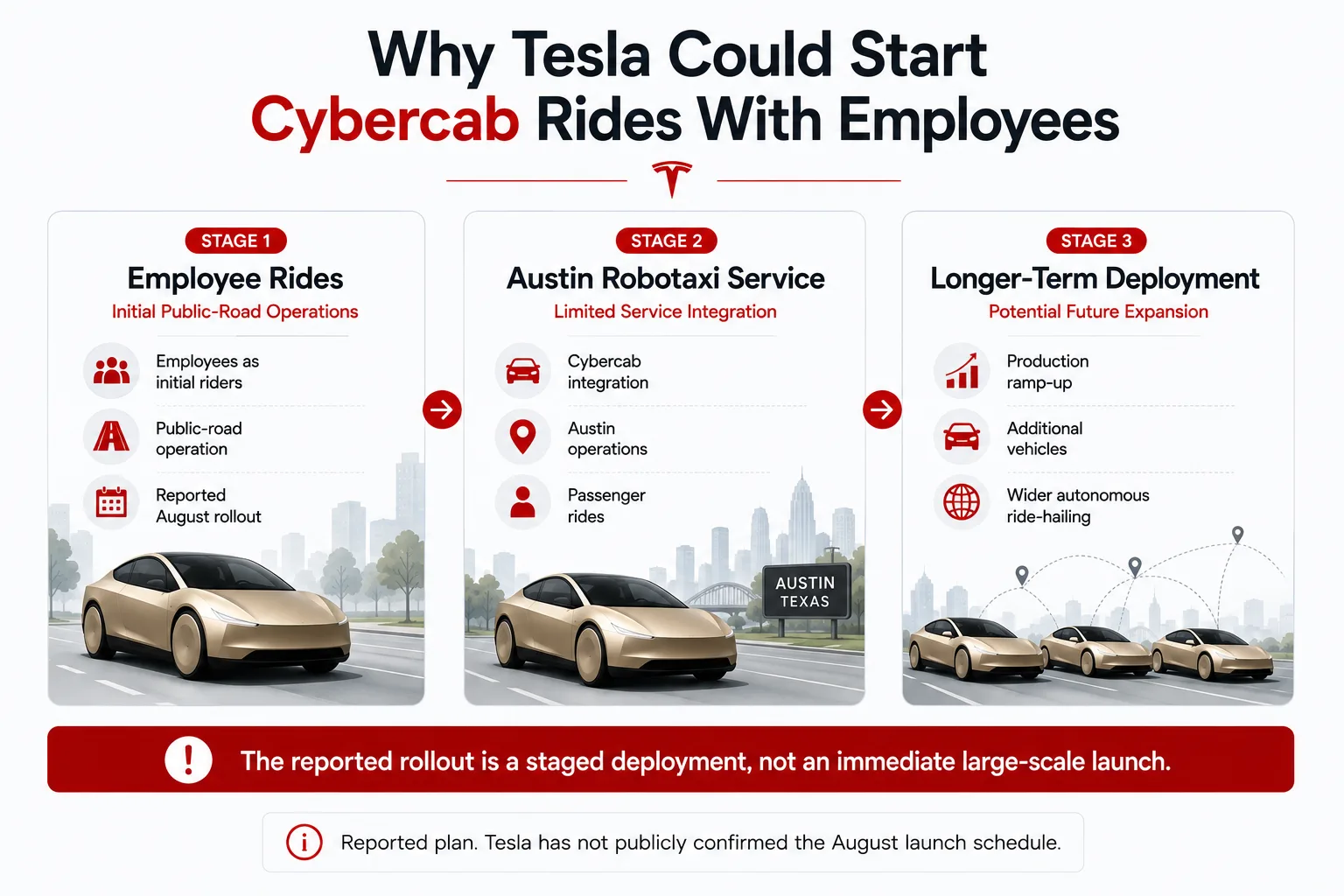
Why Employee Rides Come First
Starting with employees would create an intermediate stage between testing and wider passenger operations. According to the reported plan, Cybercabs would first carry employees on public roads before being incorporated into Tesla's Austin robotaxi service a few days later.
Reuters also reported that Tesla has been conducting test drives, private-road employee rides and first-responder training as it prepares for the rollout.
Production Will Be Another Critical Test
Launching the Cybercab is only one part of Tesla's broader challenge.
The company will also need to produce the vehicle at scale if the Cybercab is eventually deployed more broadly.
Reuters reported that production of the Cybercab is expected to ramp up later in 2026.
Tesla has previously identified Cybercab as a vehicle intended for volume production. Its 2025 quarterly materials listed Cybercab production capacity as under construction, while Tesla's filings have described it as a purpose-built Robotaxi product.
A robotaxi operation also involves more than the vehicle itself.
For enterprises and mobility operators, autonomous transportation can require coordination across vehicle production, software, fleet operations, maintenance, passenger support, emergency-response procedures and regulatory requirements.
The Cybercab therefore represents both an autonomous-driving project and a mobility deployment.
However, the sources do not provide a specific production target for the Cybercab or a detailed schedule for increasing fleet size.
Additional details were not disclosed in the announcement.
What the Latest Development Means
The reported August rollout does not represent the end of Tesla's autonomous-driving development. Instead, it appears to be another operational step toward the company's larger robotaxi strategy.
For Tesla, the significance of the Cybercab lies in the combination of vehicle design and autonomous service.
A purpose-built vehicle without conventional driving controls requires Tesla to demonstrate that the vehicle can be operated safely and reliably within the intended service environment.
The reported Austin rollout therefore provides an opportunity to observe how Tesla moves its purpose-built autonomous vehicle from engineering and public-road testing toward passenger operations.
Original analysis: The development highlights a broader industry shift toward designing vehicles around autonomous mobility rather than simply adding autonomous technology to conventional cars.
For enterprises and mobility operators, this could mean that future autonomous fleets may require changes not only to driving software but also to vehicle design, emergency-response procedures and fleet operations.
At the same time, the available information does not establish how quickly Tesla will expand the Cybercab beyond Austin or what operational model will ultimately be used at larger scale.
What the Current Reporting Confirms
The available reporting establishes several important milestones, but it also leaves some details unanswered.
Reported developments
Tesla has told employees it is preparing for a Cybercab launch in Austin as soon as August.
Employee rides on public roads are expected to precede integration into the Austin robotaxi service.
The transition to the Austin robotaxi service could occur a few days after the employee rollout.
Tesla has recently conducted test driving and private-road employee rides.
The company has conducted training with local first responders.
Production Cybercab testing on public roads began in June.
Cybercab production is expected to ramp up later this year.
The Cybercab is purpose-built for autonomous operation and has no pedals or steering wheel.
What remains undisclosed
The reporting does not establish:
The number of Cybercabs involved in the initial Austin rollout
The number of employees expected to participate
The exact August launch date
The exact operating area for the initial rides
The size of the initial robotaxi fleet
A timetable for expansion beyond Austin
Cybercab production volumes
This distinction is important because the reported August schedule should not be treated as a confirmed large-scale commercial launch.
What Happens Next?
The immediate milestone is the reported Cybercab rollout in Austin.
According to The Information's reporting, Tesla has told employees it is preparing for a launch as soon as August, beginning with employee rides and potentially moving Cybercabs into the Austin robotaxi service a few days later.
Reuters reported the same plan but noted that Tesla had not immediately responded to its request for comment.
The company has already been testing production Cybercabs on public roads and preparing through employee rides, testing and first-responder training.
If the reported schedule moves forward, the next phase will provide a closer look at how Tesla's purpose-built autonomous vehicle performs outside controlled testing.
For now, however, the August launch timing remains a reported plan rather than a confirmed Tesla announcement.
About the Author